
EPISODE · Aug 17, 2026 · 1H 12M
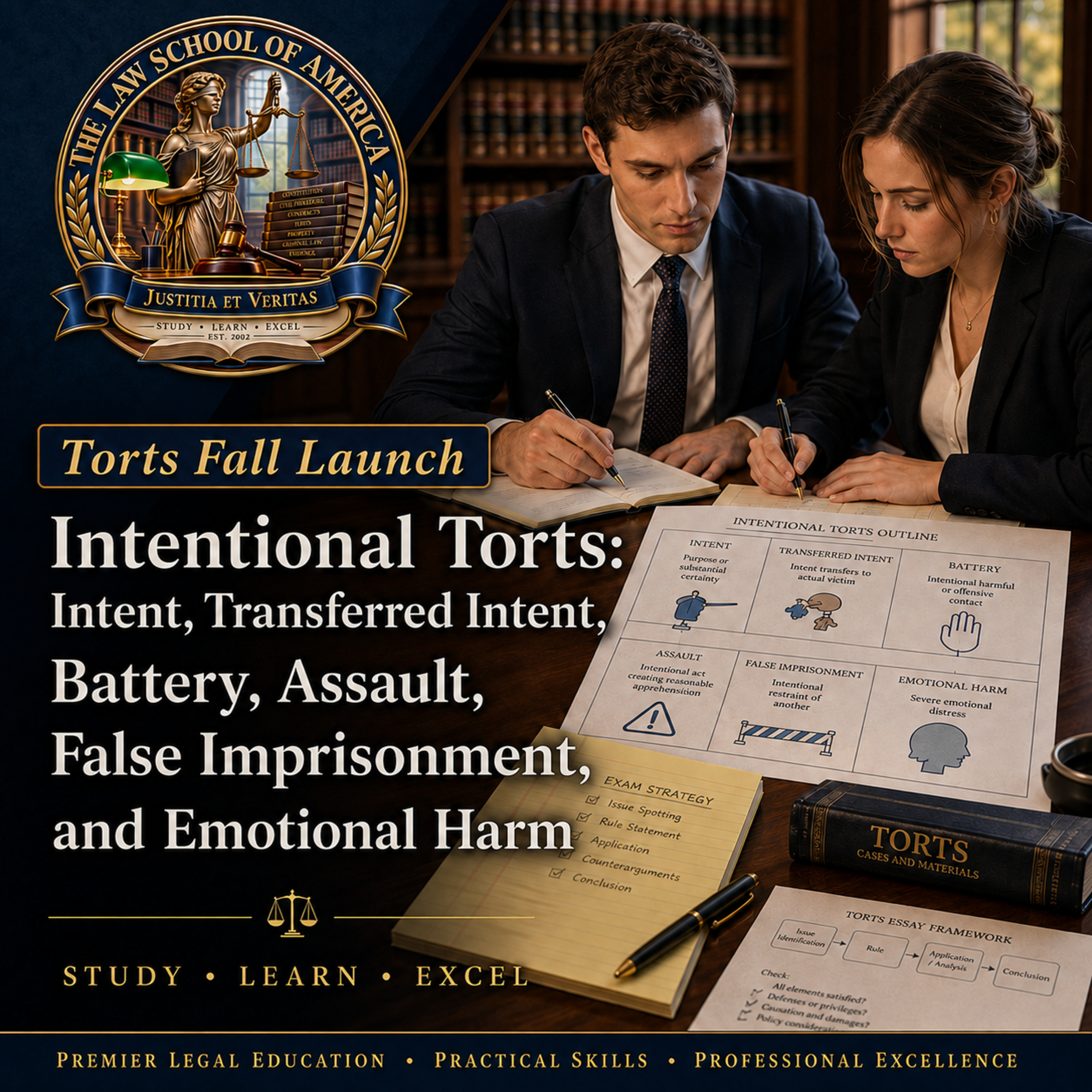
Torts Fall Launch: Intentional Torts: Intent, Transferred Intent, Battery, Assault, False Imprisonment, and Emotional Harm
from Law School · host The Law School of America
📘 FREE COMPANION STUDY GUIDE 📘👉 CLICK HERE TO OPEN YOUR FREE STUDY GUIDE 👈Turn this episode into an exam-ready study plan.🎧 EPISODE SUMMARY 🎧Intentional torts protect distinct interests and require precise analysis of the defendant’s mental state.Intent generally exists when the defendant acts with the purpose of causing the legally relevant consequence or knows with substantial certainty that it will occur.Intent differs from motive. A benevolent motive does not eliminate intentional-tort liability when the required intent exists.Intent also differs from negligence and recklessness. Negligence involves unreasonable risk. Recklessness involves conscious disregard of substantial risk. Intent requires purpose or substantial certainty.Mistake ordinarily does not eliminate intent when the defendant intended the act constituting the invasion. Children and persons with mental impairments may possess tort intent if they actually form the required mental state.Transferred intent traditionally operates among battery, assault, false imprisonment, trespass to land, and trespass to chattels. Intent may transfer between victims and among those traditional torts.Battery protects bodily integrity and dignity. It requires intent, harmful or offensive contact with the plaintiff’s person, and causation. Physical injury is unnecessary. Contact may be indirect and may involve objects intimately connected with the plaintiff.Assault protects freedom from apprehension of imminent harmful or offensive contact. Apprehension means awareness, not fear. The plaintiff ordinarily must perceive the threat while it is imminent. Apparent ability may be sufficient even when actual ability is absent.False imprisonment protects freedom of movement. It requires intended confinement within bounded limits, awareness or resulting harm, and causation. A known reasonable means of escape defeats complete confinement, but a dangerous, humiliating, hidden, or otherwise unreasonable route does not.IIED requires extreme and outrageous conduct, intent or recklessness, causation, and severe emotional distress. Ordinary insults and annoyances generally do not suffice. Repetition, abuse of authority, exploitation of vulnerability, threats, and particularly vulnerable plaintiffs may make conduct more likely to qualify as outrageous.The key lesson for Monday is that intentional-tort liability turns on the exact mental state and the exact interest invaded. Strong analysis does not ask merely whether the defendant acted intentionally. It asks what the defendant intended, what happened to the plaintiff, and which tort’s elements accurately describe that invasion.ℹ️ INFORMATION, PRIVACY POLICY & TERMS OF USE ℹ️The Podcast and Website PurposeThe Law School Podcast and 1L Study Aide webpage supplements law-school and Bar Exam study with strategies, condensed rules, quizzes, and flashcards.Educational DisclaimerContent is for educational and informational purposes only. It is not legal advice, creates no attorney-client relationship, and does not guarantee law-school or Bar Exam success.Privacy PolicyNo account or login is required.This webpage uses no forms or analytics to collect personal information.Quiz and flashcard activity stays in your browser and may clear when local site data is removed.Terms of UseBy using this webpage, you agree to use its content only for lawful, personal, noncommercial educational purposes. It supplements—not replaces—courses, textbooks, official materials, or qualified instruction.
Embed this episode
Ready to play
Torts Fall Launch: Intentional Torts: Intent, Transferred Intent, Battery, Assault, False Imprisonment, and Emotional Harm
No transcript for this episode yet
Similar Episodes
No similar episodes found.
Similar Podcasts
No similar podcasts found.