
EPISODE · Aug 19, 2026 · 1H 6M
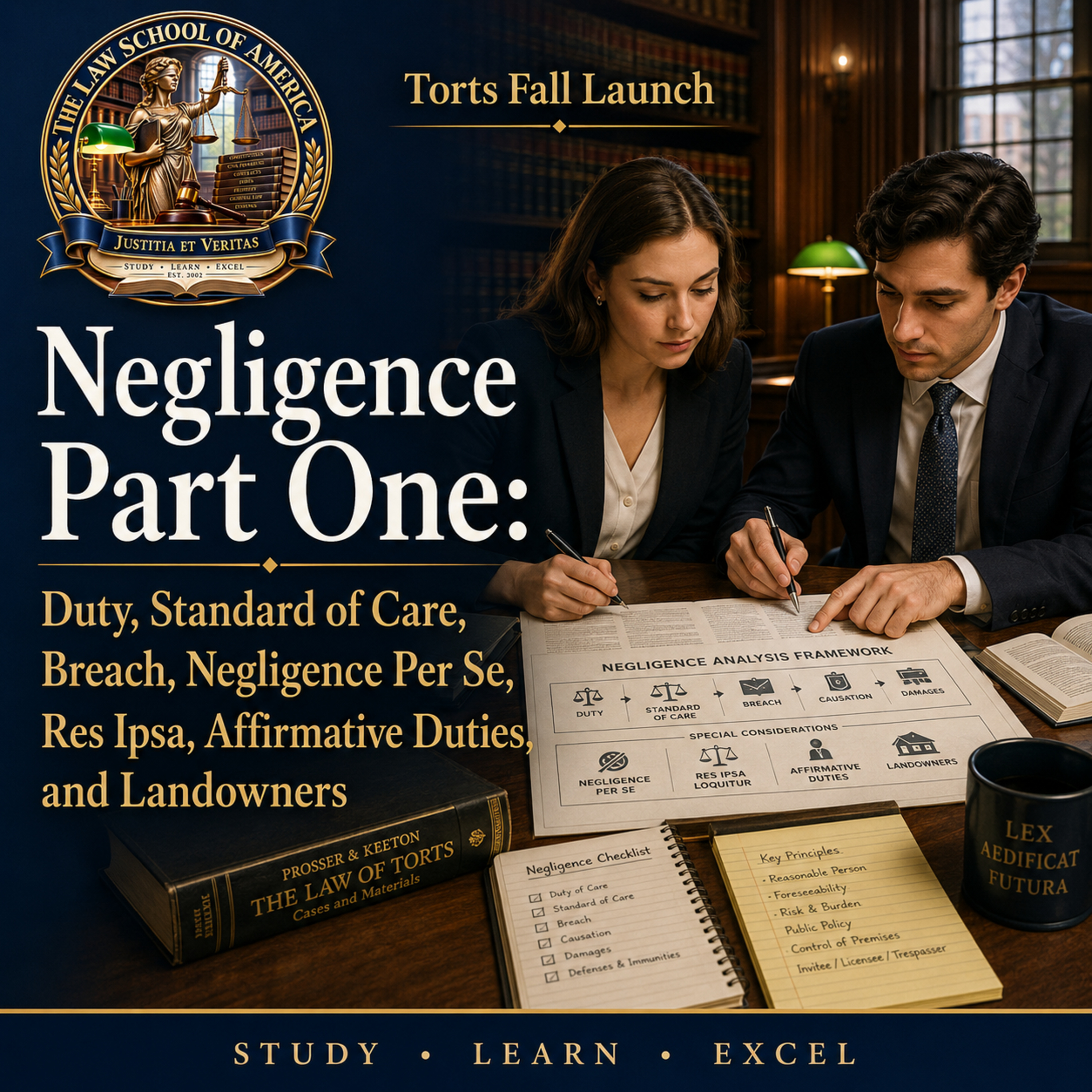
Torts Fall Launch: Negligence Part One: Duty, Standard of Care, Breach, Negligence Per Se, Res Ipsa, Affirmative Duties, and Landowners
from Law School · host The Law School of America
📘 FREE COMPANION STUDY GUIDE 📘👉 CLICK HERE TO OPEN YOUR FREE STUDY GUIDE 👈Turn this episode into an exam-ready study plan.🎧 EPISODE SUMMARY 🎧Negligence requires more than careless conduct. The plaintiff must establish actual causation, proximate causation, and actual damages.Actual causation ordinarily uses the but-for test: but for the defendant’s breach, would the injury have occurred? If the answer is no, factual causation is established.Multiple sufficient causes require special treatment when several independent acts were each sufficient to cause the same harm. Alternative liability may shift the causal burden when multiple defendants acted negligently but uncertainty prevents identification of the actual wrongdoer. Loss-of-chance doctrine may address medical negligence that reduces a patient’s probability of survival or recovery.Proximate cause limits liability to injuries within the scope of the risks that made the defendant’s conduct negligent. The exact mechanism and extent of harm need not always be foreseeable, but the general type of injury ordinarily must fall within the relevant risk.An intervening event does not automatically cut off liability. Ordinary medical negligence, reasonable rescue, reactions to danger, normal natural forces, and foreseeable negligent conduct often remain within the scope of responsibility.A superseding cause is sufficiently extraordinary or outside the original risk to cut off liability. Intentional and criminal acts are not automatically superseding when the defendant’s negligence increased the risk that those acts would occur.The rescue doctrine recognizes that danger invites rescue and generally treats reasonable rescue attempts as foreseeable.The eggshell-plaintiff rule requires the defendant to take the plaintiff as found. Once the defendant is responsible for the relevant type of physical harm, the unforeseeable severity caused by the plaintiff’s vulnerability generally does not reduce liability.Negligent infliction of emotional distress varies among jurisdictions. Major approaches include zone-of-danger recovery, bystander recovery, and special-relationship situations in which emotional well-being is central to the undertaking.Negligence requires actual compensable injury. Damages may include medical expenses, lost wages, lost earning capacity, property damage, pain and suffering, emotional distress, disability, disfigurement, loss of enjoyment, and reasonably certain future losses.The traditional collateral-source rule generally prevents a tortfeasor from reducing liability because the plaintiff received compensation from an independent source, although statutory modifications vary.Wrongful-death actions compensate designated survivors for losses resulting from death. Survival actions preserve claims the decedent could have asserted had death not occurred.The key lesson for Thursday is that causation is a two-stage inquiry: did the defendant actually contribute to the harm, and is the resulting harm within the scope of the defendant’s legal responsibility?ℹ️ INFORMATION, PRIVACY POLICY & TERMS OF USE ℹ️The Podcast and Website PurposeThe Law School Podcast and 1L Study Aide webpage supplements law-school and Bar Exam study with strategies, condensed rules, quizzes, and flashcards.Educational DisclaimerContent is for educational and informational purposes only. It is not legal advice, creates no attorney-client relationship, and does not guarantee law-school or Bar Exam success.Privacy PolicyNo account or login is required.This webpage uses no forms or analytics to collect personal information.Quiz and flashcard activity stays in your browser and may clear when local site data is removed.Terms of UseBy using this webpage, you agree to use its content only for lawful, personal, noncommercial educational purposes. It supplements—not replaces—courses, textbooks, official materials, or qualified instruction.
Embed this episode
Ready to play
Torts Fall Launch: Negligence Part One: Duty, Standard of Care, Breach, Negligence Per Se, Res Ipsa, Affirmative Duties, and Landowners
No transcript for this episode yet
Similar Episodes
No similar episodes found.
Similar Podcasts
No similar podcasts found.