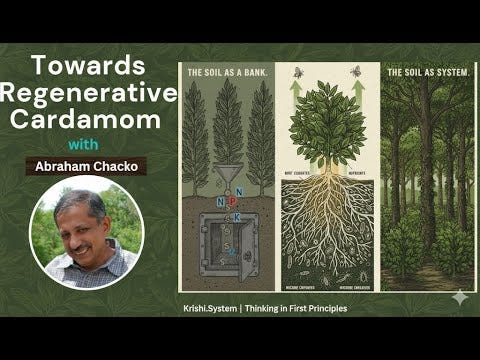
Towards Regenerative Cardamom
from Agribusiness Matters Hosted by Venky Ramachandran
Abraham Chacko is 70 years old. He has farmed cardamom in the high ranges of Idukki, Kerala for over four decades. In that time, he has witnessed three distinct eras of Indian agriculture play out on the same thirty acres of sloped forestland: the pre-chemical indigenous phase his grandfather practiced, the Green Revolution’s assault on soil fertility, and what he now calls the biological turn. His story is not one of romance or ideology or jumping onto the latest fad. It is an honest, empirical account of failure, observation, and recalibration. As he candidly shares with us in the podcast, he was considered a “gone case nut” by his community during the transition period. He nearly gave up. When I spoke with him, what struck me was not the success he has achieved in selling premium organic cardamom to foreign buyers at double or triple the market price. What fascinated me was his articulation of a systems framework that connects all the way from photosynthesis to soil carbon to indigenous seed varieties to Vasudeva kutumbakam (through holobiont) It was the perfect place to do the second of my post-AI age podcast series where I sketch systems principles live in whiteboard while talking with a wide range of experts. It was also the first podcast I recorded after I rebranded Agribusiness Matters to Krishi.System This conversation was also high-stakes: The son of a conventional cardamom farmer listened to us patiently all along and shared his challenges in convincing his parents to transition towards regenerative practices. And that’s the reason why I keep these conversations unedited (of course, I am lazy) with all its messiness. I want to keep things raw and real. You will in fact hear one listener wondering if I would turn off the recording when we get to talk about the real challenges. Here are few fascinating systems learning principles we unearthed through the conversation. 1) Carbon as Currency Air contains 80% nitrogen and only 0.04% carbon dioxide. Yet nature does not allow nitrogen to accumulate as an element in soil. It actively works to remove excess nitrogen through denitrifying bacteria. Carbon, however, can persist in soil—as dead microbial mass (what scientists call necromass), as organic matter, as the structural glue holding soil particles together. Soil carbon holds eight times its weight in water. When carbon depletes, soil loses both its water-holding capacity and its aeration. Without water and air in the soil matrix, aerobic microbes cannot survive. Without microbes, plants cannot access nutrients locked in mineral form. The system collapses. Not from a single point of failure but from a cascade of interdependent failures. When Chacko started applying synthetic nitrogen fertilizers in the 1980s, yields initially increased. But each year required more inputs. The soil hardened. Pests proliferated. Costs mounted. He was stuck in a reinforcing feedback loop running in the wrong direction: More nitrogen → denitrifying bacteria proliferate → soil carbon consumed → microbes die → plants stressed → more inputs needed. The lesson took fifteen years to internalize: we were treating symptoms while accelerating the underlying disease. 2) Photosynthesis as Communication Around 2000, Chacko encountered the work of Subhash Palekar and later the wonderful videos and writings of Christine Jones. What he learned transformed his understanding of plant biology. The conventional model taught in agricultural colleges treats photosynthesis as a plant’s way of making food for itself. Carbon dioxide enters leaves, sunlight provides energy, glucose is produced, the plant grows. This model is incomplete. What scientists discovered only after 2000—through technologies like isotope tracking and confocal laser scanning microscopy—is that plants exude 30 to 40 percent of their photosynthetic products directly into the soil through their root tips. They are not leaking. They are transacting. These root exudates are liquid carbon: dissolved sugars, organic acids, amino acids. They flow into the rhizosphere (the zone immediately surrounding roots) and feed a specific community of bacteria and fungi. In exchange, these microbes are happy to be your unpaid interns and perform services the plant cannot do for itself: fixing atmospheric nitrogen, solubilizing phosphorus bound to soil minerals, chelating micronutrients and delivering them in plant-available forms. Now when you supply synthetic nitrogen to a plant, you break this communication channel. The plant no longer needs to negotiate with nitrogen-fixing bacteria. It reduces its photosynthetic exudation. Less liquid carbon flows into the soil. The microbes are fired from their job they were willing to undertake. The mycorrhizal networks that connect plants underground—what some researchers call the “wood-wide web”—collapse. The farmer thinks she is helping the plant. She is actually severing the plant’s supply chain and immune system simultaneously. 3) Microbes as Employees Microbes are employees of the plant. The plant manages them through exudates the way a company manages staff through compensation. Different microbes specialize in different tasks. Nitrogen-fixing bacteria handle nitrogen. Phosphorus-solubilizing bacteria handle phosphorus. Potassium mobilizers handle potassium. Each element in the periodic table that exists in soil has a corresponding microbial workforce capable of making it plant-available. The elegance of this system is in its self-regulation. When a plant needs nitrogen, it exudes specific compounds that feed and signal nitrogen-fixing bacteria. When it needs phosphorus, it changes its exudate profile to recruit phosphorus solubilizers. The plant is not passive. It is actively farming the microbial community around its roots. But there is a deeper layer to this relationship that science only described in 2018. James White at Rutgers University documented a process he called the rhizophagy cycle. In this cycle, bacteria enter plant root cells at the growing tip, lose their cell walls, get partially digested by plant-produced reactive oxygen species (effectively the plant is eating part of the bacteria to extract nutrients), then surviving bacteria are expelled through root hairs back into the soil where they regain their cell walls and continue foraging for more nutrients. The mechanism is documented across dozens of plant species. Plants are not just transacting with microbes—they are farming them, consuming them, and releasing them in cycles that may repeat every few days. This is not alternative agriculture. This is now mainstream soil biology. 4) The Microbiome Travels in Seeds During our conversation, Chacko argued that indigenous varieties carry what he calls their “core microbiome” within the seed itself. When such seeds germinate, they arrive with a pre-adapted microbial community that has co-evolved with that variety over generations. These core microbes then interact with the “associated microbiome” already present in the soil. High-yielding varieties that have been bred for yield alone, he suggests, may lack this core microbiome. The plant arrives in the field without its evolutionary partners. It cannot establish the microbial relationships necessary for resilienc… This is a public episode. If you'd like to discuss this with other subscribers or get access to bonus episodes, visit www.krishidotsystem.com/subscribe
Embed this episode
No transcript yet.