
EPISODE · Feb 20, 2026 · 16 MIN
Traitor or faithful ... and how can we tell?
from The choreography of power · host Rob Dalton PhD
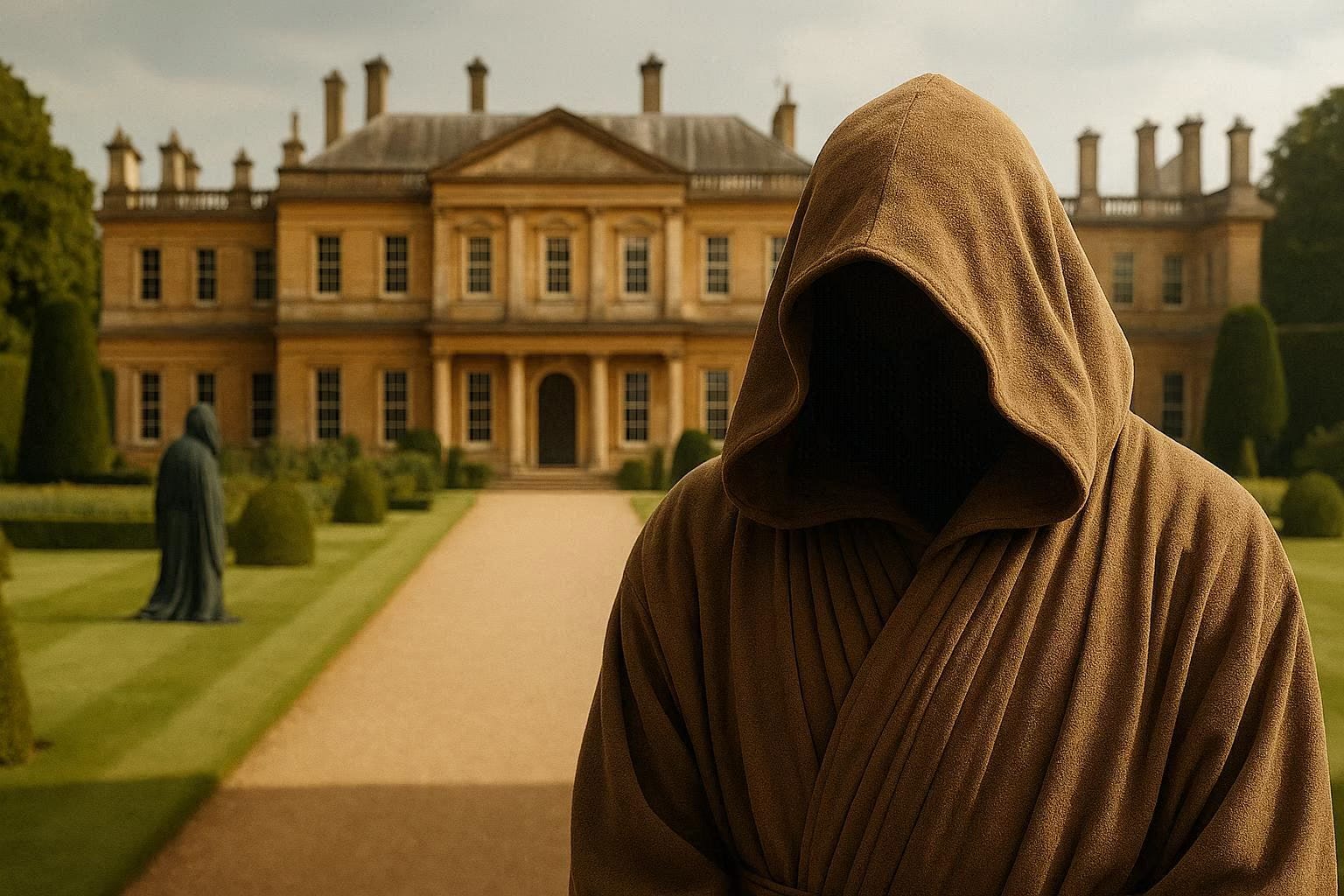
Reality television is too often dismissed as trivial entertainment, nihilistic or without meaning. This is more than a little harsh. Indeed, it might just provide us with a very useful way to examine the complex workings of power.The Traitors is a good place from which to do this. It combines formal rules, the control of information, asymmetric intelligence, editorial mediation and intense interaction between contestants, and all within a closed and highly regulated system. Power in The Traitors doesn’t just operate through authority, compliance, falsehood or domination. It’s distributed across rules, roles, conversations, surveillance and performances. This shows how power changes its shape, from something possessed or imposed to something performed, and as always at work.Structure and formalityThe Traitors is governed by explicit rules, such as the selection of participants, concealed ambitions, nightly ‘murders’, round-table banishments and the business of identifying or deceiving others. From the classical perspective on power, these rules operate as a form of legitimate authority.Weber’s analysis of authority is very helpful here (1978). He would see the game’s power structure as primarily rational-legal. Authority is vested in its impersonal rules rather than in individuals. Indeed, contestants must always consent to these as a condition of participation.This makes the host less of a sovereign or commanding figure and more of a referee, and certainly not a representative of the audience. All parties work to reinforce the legitimacy of the system they have signed up for and not to somehow prioritise popularity or merit nor even to reassure the viewers that these will prevail.From a normative perspective, the rules here produce order, cohesion and purpose. Parsons’ view of power (1967), as a generalised capacity to secure collective goals, is evident. Both ‘faithfuls’ and ‘traitors’ feel they can ‘win’ within the agreed framework. The confrontation that follows shows not as an aberration, as an error, but as purpose, as the true name of the game.All of this reminds us not to be too beguiled by the degree of consensus on display or, indeed, that rational agreement is possible in the first place. This isn’t what’s on offer. While all participants accept the rules, they don’t occupy equal positions within them. The knowledge gained by contestants isn’t shared fairly between traitors and faithfuls. Structural inequality lies at the very heart of the premise.This inequality resonates with Lukes’ ‘three-dimensional’ view of power (2005). The traitors’ advantage is not just the ability to decide who will be murdered. It’s a product of the agenda they follow and work to. They also benefit from the programme’s ideological tone, one where suspicion divides and fragments. This serves them, the few, rather than the majority.The most effective traitors are those who hide this type of structured authority and edge within the everyday and routine, making their influence appear trustworthy rather than controlling. The stories we believe and who writes themOf course, the formal rules of The Traitors’s closed society are pretty obvious once we’re used to them. They are overt and knowable. However, a second, less visible layer of power is also pursued by the programme’s producers, editors and directors.Post-structural accounts of power, particularly those associated with Foucault, are quite useful here. Foucault’s concept of power as productive (1977), as always on, always working to create something, highlights how meaning, identity and truth are being constantly constructed through and around us.Through editing, music and camera angles, the programme produces specific narratives of suspicion, guilt, innocence and betrayal. These are directed at us, the observers. They tell tales, delude us, lay down red-herrings and set hares running. They don’t construct updates or review positions in an even-handed or objective manner.The ‘single’ interview or ‘private’ conversation is a key technology of power here, allowing us to eavesdrop on what we think of as personal. Contestants are invited to articulate their thoughts, fears and strategies, creating a conversation that seems private and authentic but which, in reality, is no better than highly selective.This also resembles what Foucault describes as the modern compulsion to confess, where subjects participate in their own governance by narrating stories about themselves (Foucault, 1978), testing their own relative position and justifying their policing of others.Importantly, these confessions within the programme cannot really reveal truth. They are deliberate, chosen, curated, sequenced and juxtaposed to produce a dramatic coherence not something interested in reality. Editorial power operates by shaping what we recognise as intelligible or credible motivation. We often allow ourselves to be co-conspiracists in this ruse, somehow knowing this is happening but enjoying the result regardless.Surveillance is central to the fantasies we construct. Contestants are watched, not only by cameras but by one another. This produces a panoptic effect in which individuals regulate their own behaviour because they are always anticipating scrutiny from elsewhere (Foucault, 1977).The knowledge that every gesture may later be reinterpreted as evidence of deception or not encourages a sort of hyper-reflexivity, a state of persistent anxiety, where contestants become overly sensitive to their own actions as they review those of others. This regulates compliance, making the power needed to do this diffuse, something operating through anticipation and self-discipline and not just through direct coercion.From an actor–network perspective, power isn’t found solely in the show’s contestants or directors. It resides in its sets, games, schedules and even audience participation. Power is distributed through all of its physical and material components and all of its symbolic and cultural expectations. The round table, the sealed envelopes, the castle setting, even the soundtrack, all contribute to this, stabilising demands and beliefs (Latour, 2005). These non-human cogs in the machine help align emotions, expectations and decisions, making power an effect of this type of interaction rather than a resource held by any single person, role or institution at any particular time.Power as behaviour, twitch and reactionPower rests not just in the ‘big picture’, in the grand and compelling demands of life. It can be traced too to the way we live with others, to the deeply personal and to the ingrained habits we have when we interact with each other.The Traitors can be analysed using this approach to power via interactionist and relational theories. For instance, Goffman’s dramaturgical analysis (1959) is very good at doing this.Contestants engage in continuous impression management, carefully controlling their actions ‘front stage’, as it were. These are performances in themselves but they’re also an attempt to represent, conceal or reinterpret what’s happening ‘back stage’, in their own personal and private world.Accusations at the round table function as high-stakes displays in which credibility, emotional control and narrative coherence are decisive. They deal not just in what is believed but also in what contestants themselves feel must be shown to others. These displays build justification or credibility first, thus making honesty or deceit no more than a second choice. Bourdieu’s views about what he called habitus and symbolic capital illuminate why some traitors and faithful are more persuasive than others. He describes a world in which power is mainly symbolic, operating through culture and ideology, through our habits and behaviours.Individuals bring pre-existing characteristics quite literally to the table. These are shaped by class, profession, gender and cultural competence. These may influence how confidently they speak, how they interpret suspicion and how they are understood and pigeonholed by others (Bourdieu, 1984).Symbolic capital, such as perceived levels of intelligence, moral authority or emotional warmth, is then converted into power before our very eyes. This allows some contestants to shape group decisions in ways that others can’t. Importantly, power in ‘The Traitors’ is unstable and highly reversible. Alliances shift, reputations collapse and authority can evaporate rapidly. This aligns with post-structural views of power as temporary, as reflecting inherent instability rather than predictability.Even ‘traitors’, despite their structural advantages, must remain vulnerable to the persistent exposure this brings. This shows that power must be continuously enacted and reaffirmed. It must persist rather than only exist and can’t just be any simple overbearance, coercion or persuasion we experience at any specific moment.So …The Traitors provides a laboratory for analysing contemporary forms of power. Classical and normative theories help explain the role of rules, authority and inequality within the game’s formal structure but this is not all we find.Post-structural accounts are needed to reveal how power operates through conversations and ideas, surveillance and editorial choices. It is this that shapes what contestants and audiences perceive as truth.Interactionist and relational perspectives show how power is realised not by rules but through life’s everyday performances, as grounded in the symbolic capital we can command.The Traitors shows us that power is about more than the capacity to shape meaning or influence interpretation, even to sustain credibility under conditions of uncertainty. It shows that power operates through visibility, performance and narrative and not just through the loudest voice or biggest stick.It’s often difficult, if not impossible, to second guess what’s happening in The Traitors or to decide who is going to win. As such, it might represent as good a definition of power as any to be found in the text books.ReferencesBourdieu, P. 1984. Distinction: A Social Critique of the Judgement of Taste. London: Routledge.Foucault, M. 1977. Discipline and Punish: The Birth of the Prison. London: Penguin.Foucault, M. 1978. The History of Sexuality, Volume 1: An Introduction. London: Penguin.Goffman, E. 1959. The Presentation of Self in Everyday Life. London: Penguin.Latour, B. 2005. Reassembling the Social: An Introduction to Actor-Network-Theory. Oxford: Oxford University Press.Lukes, S. 2005. Power: A Radical View, 2nd edn. Basingstoke: Palgrave Macmillan.Parsons, T. 1967. Sociological Theory and Modern Society. New York: Free Press.Weber, M. 1978. Economy and Society. Berkeley: University of California Press.Image: Ai This is a public episode. If you would like to discuss this with other subscribers or get access to bonus episodes, visit drrobdalton.substack.com
Embed this episode
Ready to play
Traitor or faithful ... and how can we tell?
No transcript for this episode yet
Similar Episodes
No similar episodes found.
Similar Podcasts
No similar podcasts found.