
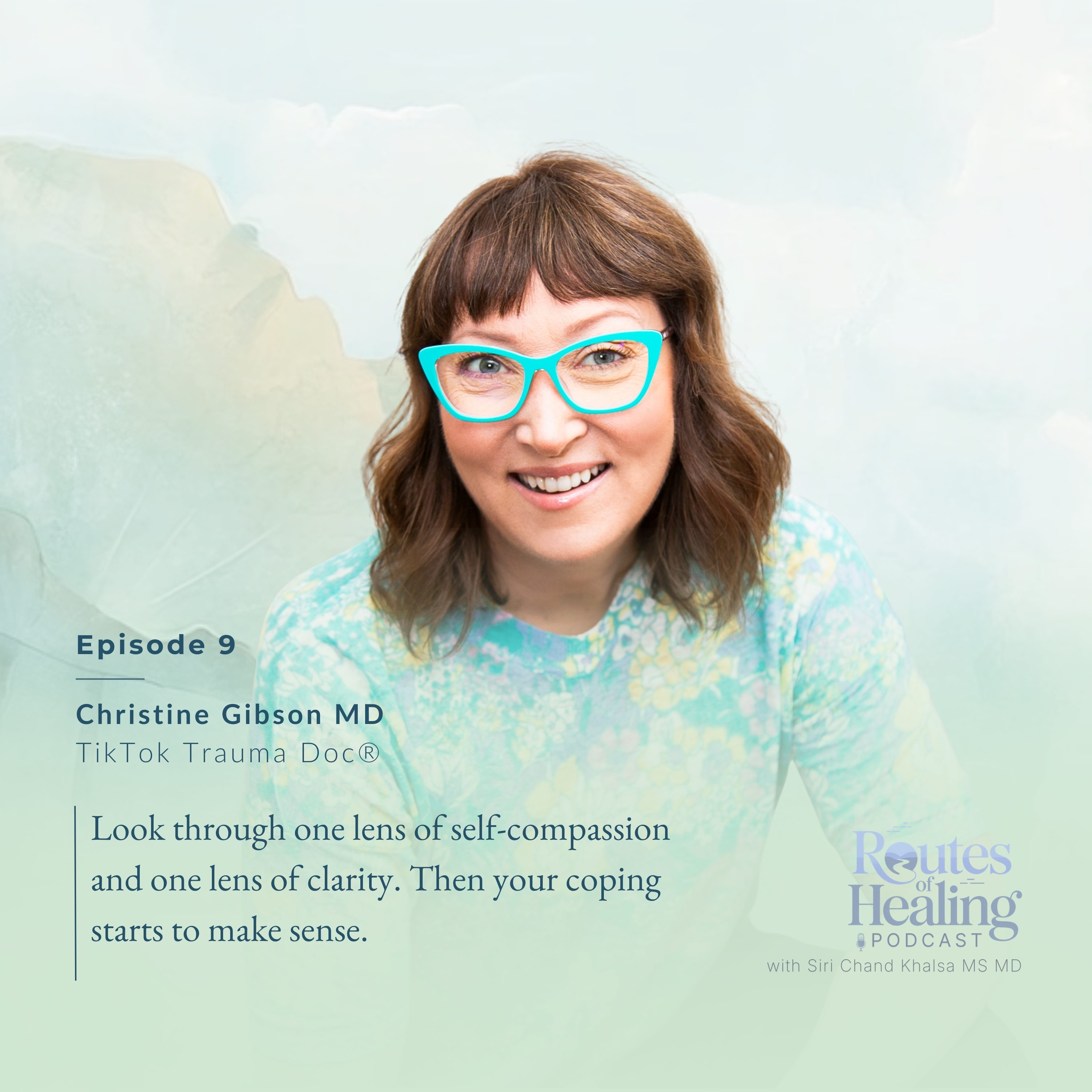
EPISODE · Dec 30, 2025 · 1H 5M
Trauma Is Ubiquitous: Somatics, Nervous System Science & Post-Traumatic Growth with Dr. Christine Gibson
from Routes of Healing
Show Notes (Episode 9) — Dr. Christine GibsonIn this week’s episode of Routes of Healing, Dr. Siri Chand Khalsa sits down with Dr. Christine Gibson, a family physician, trauma therapist, and author of The Modern Trauma Toolkit. Known online as TikTokTraumaDoc, Dr. Gibson has built a wide-reaching educational platform grounded in nervous system science, practical somatic tools, and a strong commitment to health equity and systems change.Together, they explore how trauma shows up far beyond the psychiatric labels most clinicians were trained to recognize. From hospital culture and medical apprenticeship models that reward dissociation, to the ways trauma lives in the body through chronic sympathetic activation, inflammation, and functional syndromes, this conversation reframes trauma as both deeply personal and profoundly systemic.Dr. Gibson shares how the 2015 Nepal earthquakes catalyzed a decade-long immersion into trauma-informed care, somatic therapies, and polyvagal theory, alongside a global lens shaped through her nonprofit work in community-based family medicine training. Dr. Khalsa reflects on her own long COVID autonomic nervous system journey and the clinical implications of persistent nervous system dysregulation for metabolism, sleep, digestion, and behavior change.This episode is for clinicians, educators, wellness professionals, and anyone who wants a clearer, kinder framework for understanding why symptoms persist, why “compliance” is the wrong frame, and how safety, self-compassion, and practical tools can create a pathway to healing and post-traumatic growth.If you’re inspired by our exploration on Routes of Healing, a physician-led podcast uplifting the wisdom and lived experience of integrative & lifestyle medicine doctors, subscribe to receive new episodes weekly.🔑 Key Topics & TakeawaysTrauma is ubiquitous: How healthcare settings can unintentionally create trauma through loss of dignity, privacy, and autonomy.Trauma beyond PTSD: Why complex, relational, developmental, and ancestral trauma often go unnamed in conventional frameworks.Trauma as physiology: Trauma as the body’s response, including epigenetic and transmitted trauma across lineages and communities.Dissociation as training: How medical culture normalizes disconnection from basic human needs and emotional processing.Somatic vs cognitive approaches: Why bottom-up tools can be more effective when the thinking brain is offline during threat states.Polyvagal theory in practice: Understanding sympathetic “motion” and parasympathetic “stillness,” and what it means for digestion, immunity, and reproduction.Refugee health and somatic symptoms: How trauma is often expressed culturally through pain, headaches, belly symptoms, and tension.Trauma therapy and chronic disease: Clinical examples of improvements in diabetes and other conditions after trauma processing.Self-compassion + clarity: A practical lens for reducing shame around coping strategies like scrolling, irritability, or stress eating.TikTok as knowledge translation: Why Dr. Gibson chose social media to make nervous system science accessible beyond academia.System barriers to trauma-informed care: A direct look at structural forces that shape care delivery and clinician burnout.Global family medicine systems change: Training models that support rural retention and community-based medical education.What’s next: Courses for clinicians on trauma-informed practice, somatic skills, and climate psychology.00:00 — Trauma Is Ubiquitous and How Healthcare Can Cause Harm00:39 — Welcome to Routes of Healing + Disclaimer01:20 — Introducing Dr. Christine Gibson (TikTokTraumaDoc, Modern Trauma Toolkit)02:28 — From Hospitalist Culture to Trauma Work: The Turning Point03:03 — Nepal Earthquakes and the Beginning of Trauma Study04:53 — Lifelong Learning, Systems Change, and Transdisciplinary Work05:39 — The Doctor as Teacher and the Evolution of Identity06:37 — Dissociation, Embodiment, and “Flow”07:25 — Why Embodiment Matters for Midlife Clinicians08:54 — Modern Trauma: Hustle Culture, Climate Stress, and Collective Threat10:55 — Defining Trauma: Body Response, Complex Trauma, and Ancestral Threads13:40 — First Teachers and First Modalities: Somatic Practices and Neuroscience18:35 — Intuition, Presence, and Untapped Human Capacities20:58 — Somatic Techniques Explained: Bottom-Up Regulation and the Window of Tolerance27:17 — Trauma Therapy Outcomes in Clinical Practice28:01 — Long COVID, Autonomic Dysregulation, and Allostatic Load31:29 — Sympathetic vs Parasympathetic: A Practical Framework36:56 — Why One Size Does Not Fit All in Healing39:16 — Training Clinicians: What Trauma-Informed Care Can Look Like41:06 — PTSD in Healthcare Workers and the Gap Between Awareness and Action42:33 — Solutions at Every Level: Individual, Community, System, Ecosystem43:40 — TikTok Origin Story: Education, Reach, and Systems Change47:35 — Health Equity, No-Shows, Dissociation, and Reframing “Noncompliance”53:03 — Lifestyle Medicine and the Missing Pillar: Nervous System, Grief, Spiritual Health54:44 — Addiction, Self-Soothing, and “Glasses” of Self-Compassion + Clarity57:21 — Global Family Med Foundation: Training, Retention, and Community-Based Models1:00:22 — Agency, Healing, and the Roots of Medicine as Relationship1:01:58 — Where to Find Dr. Gibson + What’s Coming Next1:04:43 — ClosingAbout Today’s GuestChristine Gibson, MDFamily Medicine • Trauma Therapy • Nervous System Education • Health EquityDr. Christine Gibson is a family physician and trauma therapist, and the author of The Modern Trauma Toolkit. She is widely recognized online as TikTokTraumaDoc, where she translates nervous system science and trauma-informed tools for a broad audience. Dr. Gibson has a longstanding commitment to health equity and systems change and has worked internationally in community-based medical education and resource-constrained settings.She runs the international nonprofit Global Family Med Foundation and leads professional education initiatives focused on psychological safety and trauma-informed workplaces through Safer Spaces Training and the Belong Foundation. Her work emphasizes practical, accessible tools for regulation, emotional processing, and post-traumatic growth, alongside systemic approaches to trauma-aware policy and community resilience.🌐 Find Dr. Christine GibsonBook + Resourceshttps://www.ModernTrauma.comProfessional Websitehttps://www.ChristineGibson.netTraining + Workshopshttps://www.saferspacestraining.comTikTokTikTokTraumaDocYouTubehttps://www.youtube.com/@dr.christinegibsonFacebookhttps://www.facebook.com/gibtrotterMD<span...
Embed this episode
Ready to play
Trauma Is Ubiquitous: Somatics, Nervous System Science & Post-Traumatic Growth with Dr. Christine Gibson
No transcript for this episode yet
Similar Episodes
No similar episodes found.
Similar Podcasts
No similar podcasts found.