
EPISODE · Dec 4, 2025 · 13 MIN
Treatment Effect Estimation for Optimal Decision-Making
from Best AI papers explained · host Enoch H. Kang
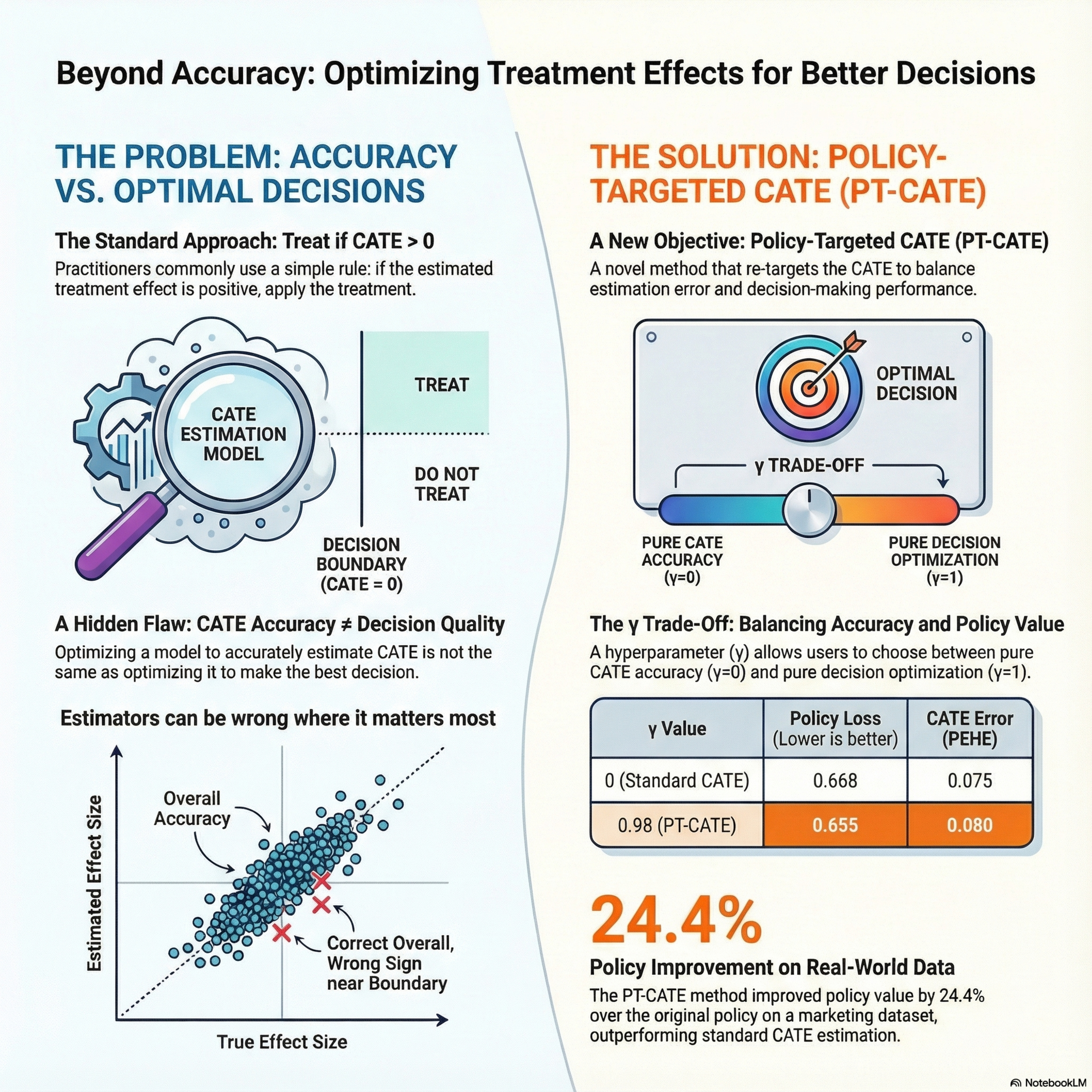
This academic paper analyzes the common practice of using Conditional Average Treatment Effect (CATE) estimators for data-driven decision-making, such as in medicine or public policy. It argues that minimizing CATE estimation error often leads to suboptimal decision performance when researchers employ restricted or regularized model classes, as these estimators fail to prioritize accuracy near the critical decision boundary. To remedy this discrepancy, the authors introduce a novel second-stage objective function designed to learn a Policy-Targeted CATE (PT-CATE). This approach dynamically balances the trade-off between CATE estimation accuracy and maximizing the policy value of the resulting decisions. The paper proposes a three-step adaptive neural learning algorithm to optimize this new objective, demonstrating that the PT-CATE method significantly improves downstream decision performance over standard two-stage meta-learners.
Embed this episode
NOW PLAYING
Treatment Effect Estimation for Optimal Decision-Making
No transcript for this episode yet
Similar Episodes
No similar episodes found.