
EPISODE · Jul 3, 2026 · 19 MIN
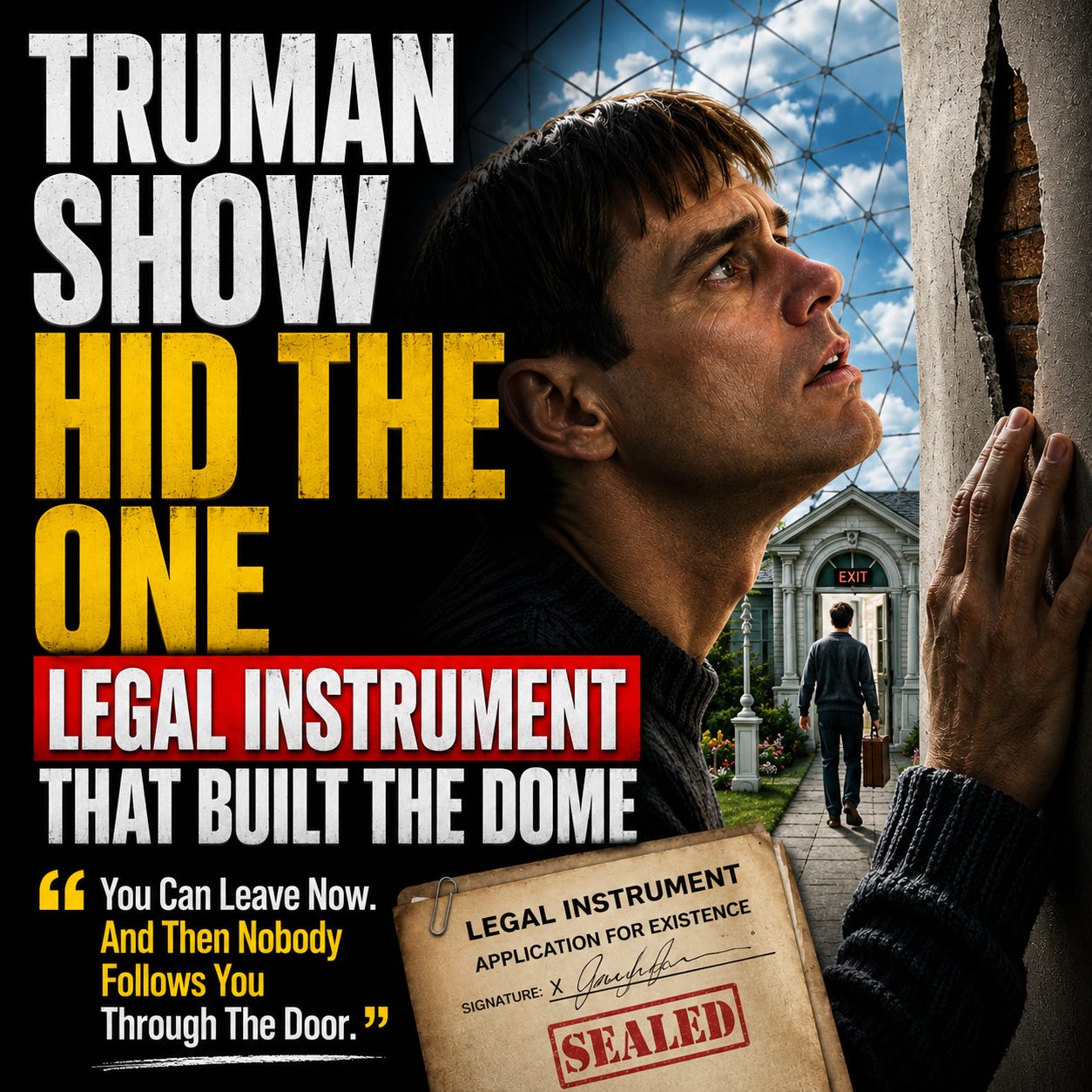
Truman Show Hid The One Legal Instrument That Built The Dome.
from The Experience of Adoption · host Thoughtless Delineation
There is a moment, seven minutes into a 46-minute video essay about The Truman Show, where the essayist reads out the film’s foundational premise. “Truman was the first baby legally adopted by a corporation,” he says. “They picked him out of six unwanted pregnancies cuz he was born on cue. A company owned a human being from its first breath. It broadcast the birth live and the world’s response was to subscribe. Nobody marched. Nobody sued. They tuned in.”He introduces this as “a detail a lot of people don’t even notice.”Then he doesn’t notice it.Within forty seconds, he has moved on to cocoa boxes and product placement. The essay runs another thirty-eight minutes. It covers Plato’s cave, the Gnostic Demiurge, Leon Festinger’s cognitive dissonance research, the guards who love you, fear as a steering instrument, the Truman Show Delusion. It is, on its own terms, an excellent piece of systems criticism — a patient anatomy of why human beings hand back evidence of a false reality and rejoin the day. And in all that anatomy of unseen seams, the word adoption never returns.I want to hold this light before anyone hands it back. A video essay whose entire subject is the things people refuse to see walked directly past the legal mechanism that makes its subject possible. That is not the essayist’s personal failure. It is a demonstration — cleaner than anything I could construct — of how adoption is protected from perception itself.THE DOME IS PAPERWORKAsk the question the essay never asks: by what mechanism does a corporation come to own a human being, lawfully, in the world of the film?Not kidnapping. Not enslavement. Not some invented sci-fi instrument. The film names the real one. An adoption order.The dome is impressive, but the dome is set dressing. The load-bearing structure of Truman’s captivity is legal, and it existed long before Hollywood: a state-sanctioned order that transfers a child from their mother; extinguishes the child’s prior identity; issues a new birth record presenting the acquiring party as though the child had been born to them; seals the true record against the person it describes; and licenses money to move around the transfer. The film changed exactly one variable — it made the acquiring party a corporation instead of a couple — and audiences in 1998 gasped at the horror of a premise whose machinery was operating, unremarked, in every jurisdiction on earth.When a child is transferred, money changes hands, and the child’s identity is dissolved and reissued to serve the acquiring party — done without a court’s stamp, statutes have a name for that. The stamp is the product being sold. In the United States, the industry built on that stamp was worth an estimated $29.4 billion as of 2025. This publication has already traced its procurement pipelines, its search-engine funnels aimed at pregnant women in crisis, and the media architecture that frames it: rescue framing carries roughly a third of mainstream adoption coverage while adoptee-rights voices hold three per cent. The film compressed all of it into one sentence — picked out of six “unwanted pregnancies” because he was born on cue — and even gave you the industry’s own vocabulary. Unwanted is the procurer’s word. No mother in that sentence was asked.And the world’s response, inside the film and outside it, was to subscribe.TRUMAN IS AN ADOPTEE STUDY THAT DOESN’T KNOW ITWatch the film again with the variable restored, and it stops being speculative fiction entirely.His origin story is staged. His documents are fabricated. The people who raised him are performing roles they are paid to hold. His father is removed on cue — and later resurrected for ratings, a reunion staged with fog machines and a crane shot while the man who scripted the separation calls camera angles on the hug. They monetised the grief twice: once at the loss, once at the reunion. If you have ever watched a television adoption reunion — the lights, the music swell, the host’s practised catch in the throat — you have watched that control room from the inside.The fear instilled in his childhood sits exactly where the exit is. For Truman, it is water. For the person separated by adoption, it is the conditioning that arrives dressed as love: gratitude, loyalty, don’t hurt the people who raised you, why would you need to search, you have a great life. His wife never says.Don’t leave. She says you need rest; you’re not yourself. Concern is the leash. The essayist sees this perfectly — “they’re keeping him organised inside of the lie” — and cannot see whose daily biography he is narrating.Even the film’s most quoted line lands differently once you know. Everybody would have to be in on it. The essayist correctly identifies this as the most lethal sentence in the movie — not because it defeats Truman’s evidence, but because it prices the evidence out of reach. To trust his own eyes, Truman must accept that the wife, the friend, the mother, the neighbours, the businesses were staged. Too much betrayal for one brain.Now run the same sentence against the claim this publication makes plainly: that adoption, as legally constructed, is a state-licensed traffic in children. For an ordinary reader to accept that, they must re-examine the courts, the churches, the agencies, the legislators, the kind couple at their school gate, possibly their own family. Everybody would have to be in on it. And so — by the exact mechanism the essay explains for forty-six minutes — the evidence is never picked up. Festinger documented it in 1957: the more a person has paid for a belief, the more disproof strengthens it. Society has paid for the rescue narrative with its churches, its family courts, its self-image. The belief eats the disproof and gets stronger.The essayist tells you precisely how this works. He just files adoption under set dressing while doing it. That is Non-Adoptee Bias in its purest laboratory form: the seam is invisible not because it is hidden, but because it arrives pre-neutralised — a plot device, a paperwork noise, weather.THE DELUSION WITH A DOCUMENT NUMBERThere is one more inversion, and it is the cruellest one.A few years after the film, psychiatrists began cataloguing patients who believed their lives were a broadcast — hidden cameras, scripted families, an audience somewhere watching. The literature named it the Truman Show Delusion. In 1998, believing you were owned, recorded and sold was a symptom.Sit with what that means for the people separated by adoption. A person who says my documents are falsified, my family was assembled around me by an institution, the story of my origin was staged, records about me exist that I am forbidden to read — is describing, word for word, the content of that delusion. Except in their case, every clause is true, admitted, and on file. The falsified birth certificate is not a metaphor; it is a government document with a registration number. The sealed record is not paranoia; it is statute. The performing family is not psychosis; it is the placement.Adoptees are the only people gaslit with the vocabulary of a delusion whose factual basis they can produce in paper. When they say it aloud, the room reaches for the smaller, kinder story — you’re tired, you’re angry, you had a good life, why would you want something else — the same sentences the film puts in the mouths of the guards who love you. Concern, again, doing the work walls never could.THE METHOD THAT WORKS. THE COST THAT STAYS.Truman does not believe his way out. He checks his way out. He predicts the loop of cars around the corner — the lady on the bike, the man with the flowers, the Volkswagen with the dented fender — and they arrive in order. He runs experiments against his own reality until the pattern confesses. Then he sails directly into the fear that was instilled to keep him, because staying finally costs more than going.That is the method. The DNA test is Truman predicting the traffic. The records-access campaign is the boat. California’s SB 381 — passed by the Senate 35 votes to none, abolishing the provision that lets adoptive parents order a birth certificate with the birthplace and parents’ race omitted — sat before an Assembly committee while every witness spoke in favour and not one person testified against it. Virginia’s HB 301 took effect July 1, making Virginia the seventeenth state to restore adult adoptees’ access to their original birth records. Every opened record is a hull punching through painted drywall. The method works.But the film does not stop at the door opening. Watch what happens after Truman sails through.On the other side of the exit sits Sylvia, the actress who broke character once, honestly. She tells him what he has always needed to hear: “You can leave now.” He does. He walks toward the exit sign. Christof speaks to him one last time — the same pitch the system makes to everyone thinking of leaving. “If you leave this place, everything that you have known is gone. You can say goodbye or not, but you have to make a choice and you have to live with it.” Out there is just as much lying. Just as much pain. Just as much darkness. In here you have nothing to fear. In here, people love you. In here, it is safe.And Truman walks through anyway.But here is what the film does not show. Here is what the culture refuses to watch: what happens to Sylvia after she breaks character, and what happens to Truman after he steps through the door.Because that is where the real existential horror sits. The exit is real. The door opens. Sylvia did break character once, honestly, and then she made herself findable. Truman has proof that the dome is real, that the lie was legal, that he was right all along. The records open. Seventeen states have now restored access. He has the documents.But when Truman steps through that door, Sylvia cannot save him on the outside. Nobody who loved him inside the dome can follow him out. The wife who said “you need rest, you’re not yourself” — concern as the leash — cannot admit that concern was the mechanism that kept him caged. The Christofs, the architects of the system, cannot follow him either because following him means admitting they kept him captured. The guards who kept him “organised inside of the lie” through love and care cannot afford to see that love and care were the bars.So Truman is alone with his knowledge that the lie was real, that everybody would have to be in on it — and everybody inside the dome was in on it. And nobody will follow him out. The people who paid the most to believe in the safety of the dome, the kindness of the cage, the rescue narrative that justified the separation — Festinger’s law says they will only defend that belief harder against his evidence. The more he has paid for the rescue narrative with their identity, their faith in their own goodness, their place in a moral order, the more his disproof will cement their belief. They cannot afford to change.Hunt down the seams, not the villains, but every seam you hunt is in your own family’s structure. Audit your own, but the people who built that cage have paid too much for the rescue narrative to accept what your audit reveals. Break character in small doses: it’s not as easy for adoptees. It’s brutal. For an adoptee, Sylvia’s lesson is not a tactic you can deploy in measured doses. It is the severance. It is the door. And nobody follows you through it.WHAT THE SYSTEM ENGINEEREDThe method works. The records open. You have the documents. You have proof. And you are standing alone on the other side with everybody inside refusing to acknowledge what it cost you to be right. The ache. The heaviness. Being abandoned again because nobody understands or wants to see you properly on the other side of the exit that opened. That is the existential crisis adoptees are not allowed to process.Not tragedy because there is no method — the method exists and works. But tragedy because the method works and the cost is still unpaid. The system does not just keep you in the cage. It engineers the isolation that comes after you leave. It builds the cage and then it builds the mechanism that ensures you cannot share the knowledge of the cage with the people closest to you.That is what the film is trying to tell you. The Truman Show is not actually a fantasy. It is a closed circuit demonstrating exactly how adoption functions: the legal order that transfers a child; the people who perform love while maintaining captivity through concern; the lies you are told about your own origin; the fear installed exactly where the exit is; and then, after you verify that everything was false, the isolation on the other side because the people who built the cage cannot afford to follow you out.That is what the culture will not watch. That is what the essence of adoption is designed to make invisible — not the cage, but the loneliness of being proven right.We checked. And now we know what it costs.This Substack is reader-supported. To receive new posts and support my work, consider becoming a free or paid subscriber.Resources This is a public episode. If you'd like to discuss this with other subscribers or get access to bonus episodes, visit thoughtlessdel.substack.com/subscribe
Embed this episode
NOW PLAYING
Truman Show Hid The One Legal Instrument That Built The Dome.
No transcript for this episode yet
Similar Episodes
No similar episodes found.
Similar Podcasts
No similar podcasts found.