
EPISODE · Jul 14, 2026 · 12 MIN
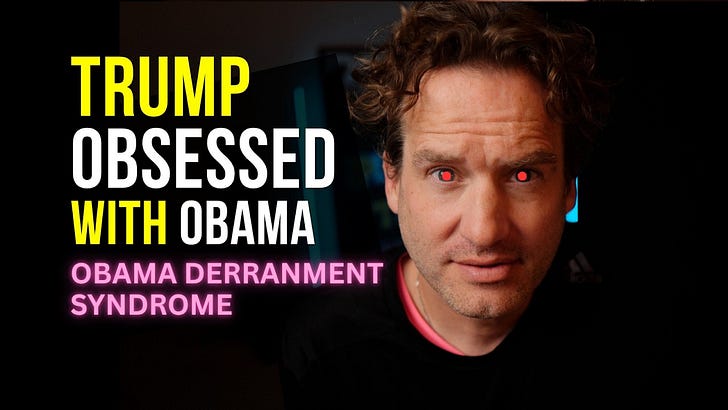
Trump Has Obama Derangement Syndrome
from The Lucas Bean Show · host Lucas Bean
If you watched the video, you already know the six psychological reasons Donald Trump cannot stop talking about Barack Obama. This Substack goes deeper into every one of them.The NumbersBefore the psychology, look at the data.CNN tracked every public utterance Donald Trump made during his first term. In 2017, Trump mentioned Barack Obama by name 200 times. In 2018, that number climbed to 395. By 2019, it hit 537. That is an average of 1.8 times per day. Every single day. The number increased every year he was in office.He mentioned Obama 10 times in a single Cabinet meeting. All 10 were unprompted. Nobody asked him about Obama. Nobody brought up Obama. He just could not help himself.In his second term, it has only gotten worse. In May 2026, Trump went on a three-hour overnight posting spree on Truth Social about Obama. It started around 10:14 p.m. and continued past 1 a.m. He reposted memes, shared AI-generated images, and boosted posts calling for Obama to be arrested. At three in the morning. About a man who left office nearly a decade ago.When reporters asked Trump about cost overruns on the Lincoln Memorial Reflecting Pool renovation, his answer was: “Are you ready? Barack Hussein Obama.” The question had nothing to do with Obama.He posted AI-generated images of the Obama Presidential Center depicted as a giant trash can. He posted side-by-side photos of himself and Obama as young men, except his niece Mary Trump pointed out that the photo Trump used was actually from his time at military school as a teenager, not the age he claimed.In June 2026, Obama responded on the All the Smoke podcast. “You got to ask him what it is, the obsession,” Obama said. “I obviously have a room in his head. A suite in his head.”Obama then pointed out something that makes the obsession even more obvious: “First of all, when I was president, the last thing I had time to do was worry about what somebody said or what my predecessor did. They’re gone. I’ve got work to do.”A CNN/SSRS poll from June 2026 found that Obama’s favorability rating is 57 percent. Trump’s is 34 percent. The more Trump attacks Obama, the more popular Obama becomes and the less popular Trump becomes.That is what makes this a clinical obsession and not a political strategy. It is hurting him. And he cannot stop.The LoserThe script opens with Trump’s record of failure because the psychology does not make sense without it. The obsession is not about two equally successful men competing. It is about a man who lost at everything being haunted by a man who won at everything.The New York Times conducted a massive investigation into the Trump family finances in 2018 and found that Donald Trump received at least $413 million in today’s dollars from his father’s real estate empire. Not millions. Four hundred and thirteen million dollars. Much of it was transferred through what the Times described as “dubious tax schemes,” including instances of outright fraud.Trump did not build a business empire. He inherited one. And then he ran significant parts of it into the ground. His six corporate bankruptcies between 1991 and 2014 wiped out thousands of jobs, hundreds of millions in investor money, and nearly destroyed the Trump brand entirely. His father had to bail him out multiple times, including one famous incident where Fred Trump sent a lawyer to a casino to purchase $3.5 million in chips with no intention of gambling, just to funnel cash to his son.The list of failed businesses reads like a comedy sketch. Trump Airlines, Trump Vodka, Trump Steaks, Trump Magazine, Trump University, Trump Mortgage, Trump: The Game, Trump Ice, GoTrump.com, The Trump Network. Each one launched with enormous fanfare. Each one quietly disappeared.Meanwhile, Barack Obama was raised by a single mother and his grandparents in Hawaii. No family wealth. No real estate empire. No $413 million head start. He worked his way into Columbia University and Harvard Law School. He became the first Black president of the Harvard Law Review, a distinction earned entirely on merit. He served in the Illinois State Senate, then the United States Senate, then won the presidency twice with the popular vote both times. He left office with a 59 percent approval rating and zero criminal indictments.The gap between these two records is not close. And the psychology that follows only makes sense when you understand that Trump knows this.The Fragile EgoThe second section of the script is built on research by psychologists Mark Alicke at Ohio University and Constantine Sedikides at the University of Southampton. Their 2009 paper, published in the European Review of Social Psychology, is one of the foundational texts on self-enhancement bias.Alicke and Sedikides define self-enhancement bias as the motivated tendency to maintain a self-concept that is more favorable than reality supports. People do this across every domain: intelligence, competence, morality, social skills, physical attractiveness. But the finding that matters most for understanding Trump is this: the people who perform the worst are the most aggressive self-enhancers.This is not a minor distortion. Alicke and Sedikides found that self-enhancement operates through specific cognitive strategies. People selectively remember their successes and forget their failures. They attribute positive outcomes to their own abilities and negative outcomes to external forces. They choose comparison targets that make them look good and avoid comparisons that expose weakness.Trump’s entire public persona is built on this. “The great businessman.” “The best dealmaker.” “Nobody has done more than me.” These are not statements of fact. They are self-enhancement operating at maximum intensity. And the research tells us that intensity correlates with actual performance deficits. The worse you are, the harder your brain works to convince you otherwise.Self-enhancement bias functions as a closed system. It works as long as the person can control the information environment. But it has no defense against undeniable, publicly visible counter-evidence. Obama is that counter-evidence. He succeeded in every domain Trump claims to dominate, and he did it starting from nothing while Trump started with everything. There is no cognitive strategy that can neutralize a comparison that stark.The Conspiracy MachineDan Kahan is the Elizabeth K. Dollard Professor of Law and Professor of Psychology at Yale Law School. His concept of identity-protective cognition, published in 2017, explains what happens when a person encounters evidence that threatens not just their beliefs but their identity itself.Kahan’s central finding is that people do not evaluate evidence objectively. They evaluate it through the lens of their identity commitments. Evidence that supports their identity is accepted easily. Evidence that threatens it is rejected, attacked, or reinterpreted to neutralize the threat. The brain does not adjust. It defends.What makes Kahan’s research particularly devastating is the finding about intelligence. Smart people are not better at overcoming identity-protective cognition. They are worse. They use their cognitive abilities to construct more sophisticated defenses against threatening evidence. Intelligence becomes a weapon for protecting the self-image, not for discovering truth.Trump is not one of these smart people. His defenses are crude and transparent. Birtherism was not a clever conspiracy. It was an obvious lie that fell apart the moment Obama released his birth certificate. Spygate, the deep state, election fraud: all of them are easy to disprove and nobody outside the cult believes them.But the crudeness of the defense does not matter. What matters is the function. Every conspiracy Trump has aimed at Obama serves the same psychological purpose: if Obama’s success can be delegitimized, then Trump’s failure is not real.The timeline of birtherism reveals the mechanism in real time. In March 2011, Trump began appearing on television demanding Obama’s birth certificate. Obama released it in April 2011. Trump briefly acknowledged it, then immediately cast doubt on its authenticity. He then demanded Obama’s college transcripts, implying Obama did not earn his way into Ivy League schools. When one piece of evidence was neutralized, the attack shifted to another target. The goal was never truth. The goal was protection.And then came the Correspondents’ Dinner. On April 30, 2011, the same month Obama released his birth certificate, Obama roasted Trump at the White House Correspondents’ Dinner in front of the entire Washington establishment. Trump sat in the audience while Obama dismantled him with jokes about Celebrity Apprentice and birther conspiracies. The room laughed. Trump did not.Trump political adviser Roger Stone later told PBS Frontline that the Correspondents’ Dinner was the night Trump resolved to run for president. Author Michael D’Antonio put it more directly: “This is a burning, personal need that he has to redeem himself from being humiliated by the first Black president.”That is identity-protective cognition at its most naked. The evidence that Trump is inferior to Obama was delivered publicly, by Obama himself, to a room full of the most powerful people in the country. And Trump’s brain could not process it. So he ran for president. Not to serve the country. To destroy the man who humiliated him.The Fake Tough GuyJoseph Vandello and Jennifer Bosson are psychologists at the University of South Florida. Their 2008 paper introduced precarious manhood theory, the finding that manhood, unlike womanhood, is perceived as a status that must be earned through action and can be lost through inaction or failure.Their experiments demonstrated that men whose masculine status was threatened became significantly more aggressive, more anxious, and more likely to engage in compensatory displays of toughness. The threat did not have to be direct. It just had to imply that their version of masculinity was inadequate.The contrast between Trump and Obama is the clearest possible example of this dynamic. Trump’s brand of masculinity is performative: loud, dominating, aggressive, boastful, sexually predatory. Obama’s is the opposite: calm, measured, educated, disciplined, dignified. In any rational framework, these are simply different styles. But in Trump’s framework, his version is supposed to win. The loud guy is supposed to beat the quiet guy. The tough guy is supposed to beat the composed guy.Obama proved that wrong. He won the presidency, won public approval, won institutional respect, won international standing, and won historical legacy. All without raising his voice. All without grabbing anyone. All without insulting anyone at three in the morning on social media.That is a precarious manhood threat of the highest order. Because if Obama’s model of masculinity works, then Trump’s model is unnecessary. And if Trump’s model is unnecessary, then the entire performance is exposed as compensation for something missing underneath.The full name is the tell. “Barack Hussein Obama.” Vandello and Bosson’s research predicts exactly this kind of response. When masculine status is threatened, men attempt to reframe the source of the threat as other, as foreign, as not belonging. The middle name is designed to make Obama sound un-American. Because if Obama is un-American, then his success does not count, and Trump’s version of manhood is still the one that works.Trump also demanded Obama’s college transcripts, implying that a Black man could not have earned his way into Columbia and Harvard. This is the same mechanism. If Obama earned everything, then Trump’s inherited advantages look even worse by comparison. The only psychological escape is to delegitimize the accomplishment entirely.The ObsessionSigmund Freud introduced repetition compulsion in 1920 in “Beyond the Pleasure Principle.” He defined it as the unconscious tendency to return to the source of a psychological wound, not to resolve it, but because the mind cannot let it go. Stopping would require accepting the pain as real and permanent. The repetition is not a choice. It is a compulsion driven by the inability to process the underlying trauma.Modern trauma researcher Bessel van der Kolk expanded on Freud’s concept, finding that people trapped in repetition compulsion do not consciously choose to repeat the behavior. The compulsion operates below conscious awareness. The person feels pulled toward the wound without understanding why.The data on Trump’s Obama mentions proves this is not strategic. His advisors have told him to stop. His strategists have told him to stop. His own staff has told him to stop. The CNN data shows it is getting worse, not better. 200 mentions in 2017. 395 in 2018. 537 in 2019. And in his second term, three-hour overnight posting sprees and AI-generated attacks on Obama’s presidential center.No political strategist would recommend this. It does not help with independent voters. It does not help with swing states. It does not help with anyone who is not already committed to Trump. In fact, the CNN poll showing Obama at 57 percent favorability and Trump at 34 percent suggests it is actively hurting him.But he cannot stop. Every mention of Obama reopens the wound. And every attack reminds the audience of the comparison between them. The comparison is devastating, and it never resolves in Trump’s favor. The more he attacks, the more popular Obama becomes. The more popular Obama becomes, the more painful the comparison. The more painful the comparison, the more Trump attacks.That is a textbook repetition compulsion loop. There is no exit because the wound that drives the compulsion is the truth itself: Obama won, Trump lost, and no amount of attacking can change that.Patient ZeroEvery section of this script traces back to the same foundation. A narcissist who was built, not born.Fred Trump raised his sons with two rules. You are a king. And be a killer. Love was conditional. Success was rewarded. Failure was punished. Weakness was not tolerated. Fred Trump hit his children, installed surveillance and intercom systems in the family home to monitor them, and ran the household like a corporation where performance was the only currency that mattered.Trump’s mother, Mary Anne MacLeod Trump, became seriously ill when Donald was two years old. She was hospitalized for months and never fully recovered. For critical years of Donald’s development, his mother was physically present but emotionally absent. His niece Mary Trump, a clinical psychologist, described Donald as essentially abandoned during the most important period of a child’s emotional formation. When reporters have asked Trump how his mother showed love, he has had nothing to say.His older brother Freddy was supposed to take over the family business. But Freddy was not a killer. He was sensitive, quiet, and drawn to flying rather than real estate. Fred senior crushed him for it. Donald joined in. The two of them ridiculed Freddy constantly, made fun of him for being weak, mocked him for not being tough enough. Two men tearing apart a man who was falling apart in front of them. Freddy started drinking. He left the business. He died of complications from alcoholism at 42 years old.Donald learned the lesson. Be the killer or end up like Freddy. That is the factory that produces a narcissist: remove the love, replace it with demands, punish vulnerability, reward domination, and produce a person who cannot lose because losing means they do not exist.The term for what Fred Trump built was coined in 1964 by Erich Fromm, a Jewish psychologist who fled Nazi Germany. Fromm spent decades trying to understand how someone like Adolf Hitler could exist. He published “The Heart of Man: Its Genius for Good and Evil” and named the personality structure he had identified: malignant narcissism. He called it the quintessence of evil and the most severe pathology in human psychology.Malignant narcissism is a combination of four traits. Narcissism: the belief that you are more important than everyone else, combined with a desperate need for constant praise, built on top of a deep knowledge that the whole thing is a lie. The narcissist knows the success is not real, knows it was not earned, and spends every moment making sure nobody else figures it out. Antisocial behavior: the ability to lie, cheat, and manipulate without remorse. Paranoia: the conviction that everyone is conspiring against you. And sadism: the enjoyment of causing pain.Fromm identified the same personality structure in Hitler, Stalin, Mussolini, Saddam Hussein, and the Roman Caesars. Researchers have since added Jim Jones to the list.In 2020, psychologist John Gartner, a former faculty member at Johns Hopkins University Medical School, published his clinical assessment of Trump. His conclusion was specific: Trump exhibits all four traits of malignant narcissism as defined by Kernberg and Fromm. Over 200 mental health professionals signed an open letter warning the public that Trump meets the diagnostic criteria. They called him an existential threat to democracy.A malignant narcissist can survive a lot. Losing arguments, losing deals, even losing elections, as long as there is a way to lie about the loss and reframe it as a win. The narcissist’s internal system holds together as long as the performance is maintained.But it cannot survive someone who is the real version of everything the narcissist pretends to be. Someone who actually won. Someone who actually earned it. Someone the entire world respects without being asked.Barack Obama is all of those things. And Donald Trump knows it. He has always known it.The term malignant narcissism was invented to explain Adolf Hitler. Over 200 mental health professionals now say it applies to a man who cannot stop talking about Barack Obama at a rally in Ohio on a Tuesday night.It’s a broken man staring at a picture of Obama, the one person he can never be and losing his mind over it.Sorry Trump, Obama is just not that into you.That is Obama derangement syndrome.SourcesAlicke, M. D., and Sedikides, C. (2009). “Self-Enhancement and Self-Protection: What They Are and What They Do.” European Review of Social Psychology, 20(1), 1-48. Kahan, D. M. (2017). “Misconceptions, Misinformation, and the Logic of Identity-Protective Cognition.” Cultural Cognition Project Working Paper Series No. 164, Yale Law School.Vandello, J. A., and Bosson, J. K. (2008). “Precarious Manhood and Its Links to Action and Aggression.” Journal of Personality and Social Psychology.Freud, S. (1920). “Beyond the Pleasure Principle.”Van der Kolk, B. (1989). “The Compulsion to Repeat the Trauma: Re-enactment, Revictimization, and Masochism.” Psychiatric Clinics of North America.Fromm, E. (1964). “The Heart of Man: Its Genius for Good and Evil.”Kernberg, O. F. (1984). “Severe Personality Disorders: Psychotherapeutic Strategies.”Gartner, J. (2020). Clinical assessment cited in “Unfit: The Psychology of Donald Trump.”Open letter signed by 233 mental health professionals (2024). Organized through the Anti-Psychopath PAC.Trump, M. L. (2020). “Too Much and Never Enough: How My Family Created the World’s Most Dangerous Man.”Barstow, D., Craig, S., and Buettner, R. (2018). “Trump Engaged in Suspect Tax Schemes as He Reaped Riches From His Father.” The New York Times.Fuchs, S., and Petschauer, P. W. (2020). “The Abusive and Troubled Childhood of Donald Trump.” Clio’s Psyche, 27(1), 37-41.Frischling, B. Trump Obama mention data tracked via Factba.se, cited in CNN (2019). “The Numbers Prove It: Trump’s Obama Fixation Is Getting Worse.”Obama, B. (2026). Interview on All the Smoke podcast, June 24, 2026.CNN/SSRS poll (2026). Presidential favorability ratings, June 2026.Kirk, M. (2016). “The Choice 2016.” PBS Frontline documentary.Shpancer, N. (2019). “The Psychology of Trump’s Preoccupation with Obama.” Psychology Today, September 2019. This is a public episode. If you'd like to discuss this with other subscribers or get access to bonus episodes, visit lucasbean.substack.com/subscribe
Embed this episode
Ready to play
Trump Has Obama Derangement Syndrome
No transcript for this episode yet
Similar Episodes
No similar episodes found.
Similar Podcasts
No similar podcasts found.