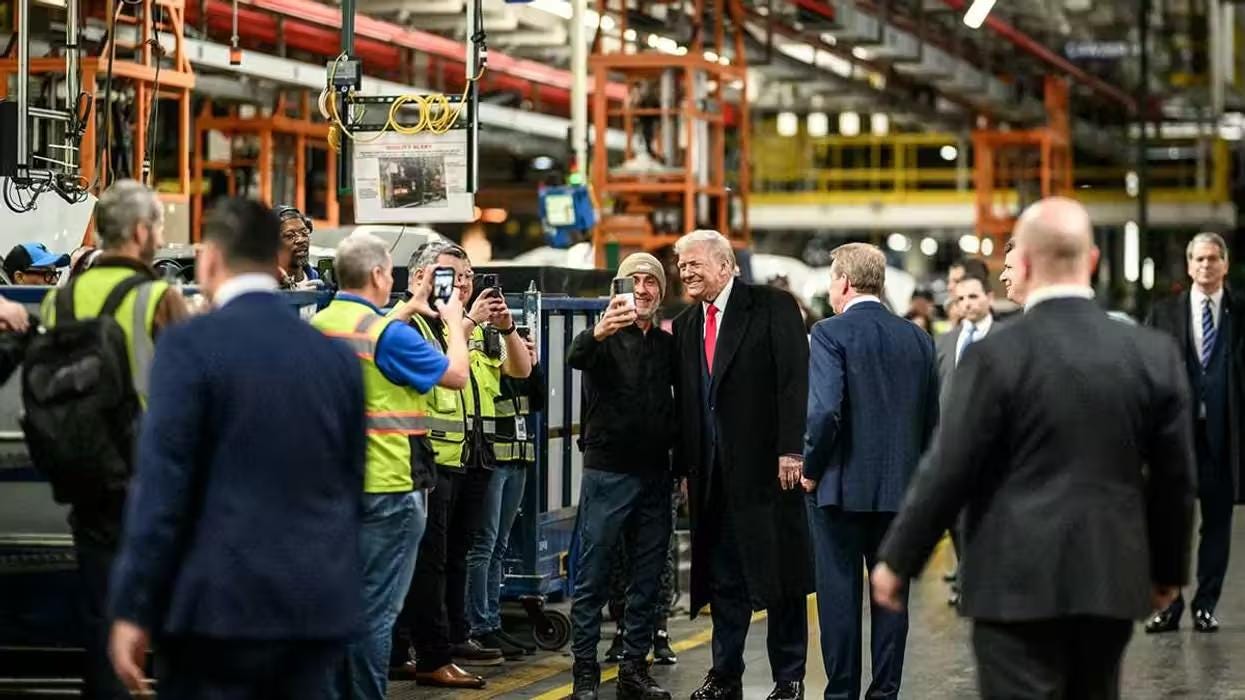
Trump pulls the plug on swing state industry — shocking local workers
from Systemic Error Podcast Hosted by Paulo Santos
| White House photo Georgia’s EV “Confusion” Is a Policy Choice The Factories Came; the Politics Turned Hostile Georgia spent years recruiting electric-vehicle, battery, and solar manufacturers with tax breaks, worker training, and aggressive economic-development deals. Hyundai and Rivian became two of the largest projects in state history. Then the Trump administration eliminated federal EV credits, imposed tariffs on critical components, weakened emissions rules, abandoned federal fleet electrification, and sent immigration agents into a battery plant, arresting more than 400 people—mostly South Korean workers helping launch the facility. That is not market uncertainty. It is government manufacturing instability. Help fuel the work. Independent analysis doesn’t fund itself:☕ Buy us a coffee Washington Pulled the Levers Consumers did not spontaneously reverse federal policy. Automakers did not repeal their own incentives. The Trump administration changed the economics of EV production and ownership through deliberate executive decisions. Kia’s factory leadership says sales had been moving in the right direction before the federal tax credit disappeared. Hyundai, Kia, and battery manufacturers are now adapting by expanding hybrids or shifting toward grid-storage batteries. Calling this merely a “messy period” launders political agency into atmospheric conditions, as though the industry encountered bad weather instead of a hostile federal agenda. The companies are adjusting because Washington forced them to absorb the cost of Washington’s choices. Georgia Subsidizes Production and Penalizes Adoption Governor Brian Kemp’s government wants the investment, factories, and jobs attached to electrification without fully supporting the transition that makes those investments durable. Georgia recruited EV manufacturers but offers no comparable state incentive for residents to buy their products. It instead charges EV owners an additional registration fee. This is not “utter confusion,” as one advocate describes it. It is a politically calculated split: subsidize corporations when ribbon-cuttings are available, then keep consumers at arm’s length from a technology that Republican politics has turned into a cultural target. The result is an industrial policy missing its domestic market. Georgia officials helped build production capacity while refusing to cultivate demand inside the state. Private Capital Is Covering for Political Cowardice Kia and Hyundai participate in a consortium installing charging stations. Electric utilities are increasing charging investments. Advocates are asking Georgia Power and regulators to fill the void left by legislators. That void has authors. State policymakers created it by declining to build a coherent adoption policy. Private companies and regulated utilities are now expected to supply infrastructure that elected officials will not defend publicly. This arrangement lets politicians claim credit if the industry succeeds while preserving deniability if it contracts. The public carries the risk through subsidies and weakened economic prospects; officeholders retain the photo opportunities. The Immigration Raid Was Industrial Sabotage The battery-plant raid exposes the deepest contradiction. Georgia recruited international manufacturers whose facilities depended on specialized workers, while federal immigration agents arrested hundreds of the people helping bring one such factory online. Whatever enforcement rationale officials invoked, the consequence described in the reporting is plain: the federal government disrupted a major industrial project that Georgia had worked to attract. An administration cannot credibly promise domestic manufacturing while treating the skilled workforce needed to establish that manufacturing as a convenient enforcement spectacle. The targets had less institutional power than the officials who designed and executed the operation. Yet coverage that folds the raid into generalized “uncertainty” obscures who acted and who paid. Strategic Investment, Disposable Policy Nearly $74 billion in regional manufacturing investment is still moving forward, far outweighing the more than $4 billion canceled or reduced. The electric transition has not vanished. It has been slowed, made costlier, and pushed onto companies, workers, utilities, and state regulators by political leaders unwilling—or actively refusing—to sustain it. The larger pattern is familiar: government recruits private investment, destabilizes the market supporting it, and then describes the consequences as consumer hesitation or political confusion. Georgia’s factories are not evidence of coherent leadership. They are evidence that industrial momentum can survive incoherent leadership—at least until the accumulated sabotage becomes more expensive than staying. Thanks to Alter Net Source: Trump pulls the plug on swing state industry — shocking local workers Systemic Error is a reader-supported publication. To receive new posts and support my work, consider becoming a free or paid subscriber. We warned them.We told them.We shouted from the rooftops.We plead.We begged.They didn’t listen.Now, we all will suffer.Y’all know what to do, right?VOTE BLUE! 💙Vote as if your life — nay, our country — depend on it.Because, this time, and every time, it does. This is a public episode. If you would like to discuss this with other subscribers or get access to bonus episodes, visit paulstsmith.substack.com
Embed this episode
No transcript yet.