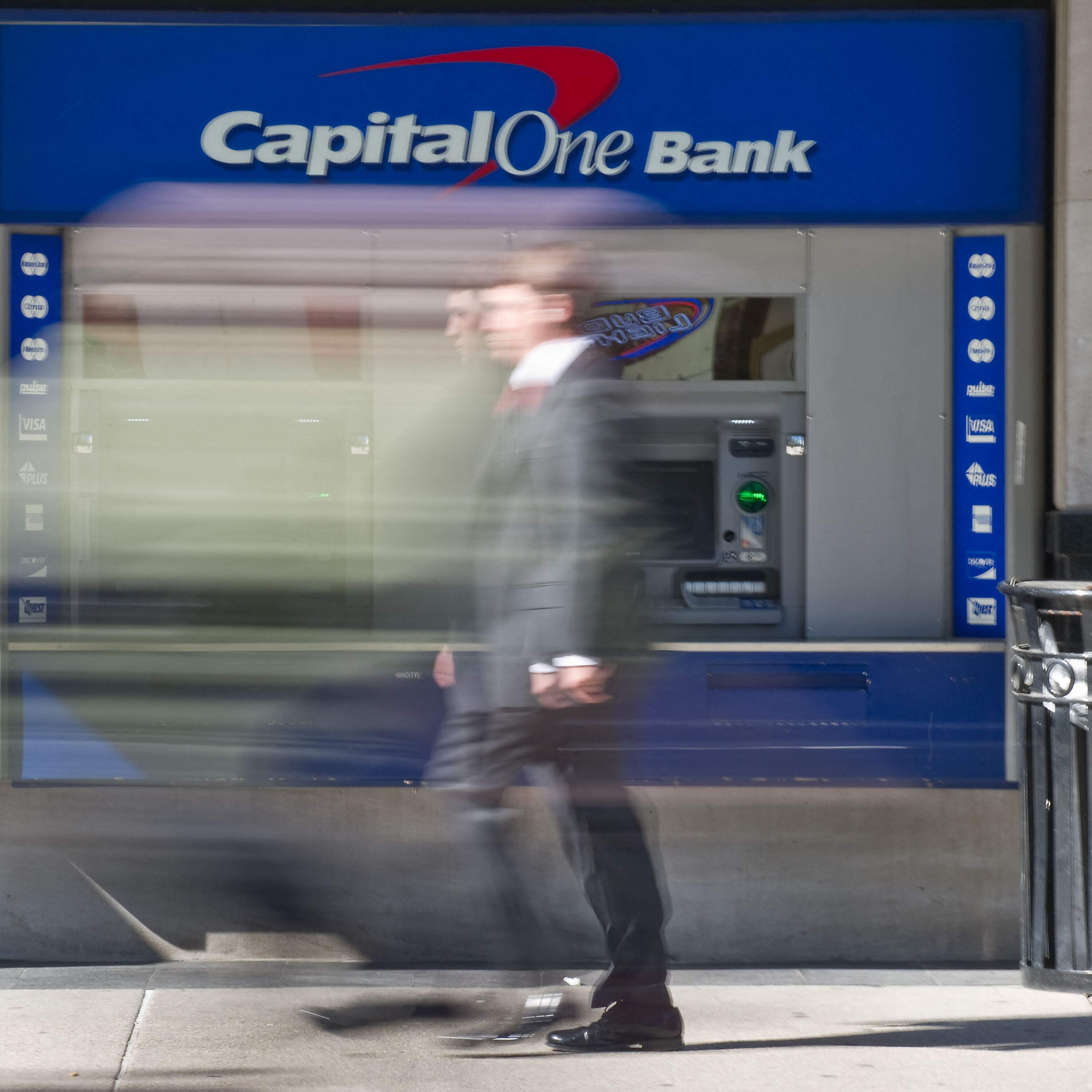
NPR. You might assume that banks want your business. But not always. In fact, if you already have an account, a bank could simply ask you, hey, please pick up a check and take your business elsewhere. Nobody has a right to a bank account.
It's up to the bank. Behind the ATMs and tellers, there's another division. It's a detective agency called the Anti-Money Laundering Department. They're checking in on transactions, marking down money flows that appear sketchy. This department can even shut down a bank account without telling the customer why.
And it's this Anti-Money Laundering Department that allegedly found the trouble organization making some unusual transactions at Capital One. This is the indicator from Planet Money. I'm Ricky Mulvie. And I'm Adrian Ma. Today on the show, we're stepping behind the curtain to find out why banks shut down accounts.
And the controversial issue of D-Banking, how banks have cut customers for political or reputational reasons. And how all this ties into the legal spat between the Trump Organization and Capital One. That's after the break. This week on sources and methods President Trump's diesel deal with Russia, would it help? Would shipping costs and would it even be legal?
The United States produces more diesel than it consumes. There's no real need to bring more diesel into this country. Plus, we dig into claims from Ukraine that the US cut access to crucial military satellites. Listen now to sources and methods from NPR. Hey, how are you feeling right now?
Exhausted from the summer? Overwhelmed with the new school year? Restless? Inksious? LifeKit is here to help.
Consider us your mental health accountability buddy, with episodes on everything from navigating social anxiety to unlearning perfectionism. Listen to the LifeKit Podcast in the NPR app or wherever you get your podcasts. This is Terry Gross. Listen to fresh air for thoughtful questions. Like when I asked Steven Spielberg about porn titles, when John Waters was on our show, he said his favorite was shaving Ryan's privates.
Did you know about this? No, not until this very moment. Listen, on the NPR app or wherever you get podcasts. So how do banks find suspicious activity? Well, first the bank has to know who you are.
Do you seem risky? Are you a school teacher? A small business owner? Are you a multinational real estate company? How risky you seem determines how much attention you get from the anti-money laundering team.
They look into suspicious transactions to make sure that their bank isn't facilitating fraud, financing terrorism, bad guy stuff. So banks are constantly looking at their customers. It's less just if he spent decades looking for financial crimes like money laundering at both the Department of Justice and Wells Fargo. Less says money laundering teams can't look into every single transaction. I mean, a large bank has millions of customers after all.
But the bank's detective team looks for sketchy transactions, often where businesses don't clearly connect. For example, a car wash in America making unusually large transfers to, let's say, a fried chicken restaurant in the Cayman Islands. If they see something unusual, they're not going to tell a customer, you know, you're kind of sketchy. We're seeing activity in your account that makes us uncomfortable. They're just going to say we're closing your accounts and they're not required to give a reason.
They often don't tell customers why they're shuttering accounts because they might not want to tip off the customer to their other investigations into nefarious activity. Attention, potential criminal, please be more careful with your finances. Yeah, not exactly keeping a low profile. And these anti-money laundering divisions are highly structured, regulated, and they keep a lot of paperwork. So when they shut down an account, they aren't necessarily accusing a customer of a crime, just suspicious transactions.
So banks can shut down accounts because they find unusual activity. They don't want to facilitate anything criminal going on. But sometimes banks make decisions about who they keep as a customer for political reasons. This is called de-banking. It happens when banks shut down an account for legal or even reputational risks.
Less says his financial crimes unit was never told to go after accounts because they were in an unfavorable industry. But he says that banks do worry about reputational risk, you know, feeling yucky about a certain kind of customer. The problem is that there isn't a clean way for banks to manage reputational risk. Brian Brooks was a bank regulator supervising national banks under the first Trump administration. Reputational risk is whatever you think it is.
If you're a Democrat, you think it's reputational risk to a bank and oil company. If you're a Republican, you think it's reputational risk to a bank parenthood. Do we actually think those are financial risks that banks are in a position to mediate? Or do we think that's pure politics? Brian says that he saw political pressure to shutter accounts that belonged to traditional energy companies, an industry that's out of favor with some on the left.
And I was on a lot of calls as a regulator with some of these groups that would just come after me saying, how can you let these banks, you know, provide financial services to these people? And I would say things like, listen, if you're a bank that, for example, offers business checking accounts, you're literally telling me that this oil company that employs a thousand people shouldn't have a business checking account to make payroll, help me understand what risk that bank is managing. There's no risk of climate change other than you want to shut down the oil company. And it's not the bank's business to make that decision. And I also mentioned other coordinated attempts to choke off certain businesses, like payday lenders, sex related products, tobacco products, pawn shops.
We discovered that the FDIC was pressuring banks to stop serving those. And when that was revealed in 2014, there was bipartisan consensus that was a terrible thing. You should not be kicked up a bank account if you're not breaking the law, okay? Or if you're not creating a risk, like a credit default risk that the bank can't manage, okay? A business might have a problem when multiple large banks shut off services to its particular industry.
Last year, President Trump signed an executive order that said banks or regulators couldn't use reputational risk as a reason to close an account. Whether or not this has teeth in the long term really depends on congressional legislation. Now, how does all of this apply in the case of the Trump Organization versus Capital One? Is it anti-money laundering or was it political? Does Capital One need a reason to shut out a customer?
When Capital One originally closed the accounts, it didn't give the organization a specific reason why. And one big question was this politically motivated? The closures came just a few months after the January 6th Capital Riot. However, less says it got interesting after the Trump Organization sued. What's unusual in this case is that Capital One came out and admitted what they believe, and frankly what I believe is the real reason for closing the accounts is that they were based on financial crimes concerns.
Another former Fed agrees. Dennis Lormel was Chief of the FBI's financial crime section. He oversaw the team that identified where the 9-11 hijackers got their money, finding it just days after the attack. I would be inclined to believe the banks position that they conducted an anti-money laundering investigation and they saw enough or they identified enough suspicious activity that raised that level of concern to the point where they would have to or felt compelled to exit the relationship. Dennis says that these bank detective teams receive alerts for suspicious activity.
That's what anti-money laundering teams respond to. Still, less Joseph believes that the January 6th Capital Riot may have added another layer. It might be possible that that's how Capital One looked at this. They said, we're looking at this activity in a different light. So now these transactions, which we were comfortable with, we're not certain we're comfortable with them anymore.
And I think that's an important perspective to look at. We reached out to the Trump Organization. In a statement, it said Capital One's decision was baseless and, quote, plainly a politically motivated decision to de-bank the Trump accounts. We reached out to Capital One, too, and they told us that the bank doesn't comment on specific customer accounts or active litigation and that it'll let their court filing speak for themselves. We should also say that Capital One is a financial supporter of NPR.
And I have a Capital One bank account. Adrian has a Capital One bank account. I haven't been de-banked yet, but there's always time. You've got to see how your cash only car wash goes. Now, we don't know exactly what Capital One saw in the Trump Organization's transactions, but this may be a case where multiple things are true.
Banks have shut down services to businesses in sectors they find disagreeable. De-banking is a political weapon. And anti-money laundering departments keep a lot of paperwork. Banks often shut down accounts they find engaging in suspicious activity. And I know we got to wrap up.
I know you got to go run your cash only car wash. I, uh, only advice of my lawyer. I played fifth. This episode was produced by Vito Emanuel and engineered by Samuel Alfredo. It was fact-checked by CRWates taking in and edits the show, Me Indicator, is a production of NPR.
This election season, let the NPR Politics Podcast save your time and your sanity. It will help you understand key races, which polls you can safely ignore, and what might happen if power shifts in Congress are short daily episodes come out every afternoon so you can spend less time scrolling through each chaotic news cycle. Make NPR Politics your hub for midterm election coverage, follow our podcast on the NPR app or wherever you get your podcasts. The next two line from NPR. I was surprised that this man every single day takes a chair and goes to the troubles and debris of his house and distorts to tell stories to his children, to his mother, to his wife.
We travel through the past four seasons of ceasefire in Gaza with NPR's NSBaba.