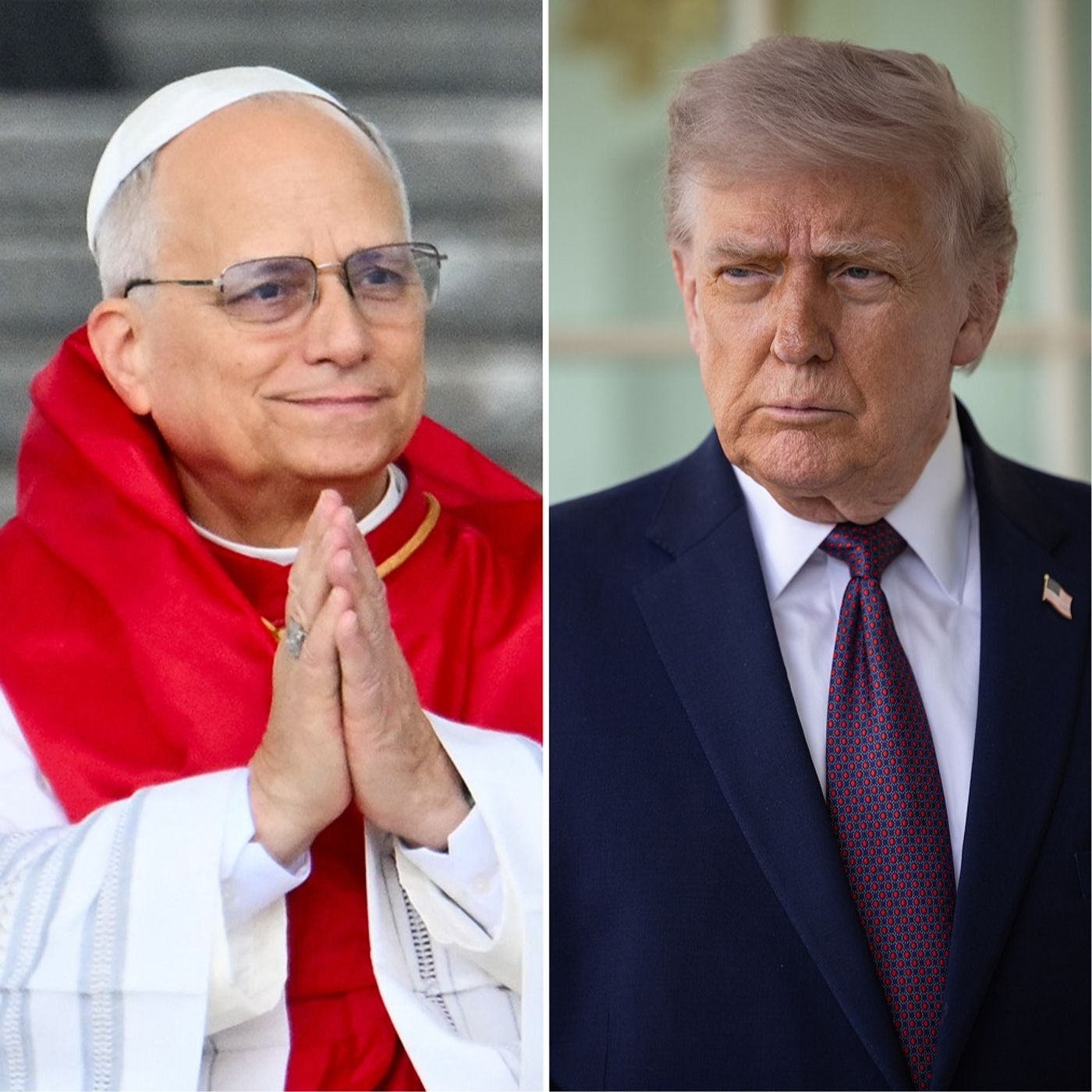
From the New York Times, I'm Natalie Kitroweth. This is the date. An unusual disagreement has broken out between the president of the United States and the Pope. This week, after President Trump lashed out at him, Pope Leo XIV openly took on the administration, setting up the most direct confrontation between a head of state and the Pope in modern history. Today, my colleague, Matoko Rich, explains why Trump cares so much about what the Pope thinks, and why it matters, the two of the most powerful Americans in the world, are so deeply at odds.
It's Thursday, April 16th. Matoko, you have just embarked with the Pope on this tour of several African countries. You are traveling on the people playing with him surrounded by top Vatican officials at this really tense moment in which the American president is attacking the first American Pope. So just set the scene for me. Where are you and what is the feeling right now among the people on Tarash?
Well, we're on the third day of Pope Leo's first trip as Pope to Africa, and we just came from Algeria and landed this afternoon in Cameroon, and I'm currently in the capital of Cameroon in a hotel. You might hear a little background noise because I'm in the press center because that's where the best Wi-Fi is. The mood here is an interesting mix because of course, the people who are waiting for the Pope's visit are super excited like we were driving on the road from the airport to the hotel. We were just seeing tens of thousands of people lining the road. So for them, this is an incredibly important pastoral visit.
And yet in the bubble of the people playing, there's this great awareness of this huge rift that has opened up between the Pope and the President of the United States due to some very public attacks by the President on social media and then following up by the Vice President in various interviews. And this is a particularly stunning moment because this Pope has, during most of the first year of his papacy, he was very mild-mannered and attempted to create a sense of unity. He's not in confrontational, and yet on Monday we saw him kind of fight back. Okay, let's get into the whole story of this rift. Walk us through how it started.
So from the moment that Pope Leo was elected because he was the first Pope from the United States, there was some expectation is he going to be sort of the anti-Trump. Pope Francis's predecessor had been perceived as this more left-leaning Pope. He had famously gone up against Trump in a number of ways in terms of calling him not Christian, going to the border of Mexico to meet with migrants. So there has been precedent for a rift between a previous Pope and the President, but Pope Leo is really making an effort to kind of calm things down. So he would make very generalized comments speaking out against wars, speaking on behalf of peace, speaking on protection for the environment, but then a sense that he might have some ideological differences with the President in the same way that Francis had started to creep in when he talked about migrants.
He encouraged the US Council on bishops when they condemned the President's migration policies, and then as he has spoken out about war, it has been perceived by the Trump administration as more and more adorable. And certainly after the war began against Iran, the Pope has increasingly been making more pointed comments. What I hear you saying is that there was some latent tension bubbling in the background between the Pope and the Trump administration before this moment, but the war sounds like it was a turning point. So how did that unfold? So soon after the war began, the Pope started making comments.
For the sisters I'm praying, I'm falling with deep discern what's happening in the Middle East and Iran in these dramatic moments. Which could sound general, but could also sound pointed about the need to return to dialogue, abhorrence for war, the need for peace. As well the parties involved. If you take out the moral responsibility too, and the spiral of violence before it becomes an irreparable chasm. And I think that started to be perceived by the Trump administration as potentially a direct attack, but he was not naming either President Trump or any other member of the cabinet.
But then, Defense Secretary Pete Hegsev. May Almighty God continue to bless our troops in this fight. And again to the American people, please pray for them. Exhorted the American public. Every day, on Bendigny.
To get down on Bendigny and pray for a military victory, and he said, I think in the name of Jesus Christ. With your family, in your schools, in your churches, in the name of Jesus Christ. We should say that that is a pretty unusual thing to say for a defense secretary. You know, the administration has given all kinds of different goals and dustifications for this war, but that comment did stand out. Absolutely, because, you know, in the United States we talk about separation of church and state, so for a high ranking government official to invoke a particular religious figure to justify an American war is highly unusual.
And then the Pope responded, where in a homily on Palm Sunday, the week before Easter, he said that Jesus does not listen to the prayers of those who age war. And he talked about, you know, what we do and do not do in Jesus' name, so he was clearly disagreeing with what Pete Hegsev was saying. Do you think that Hegsev's words invoking God in this way may have provoked him to be more outspoken than perhaps he would have been? Obviously, I can't know what is going on inside the head of the Pope, but we know that peace is a top priority for this Pope, and he has talked consistently about how he opposes war.
His Christmas message to the Cardinals at the opening of the year, all of them carried very strong anti-war messages. So this is not coming from nowhere, but I think you're right, that once Pete Hegsev invoked the name of Jesus Christ in asking for a victory for the American side, he was basically saying he was asking God to take sides. I think that really upset the Pope. Okay, so the Pope responds with this homily. Things are starting to ratchet up.
When do we get to the breaking point here? Well, then a week later, the President threatened to annihilate the civilization of Iran overnight. Right, this was in a true social post. Yes, absolutely. And in response to those remarks, the Pope became clearly much more direct, he said, to call for the annihilation of a civilization is unacceptable, and he even exhorted citizens in concerned countries to call their Congressmen, call their political leaders, and call for the end to war and all wars.
And so that seemed pretty extraordinary. This was no longer kind of generally peace be with you. We must end all wars. This was really responding to the particular language of the President. He seems to be starting to really wade in here to the fray.
Yes, absolutely. So it definitely felt like the tension was ratcheting up. And I think maybe some people were kind of waiting to see at this point whether the President would lash out because it's sort of not at all extraordinary for the President to lash out against his opponents, but there didn't seem to be a response. But then, is this a just war? No, under Catholic teaching, this is not a just war.
This past Sunday, three very high-ranking court rules from the United States, so that means high-level leadership of the Catholic Church went on 60 minutes, and they underscored completely the Pope's anti-war message. We're dehumanizing the victims of war by turning the suffering of people and the killing of children and our own soldiers into entertainment. You called it sickening? It is sickening. So we of course don't know if that is what set off the President's, but in Rome we all woke up early in the morning getting ready to bore the flight, and instead what we saw was this true social post that the President had posted literally minutes before we were all waking up where he attacked the Pope.
We attacked the Pope as a week on crime and a tool of the radical left. Right, I remember this post was very long. He called him terrible on foreign policy. There were a lot of insults in it. Yes, it went on and on. I mean, you did have to click on Read More to see the whole thing, and it was very specific. He even talked about how he preferred his brother. The Pope has two brothers, one of whom apparently is a Trump supporter and visited the White House after his election.
So it was a very extraordinary attack on the Pope. Okay, this post is up. You are about to get on the plane with the Pope. What happens? Well, of course we were all shocked by this because we were planning, you know, do we have our vaccines? Do we have our malaria pills? Do we have enough clothes to get through an 11-day trip?
Rather, now it's suddenly become a story all about Trump v Leo. And at the airport we're all talking, how can we get the Pope to comment on this? Because traditionally the protocol on the plane is that the Pope comes back, makes a few nice welcoming remarks, and then he walks the aisles and shakes the hand of each journalist. The convention is that we don't ask him questions during that moment. It's more about just making small talk and meet and greet. But of course, this moment was an opportunity we didn't want to lose.
Once he started walking up and down the aisles, many of us asked him questions about his response to that truth, social post. I have no fear of the Trump administration. No, speaking out of the other administration. He was not afraid of answering. He opened up by naming him and saying he was not afraid of the Trump administration. He made it very clear who he was responding to.
I don't want to eat into a debate with him. I don't think the message to the gospel is meant to be abused in the way that some people are doing. And I will continue to speak up out against war. Right. This was a pretty forceful response. And I remember when I saw the thing that struck me was actually what he said about how someone had to stand up for all these innocent people who were being killed.
It was almost like he was sort of taking the mantle of moral authority and saying, this is my position. This is what I'm here to do. Absolutely. I mean, I think he said something along the lines of this is what I'm here to do. This is my job to speak about the gospel's teachings.
And one of the things that he has said all along is that as Catholics and as humans, we should all stand up for the most vulnerable among us. So he's very clearly sees himself as an important moral voice in the world. But on the other hand, I know this was extraordinary in your world. But in the context of American politics in 2026, I have to say the Pope's comments, they sound pretty mild overall were used to flamethrowers. And so I'm wondering why is this such a big deal?
Well, I think part of it is that he's not a flamethrow, that Pope Leo is unlike Francis, not someone who's necessarily eager or willing to engage in fights just for the sake of it. I mean, I don't think that's a totally fair assessment of Francis's personality, but he's very colorful. He was willing to be pointed and barbed and speak off the cough and make dramatic gestures. And frankly, that was one of the conservative criticisms of him was that they thought he was more performative than anything else. And Leo is the direct opposite of that. He is very quiet. He's very mild-mannered. He sticks to his prepared remarks.
This is not necessarily someone you think of as spontaneous, always up for a fight. And so the fact that someone who has that reputation and temperament is willing to say the things that he said that he's not afraid of the Trump administration, that he's speaking up for the people who are most vulnerable. At a moment, when he's been attacked, he's sort of not taking the bait in a way. I think that almost makes his speech more powerful. It's certainly a contrast.
Like if someone's always doing this, it's hard for it to stand out. But when someone who rarely does this suddenly does it, I think it really does stand out. And it's worth saying, right, that the Pope is also extremely popular. Absolutely. I think he was very shrewd, if you will, at the beginning of his papacy that he took his time. He didn't make a lot of broad gestures. But some of the gestures he did actually endeared him to the conservatives who had been alienated by Francis.
So on the moment when he came out on the balcony, he was wearing the red mozzetta, this cape that Francis never wore. So that showed he was respectful of the papal traditions. He speaks Latin. He allowed one of the more conservative United States Cardinals to say, Mass and Latin and Saint Peter's Basilica. I mean, that's part of the Roman Catholic Church right there. So he's really kind of extended in olive branch to the conservatives. He showed that he doesn't want to be partisan within the Catholic Church, much less in politics.
He's been a uniter among Catholics, whereas Francis was willing to kind of say provocative things. Leo has been much more interested in smoothing things over with conservatives who didn't take kindly to some of Francis's more unorthodox actions. Absolutely. He seems to really take seriously that he is the Pope for everyone. And that's why he speaks to everyone.
So given that he's not been a partisan pope thus far, that is why when he actually went up against Trump, that it really felt like a very significant moment. So as if things were intense enough, we land and we turn on our phones and we see that the president has now posted an AI generated image of himself that clearly looks like he's trying to appear as Jesus Christ. We'll be right back. Law transforms agreement into reality. A word becomes an agreement. An agreement becomes a contract. A contract becomes law.
Today, Harvey, the AI platform for legal work, is writing the next chapter. More than 200,000 lawyers are building with Harvey, accelerating review, sharpening negotiations, and more. This is how the future of agreements is being crafted now. Harvey, learn more at harvey.ai. Harvey does not provide legal advice.
Users should always independently review and verify any output from Harvey. Hi, this is Sarah Koenig with News About Our Latest Podcast from Serial Productions and The New York Times. It's called Metro. Well, technically it's called Metro with Sarah Koenig because the show is hosted by me, but I prefer the name Metro. So let's just go with Metro.
It's about New York City and its most fascinating raw material, New Yorkers. Each week on Metro we bring you investigations. Don't tell them you're going to go to jail whenever we talk about this last night. Personal stories, I don't think this is the reason we're jumping when you're talking about your dad's actions. Essays and interviews. Are you a fan of the mayor?
I don't hate them. Stories that take the bigness of New York and make it human-scale and relevant, no matter where you live. See, I consider myself a citizen of everywhere. So come along with me, you two jersey, and let's hang out with the best talkers in New York City. Metro, wherever you get your podcasts.
Let's talk about the reaction to all of this, to Trump's attacks on the Pope, the Pope's response, and then this very provocative image that Trump posts of himself as a Jesus figure. So I think the response to President Trump's attack on the Pope, certainly from Catholics, was pretty outraged. They thought this was very inappropriate for the President of the United States to attack, you know, who they consider to be the vicar of Christ, the leader of their church, the spiritual leader who should be above all politicians. There was certainly a lot of pushback from around the world, even including from Iran.
This was unacceptable in rude. Prime Minister Maloney of Italy said that Trump's attack on the Pope were completely unacceptable. So there's definitely been pushback around the world, not just among the Catholic faithful, but political leaders as well. That's for the image that President Trump posted after attacking the Pope. He looked like he was trying to look like Jesus Christ. He's got a light in his hand.
He's blessing a patient who looks very sick and there's light radiating out of the patient's head. And it looks like he's up in heaven with these very angel-like figures in the sky. I want to show you an image that President Trump posted on his truth socially yesterday. What do you make of this? That's disgusting.
And this really sparked outrage, and that outrage seemed much broader. It was not just Catholics who were upset about it, but many, many Christians, including evangelical Christians. As a Christian, I was very offended. That's disgrace. How are you at fiscal QPOS would be? A machine that he would actually do that. A man I voted for, trust.
Jesus Christ is my Lord and Savior, and that right there is, I mean, I don't really have words for that. I thought that was blasphemy. That is blasphemy. It is curious. There seemed to be a much broader sense that this was bordering on sacrilegious, not just inappropriate or unacceptable.
You're mocking my Lord and Savior Jesus Christ. He's mocking him. He throws a flippancy towards what's really essential and important about our relationship with God, and God will not be mocked. President, did you post that picture of yourself? Did you think that Jesus Christ was?
Well, it wasn't a picture. It was me. I did post it, and I thought it was me as a doctor. President Trump, it should be said, claimed that he did not think that he was trying to make himself look like Jesus, but that he was trying to look like a doctor who helped people. And had to do with Red Cross as a Red Cross worker there, which we support.
But he said it was a picture of him as a doctor? What? Yeah, I was wondering what the people that you're surrounded by right now on this papal trip made of that argument by Trump. Did they buy that? No, I have not heard anyone who thinks he looks like a doctor. I think everyone got the images alluding to him as a Jesus figure.
Okay. So I want to ask about a particular group of Catholics, and that is the Catholics inside the Trump administration, and particularly about J.D. Vance, the vice president, the most prominent Catholic in the administration. What has he said? Well, that's where the surprise continues.
But as a Catholic, what does it feel like to be in the middle of that? I thought it was going to be easy questions. And it looks like the administration really is doubling down on its antagonistic approach to the Pope. But he said that God is never on the side of those who wield the sword. He seemed like he was almost schooling the Pope on Catholic theology and making an argument about the theory of the just war.
How can you say that God is never on the side of those who wield the sword? Was God on the side of the Americans who liberated France from the Nazis? Was God on the side of the Americans who liberated Holocaust camps and liberated those who had survived the Holocaust? And clearly the vice president, as has the president, are trying to argue that the attack on Iran is a just war in a Christian sense, not just in a political or moral sense. You know, each of us has our own role. I'm the vice president of the United States. The Pope's job is to preach the gospel.
And then he said that the Pope suggested to matters that concern the church. I think it's very, very important for the Pope to be careful when he talks about matters of theology. If you're going to opine on matters of theology, you've got to be careful. You've got to make sure it's anchored in the truth. It's peculiar for the vice president of the United States, a recent convert to Catholicism to be trying to lecture the Pope who has been a Catholic all his life and is the leader of the Catholic Church on Catholic theology.
But that seems to be what he is doing. Right. It is kind of stunning to hear any politician try to tell the Pope how to speak about theology. I do think that Vance's argument here, if I understand it, is that, look, this war is moral. He specifically said, you know, wouldn't the Pope have blessed American fighters liberating France from the Nazis?
I'm wondering, what do you think the Pope's response to that would be? I know you're not inside his head, but help me understand what you think his position is. I think the Pope would likely say something like, this war does not qualify as a just war. In that he has joined by many global leaders who say this is a war of choice, not a war of necessity. There isn't a sense that the war is actually about liberating innocent people and the Pope has made the point someone needs to speak up for the innocent people who are getting killed in this war.
And has the Pope weighed in on the argument that this Iranian regime has been extremely repressive toward its own people and that regime change would benefit them? That's what the Trump administration is trying to do? I don't know if he's directly weighed in on that point specifically about Iran, but more broadly, he's not saying that he's against just moral actions. He's just saying he's against war. So he keeps emphasizing dialogue as a way to get to the goals. It doesn't seem like he's saying who cares about the protesters, who cares about the nuclear weapon.
It's just saying there are other ways to get to these goals. And what about Vance's claim that this is just not the Pope's realm to engage in politics? Obviously, this is the Pope weighing in on a war, not on the US midterms, for example. But what do you make of that criticism? Well, I think in some respects that it probably is a fair criticism for a politician or a government leader to say don't meddle in our internal decisions where sovereign nation and the Vatican City is also a sovereign state, by the way.
But I think in this case, the way the Pope views it is that it's a very fundamental principle of Christianity. We are the peacemakers. And so I think the Pope takes that very seriously. The Trump administration, on the other hand, seems to want to keep up the fight, or it almost seems like they're trying to persuade the Pope. The president posted again on social media that someone should tell Leo about the 42,000 protesters who died in Iran. Those are not verified numbers as far as they know.
But it's not like he's just sort of saying, oh, Pope Leo is lame. He's weak on crime again. He's really making an argument, which I think is a slight shift in tone, it seems. Yeah, it does seem like they really care about how this war is perceived and about ensuring that it's perceived as just morally and in every other way. Well, there's something trying to make a case to persuade the American people. This is not just about religion. This is clearly something that's happening on the political realm as well.
But in as much as the Pope is the leader of a group that represents something like over 50 million people in the United States, identifies Catholic, I think the last figure's show, they're important constituency for the president. We've talked on the show, Motoko, about how the justifications for this war from the Trump administration have been a little over the place. A lot of the messaging has basically been, we are trying to cause as much damage as possible in Iran. We are winning, et cetera. But to the extent that they have invoked moral justification to the American public, it has been tied to religious and specifically Christian values.
And so, I wonder if there is some real impact for the administration of having that argument be countered so forcefully by the Pope? He is the most recognized Christian leader on Earth. That is a fact. There are other Christian leaders ahead of the Anglican church, but he is the most recognized. In fact, I think it's probably fair to say that maybe aside from the Dalai Lama that he's the most recognized spiritual leader on Earth.
And so, to have him counter what is one of their chief arguments for going to war so forcefully is very powerful and perhaps threatening. How much do you think it matters that Pope Leo is an American? Like, how much of a factor do you think that is for Trump as he thinks about how to respond? And as he processes this active and ongoing criticism? Well, I think the fact that Pope Leo is from the United States makes it difficult for the administration to discount his views.
They cannot, like, as they might with Pope Francis or any other previous Pope say, look, this guy just doesn't get us. We're different. Or this is how American politics works. They can't really say that with this Pope because he's from the United States. He was born in Chicago. He's from the Midwest, the Heartland. This is a guy who deeply understands partisan politics in the United States.
He's much harder to dismiss. What about for the Pope himself? I know when Pope Leo first became Pope, there was this worry about whether his American-ness would drag him into politics in a way that would be ugly and unseemly, not something the church wanted. And now here we are. We've arrived at that point, it seems. So do you think he is considering his American identity when he thinks about how to respond?
Well, I can't be inside the Pope's head. And he has famously told the proscor that every time you think you know what I'm thinking, you don't. That being said, how can it not be part of his thing? He is human being. He comes from the United States. His family is there.
However, I do think he's already showing signs of how he reacts, which is he said what he had to say on the plane on Monday. But he did come back to talk to us on the flate from Algiers to the capital of Cameroon. And he did not take questions this time. He did not walk the aisles. But he talked about how much joy he had had and the visit in Algiers. And he talked about being in a majority Muslim country and being in a place where we could learn the lessons of unity, of respecting difference, of living together in peace. He definitely used that word.
So I think that he's sort of returning to his oblique style, where he talks about his primary values, that he is going to let that speak for itself. He's not taking the bait, you're saying, to once he's been dragged in, stay there in the muck. He's trying. It sounds like to rise above again. I mean, it's only been a few days. I don't want to read too much into that. But this was a moment where we were wondering, is he going to address these comments? The Pope could have responded, but he didn't.
In politics, by the way, that's called message discipline, which is not something Trump has displayed very often. If there's one word we can use about Pope Leo, it is definitely disciplined. It strikes me that in that whether Pope Leo likes it or not, he is a very obvious foil for Trump. This may not be something he wanted to claim being the anti-Trump, but now it seems like maybe he can't avoid it. I think whether he likes it or not is absolutely accurate, that most likely he does not, again, I sound like I'm speaking for him, but that is what people who surround him.
That is how he's behaved from the beginning, that he didn't want this role. But how one is perceived as a leader is also important. And I think he is aware of that. And so if the moment has called him to play this role, he seems willing and certainly not afraid of stepping into it. From everything that you said, Mitoko, in describing the trajectory of this rift between the Pope and the President, it definitely seems as though Trump in this case rolled out his typical playbook for dealing with anyone who criticizes him.
We called the Pope names. He accused him of literally the exact thing that you would expect him to accuse a political opponent of being weak on crime, for example. This is like his go-to move for a Democrat, but Pope Leo is not that. He's the leader of 1.4 billion Catholics around the world who view him as the representative of Jesus on Earth, and the fallout is reflective of that. Definitely. He's not a politician. He's elected for life. And he's not a leader of a particular country. I mean, in as much as he's head of state of Vatican City, that's not really his role, his role.
Primarily, as a leader, as you said, of these 1.4 billion Catholics around the world. And they're in every country. I'm sure he thinks about wanting to be a leader for everyone rather than someone who is dividing the Catholic Church. I think it is fair to say that he is first and foremost a religious leader. That is his job. That is his role. That is his calling.
And so politics is something that sometimes happens to him as much as that he is engaging in. In some ways, the fight has been unavoidable, not because he started out, but because he's been consistent in the values that he preaches. And he really sticks to his message about peace and unity and using dialogue. That message seems to have triggered the Trump administration, which really craves the approval of a Christian leader to justify their actions. And the fight has come to him.
Right. It seems like no matter how much Trump wants the pope's approval, he's finding that he can't intimidate this pope to change his position like he can with many other global leaders. Right. I mean, I think a lot of global leaders up until very recently have tried to appease the president in some way by negotiating or compromising or watering down their actual opinions to keep him from getting angry because he has the power to retaliate in tariffs or withdrawing support or aid. He doesn't really have that power over the Vatican. He can't unseat this leader. He can't make him so unpopular that voters vote him out. So in some ways, this is a unique situation in that this is not a leader that can be intimidated, as you say.
And he has shown himself personally as speaking forcefully and saying he's not afraid. Well, Matoko, thank you so much. Good luck on the rest of the trip. Thanks so much. On Wednesday, the chairman of the US Bishops Doctrine Committee pushed back against Vice President Vance's comments about the pope, noting that just wars are those waged in defense against an aggressor and saying that when Pope Leo speaks, quote, he is not merely offering opinions on theology.
He is preaching the gospel. We'll be right back. Hi, this is Carolyn Ryan, managing editor of The New York Times. At the times we strive to help everyone stay informed, and at this critical moment we're making all of our election coverage free in our app. We have more than 100 reporters out there talking to voters, seeing what drives them, helping you figure out what's going on.
On election night, we are the place to go for race results. Our maps are updated minute by minute. Come experience all of our election coverage for free right now in The New York Times app. Here's what else you need to know today. The S&P 500 hit a record high on Wednesday.
It was a sign that Wall Street is pretty optimistic that a permanent peace deal in Iran is going to be reached soon. The Benchmark Stock Index is widely watched across the world as an indicator of just how healthy the US market really is. The S&P had already erased all of the losses that it took during the war in Iran, and after Wednesday's gains, it's actually 2% higher than it was before the fighting started in late February. And senior Pakistani mediators arrived in Tehran on Wednesday for talks aimed at shoring up the ceasefire between the US and Iran before it expires next week. Since the initial talks ended without a deal on Sunday, the two sides have continued to exchange messages through Pakistan.
They have yet to agree to another round of negotiations, but White House press secretary Caroline Levitt said the administration felt optimistic that a deal could be reached. Today's episode was produced by Shannon Lynn, Michael Simon Johnson, and Jessica Chang. It was edited by Chris Haxle and Paige Cowett. Contains music by Alicia Beitutut and Pat McCusker. Our theme music is by Wonderly. This episode was engineered by Alyssa Moxley.
That's it for the Daily. I'm Natalie Kidrolet. See you tomorrow. I'm Gilbert Cruz. This week on The Book Review Podcast, we have a special Halloween treat, or trick, or treat.
Two hard riders recommend some titles that are sure to keep you up at night. I am a big fan of sentient houses in general. I think this is one of the scariest books I've ever read. Listen to The Book Review, wherever you get your podcasts. That door shouldn't be open. Who left it open?