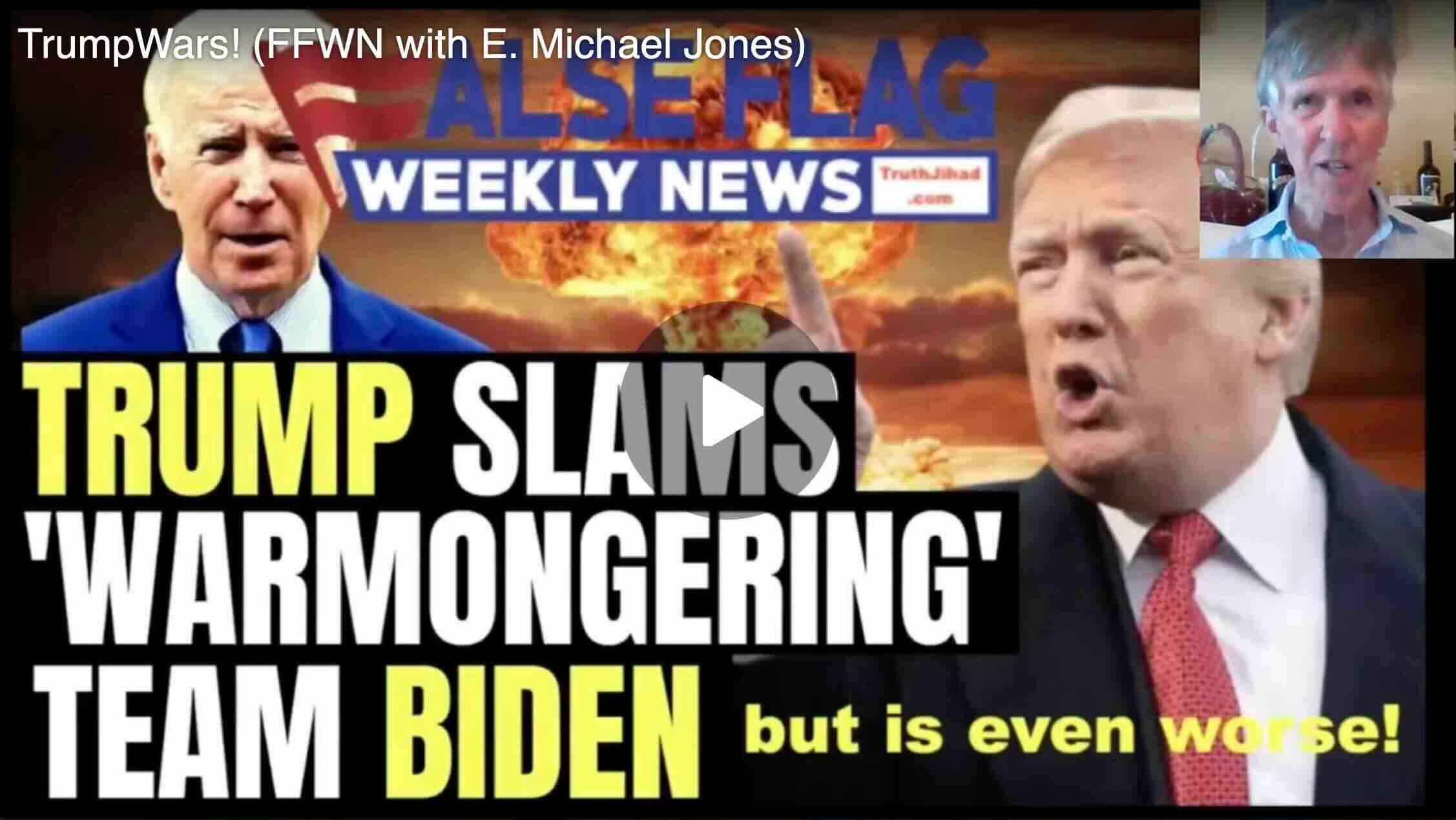
Trump Wars Doomed
from Truth Jihad Radio Hosted by Kevin Barrett
Rumble link Bitchute link FFWN link Trump voters thought they were voting for peace. But circumstances are conspiring to make Trump the worst kind of war president: a loser. From a national leader’s perspective, there’s nothing like losing a cataclysmically destructive war to make people hate you and revile your memory. Just ask Hitler. (If he’d avoided that war, or better yet won, he’d be remembered as a hero.) Trump is lucky that most Americans haven’t read Ron Unz’s free ebook Our COVID Catastrophe. If they had, they would know that the first Trump Administration created the COVID crisis by launching an ill-advised bio-attack on China and Iran. The US bioattack on Wuhan and Qom didn’t explode into World War III, thanks to Chinese and Iranian restraint. But even while the Trump Administration was sending biowar operatives to the Wuhan Military Games in October 2019 to spray COVID all over the wet market, it was arming Ukraine to the teeth and pointing those weapons at Moscow. When Russia inevitably responded in 2022, it wasn’t just Biden’s fault, but Trump’s as well. And let’s not forget that in early January 2020, just as the US-weaponized COVID virus was picking up steam in Wuhan, Trump ordered the murder of Iran’s greatest-ever military hero and would-have-been next president, Gen. Qasem Soleimani. Iranian retaliation injured dozens of Americans, and may have caused deaths, though that’s still classified. Trump backed down, angry that advocates of the killing had insisted that Iran wouldn’t retaliate, and even angrier that Netanyahu, who had promised to take responsibility, reneged. The moral of all of this is that Trump, who would prefer to be a peace-and-prosperity president, has been nudged by circumstance and bad advice toward becoming the next Hitler. By that I don’t mean he’s a bad guy—I don’t think Hitler was an especially bad guy either—but rather that Trump, like Hitler, is setting himself up to lose a hugely destructive war and be reviled in the history books. And unlike Hitler, Trump may one day be prosecuted for a real, fully-documented genocide: the obliteration of Gaza. Today’s Trump Administration 2.0 is desperately trying to repair relations with Russia so it can instead fight Iran (on behalf of Israel) and China (on behalf of US global supremacy). At first glance that may seem reasonable. After all, if you’ve driven your three biggest opponents together due to your unrelenting hostility to all three of them at once, being nice to one of them might conceivably make it easier to fight the other two. But in this case, that superficial analysis is wrong. Russia knows full well that the US is a decaying, increasingly decrepit empire that is non-agreement-capable and totally predatory in outlook, whereas China has become the world trade and manufacturing hub with a win-win orientation to its partners. So anything Putin says to mollify Trump and get what Russia wants in Ukraine should be taken with a grain of salt. But Trump’s real problem is not that Russia will at best only pretend to be America’s friend vis-a-vis China and Iran. It’s that those wars are unwinnable. Today, China and Iran have the power to deter all-out war, and to inflict unacceptable damage if war comes. Any way you slice it, the US will come out a loser. And the loss will likely be catastrophic, entailing the collapse of the dollar, the impoverishment of the American people, and the scapegoating or even lynching of the leader deemed responsible. Trump is setting himself up for that unpleasant fate. Trump’s dilemma is that he is trying to solve problems that might have been effectively addressed 30 years ago. But those trains have long since left the station. The early-to-mid 1990s would have been the time to slow China’s rise to number one power status, and to preserve American manufacturing. Had young Trump been elected—or better yet the slightly older Pat Buchanan—the US president could have decried the treason of the banksters and financiers and stopped them from moving US manufacturing abroad. He could have established a true national public bank under the auspices of the Treasury Department and made it, not the Rothschild-run Federal Reserve, the creator of American currency. And he could have established a national economic policy tasked with looking decades into the future and making optimum decisions on the basis of medium- and long-term calculations, not short-term profits. (All of these things China did, which is why they have been eating America’s lunch.) Such policies, implemented by the mid-1990s, would have made China’s rise less meteoric, and America’s collapse less catastrophic. But I doubt they would have permanently sealed off China from #1 global power status. China’s two biggest assets are its cohesive culture and huge, highly intelligent, strong-work-ethic population. One way or another, China was going to return to its normal place as the world’s biggest economy. But it didn’t have to happen this fast. And the US didn’t have to commit suicide to enable that hyper-rapid rise. Additionally, in the 1990s, the US had a certain military advantage over China. If push came to shove, at-least-somewhat-credible threats could have been made. Today, though some Americans pretend it’s still the 1990s, China can obviously take Taiwan any time it chooses, and the US can do nothing beyond making the loss bloodier and more disastrous. China’s short supply lines, increasing advantages in more and more key technologies, and multiple multiples of US manufacturing power will doom the US in any hot war. Iran, Too, Could Have Been “Solved” in the 1990s Just as a president named Trump or Buchanan could have dealt effectively with China during the 1990s, that same president could have solved America’s problems with Iran. The Iranian president at the time, Akbar Hashemi Rafsanjani, was relatively West-friendly and pragmatic in his outlook. He was the kind of deal-maker with whom people like Trump love to negotiate. Additionally, Iran was exhausted from its ten-year “imposed war” with US-backed Saddam-Hussein-led Iraq and was in no mood for further military adventures. As with 1990s China, the US then enjoyed a strong military advantage vis-a-vis Iran that would have enhanced America’s bargaining position. The question of Palestine, back then, would not necessarily have been a deal-breaker. Though committed to the eventual liberation of Palestine (like everyone else in the region, whether or not they admit it) Rafsanjani strongly emphasized Iran’s willingness to go along with any solution the Palestinian leadership deemed acceptable, which at the time meant the Camp David process. So had an “antisemitic” i.e. America-first-not-Israel-first US president been willing to force Israel to fully respect Camp David and withdraw from the 1967-occupied-territories in return for permanent peace, the issue of Palestine need not have been a stumbling block to a US-Iran “grand bargain.” (Note that all Palestinian parties including the Resistance are willing to embrace permanent peace in return for the complete fulfillment of the Camp David process; the hardliners like Hamas and Islamic Jihad merely reserve the right to campaign peacefully, but not militarily, for the complete liberation of Palestine in the wake of Israel’s withdrawal from the 1967-Occupied Territories.) Repairing US relations with Iran circa 1995 should have been a no-brainer. Rabin’s assassination by Netanyahu and his friends in November, 1995 would have been a great time for the US to read “Israel” the riot act, implement Camp David, and coax Iran into assuming a moderately independent place in the then-US-led community of nations. But already by 1995 Mossad assets like Monika Lewinsky and Jeffrey Epstein were blackmailing Clinton, who had been inserted into the presidency in part by the same Israeli leaders who had planned to assassinate the alternative, George H.W. Bush, in Madrid. So the US blew its chance to fix its M… This is a public episode. If you would like to discuss this with other subscribers or get access to bonus episodes, visit kevinbarrett.substack.com
Embed this episode
No transcript yet.