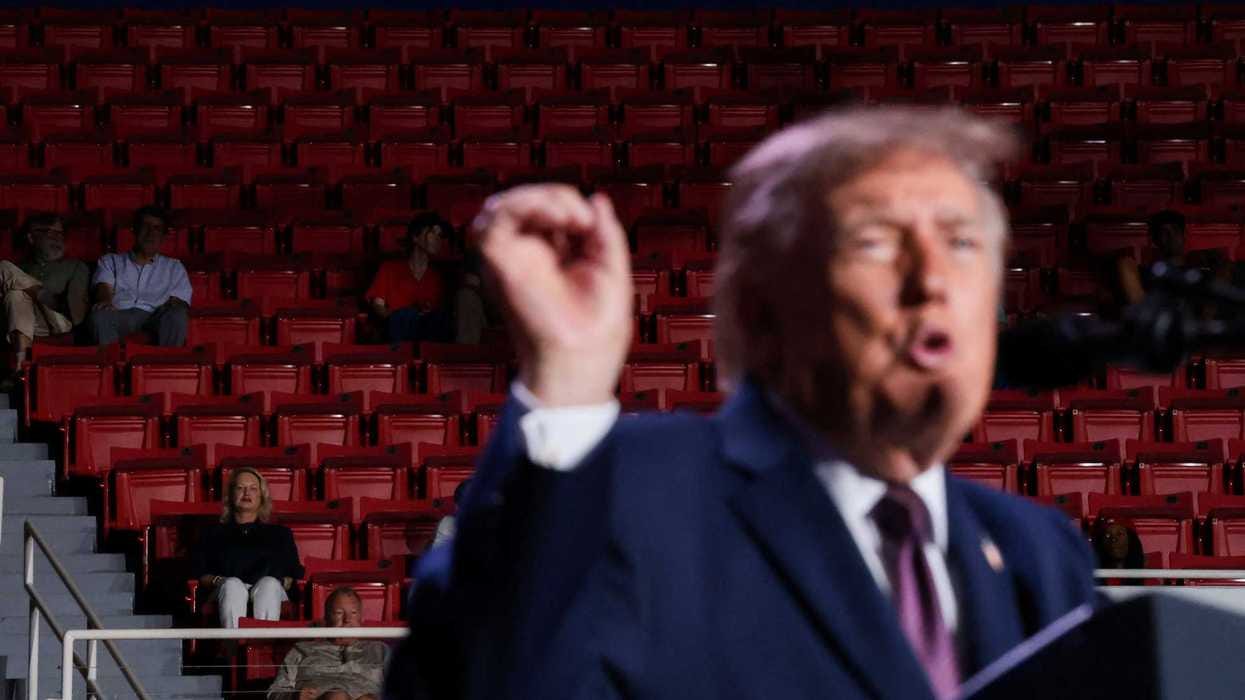
Trump's empty-seat problem gets worse as CNN issues humiliating reality check
from Systemic Error Podcast Hosted by Paulo Santos
What happened AlterNet reports that White House press secretary Katie Zacharia claimed Trump campaign events were drawing “record highs” in attendance, even as CNN aired footage showing entire sections of empty seats at a Monday rally in Youngstown, Ohio. On Tuesday, CNN anchor Erin Burnett said the claim did not match the images from the Covelli Center. The White House responded that press equipment and an American flag explained the gaps. CNN reported that some seats near the press risers were not obstructed. AlterNet also cites an earlier rally in Mobile, Alabama, where The Daily Beast estimated roughly 8,000 people attended in a 10,000-seat arena. The report connects those visible vacancies with poor polling for Trump and difficult Republican races, but it does not establish that rally attendance caused either problem. Its narrower case is stronger: the White House made a sweeping claim that the available footage appeared to contradict. The power is in the podium The important actor here is not an empty chair. It is the White House, an institution with the authority and reach to turn campaign messaging into an official account of reality. Zacharia did not merely offer an optimistic interpretation of a crowd. According to AlterNet, she asserted record attendance from the White House briefing room. That setting gives partisan promotion the trappings of government information. The administration chose the claim; the vacant sections exposed its weakness. A measurable boast meets a camera Crowd size is unusually resistant to political fog because seats can be counted and footage examined. The White House’s explanation may account for some vacancies, but AlterNet reports that CNN found unobstructed seats near the disputed areas. That leaves the central boast unsupported by the evidence presented. Still, CNN’s rebuttal should be described precisely. Video of unfilled sections can disprove the impression of a packed arena; by itself, it cannot determine nationwide enthusiasm, electoral strength or a historical attendance record. AlterNet’s broader conclusions outrun what the images alone establish. The distraction inside the correction CNN was right to challenge a factual claim from a government spokesperson. But television’s fixation on whether Trump filled every seat also accepts his preferred measure of power: spectacle. Republican prospects will be decided through votes, money, candidate recruitment and control of institutions—not arena aesthetics. Burnett reportedly connected the rally footage to contested races and Republican spending, yet AlterNet supplies little detail about those developments. The article promotes humiliation as the story when the more consequential issue is an administration using an official briefing to circulate campaign mythology. Propaganda does not require persuasion The purpose of an inflated claim need not be to convince every viewer. Repetition can reassure supporters, give allies a line to circulate and force journalists to spend airtime litigating what cameras already show. That is a familiar propaganda technique: make a simple, emphatic assertion and shift the burden of correction onto everyone else. The White House holds vastly more institutional power than the spectators who did not attend, the reporters documenting the room or Republican candidates navigating difficult races. Blaming “an empty-seat problem” subtly transfers agency from political leaders to an audience that failed to perform enthusiasm on command. The systemic error AlterNet frames the episode as personal embarrassment for a president obsessed with crowd size. The deeper failure is institutional. A White House spokesperson reportedly used public authority to market partisan strength, while the press answered mainly with the visual grammar of political entertainment. The gap that matters is not between Trump’s boasts and his seating chart. It is between what a powerful institution says and what the evidence supports. When official communications become campaign branding, journalism must do more than stage a humiliating clip. It must identify who issued the false or unsupported claim, what power amplified it and what political work the distortion was meant to perform. Thanks to Alter Net Source: Trump’s empty-seat problem gets worse as CNN issues humiliating reality check This is a public episode. If you would like to discuss this with other subscribers or get access to bonus episodes, visit paulstsmith.substack.com
Embed this episode
No transcript yet.