Trump's intel pick targeted Todd Blanche with mortgage-fraud microscope: report
from Systemic Error Podcast Hosted by Paulo Santos
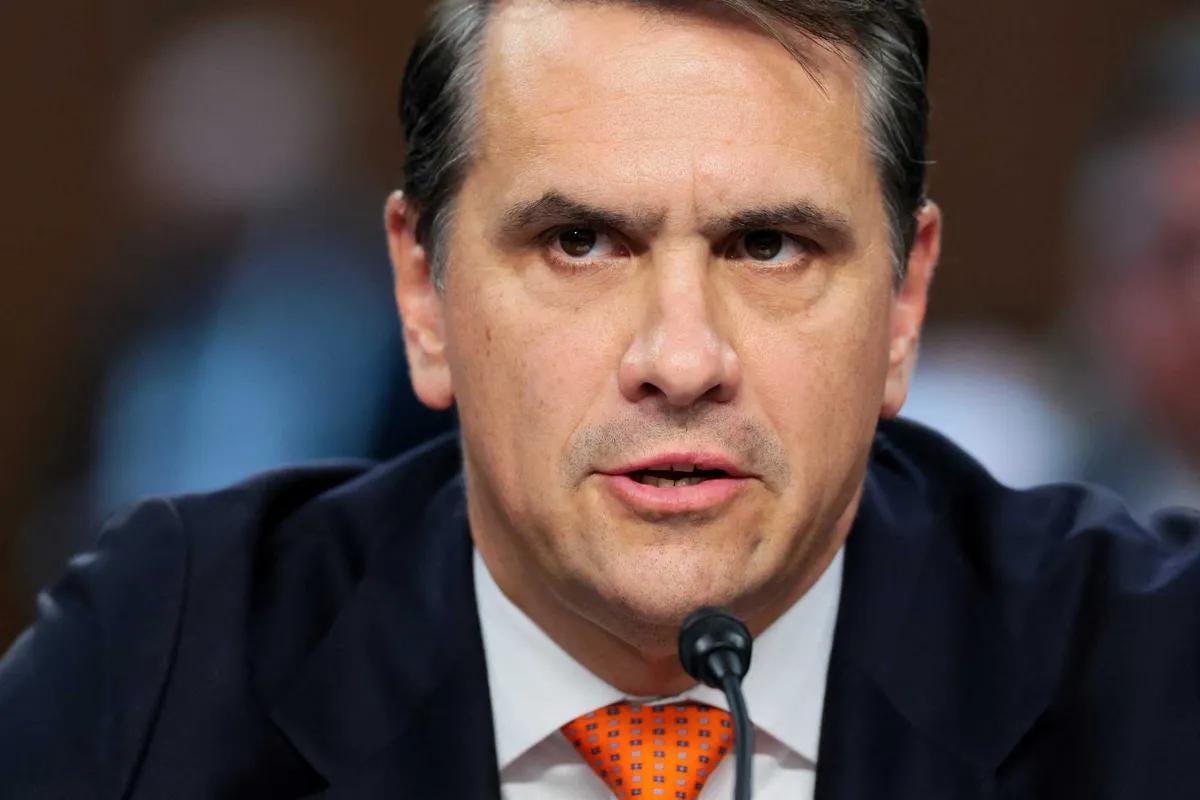
Acting U.S. Attorney General Todd Blanche testifies before a Senate Judiciary Committee confirmation hearing on his nomination to be attorney general, on Capitol Hill in Washington, D.C., U.S., July 15, 2026. REUTERS/Jonathan Ernst The Mortgage Police Turn Their Lens Inward A Regulator With a Political Target List The Wall Street Journal reports that Federal Housing Finance Agency Director Bill Pulte scrutinized mortgage records tied not only to Donald Trump’s political adversaries, but also to Todd Blanche, then the Justice Department’s second-ranking official. The reported review occurred amid a dispute over how aggressively the department should pursue Pulte’s referrals concerning Senator Adam Schiff, New York Attorney General Letitia James, and Federal Reserve Governor Lisa Cook. Pulte, through his lawyer, denies examining Blanche’s files; FHFA and Justice Department spokespeople reject the report’s suggestion of conflict. The Power Was Pulte’s to Deploy This was not ordinary opposition research, according to the Journal’s account. Pulte cited his FHFA authority when referring the three Trump adversaries to prosecutors. That matters because institutional access changes the political meaning of a records search: a federal regulator can turn information gathered under public authority into pressure backed by the machinery of government. Help fuel the work. Independent analysis doesn’t fund itself:☕ Buy us a coffee Officials cited by the Journal believed Pulte was seeking information that could undermine Blanche and accelerate the investigations. That is their allegation, not an established fact. But the alleged mechanism is clear: scrutinize the official resisting your preferred timetable, then gain leverage over the institution responsible for prosecution. Blanche Was Powerful—and Still a Target Blanche was hardly a powerless bureaucrat. As the Justice Department’s No. 2 official, he occupied one of the most consequential law-enforcement positions in the federal government. Yet the reported episode shows how factional power can operate inside an administration: formal authority does not necessarily protect an official from a loyalist trying to make the department move faster. Blanche and his aides later reviewed his mortgage records and found nothing improper, according to the Journal. A department spokeswoman said he had one mortgage and had cosigned a loan on his son’s home. Those mundane facts sharpen the point. Even an apparently unproductive search can exert pressure when the person conducting it controls regulatory access and is pushing politically charged cases. “Drive a Wedge” Dodges the Substance The official rebuttal—that the reporting was intended to “drive a wedge” between Pulte and Blanche—attacks the presumed effect of the story instead of resolving its central factual dispute. Pulte’s lawyer offered the more relevant denial, calling the claim that Pulte examined or reviewed Blanche’s mortgage files false. Those responses should not be collapsed into proof of wrongdoing or proof of innocence. But “wedge” rhetoric is institutional misdirection: it recasts scrutiny of government conduct as an attack on personal unity. The issue is not whether two officials get along. It is whether regulatory authority was used to search for leverage during a disagreement over investigations of the president’s adversaries. Loyalty as Administrative Currency The Journal describes White House officials who regard Pulte as a brash operator exceeding his lane in efforts to please Trump, sometimes with politically damaging results. It also reports that Trump values Pulte’s loyalty and resisted pressure to remove him. That account identifies the governing incentive. Pulte’s reported behavior may be disputed, but the protection structure is not subtle: loyalty to the president is presented as a reason to preserve an official whom others reportedly consider reckless. Expertise, restraint, and institutional boundaries become secondary when proximity to presidential favor is the more valuable credential. The System Rewards the Boundary-Pusher The larger pattern is the conversion of public authority into personalized political service. Agencies retain their formal mandates, prosecutors retain their titles, and officials issue procedural denials. Meanwhile, the operative question becomes who can use an office most aggressively on behalf of the president’s interests—and who can pressure colleagues when they hesitate. The Journal’s reporting does not establish that Pulte searched Blanche’s records to coerce him. It does establish a serious, specifically attributed allegation arising from a conflict over referrals targeting Trump’s opponents, alongside reported presidential protection rooted in loyalty. That combination reveals the systemic error: institutional guardrails are weakest when crossing them is rewarded from above. Thanks to Raw Story Source: Trump’s intel pick targeted Todd Blanche with mortgage-fraud microscope: report Systemic Error is a reader-supported publication. To receive new posts and support my work, consider becoming a free or paid subscriber. We warned them.We told them.We shouted from the rooftops.We plead.We begged.They didn’t listen.Now, we all will suffer.Y’all know what to do, right?VOTE BLUE! 💙Vote as if your life — nay, our country — depend on it.Because, this time, and every time, it does. This is a public episode. If you would like to discuss this with other subscribers or get access to bonus episodes, visit paulstsmith.substack.com
Embed this episode
No transcript yet.