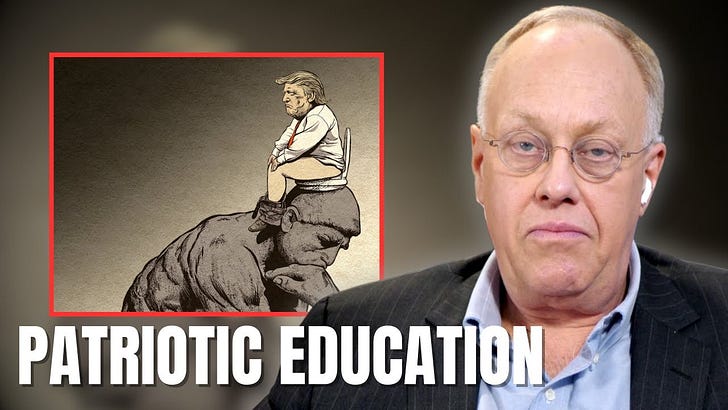
Trump's War on Education - Read by Eunice Wong
from The Chris Hedges Report Podcast Hosted by Chris Hedges and Eunice Wong
This article is read by Eunice Wong, a Juilliard-trained actor, featured on Audible's list of Best Women Narrators. Her work is on the annual Best Audiobooks lists of the New York Times, Audible, AudioFile, & Library Journal. www.eunicewong.actor Text originally published March 11, 2025 I Stink Therefore I Am - by Mr. Fish The attacks on colleges and universities — Donald Trump’s administration has warned some 60 colleges that they could lose federal money if they fail to make campuses safe for Jewish students and is already pulling $400 million from Columbia University — has nothing to do with fighting antisemitism. Antisemitism is a smoke screen, a cover for a much broader and more insidious agenda. The goal, which includes plans to abolish the Department of Education and terminate all programs of diversity, equity and inclusion (DEI), is to turn the educational system, from kindergarten to graduate school, into an indoctrination machine. Totalitarian regimes seek absolute control over the institutions that reproduce ideas, especially the media and education. Narratives that challenge the myths used to legitimize absolute power — in our case historical facts that blemish the sanctity of white male supremacy, capitalism and Christian fundamentalism — are erased. There is to be no shared reality. There are to be no other legitimate perspectives. History is to be static. It is not to be open to reinterpretation or investigation. It is to be calcified into myth to buttress a ruling ideology and the reigning political and social hierarchy. Any other paradigm of power and social interaction is tantamount to treason. “One of the most significant threats that a class hierarchy can face is a universally accessible and excellent public school system,” writes Jason Stanley in “Erasing History: How Fascists Rewrite the Past to Control the Future:” The political philosophy that feels this threat most acutely — and that unites hostility toward public education with support for class hierarchy — is a certain form of rightwing libertarianism, an ideology that sees free markets as the wellspring of human freedom. These kinds of libertarians oppose government regulation and virtually all forms of public goods, including public education. The political goal of this version of libertarian ideology is to dismantle public goods. The dismantling of public education is backed by oligarchs and business elites alike, who see in democracy a threat to their power, and in the taxes required for public goods a threat to their wealth. Public schools are the foundational democratic public good. It is therefore perfectly logical that those who are opposed to democracy, including fascist and fascist-leaning movements, would join forces with right-wing libertarians in undermining the institution of public education. I taught Howard Zinn’s “A People’s History of the United States” in a New Jersey prison classroom. Zinn’s book is one of the primary targets of the far-right. Trump denounced Zinn in 2020 at the White House Conference on American History, saying, “Our children are instructed from propaganda tracts, like those of Howard Zinn, that try to make students ashamed of their own history.” Zinn implodes the lies used to glorify the conquest of the Americas. He allows readers to see the United States through the eyes of Native Americans, immigrants, the enslaved, women, union leaders, persecuted socialists, anarchists and communists, abolitionists, anti-war activists, civil rights leaders and the poor. He holds up the testimonies of Sojourner Truth, Chief Joseph, Henry David Thoreau, Frederick Douglass, W.E.B. Du Bois, Randolph Bourne, Malcolm X and Martin Luther King Jr. As I gave my lectures I would hear students mutter “Damn” or “We been lied to.” Zinn makes clear that organized militant forces opened up democratic space in American society. None of these democratic rights — the abolition of slavery, the right to strike, equality for women, Social Security, the eight-hour work day, civil rights — were given to us by a benevolent ruling class. It involved struggle and self-sacrifice. Zinn, in short, explains how democracy works. Zinn’s book was revered in my cramped prison classroom. It was revered because my students intimately understood how white privilege, racism, capitalism, poverty, police, the courts, and lies peddled by the powerful, deformed their communities and their lives. Zinn allowed them to hear, for the first time, the voices of their ancestors. He wrote history, not myth. He not only educated my students, but empowered them. I had always admired Zinn. After that class I too revered him. Zinn, when he was teaching at Spelman College, a historically Black women’s college in Atlanta, became involved in the civil rights movement. He served on the Student Nonviolent Coordinating Committee. He marched with his students demanding civil rights. Spelman’s president was not amused. “I was fired for insubordination,” Zinn recalled. “Which happened to be true.” Education is meant to be subversive. It gives students the ability and the language to ask questions about reigning assumptions and ideas. It questions dogma and ideology. It can, as Zinn writes, “counteract the deception that makes the government’s force legitimate.” It lifts up the voices of the marginalized and oppressed to honor a plurality of perspectives and experiences. This leads, when education works, to empathy and understanding, a desire to right historical wrongs, to make society better. It fosters the common good. Education is not only about knowledge, it is about inspiration. It is about passion. It is about the belief that what we do in life matters. It is about, as James Baldwin writes in his essay “The Creative Process,” the ability to drive “to the heart of every answer and expose the question the answer hides.” The rightwing attacks on programs such as critical race theory or DEI, as Stanley points out in his book, “intentionally distort these programs to create the impression that those whose perspectives are finally included — like Black Americans, for instance — are receiving some sort of illicit benefit or unfair advantage. And so they target Black Americans who have risen to positions of power and influence and seek to delegitimize them as undeserving. The ultimate goal is to justify a takeover of the institutions, transforming them into weapons in the war against the very idea of multi-racial democracy.” The integrity and quality of public higher education in America has been under assault for decades, as Ellen Schrecker documents in her book “The Lost Promise: American Universities in the 1960s.” The protests on college campuses in the 1960s, Schrecker points out, saw “the enemies of the liberal academy” attack its “ideological and financial underpinnings.” Tuitions, once low, if not free, have soared, and with them tremendous student debt. State legislators and the federal government have slashed funding to public universities, forcing them to seek support from corporations and reduce most faculty to the status of poorly paid adjuncts, often lacking benefits, as well as job security. Nearly 75 percent of the instruction at colleges and universities is in the hands of adjuncts, part-time lecturers, and non-tenure-track full-time faculty, who have no hope of being granted tenure, according to the American Federation of Teachers. Public institutions, which serve 80 percent of the nation’s students, are chronically short of funding and basic resources. Higher education has evolved, even at major research universities, into vocational training, no longer a vehicle for learning but economic mobility. The assault sees elite schools, where tuition can run over $80,000 a year, cater to the wealthy and the privileged, locking out the poor and the working class. “The current academy functions primarily to replicate an increasingly inequitable status quo, it is hard to imagine how it could be restructured to serve a mo… This is a public episode. If you'd like to discuss this with other subscribers or get access to bonus episodes, visit chrishedges.substack.com/subscribe
Embed this episode
No transcript yet.