
EPISODE · Feb 15, 2026 · 1 MIN
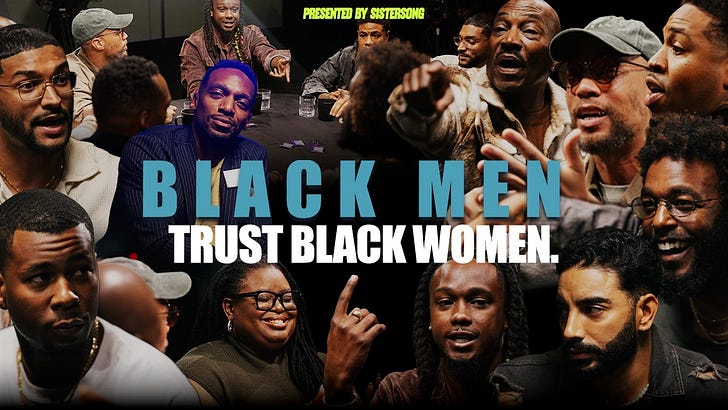
Trusting Black Women Is a Political Position, Not a Personality Test
from Education is Elevation · host The Conscious Lee
Trust Black Women Is Not a NegotiationThere is still something many people believe they need from Black women before offering trust.There is still a condition.There is still a test.There is still a negotiation.That truth sat heavy on me after a recent interaction. I was wearing a “Trust Black Women” shirt, standing in Houston, minding my business, when a man tried to play me. The question came fast, predictable, rehearsed:“What about the Black women that lie?”That reflex reveals everything.A proposal followed. I asked him to consider a parallel. Imagine someone says, “Trust Black people,” and the immediate response is, “What about the ones that lie?” Most Black folks instantly recognize the issue. That move takes the worst example of a group and uses it to justify withholding baseline trust from the whole. That move is recognizable as racism when applied to Black people collectively.That same move becomes acceptable, even normalized, when applied to Black women.The symmetry is not accidental. The logic is identical.The ideology is familiar.The harm is structural.Trusting women through the lens of their worst example mirrors how white supremacy teaches people to view Blackness itself. White supremacist thinking isolates the most stigmatized instance of a group and elevates it as representative truth. Suspicion then becomes rationalized as prudence. Bias then becomes framed as realism. Dehumanization then becomes reframed as discernment.That pattern shows up again when people encounter the phrase “Trust Black Women.” Instead of hearing a political directive about correcting historic disbelief, some hear a personal claim about moral perfection. The slogan becomes interpreted as “Black women never lie,” which is not the claim being made.Trust Black women is about starting position, not statistical denial of human fallibility.Every social group contains people who lie. Every demographic contains people who cause harm. No serious political movement depends on the premise that any category of human beings is incapable of wrongdoing. The existence of wrongdoing has never disqualified any other group from receiving baseline credibility. No one responds to “believe victims” by asking whether some victims lie, then concludes disbelief should be the default. No one responds to “trust doctors” by citing medical malpractice as proof physicians should be presumed dishonest. No one responds to “trust voters” by highlighting voter fraud cases as reason to treat all ballots as suspect.Selective skepticism is never random.Research Over Mesearch is a reader-supported publication. To receive new posts and support my work, consider becoming a free or paid subscriber.Black women sit at the intersection of misogyny and anti-Blackness, which creates a long archive of disbelief attached to their testimony. Enslaved Black women were legally unrapeable. Black women reporting sexual violence were historically ignored or punished. Medical abuse against Black women relied on assumptions they exaggerated pain. Welfare discourse painted Black mothers as deceitful. Criminal legal narratives portrayed Black women as manipulative or inherently suspect. Media tropes cast them as angry, dramatic, or untrustworthy.“Trust Black Women” responds to that history.The slogan does not erase complexity. The slogan corrects imbalance. The slogan addresses power. The slogan identifies where disbelief has been structurally concentrated and says: start from credibility instead of suspicion.Opposition to that principle often arrives disguised as neutrality. People claim they are simply acknowledging reality: some people lie. That statement is true and irrelevant. The issue is not whether any individual can lie. The issue is why Black women uniquely face collective doubt as a starting condition.When someone hears “Trust Black Women” and immediately reaches for “what about the ones who lie,” they reveal an assumption hierarchy. Trust is seen as something Black women must earn against a backdrop of presumed doubt. Other groups receive trust until disproven. Black women often face doubt until proven.That difference is political.The Houston interaction was not unusual. Variations of the same exchange occur daily across digital spaces, workplaces, movements, and relationships. The rhetorical structure remains constant: identify a negative example, universalize it to the group, use it to justify withholding solidarity.White supremacist discourse does this to Black people broadly. Patriarchal discourse does this to women broadly. Misogynoir does this specifically to Black women.The slogan therefore operates as a counter-narrative. Trust Black Women interrupts the reflex that seeks a disqualifying anecdote. Trust Black Women refuses the framing that treats Black women’s credibility as contingent. Trust Black Women asserts that historic disbelief requires intentional reversal.Many people resist because the phrase removes evaluative authority. If Black women are trusted as narrators of their own experience, outside observers lose the power to adjudicate whose suffering is legitimate. Discomfort then gets reframed as skepticism. Skepticism then gets reframed as objectivity.Language reveals ideology. The question “what about the ones who lie” functions less as inquiry and more as permission structure. It authorizes doubt toward a marginalized group by citing the inevitability of imperfection that exists in every group. It maintains asymmetry while appearing neutral.Trust Black Women asks for symmetry.If one recognizes the injustice of distrusting Black people because some individuals commit harm, the same reasoning must apply to Black women. Any attempt to separate those logics collapses under scrutiny. The frameworks are structurally identical. The historical harms are interlocking. The ideological roots are shared.The shirt did not create the tension. The shirt exposed it.The slogan did not invent distrust. The slogan named it.The exchange did not surprise me. The exchange confirmed the work remains unfinished.Trust Black Women is not about sainthood.Trust Black Women is about starting point.Trust Black Women is about power.Trust Black Women is about history.Trust Black Women is about refusing white supremacist and patriarchal reasoning when it appears in everyday conversation disguised as common sense.The question people should ask themselves is simpler than the reflex they keep reaching for: why does the possibility that some Black women lie feel like relevant counter-evidence to trusting Black women at all?The answer reveals more about the listener than the slogan ever could.Related Readings* Moya Bailey — Misogynoir Transformed: Black Women’s Digital Resistance* Patricia Hill Collins — Black Feminist Thought* Saidiya Hartman — Scenes of Subjection* Dorothy Roberts — Killing the Black Body* bell hooks — Ain’t I a Woman: Black Women and Feminism* Kimberlé Crenshaw — Mapping the Margins (intersectionality)* Jennifer L. Morgan — Laboring Women* Dána-Ain Davis — Reproductive Injustice This is a public episode. If you'd like to discuss this with other subscribers or get access to bonus episodes, visit theconsciouslee.substack.com/subscribe
Embed this episode
NOW PLAYING
Trusting Black Women Is a Political Position, Not a Personality Test
No transcript for this episode yet
Similar Episodes
No similar episodes found.
Similar Podcasts
No similar podcasts found.