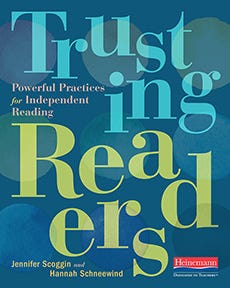
Trusting Readers: A Conversation with Hannah Schneewind
from Read by Example Hosted by Matt Renwick
“What is the goal of independent reading, and why does this goal so often get lost in instruction?” We asked this and other questions of Hannah Schneewind. She is the author along with Jennifer Scoggin of Trusting Readers: Powerful Practices for Independent Reading (Heinemann, 2021). We explored how to best use our limited classroom time, as well as how leaders can support this critical element of the literacy block. You can purchase Hannah’s book here. For a full transcript of this conversation, see below or click here. Full subscribers also have access to the video recording of this conversation, as well as the professional discussion guide for this conversation. Read by Example is a reader-supported publication. Thank you to our full subscribers for making transcripts and other benefits available to everyone. Full Transcript Matt Renwick (00:03): Welcome to Read by Example, where teachers are leaders and leaders know literacy. That tagline is from Regie Routman's book, Read, Write, Lead, and I find that line especially appropriate for our conversation today. Our special guest is Hannah Schneewind, and she is the co-author, along with Jennifer Scoggin, of Trusting Readers: Powerful Practices for Independent Reading through Heinemann. Reading the bio in the back of the book, which is right here: Hannah Schneewind has been a teacher, staff developer, curriculum writer, keynote speaker, and national literacy consultant. Hannah's interest in student and teacher agency, and her belief in the power of books informs her work with schools. Together, Jen and Hannah are the co-creators of Trusting Readers, a group dedicated to collaborating with teachers to design literacy opportunities that invite all students to be engaged and thrive as readers and writers. Welcome, Hannah. Hannah Schneewind (01:07): Great. Thank you so much for having me. And I know that Jen is sorry that she's not here. She's traveling at the moment, so you'll have just me, I'm afraid. Matt Renwick (01:17): We are delighted to have you. And we have another guest with us, Mary Beth Nicholas, a Wisconsinite now living in Minnesota, working at an alternative school secondary level. She had been working with intervention students at the secondary level and brings a neat perspective as well to trusting readers, especially after that elementary experience. So, with that I have three questions I was going to pose to Hannah, but take the direction wherever you want it to go. And again, our intentions for this conversation are just to build knowledge and awareness around this topic, and to practice coaching skills while engaging in conversation around professional topics. So, really trying to serve as a model for any leader of any position, how you might, co-create knowledge together instead of living in sometimes these echo chambers we see in education. My first question is for Hannah: what is the goal of independent reading and why does this goal so often get lost in instruction? Hannah Schneewind (02:26): So the first thing I would say is that the goal of independent reading is for students to become really skilled and proficient readers. And being proficient includes being skillful with decoding, fluency, and comprehension. So the reason I think it's really important to start with that is that too often independent reading is seen as this kind of fluffy thing, or it's an add-on, or it's a thing that you do for 10 minutes at the end of the day if you have time. And so I just want to start by saying, no, this is a serious teaching and learning time. So I would say that's the big goal. And then within that goal, of course, we have lots of other things, right? We want kids to find joy in reading. We want them to have books that they connect with. We want them to find books where they can make meaning and then really are motivated to take some kind of action after they're reading. (03:28): I'll tell you though, I won't say that the goal of independent reading is to make students love reading, because I think when we say that, number one, we do ourselves a disservice as professionals because that seems kind of fluffy. And number two, I actually can't do that. That is to say, I can set up the condition, you know, I can give you lots of choice and I can give you the right feedback at the right time, and I can give you lots of time to read. I can set up the conditions for you to love reading, but I can't actually make you love reading. So I think, that's something I have thought a lot about. So I no longer say, the goal is for all them to love reading. They might or they might not. So, then in terms of why does it get lost? (04:16): I think it gets lost for a few reasons. I think it gets lost, number one, when it is not in fact the focus of reading instruction. When it becomes something to do at the end of the day or it sometimes gets lost because the teacher is trying to also work with small groups, let's say, and independent reading is something that the students can in fact do independently that she knows it's going to be really impactful. And so she ends up doing small group instruction during that time and does not confer with kids. And independent reading without conferring is not actually independent reading, such as giving kids books and letting them read. So I think those are two very different things. Matt Renwick (05:03): That's very helpful for me. Especially the comment about you cannot make kids love reading. It almost seems kind of refreshing that I can kind of take that part off of my responsibility, and not that I'm not responsible for the conditions, but puts more of the onus on that part of a reading right on the kids. And I think kids would rise to that trust, which comes back to your book title, Trusting Readers. Hannah Schneewind (05:38): Yeah, absolutely. I mean, for example, in high school, I became skillful at biology, right? I had a very good teacher. I did all my homework. I never loved biology. I did not decide to become a scientist. You know, so much as we hope that kids will love reading, I do think that we can separate, being skilled at reading from necessarily the love of it. With one important caveat, which is, and Mary Beth, maybe you've seen this with older students, I have talked to older readers who are very proficient readers and actively hate reading. You know, there are kids who think reading is boring, I have to do it, my teacher makes me write a certain number of post-its, or I have to write in this reading log. So when I say we can't make kids love it, that's true. However, , we don't want to be setting them up to hate it either, which sometimes people inadvertently do. Matt Renwick (06:46): Well, that comes into the next question I had. You noted on page one, Hannah, that the number one obstacle for teachers trying to increase independent reading time to be able to confer with students to support them in being independent is the demands of the literacy curriculum. But then at the same time, you do share ways to prioritize independent reading that can exist alongside a curriculum resource. So, I guess the connection here is I've heard teachers say, I just don't have time to meet with all my kids, you know? And because of the resource, because of this, or because I can't meet with small groups, there's just too many things to do. What have you found that teachers have done to make better use of their time to increase independent reading? Because I do think there are opportunities that teachers don't always see, to be able to support kids at that level of independence. Hannah Schneewind (07:50): Absolutely. So I think there are two different scenarios. So I think one scenario is that I have a program that I have to follow and I'm not sure how to follow this program and still make time for independent reading. And then there's a second scenario, which is I have independent reading up and going, I have devoted time for it. My administrator's completely behind it. I have the … This is a public episode. If you'd like to discuss this with other subscribers or get access to bonus episodes, visit readbyexample.substack.com/subscribe
Embed this episode
No transcript yet.