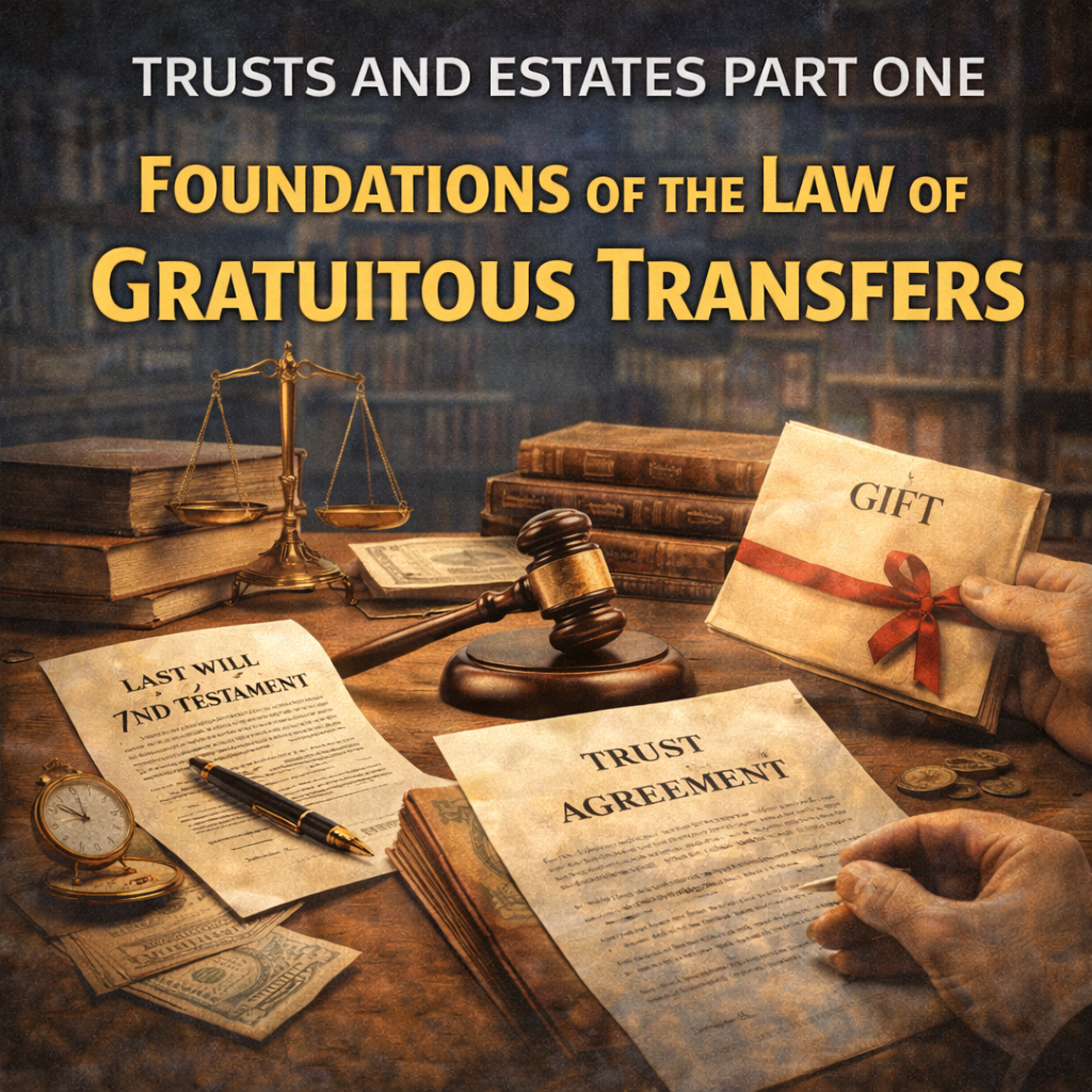
Trusts and Estates Part One: Foundations of the Law of Gratuitous Transfers episode artwork

EPISODE · Mar 2, 2026 · 44 MIN

Trusts and Estates Part One: Foundations of the Law of Gratuitous Transfers

from Law School · host The Law School of America

This episode offers a comprehensive deep dive into the foundational principles of property transmission, focusing on the law of gratuitous transfers, including trusts, estates, and the legal doctrines that govern inheritance and gift law. Perfect for law students and legal practitioners preparing for exams or practicing estate planning.Most people think estate planning is just about writing a will, but beneath the surface lies a complex legal battle between personal freedom and societal safeguards. In this episode, we dissect the core legal conflict: how the law balances your right to control your property with the need to prevent fraud, undue influence, and dead hand control. You’ll uncover how American law uniquely prioritizes donor autonomy—allowing you to disinherit family, leave assets to pets, or give to fringe causes—unless public policy steps in to impose limits.We explore the intricate frameworks that govern property transfers—probate versus non-probate—and why understanding these pathways is crucial. Discover how donative intent must be clear and objective, matching the transfer’s timing: immediate for lifetime gifts, and at death for wills. You’ll learn about the rigorous formalities required for valid wills—signatures, witnesses, and the evidentiary purpose they serve—versus the flexible world of trust agreements and contract-style transfers, like life insurance, POD accounts, and revocable trusts, which bypass probate and streamline estate management.The episode also delves into the infamous "dead hand" control—how a testator’s stipulations can influence heirs decades after their death. Case studies like Shapira reveal the fine line courts walk in allowing partial restraints on marriage to promote social policy without outright banning personal autonomy. We detail how incentive trusts—conditional gifts for education or behavior—are generally valid, but conditions that encourage illegal acts or family disintegration cross the line into voidness.Finally, we tackle exam pitfalls—common errors like conflating rules applicable to wills and gifts, neglecting the objective proof standard for intent, or overestimating fairness arguments—which can cost you points. Learn how to analyze legal issues step-by-step: identify transfer type, apply the relevant doctrine, and support your reasoning with policy insights. This episode arms you with the conceptual map to navigate the tangled maze of estate law confidently, transforming a confusing jumble into clear, exam-ready mastery.Whether you're preparing for the bar or just want to understand how the law manages death, inheritance, and legacy, this episode is essential listening. It’s not just about rules—it's about the profound questions of control, family, and society’s role in shaping our final wishes.Key TopicsThe core principles of property transmission and inheritance lawThe balance between personal autonomy and public policy in estate lawThe legal requirements for valid gifts and willsThe distinction between probate and non-probate transfersThe role of donative intent and formalities in estate planningtrusts, estates, inheritance law, gratuitous transfers, donative intent, probate, non-probate, formalities, dead hand control, estate planning

This episode offers a comprehensive deep dive into the foundational principles of property transmission, focusing on the law of gratuitous transfers, including trusts, estates, and the legal doctrines that govern inheritance and gift law. Perfect for law students and legal practitioners preparing for exams or practicing estate planning.Most people think estate planning is just about writing a will, but beneath the surface lies a complex legal battle between personal freedom and societal safeguards. In this episode, we dissect the core legal conflict: how the law balances your right to control your property with the need to prevent fraud, undue influence, and dead hand control. You’ll uncover how American law uniquely prioritizes donor autonomy—allowing you to disinherit family, leave assets to pets, or give to fringe causes—unless public policy steps in to impose limits.We explore the intricate frameworks that govern property transfers—probate versus non-probate—and why understanding these pathways is crucial. Discover how donative intent must be clear and objective, matching the transfer’s timing: immediate for lifetime gifts, and at death for wills. You’ll learn about the rigorous formalities required for valid wills—signatures, witnesses, and the evidentiary purpose they serve—versus the flexible world of trust agreements and contract-style transfers, like life insurance, POD accounts, and revocable trusts, which bypass probate and streamline estate management.The episode also delves into the infamous "dead hand" control—how a testator’s stipulations can influence heirs decades after their death. Case studies like Shapira reveal the fine line courts walk in allowing partial restraints on marriage to promote social policy without outright banning personal autonomy. We detail how incentive trusts—conditional gifts for education or behavior—are generally valid, but conditions that encourage illegal acts or family disintegration cross the line into voidness.Finally, we tackle exam pitfalls—common errors like conflating rules applicable to wills and gifts, neglecting the objective proof standard for intent, or overestimating fairness arguments—which can cost you points. Learn how to analyze legal issues step-by-step: identify transfer type, apply the relevant doctrine, and support your reasoning with policy insights. This episode arms you with the conceptual map to navigate the tangled maze of estate law confidently, transforming a confusing jumble into clear, exam-ready mastery.Whether you're preparing for the bar or just want to understand how the law manages death, inheritance, and legacy, this episode is essential listening. It’s not just about rules—it's about the profound questions of control, family, and society’s role in shaping our final wishes.Key TopicsThe core principles of property transmission and inheritance lawThe balance between personal autonomy and public policy in estate lawThe legal requirements for valid gifts and willsThe distinction between probate and non-probate transfersThe role of donative intent and formalities in estate planningtrusts, estates, inheritance law, gratuitous transfers, donative intent, probate, non-probate, formalities, dead hand control, estate planning

NOW PLAYING

Trusts and Estates Part One: Foundations of the Law of Gratuitous Transfers

0:00 44:15

No transcript for this episode yet

We transcribe on demand. Request one and we'll notify you when it's ready — usually under 10 minutes.

The Small Business Startup School – Business Notes | Financial Literacy | Retail Psychology – For Professionals & Entrepreneurs The Small Business Startup School Inc. Starting or buying a small business? While personal circumstances may vary, business patterns remain timeless. On The Small Business Startup School, we explore strategies, insights, and practical solutions to help entrepreneurs confidently navigate their journey.Hosted by Ola Williams—a retail entrepreneur, fintech founder, and financial coach with over two decades of experience—this podcast marries financial awareness and retail psychology with optimism to deliver actionable takeaways.Join us to learn, grow, and connect as we uncover the keys to business success.Let’s continue to learn together and be encouraged to keep on connecting! The 48 Laws of Power by Robert Greene (Full Audiobook) Robert Greene Amoral, cunning, ruthless, and instructive, this multi-million-copy New York Times bestseller is the definitive manual for anyone interested in gaining, observing, or defending against ultimate control – from the author of The Laws of Human Nature.In the book that People magazine proclaimed “beguiling” and “fascinating,” Robert Greene and Joost Elffers have distilled three thousand years of the history of power into 48 essential laws by drawing from the philosophies of Machiavelli, Sun Tzu, and Carl Von Clausewitz and also from the lives of figures ranging from Henry Kissinger to P.T. Barnum.Some laws teach the need for prudence (“Law 1: Never Outshine the Master”), others teach the value of confidence (“Law 28: Enter Action with Boldness”), and many recommend absolute self-preservation (“Law 15: Crush Your Enemy Totally”). Every law, though, has one thing in common: an interest in t Guardians Of Innocence Guardians Of Innocence Guardians of Innocence is a powerful and informative podcast designed to equip parents, teachers, and communities with the knowledge and tools needed to protect children from the growing threat of trafficking. Each episode dives deep into the tactics traffickers use to target vulnerable children—both online and in real life—and provides actionable advice on how to recognize the warning signs.Through expert interviews with cyber safety professionals, law enforcement, and survivors, we uncover the latest grooming methods, share real-world stories, and empower listeners to become vigilant guardians of innocence in their own families and communities.Guardians of Innocence is more than just a podcast; it’s a call to action to safeguard our children, raise awareness, and foster a united front against trafficking.Listen. Learn. Protect. The Laura Ingraham Show Laura Ingraham The most-watched woman in the history of cable news brings her no-holds-barred political and cultural commentary to podcasting with The Laura Ingraham Show. A bestselling author, breast cancer survivor, and mother of three internationally adopted children, Laura was the most listened-to woman in talk radio before launching her own podcast. A trailblazer across media platforms, she brings a unique perspective to this twice-weekly show, drawing on her experience as a white-collar criminal defense litigator and a Supreme Court law clerk.New episodes drop twice a week—delivering the clarity, courage, and common sense America needs.

Frequently Asked Questions

How long is this episode of Law School?

This episode is 44 minutes long.

When was this Law School episode published?

This episode was published on March 2, 2026.

What is this episode about?

This episode offers a comprehensive deep dive into the foundational principles of property transmission, focusing on the law of gratuitous transfers, including trusts, estates, and the legal doctrines that govern inheritance and gift law. Perfect...

Can I download this Law School episode?

Yes, you can download this episode by clicking the download button on the episode player, or subscribe to the podcast in your preferred podcast app for automatic downloads.
URL copied to clipboard!