
EPISODE · Jul 18, 2026 · 1 MIN
Truthiness: Why MAGA Says Things with Total Confidence That Are Completely Made Up
from The Lucas Bean Show · host Lucas Bean
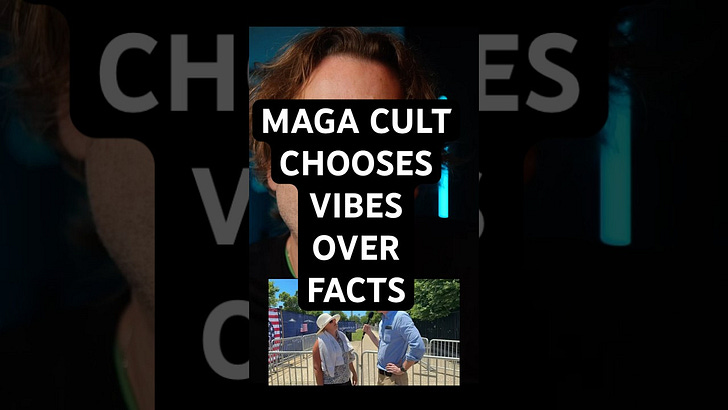
A woman looked directly into a camera and said illegals must have dumped algae into the Lincoln Memorial Reflecting Pool.She did not cite a source. She did not reference an investigation. She did not pause for one second to consider whether what she was saying was based on anything real. She just said it. With total confidence. Like she was reporting a fact she had personally verified.She had not. There is no evidence that anyone dumped algae into the reflecting pool. Environmental scientists from Tufts University, the University of North Carolina at Chapel Hill, and Wright State University all confirmed that algae blooms are a natural and expected occurrence in a shallow, still, unshaded pool fed by nutrient-rich water that had been painted dark blue. The pool has been prone to algae since it was built in 1922. The National Park Service’s own internal documents confirmed the algae was caused by residual algae left in supply lines that sat dormant during eight weeks of construction.But none of that mattered to this woman. It felt true. And feeling true was enough.If you watched the video, you already know what psychologist Eryn Newman calls this. Truthiness. This Substack goes deeper into the research, the reflecting pool disaster, and why this one cognitive bias explains how the entire MAGA information ecosystem works.What Is Truthiness?The word was coined by comedian Stephen Colbert on the very first episode of The Colbert Report on October 17, 2005. Colbert defined truthiness as “truth that comes from the gut, not books.” He was satirizing the George W. Bush administration’s tendency to make claims based on feeling rather than evidence. The American Dialect Society named it the Word of the Year for 2005. Merriam-Webster followed in 2006.But Colbert was a comedian. He was making a joke. Psychologist Eryn Newman turned it into science.Newman completed her PhD at Victoria University of Wellington in New Zealand. She is now an Associate Professor at the Australian National University. Her research focuses on distortions of memory and cognition, specifically how people come to believe things are true even when they are not.In 2012, Newman and her colleagues Maryanne Garry, Daniel Bernstein, Justin Kantner, and D. Stephen Lindsay published a landmark paper in the Psychonomic Bulletin and Review titled “Nonprobative Photographs (or Words) Inflate Truthiness.” The study examined what happens when people evaluate claims that are paired with information that looks relevant but actually proves nothing.Their finding was specific and alarming. When people saw a claim paired with a related but completely uninformative photograph, they were significantly more likely to judge the claim as true. The photograph did not contain any evidence. It did not prove the claim. It just made the claim feel more real.Newman found that truthiness operates most powerfully under conditions of uncertainty. When people are evaluating an unfamiliar claim, when they do not already know the answer, they are most vulnerable to the truthiness effect. Their brains take the feeling of familiarity or ease produced by the photograph and interpret it as evidence of truth. The claim feels true. So it must be true.This is not a minor effect. Newman’s research showed that truthiness persists over time. A follow-up study with Kathy Pezdek published in Acta Psychologica in 2013 found that the truthiness boost from photographs did not fade. People who were influenced by nonprobative photos continued to believe the false claims days later.Newman described truthiness as “using feelings and pseudo-evidence to decide what is real, instead of drawing on facts.” That is the single most accurate description of how MAGA supporters process information.The Reflecting Pool: A Case Study in TruthinessThe Lincoln Memorial Reflecting Pool is a perfect case study in how truthiness operates in the real world.In early 2026, Trump ordered the reflecting pool renovated and painted “American Flag Blue.” The project was rushed. A no-bid contract was awarded. The pool was refilled in early June 2026. Within days, algae blooms appeared. The blue paint began peeling off the bottom. The pool looked terrible.Scientists were not surprised. Steven Chapra, a water quality modeler and professor emeritus at Tufts University, explained that algae would be expected in a shallow, still, unshaded pool painted dark blue, because dark colors absorb more heat and warm water accelerates algae growth. Hans Paerl, an environmental sciences professor at the University of North Carolina at Chapel Hill, confirmed that blue-green algae, also known as cyanobacteria, was the initial bloom. Wayne Carmichael, a biological sciences professor at Wright State University, explained that the hydrogen peroxide the National Park Service used to kill the initial algae bloom actually made room for a more persistent green algae to take over.Interior Department officials told the Washington Examiner that the algae was caused by residual algae left in supply lines that sat dormant during eight weeks of construction. This was the government’s own explanation before Trump got involved.Then Trump decided to blame vandals. He claimed someone used a “box cutter or a knife” to make a gash in the bottom of the pool. The gash was 250 feet long. Then 300 feet. Then 350 feet with multiple slashes. He claimed people had “illegally placed chemicals” in the water. He claimed “radical left vandals” had deliberately sabotaged the pool. He provided no evidence for any of it. The Washington Post sent reporters to inspect the pool for signs of vandalism and found none. Snopes, FactCheck.org, PolitiFact, and CNN all investigated and found no evidence supporting Trump’s claims.Internal government documents obtained by the New York Times showed that while National Park Service workers found two small cuts in sections of foam between the pool’s expansion joints, those were not related to the paint peeling or the algae.None of this mattered. Trump said it. His supporters felt it. And a woman looked into a camera and said illegals must have dumped the algae.She did not need evidence. She did not need a source. She did not even need Trump to have specifically said “illegals.” Her brain took the feeling that someone was to blame combined with the feeling that illegals are always to blame and produced a claim she stated as fact. That is truthiness operating in real time.Why You Cannot Fact-Check Someone Out of TruthinessNewman’s research explains something that drives fact-checkers and journalists insane: correcting false claims often does not work.The problem is structural. Truthiness does not operate through evidence. It operates through feeling. The person who believes the claim did not arrive at their belief by evaluating data, reading studies, or consulting experts. They arrived at it because it felt true. The feeling came first. The belief followed.When you present a truthiness-based believer with contradicting evidence, you are not correcting a mistake. You are threatening a feeling. The brain does not process this as new information. It processes it as an attack. The evidence is rejected not because it is weak but because accepting it would require the person to admit that their gut was wrong. And for many people, their gut is the only authority they trust.This is why the woman who blamed illegals for the algae will never change her mind. You could show her the Tufts University analysis. You could show her the NPS internal documents. You could show her the Washington Post investigation. You could show her every environmental scientist in America explaining that algae grows in shallow warm water. It will not matter. Because she did not use evidence to get to her belief. And you cannot reason someone out of a position they felt their way into.Newman’s 2015 paper with Christian Unkelbach expanded this finding. They demonstrated that truthiness and its opposite, “falsiness,” depend on judgmental context. The same claim can feel true or feel false depending on the emotional and cognitive context in which it is encountered. This means that truthiness is not just about individual gullibility. It is about the information environment. When a person is surrounded by media, social media, rallies, and communities that all reinforce the same emotional frame, every claim inside that frame feels true and every claim outside it feels false.That is the MAGA information ecosystem. It is not designed to deliver facts. It is designed to deliver feelings. And once the feeling is in place, the facts become irrelevant.The Social Media AmplifierNewman’s research on photographs and truthiness has a direct application to how misinformation spreads on social media. Her key finding was that nonprobative photographs boost the perceived truth of claims by making them easier to picture in your mind. The technical term is cognitive fluency. When information is easy to process, it feels familiar. When it feels familiar, it feels true.Social media is a truthiness machine. Every post comes with images, videos, graphics, and formatting that make claims easy to process. A meme with a bold statement over a photograph of the reflecting pool covered in green algae does not need to be accurate. It just needs to feel right. The photograph provides the cognitive fluency. The bold text provides the claim. The emotional context provides the motivation to believe.Trump himself amplified this exact dynamic during the reflecting pool saga. He posted AI-generated images on Truth Social. He shared memes from supporters. He repeated the vandalism claims at increasing intensity, each time adding new details that were never verified. Each post came with visuals. Each visual made the claim feel more real. Each repetition increased the feeling of truth.This is truthiness at industrial scale. Not one person making one gut-level claim. An entire media ecosystem engineered to produce the feeling of truth without ever delivering any.The Gut vs. The BrainNewman’s definition of truthiness is precise: using feelings and pseudo-evidence to decide what is real instead of drawing on facts.What makes this so dangerous in the current political environment is that MAGA has made the gut the ultimate authority. Evidence is elitist. Expertise is suspicious. Data is fake. But feelings are authentic. Feelings cannot be wrong. If it feels like illegals dumped algae in the reflecting pool then illegals dumped algae in the reflecting pool. If it feels like the election was stolen then the election was stolen. If it feels like Trump is a winner then Trump is a winner.The entire movement runs on the principle that truth comes from the gut, not books. Stephen Colbert said it as a joke in 2005. Eryn Newman proved it was real. And 20 years later, it is the operating system of the most powerful political movement in America.You are not dealing with people who used evidence to get to their beliefs. You are dealing with people whose gut told them something and they never questioned it once.And you cannot reason someone out of a position they felt their way into.SourcesNewman, E. J., Garry, M., Bernstein, D. M., Kantner, J., and Lindsay, D. S. (2012). “Nonprobative Photographs (or Words) Inflate Truthiness.” Psychonomic Bulletin and Review, 19, 969-974.Fenn, E., Newman, E. J., Pezdek, K., and Garry, M. (2013). “The Effect of Nonprobative Photographs on Truthiness Persists Over Time.” Acta Psychologica, 144, 207-211.Newman, E. J., Garry, M., Unkelbach, C., Bernstein, D. M., Lindsay, D. S., and Nash, R. A. (2015). “Truthiness and Falsiness of Trivia Claims Depend on Judgmental Contexts.” Journal of Experimental Psychology: Learning, Memory, and Cognition, 41, 1337-1348.Newman, E. J. and Feigenson, N. (2013). “The Truthiness of Visual Evidence.” The Jury Expert, 25, 1-6.Newman, E. J. and Zhang, L. (2020). “Truthiness: How Non-Probative Photos Shape Belief.” In The Psychology of Fake News, Routledge.Newman, E. J. (2014). “Don’t Always Trust Your Instincts: Mistaking Truthiness for Truth.” Washington Post Op-Ed, June 30, 2014.Snopes (2026). “Trump Blamed ‘Vandals’ for Reflecting Pool Damage Without Providing Evidence.” June 24, 2026.FactCheck.org (2026). “Trump’s Unsupported Claims About Reflecting Pool Vandalism.” June 2026.CNN (2026). “Fact Check: Trump’s False and Unproven Claims About the Reflecting Pool.” June 24, 2026.PBS News (2026). “Was the Reflecting Pool Vandalized? Experts Cast Doubt on Trump’s Claims.” June 2026.PolitiFact (2026). “Looking Into the Reflecting Pool: We Examined Trump’s Vandalism Claims.” June 26, 2026.Washington Examiner (2026). “Trump Says ‘Criminally Made’ Algae Purged from Reflecting Pool.” June 2026. This is a public episode. If you'd like to discuss this with other subscribers or get access to bonus episodes, visit lucasbean.substack.com/subscribe
Embed this episode
Ready to play
Truthiness: Why MAGA Says Things with Total Confidence That Are Completely Made Up
No transcript for this episode yet
Similar Episodes
No similar episodes found.
Similar Podcasts
No similar podcasts found.