
EPISODE · Jun 5, 2026 · 4 MIN
Twice as Level, Half as Steep
from The 1937 Flood Watch Podcast · host Charles Bowen
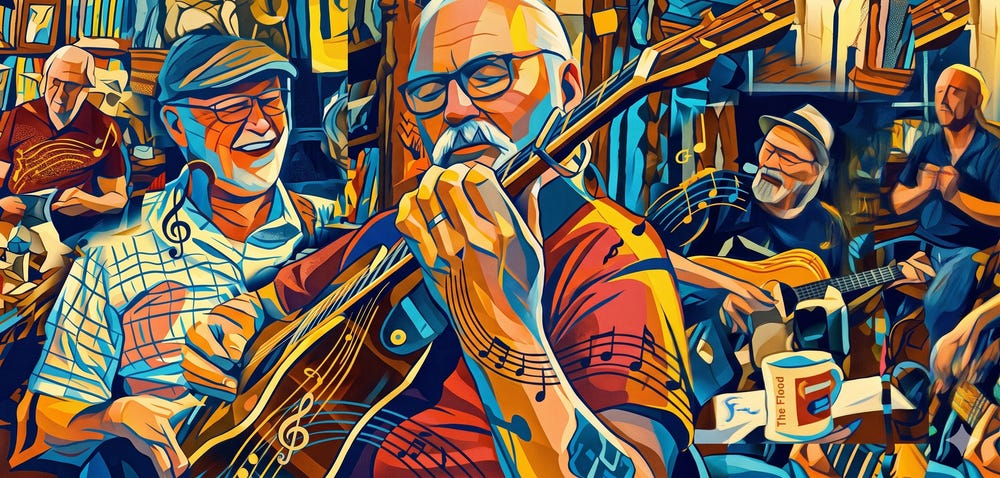
Woody Guthrie once wrote that a song is just “a conversation fixed up to where you can talk it over and over without getting tired of it.”“When you sit down with a couple of friends,” he continued, “and you’ve all got your guitars parked under a shade tree or in an old kitchen, you aren’t trying to show off. … You’re just talking. “One guy tells a story with his strings, and the next guy nods his head and matches it with a little lick of his own. It makes the world twice as level and half as steep.”That is a concept that The Flood certainly embraces. And nothing demonstrates it better than this week’s podcast, featuring the guys’ latest take on the rockin’ “Opus One.” This particular musical conversation — taken from the opening moments of last week’s rehearsal at the Bowen house — is really saying, “Damn, man, it’s good to see y’all again!”Pete’s Two-Cents’ WorthWoody’s old friend and young protégé Pete Seeger also knew a thing or two about that kind of wordless musical chat. “It’s an effortless shorthand,” he wrote in his book, Where Have All the Flowers Gone.“You look across the circle and catch an old friend’s eye just as the harmony locks into place,” he wrote, “and there’s this quiet, shared smile that says, Yes, this is exactly where we’re supposed to be. It’s the sound of community in its purest form.”Pete said it even better in one of his “Johnny Appleseed Jr.” columns in the good old Sing Out! magazine: “You realize that the song is just a vehicle for the affection in the room. It’s a way of saying ‘I’m glad you’re here’ without having to make a formal speech about it. It fills you up and stays with you long after the instruments are put back in their cases.”Jive TalkSuch wordless wordiness is even better defined in the jazz world, where improvisation is the mother tongue. Musicians might have played a tune a thousand times before, “a melody so old it felt like part of the weather,” Geoff Dyer wrote in 1991 in his seminal But Beautiful: A Book About Jazz in a passage about listening to old friends play.“But they didn’t just play it,” he recalled. “They pulled it apart like an old clock to see how it worked from the inside. … It was a language made entirely of nods, shifts in weight, a sudden drop in volume … that told everyone, let’s go down this alleyway for a second.“Listening to them,” Dyer remembered, “was like watching people walk through a dark house they’d lived in for 40 years — they knew exactly where the furniture was, so they could dance through the rooms without ever bumping into a thing, even with the lights completely out.”Brain BusinessFamed neurologist Oliver Sacks was fascinated with how music affects the mind. In an essay called “The Common Pursuit,” reflecting on lifelong bonds forged by musicians, he reached a lovely conclusion.“They do not play to impress,” Sacks wrote. “They play to inhabit a space they built together 50 years ago. To sit in a room and witness this is to realize that music is not merely an acoustic phenomenon, but a profound architecture of memory and shared love.”Meanwhile, About This Week’s Tune …As reported earlier, “Opus One,” written by Sy Oliver, became a huge late World War II-era hit for Tommy Dorsey’s orchestra. Dorsey recorded it as an instrumental on Nov. 14, 1944.The following summer, the signature vocal version was released by Anita O’Day in an all-star session. Drummer Gene Krupa led the big band and trumpeter Roy Eldridge accented O’Day’s vocals.For more on the song’s history, click here to read the earlier Flood Watch backgrounder.More from This Groove?If today’s musical conversation has you wanting more from The Flood’s jazzier selections, drop by the free Radio Floodango music streaming service and click into the “Swingin’” channel. This is a public episode. If you would like to discuss this with other subscribers or get access to bonus episodes, visit 1937flood.substack.com
Embed this episode
NOW PLAYING
Twice as Level, Half as Steep
No transcript for this episode yet
Similar Episodes
No similar episodes found.
Similar Podcasts
No similar podcasts found.