
EPISODE · Oct 24, 2024 · 12 MIN
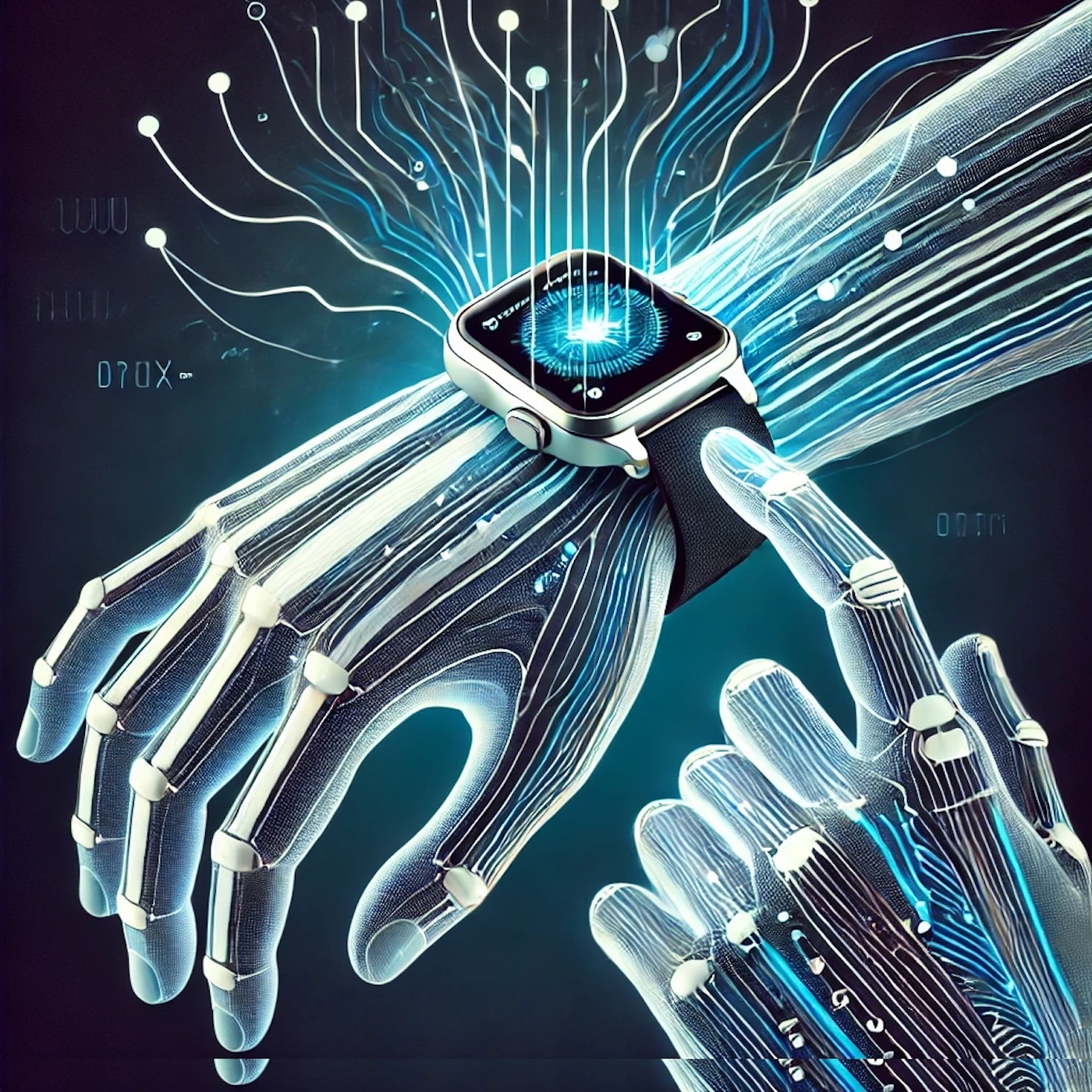
UIST 2024 Honorable Mention: Can a Smartwatch Move Your Fingers? Compact and Practical Electrical Muscle Stimulation in a Smartwatch
from HCI Deep Dives · host Kai Kunze
Akifumi Takahashi, Yudai Tanaka, Archit Tamhane, Alan Shen, Shan-Yuan Teng, and Pedro Lopes. 2024. Can a Smartwatch Move Your Fingers? Compact and Practical Electrical Muscle Stimulation in a Smartwatch. In Proceedings of the 37th Annual ACM Symposium on User Interface Software and Technology (UIST '24). Association for Computing Machinery, New York, NY, USA, Article 2, 1–15. https://doi.org/10.1145/3654777.3676373 Smartwatches gained popularity in the mainstream, making them into today’s de-facto wearables. Despite advancements in sensing, haptics on smartwatches is still restricted to tactile feedback (e.g., vibration). Most smartwatch-sized actuators cannot render strong force-feedback. Simultaneously, electrical muscle stimulation (EMS) promises compact force-feedback but, to actuate fingers requires users to wear many electrodes on their forearms. While forearm electrodes provide good accuracy, they detract EMS from being a practical force-feedback interface. To address this, we propose moving the electrodes to the wrist—conveniently packing them in the backside of a smartwatch. In our first study, we found that by cross-sectionally stimulating the wrist in 1,728 trials, we can actuate thumb extension, index extension & flexion, middle flexion, pinky flexion, and wrist flexion. Following, we engineered a compact EMS that integrates directly into a smartwatch’s wristband (with a custom stimulator, electrodes, demultiplexers, and communication). In our second study, we found that participants could calibrate our device by themselves <Formula format="inline"><TexMath><?TeX $\sim 50 \%$?></TexMath><AltText>Math 1</AltText><File name="uist24-51-inline1" type="svg"/></Formula> faster than with conventional EMS. Furthermore, all participants preferred the experience of this device, especially for its social acceptability & practicality. We believe that our approach opens new applications for smartwatch-based interactions, such as haptic assistance during everyday tasks. https://dl.acm.org/doi/10.1145/3654777.3676373
Embed this episode
NOW PLAYING
UIST 2024 Honorable Mention: Can a Smartwatch Move Your Fingers? Compact and Practical Electrical Muscle Stimulation in a Smartwatch
No transcript for this episode yet
Similar Episodes
No similar episodes found.
Similar Podcasts
No similar podcasts found.