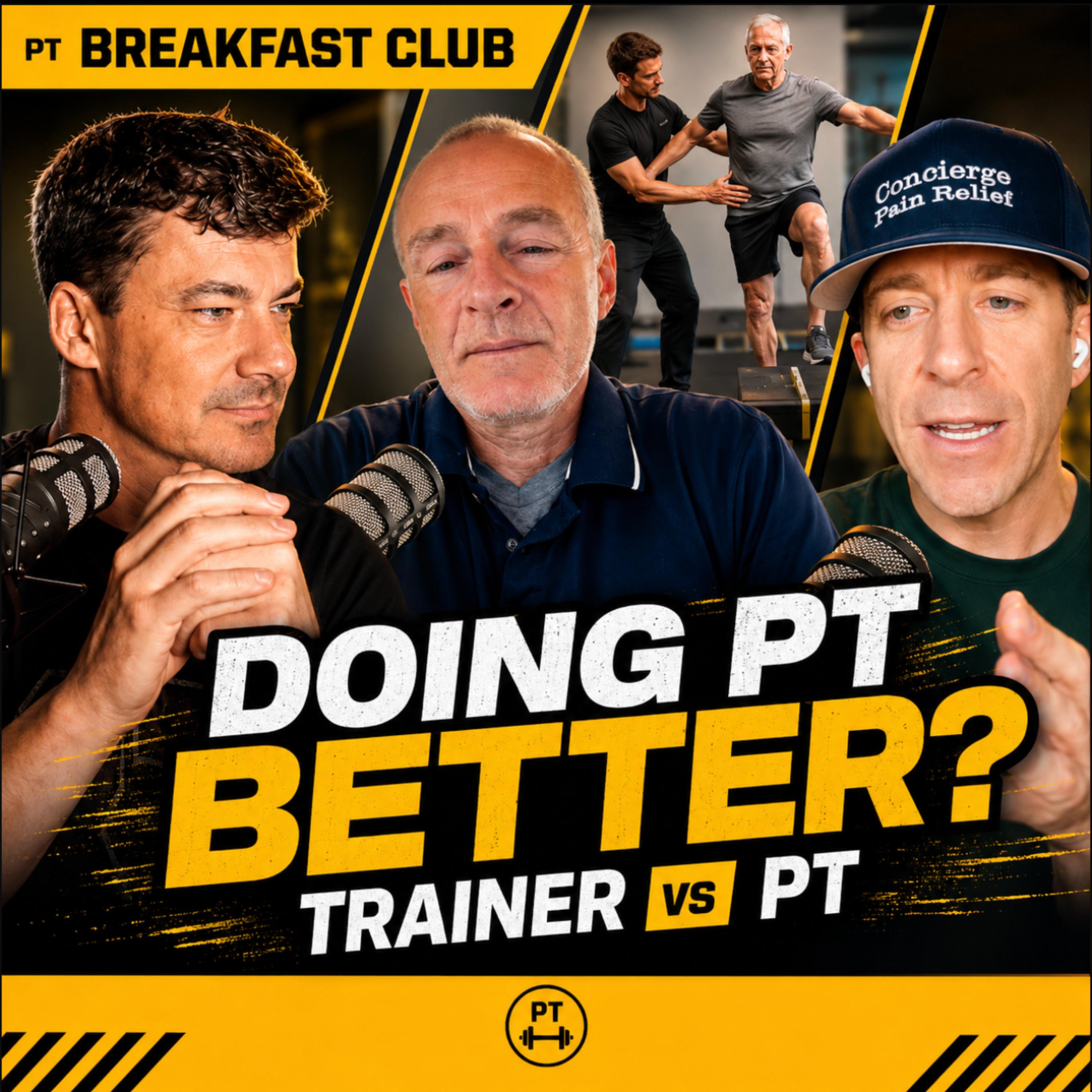
Broadcasting way too early from three separate Wi-Fi connections. It's PT Breakfast Club with Tony Maritato, Dave Kittle, and Jimmy McKay. All right. Good morning here on PT Breakfast Club. I call it the drunk mariachi band sound effect in the background. That's the music. He's Tony Maritato. I'm Jimmy McKay. Dave Kittle. He's probably coming along. He's probably trafficked. He lives in New York City. He's probably caught in traffic. We've got some interesting topics today, but I was just telling Tony before we went live.
Playing golf this weekend, which I do 2.3 times per year. It's usually in direct proportion to how many of my friends are getting married. That's like more friends getting married that year, more golf, less friends, less golf. We had talked earlier about like a business model where if you've got someone who's older and they'd still want to golf, do you hire the physical therapist to play the round of golf with them? Yeah. And I don't know if I've ever seen that was, I feel like a year ago. I don't know if I've seen anybody do that yet. Still a viable idea. And I feel like we're getting closer. I feel like a year ago was 10 years ago in terms of acceptance time for a topic like that.
So switch out golf, fishing, hiking, biking, like Dave in the park, having a catch. Switch out whatever activity you want. This all originated from Ryan Pineda, the YouTuber who was like, hey, I've never played golf. I want to start playing golf, but I want to optimize my time. People want to come consult with me. I'm going to charge, I don't remember, two, $3,000. We'll do a round of golf. I'll put together a foursome. And that kind of inspired me to think like, yeah, you know, there's so many adults.
who aren't confident, don't feel safe, are concerned about falling on the golf course. You, the physical therapist, make them go out there safely. You help keep them out of trouble. You stop the problem before it happens. And you get to play around the golf. But, you know, it could be anything, fishing and other stuff that I mentioned. You charge a premium rate for it because these individuals wouldn't be able to do it without you anyway. Yeah, and you put it maybe a small group or you do one-on-one. It doesn't matter. We talked about going to baseball games. Like, this is something that you're right. I have not seen it happen. I have not seen it gain traction. I think...
We're just too busy. We're too busy. We don't get off the hamster wheel. And because of that, we never give it a chance to grow roots. Let me, let me, let me push back on you. What would you have to charge? Because golf takes.
three, four hours. What, you know, what, and you're, so you're not working in your, how many people, I think that's where people hesitate for a half a day of not being in the clinic. Oh my God. But how many of these clients would you have to find and play a round of golf or be with them on a round of golf per month to exceed that? So how much, how would you work backwards from, cause I think this is a big hesitation. I think people are with you so far. And then I was helping someone yesterday, right? A one pager for a sponsorship, same thing. And she literally said, my finger is hovering above the enter button. And I said, I think I gave her, I'll find the actual text conversation. But I said, what do you worry about? If they say, no, you're going to have exactly the same amount of money you have now.
And if they say yes, you're going to have a whole lot more. And this person had asked three times for a one pager to be sent to them. So this is a weird relationship with money. How would you work backwards to price this? And if you're just joining, as we say good morning to Dave, if you're going to have a physical therapist follow you on the golf course, I feel like this is something concierge pain relief could have on the menu. So walk me backwards how you guys would price this.
This is where you go back to the same kind of three pricing methodologies. You either price it based on what other people are selling a similar service for, which nobody is selling the service, or you go to like Titleist or TPI guys, you know, and see what they're charging. You do it based on your cost. Well, if I would be in the clinic making, you know, 100, 150 an hour, I'm going to be out of the clinic for six to eight hours. What is the cost of that?
Or you price it based on value. What is it worth to the individual? Somebody who hasn't golfed in three or four years because they've had Parkinson's, they've been falling, they're unsafe, they're uncomfortable. Is it worth a $2,500 a day? Absolutely. And then you say, okay, well, everybody can't afford that. No, they cannot. Everybody can't afford to live in New York and they shouldn't be able to if you can't afford it. I can't afford everything either. You offer it to the people who can afford it. And either of those three pricing methodologies, it does not matter. Just get it out there. Is this something you think you could sell in New York City, Dave? I'm gonna answer what I think. I'm gonna say, yeah. I would say, yeah.
Oh, you might be on mute there, Dave. Hang on. Give me some more context because I was coming in late and adjusting my AirPods here. We talked a while ago about a physical therapist accompanying you on a round of golf. So they would be there for all the things. Listen, you can take lessons from a pro on the range and then go out and play golf. Or you can have that person in your back pocket and say, I want to speed up my improvement education and I'm willing to pay a premium for that. Now I've got this person's eyes on me for 18 holes when I'm actually out there, not on the range, which is usually perfect conditions.
So this is you pitching us this type of offer or this is Tony's idea in terms of presenting to. Tony had brought it up a while ago and I was just saying, hey, I feel like that was a year or two ago we heard about that. And then I hope and pray that someone steals it and does it. And I see them like the biggest compliment, I think, for what we do here on a live stream. And I don't want to speak for you guys, but for me is a year from now, someone's like, yeah, man, July 2026. I watched this episode and I listened to it three times in my car and I quit. You know, I decided that day I would then begin building my thing. And then a year later, they DM us and they go, this started with you guys. And it's not because of us. It's just the fact that we're shooting our mouths off with ideas. So I'm hoping to see the concierge golf PT somewhere.
Yeah. I mean, there's a bunch of PTs doing this in terms of just like golf focused. A couple of initial thoughts. One would be it would be a good. front end offer. It can also be a good backend offer. So for us, like we have more, you know, 60, 70, 80 year old retired professionals who want to get back to golf where the initial offer is just like the first visit evaluation, right? Like home visit and they're banged up. They got discharged from a hospital. They have significant back pain, something different. Right. And then it's like, so it's the evaluation. Then it's like the plan of care. And then getting back to golf might be like the second or third goal. And like the one guy who I posted on social media, it's kind of like getting back to putting in his living room. That was like one goal. And then it was, then it was getting back to the golf simulator.
for like an hour rental, but he's not gripping and ripping for a full hour, right? So it was like a dynamic stretch and he took his time and all that. Then it was like, okay, golf simulator multiple times and being obsessed with the data and like, okay, I'm hitting it further. I'm making some progress, right? Then it could be like, hey, we also have this offer, which is X amount of dollars for your doctor of physical therapy to accompany you to the nine holes of golf and then eventually maybe a full round of golf, right? So for us, the way it fits in is we just haven't advertised it up front. So for us, it's almost like more of a backend offer. But I think that also...
can be lost right like so it's i'm sure tony would have better ideas in terms of like why not also put it in the front and then it might motivate those types of people to want to work with us and maybe you know maybe tony can give some other ideas in terms of like let's say it was like someone had a knee replacement they saw that they still might need tony and his his plan of care in his rehab and then maybe the golf is somewhere during the plan of care but it's a separate event it's a separate dollar amount it's a separate purchase separate from the covered service of physical therapy. You don't call it a front-end offer or a back-end offer, you call it the front-end and the back-end. Listen, it's got to have a name, guys. It's got to have a name. That's what you do. But guys, no one would pay for something like this. No one would... Oh, would you look at that? Have you guys ever heard of these services?
I just Googled caddy girls. Oh, this is what they do during the day? This is what they do during the day. You can rent fitness models for your foursome. People don't pay for stuff like this. Now, the biggest mistake of this, and I do not get an affiliate code, it's the caddy girls from thecaddygirls.com. How are you not playing off of that girl, Alex, and just call me caddy? But no one would pay for something like this. And yet organizations like this exist because they're like people, they will not pay for it if you do not let them.
You swipe a credit card and give them an offer. You have 100% chance of getting $0, which is the wrong side of the math equation to be on. So I'm still waiting for this. I did find that I have to reschedule with a guy. He is a physical therapist online only for people who are in dental. So dentists and a lot of, he said more hygienists. He's like, talk about niche within a niche. Just healthcare providers, just dentists, really just for hygienists. He's like, they're banged up, man. And this is their livelihood. So that's what he does. Okay. Tony's making deals. I want to talk about the Instagram story.
that you shared with uh the trainer where he was teaching older adults how to fall or how not to fall but exactly why he essentially like if i had to talk to a pt i would say it looked like he was walking through like an lsvt big prep course but he's a trainer right so tony tell me about that video Real quick, before we do, Dave's 100% right. My patients say, don't buy green bananas. They know they don't have enough time to get stronger, improve your mobility, work on your fitness, do all of these things, then start putting, then start chipping. They're like, no, let's just go out and play. Let's just get out there, go out and hit the ball, even if it goes 10 yards and dribbles into a ditch. Don't buy green bananas. So yeah, I've been following, there's two kind of channels I've been following on Instagram. I'm sure there's a thousand more behind them. These are not physical therapists. I don't know exactly. One says RN, so I don't know if he's a nurse, but two guys.
They've got a bunch of geriatrics and they're working on falling. I actually shared a video and maybe this is why it came up in my algorithm where I was doing like forward rolls and fall recovery, I call it instead of prevention. And then I saw these guys and I'm like, first, where do they find? These are like 60, 70, 80 year old adults who are willing to simulate falling, fall on mats, fall on carpet, like sit down and lay back. I can't get a single person in my clinic without like begging them to even sit on the ground. So first, I don't know how they handle the liability.
I don't know where they find the individuals willing to challenge themselves and do this. But yeah, hey, they're not physical therapists. They're not licensed PTs. So then my question is, okay, if we know that this exists because it's there on social media, it must be true. If I'm the physical therapist evaluating somebody and I make the determination, okay, this person needs to do some work on fall recovery and falling. There's a resource out there that's self-pay that allows them to do this at a pretty good level. Like they're doing good stuff. Am I committing fraud?
by continuing to bill insurance for doing that same thing myself. That's number one. Am I committing fraud because I'm not putting this person out to somebody else who can do it not billing insurance? Why are more physical therapists not doing it themselves? This is obviously something that we could do, something that many want to do. And then where else do you want to go with it, Jimmy?
yeah is it is it effective i mean it looks like it would be effective for like the human right in terms of like balance and reaction and all that strength mobility i don't know it hasn't been studied there's no peer-reviewed double-blind placebo studies that determine whether it's effective to practice getting on the floor but my assumption is yes it's probably effective yeah adam paris i don't know if he's watching but he had a post this morning and this was on my brain already and he was he was he was drawing a straight line between listen thousands of pte students sat for the npte this week but the license doesn't certify you've mastered the profession. So again, it's like a license question because the license exists to protect the public. So is this guy without a license scary? Is he harmful? Is the license the moat, right? It's the thing we hide behind that we say, well, nothing can cross this and let's defend the moat. Are we defending the wrong thing? Is the license just the receipt that you hang on the wall and say, I'm accountable when this gets complicated? Since I think, I think the trainer, what if this guy was actually, what if he read more studies and more textbooks than any PT? Let's have a hypothetical.
but no license. Is he still not as good? Is he still not good? I just think we're defending the wrong thing all the time. I think, I think we're not paying attention to the right thing. I think that leads into the burnout discussion, which is you're paying attention to the wrong thing. You're just, you're not under, you're not seeing. So I started a series on my Instagram where I'm finding, I DM'd Dave because I wanted you to be on too.
where I want to find people who are like, I didn't like doing this. So instead of just quitting and like, oh, I'll be mad at this personal trainer is doing the thing that I'm supposedly getting 60 bucks a visit for. You're just like, I did the thing. I just think the thing is different. There could be a thousand different things. I did one video with Sean, Stephen Burkhart, who started Snowbeast Performance. He just packed up his stuff in a car, drove to Vermont, stood in the corner of a CrossFit studio, treating people. And now all he does, he decided, all I want to do is treat people who ski and snowboard. And where do I go to do that? Vermont.
But I don't know anybody. I don't have an MBA. And there's no funding. There's no PE backing. He's like, I don't care. I just did it. You can do that. I feel like these people are small. It's not a story of 13 locations. He's got four people. But he employs four people doing exactly what they want all day, every day. You can do that. You don't have to just leave and sell Pokemon cards or sell shoulder courses. Neither are bad. But you don't have to leave clinical care and do that. I think you guys are an example of that. So that's where you're going. You don't have to leave. And that personal trainer that's doing the balance reaction type of dynamic stuff with older adults.
If they like it, they are safe. If he's safe, if they enjoy it, if they feel benefit and they continue to pay him or any company or personal trainer like that out of pocket, that's just the market, right? There's nothing that holds that individual back from doing it. As long as I guess they're not saying that it's physical therapy and they're just like a personal trainer that's not licensed. So that, you know, in a way, maybe it's some competition, but it's also like, hey, that's the market. And if they're doing like, obviously he's doing social media videos and that's how Tony caught it and shared it with us. So like learn from it. How can you, you know, model it or maybe mimic it a little bit?
Yes. And then, but don't complain about it. Don't come into a Facebook group, a physical therapy Facebook group and say, this is wrong and all that. It's like that trainer is getting after it. He's creating, he or she is creating a following, a community of people that like it, that benefit from it. And they're like, oh, wow, like I'm going to just keep paying this person because they, no, they're not a licensed physical therapist. No, they're not a healthcare provider or a doctor or physician or whatever, but they feel better. They feel more empowered. They like it. They want to continue. There's some socialization or community. Yeah. So like.
That's just competition. This is no different than like the stretch labs. Right. You have to ask the question, are you mad they're doing it or mad they're doing it better than you? Which one is it? Because you know you're mad they're doing it better than you. I'll give you two parallels. Let's imagine you owned a taxi medallion. And for people outside of, I don't know, major cities, I don't know if there's a thing. You used to buy a medallion, which is a license to drive taxis. And they were like a million dollars. I'm sure there are more now. I remember growing up as a kid, it's a million dollars. Imagine you bought a medallion and then a year later, Uber starts.
You'd be offended. That's just life, folks. That's business and life. Your neighbors would be mad for you. They would be. They'd be mad for you while they're calling an Uber. They'd be outraged for you. And you have to adapt and respond and suck it up and not blame anyone else. Just take action. Maybe you sell it. Maybe you buy other cars and you become like a mini Uber. I was going to say a host, not a host. Have a fleet of Ubers or cars or car service or whatever. Imagine you owned a hotel and you put a bajillion dollars in your life savings into a hotel and then all of a sudden I can buy someone's living room. Are you mad?
What would you do if you owned a hotel and Airbnb rolled into your town? Easy, easy. You go attract customers that would not like me. Customers that don't want an Airbnb. I told you guys on the show before, went to San Francisco, there's a dog running around. We were below and the host was upstairs and the dog was running around at 11 p.m., 12 midnight. I'm never going back to Airbnbs. So the host tries to find more people like me online and advertise to me online because I want the certainty of a hotel room with a front desk person and a gym. And typically it's quiet. Most of the time it's quieter.
I want certainty. So you find customers that want the certainty and the reliability and not the curveballs that come with an Airbnb. And there are so many stories. Yep. I would, if I were the marketing guy for, I don't know, Hilton, I would hire a third party marketing company. I would hire them. Never run an ad for Hilton. Never do that. You're going to go start 10 Instagram accounts. And the only way you get content is you go to Reddit and look for Uber, sorry, Airbnb fails and you make funny videos. So you put out, you make sure you shine a light on all the disasters. Hilton never shares it. There's no connection to it. You just make sure their stories get shared.
Or you double down on what you're good at, right? Dave mentioned the gym. I don't know many Airbnbs that have a gym with there. So if you want that, go there. We are for this. I mean, this is Grey Poupon, man. Am I dating myself with Grey Poupon? Understand that above this line is us and below this line is everybody else. Do that. Do that.
There were some great commercials where they were, I don't remember exactly, but basically like comparing you go to a hotel, you have, you know, the service that cleans your room, makes your bed, like everything is taken care of. You have all of these guarantees. You go to an Airbnb and you have to clean the house. You're not allowed to use the shower. That's another thing. It irritates me beyond belief. I got to clean your house. Are you kidding me? I'd rather pay extra so that I pay extra for the hotel. And because they employ someone who cleans the room and flips the room and changes the sheets and all that. Yes.
The thing is, how do we do that in physical therapy the right way? Because what I see in physical therapy is come to me, a cash pay provider, because you get one-on-one service. Come to me, a cash pay provider, because I'm not controlled by insurance. I don't think the physical therapy profession has figured out how to make the comparisons correctly yet, but the hospitality figured it out. Yeah. So a couple of things that we kind of lean on or complaints that we hear from other people when they call in, when they've tried.
Medicare Part B, home visits, and or busy in-network offices, is that they'll say things, Tony, like, I didn't like that I was treated simultaneously with two, three, four other people at the same time. I want more attention from my physical therapist. If it's home visits, sometimes they send other therapists, and it's not the same therapist, and the patient doesn't know who's even coming or showing up. There's less continuity. Especially from VNS, which is like a Medicare Part A service, after you're discharged and you get home visits, and the patient complains that...
the therapist says, I'll be there today between 9 a.m. and 3.30 p.m., like the cable guy. And then the therapist calls 10 minutes before the visit. And I was like, hey, I'm 10, 15 minutes away. Can we do it in like 15 minutes? You good with that? And they're like, no, I'm just doing something else. Or literally one of our therapists, my private therapist is here that I'm paying out of pocket for. So now it's not a good time because we scheduled on time, but the system is different. Those are some of the things that we've heard. And maybe we haven't done a lot of messaging or marketing on Instagram about it, but we definitely discuss those points on the phone, like one-on-one. Does that make sense?
yeah i do like the fact that dave just said i would pay more to have someone else clean the room that's a hotel like that's no no that's what i mean it's like yes it's cheaper although now if you go to airbnb it's like the same it's like the same yeah so if you're if you're gonna line me up the same cost Unless it's like a house on Lake Como or something, then we're talking. But that's the more VRBO. Like Airbnb is trying to be a hotel. VRBO is trying to be a house on Lake Como or a Skyline apartment in New York City. I wanted to know what Rory Sutherland would do. And if you don't know the audience who Rory Sutherland is, look him up. I feel like he could read a bedtime story. He could read the phone book and I'd be terribly interested just the way he talks. Not just his accent, like his pacing.
I asked him, I asked my Jarvis, what would you do to position one-on-one care better than just one-on-one or not constrained by insurance? I think we agree. You're trying to create a problem that I don't know if the patient knows exists. They're like, I don't know, I have insurance. That's a good thing. I think you're talking past each other. So here's some positioning lines that AI, Rory thinks it would say, you're not buying more care, you're buying fewer handoffs. That's a real friction. People don't like that. We have a hard enough time in 2026 making a connection with one human. I got to meet someone and I've known for two or three.
weeks, and then I got this other person, and I got to meet, and I don't like that, and that's icky. We really want to talk to each other. I'd rather just text. So I do like the line. You're not buying more care. You're buying fewer handoffs. I do like that. The expensive version is the one you quit after three visits. Why start the $60 a session one, do it three times, get nothing, and leave?
But this is what a ton of patients do across the country. Now, way less often at Tony's because at Tony's practice, there's like the community and they know him or they know other people, they know the other patients there. And Tony kind of has that whole, you know, cheers effect, like the tribe, the community, there's socialization. But the one staff from WebPT from the last eight, 10, whatever years is like, I think it's like approximately, you know, three visits and then drop off, like on average across the country over like a crazy large data set. That's what Larry Ben said. He's like, I mean, he's had large data sets. He's like the valley of three.
Right. And so it's like, why is that? If it's not just like certain clinics or certain, certain, like, it's not just Confluent and it's not just ATI, it's not just Athletico, it's across the entire country. And in my opinion, it's if you don't have the socialization and the community that Tony has built. And if it's really, if you don't have that, it's super transactional. It's low dollar amount, right? Just a copay. It's your copay. So it's low dollar amount. And most of the time, probably lower value, unfortunately.
Right. So people don't or the therapist is so busy with patients that they have the inability to lay out a clear plan. Hey, we're doing this for this reason or we're doing these things to relate to your goal that you care about. And it's just so you can't do all that if you're a therapist treating 15 to 30 patients a day. Rory Sutherland, another line you're paying. This is like a British line, but he's British. So you have to say you're paying for the absence of nonsense. That only works if you've had nonsense, though. I think most I think people understand nonsense, though, and they can go, you know, doctor's office. I showed up on time and they were 42 minutes late. Right. Good morning. Well, good morning, Teresa, as you watch the live stream. Some other lines that he had.
CashPT is what people thought PT was going to be before they experienced the system. I like how we were framed. And you can hear it. Who says that? It's Rory Sutherland. If he got hired by me.
and gave me lines. Most people don't want premium care. They want care that doesn't make them feel like a stranger every Tuesday. Like that, that gives you a nipple twist of an emotion, not just we're better date me because the other guy's a douchebag that makes you look like a douchebag. But there are some outpatient in network physical therapy practices across the country where if I'm the therapist for Jimmy and I'm sick today, they just allow Jimmy to still show up and they're like, Hey Jimmy, your therapist is Tony today. And Jimmy's like, Oh really? I kind of feel blindsided. Like maybe in some places, if, if the vibe is communicated upfront.
Like if the first visit for Jimmy, he's introduced to Dave and he's introduced to Tony and he's introduced to the other therapist. I've been in an environment like that. Now it's a team approach, but there's other practices that are like, we would never call Jimmy the patient who's going to be coming in today and give him a heads up. It's going to be different therapists because we don't want them to lay cancel. Right. So like, if you know that that's going to happen, why not lean into that and introduce Dave as the, as the quarterback, but also you got to introduce the wide receivers and the, and the tight ends and the running backs and be like, listen, main guy also going to, we're also gonna spread the ball around because we do that here. And then there's no missed expectation that was expected from the start.
I don't know that I've ever heard anybody do that. All right, Tony's got to leave a little bit early. I want him to jump in and fill this a little bit because I want to get his feedback. I'm just listening. I'm absorbing. I'm learning. This is how I learn. No, we want to hear from you because you have built like a magic community that other practices, I feel like across the country are just way more transactional and don't have the stickiness or the retention.
I could do that because I got small. Like, that's the only reason why I could do that. When we were five locations across two states, I couldn't do it. I would have to implement the systems. I would have to have the protocols. It would have to be, you know, machine run. Now, I just told you guys off air. I was like, look, three patients showed up early. We've got three patients out there already. I need to jump off to go help my PTA. Like, we can do this because we are small and we can control things. But if I had to force therapists to follow protocols and guidelines, I could.
Uh-oh. He's so busy, his internet cut out. He's like, nope, sorry. There is, there is, we can hear you, Tony. I'm back. I'll wrap it up with this. You know, you have to know what it is that you're trying to sell. I don't sell physical therapy. I sell an experience. I'll catch you guys next week. All right, Tony. Yeah, there's a, you know, it's all psychology, right? Like, picture your supermarket, Dave. What's the name of the supermarket you go to in the city? What's the brand? Met Fresh. Met Fresh. When you walk in, which way do you turn? I go straight.
But then you're going to walk around the store. Then eventually left. So you're the outlier because there's research that shows that retail stores and supermarkets, they want you to walk counterclockwise. So you walk in and usually produce and fruit are to the right. And you walk in straight and the produce is either in front of you and then to the right. And then it is a left, which would be counterclockwise. So yeah. No, that's strange though, because it's usually counterclockwise. It's usually to the right and going counterclockwise. Usually. But what I'm getting at is like human beings are big, dumb animals. And there is, I forget the number and I'll Google it in a second.
If you're at a dinner party and there's two of you talking and then a third and then a fourth, there's a number of people, and no one taught you this, but there's a number of people when the group splits into two. It's too big for one conversation. It needs to be two. You've been there. You've been on the sideline and you're watching and then all of a sudden you just turn to the person next to you or you make eye contact with someone that you want and you two break off. What I'm getting at is, Tony said, the only reason I'm able to do this is because I got small. Every PE organization wants to scale Tony to 500 locations and you can't. And it's not a systems thing. It's a human being brain thing because we're big dumb animals.
That's the answer. Like there's a point when you'd have too many therapists, although you don't scale, you're scaling relationships. So you really are at concierge pain relief. You are not scaling. You're one-on-one at scale. Do you know what I mean? Like you're trying to have more one-on-ones, not 500 people come in to the machine. I think the PE organizations, and I don't, I mean, there's the data to back it because everybody keeps doing it and striking out. When you remove the thing that makes you special and then fail and then get shocked that you lost money doing it. How many times do we have to touch that stove before it doesn't work? I don't know.
I think, I mean, I want to be partnering or eventually buying, more so partnering with other PTs that are self-pay, like cash pay practices and have a portfolio of them across the country because then they're like still part owners. Right. And we share all the best practices. We share what's working with marketing or admins, whatever it is, that type of stuff. But still having the patient, the clients pay whatever like the premium rate is out of pocket. That's actually, that's, yes, it's like you need the right therapist. Like you need the right human, right? I'm interviewing therapists right now. And any, like the first step is a 15 minute phone.
phone call like a 15 minute phone call introduction and i almost like that 15 minutes i'm getting like obviously more reps at it so it's like i can i pretty much have a good gut of like who's like hell yeah i'll write the right fit or a great fit within 15 minutes and it's like it's either that or it's like like they're probably not or like some once in a while it's like they're definitely not you know so but there's a lot of those therapists but that's that's part of it i don't i don't want to get off topic but like yes yes yes you need the therapist But also the separate topic is when someone's paying something out of pocket, all of a sudden they take it more seriously and they're more likely to get results, meaning the patient paying for the service, which is completely a disconnect from all the in-network practices across the country where, yes, I know premiums are higher, co-pays, co-insurances are higher, but in general, like, come on, you're paying $40 a visit, $20 a visit to usually network PT services, like whatever practice across the country. You don't take it as seriously. Come on. Like it just, it is what it is. Like the more I pay for something, the more I take it seriously. It's just, it's fact. I want to go back to the other thing that I think you're saying, which is.
you might not be able to verbalize or write an, let's say you had to write an SOP standard operating procedure and you were going to hand off hiring. That would be hard. I assume for you, I'm picturing at this time, but I think it always should be hard. I mean, it's, it's pretty, it's pretty crucial to, to know who to let in. And I think it's most of your business outside of systems and what tools you use. I think you are mostly people. That's what you are. You're not even the product is there, but without the people, that's why Marcus Lamona said people process product processes all your tools and how you're doing it, the order.
a machine that you can run. But part of that is the, it's vibe. Like this is all I was in radio. Again, I said, I sat there in the radio studio. I had a lot of time to think if I was going to open another radio station in my market that was going to go after and play the same music, what would I do? I know what I would do. I would, I would have an intern sit there and listen to my competitor. Like if I was coming in as the new guy, I would go to the legacy established radio station. I would have an intern write down all 15 songs they played last hour and I would play the next hour. I'm playing the exact same music, right? But now we're even, they have a headstart. It's the difference is what you do between the songs.
you're providing physical therapy. Let's just say like, you can only do so many things. You can only be so creative with the body, right? It's everything else. That's the differentiator. But if you asked me to write down how I find a new DJ, broadcaster, I'd be like, I want to meet him and I'm going to smell him and lick him. And you know, like all the other things besides just let me see your resume or how do you pronounce the word Foo Fighters? Like that's not it. It's everything else that you can't do. And you have to, this has to be, it's like brain or gut. This is sort of a gut thing. And I don't know the answer, but you don't know what's right, but you sure as hell know what's wrong or you should be. And that's when you know you have your finger on it.
yeah and one of the things i'm like i definitely i don't know if it's like it's not like the best uh approach but like at least for us it's still the old adage of like hiring someone who you would want to have a beer with or have a coffee with like meaningly and it doesn't mean we're gonna be friends it doesn't mean like we're gonna like hang out but it means like you can't like you have to at least like like have some affinity for this therapist or this person you're hiring like you have to like them they have to be likable it can't be like you go home you tell your spouse like oh my god i had a coffee or a beer with so-and-so and it was terrible they were talking about themselves the whole time or it like there was no uh there was a disconnect there was no communication or there was we weren't on the same page with i don't know they were bringing up politics and i don't want to talk about whatever it is right so for me it's like I take my therapist out for meals and stuff and coffees and all that. And like, you have to, you have to, they have to be likable. And if you like them, then most likely your ideal client and patient will like them. The fact that you actually used a not often used word affinity.
That is the word. It doesn't mean you need to be in love with him. You want to be the best friend. So have you ever heard of the arc? This is the arc triangle. I think this is from the dude from Dianetics. I think this is L. Ron Hubbard. Oh, no. Dude, wild stuff. Wild. Scientology is wild. It is cold. Doesn't mean you can't be right about some stuff. But this is his arc triangle and it holds up. And the three corners of the arc triangle, ARC, what Dave said, affinity. You have to have, you can't, when the person walks in, you can't be like, oh, this guy again. You can't have that. You have to have a modicum. And I love that word because I never use it. Modicum.
of likability, right? So affinity, reality is next. We have to be on the same page. You couldn't hire someone that you like, Dave, I'm guessing, that is over here doing the weird thing where they do the hand thing, the Reiki. I'm guessing if you're like, hi, I'm great. You love me. I'm a good guy. You'd have a beer with me. You'd play catch with me. But I'm doing Reiki over here. You're like, listen, I like you. You're a good guy. This ain't going to line up. So I wish you well. I don't hate you for it. But next, right. And then communication. You have to be able to transfer information back and forth. And if you can't. So that's the arc triangle. You have to have those three things to achieve. And that's the goal is understanding.
And you've been in situations, I've been in situations, we've all been in situations where one or two or three of these things is out of whack. It just does not work. It doesn't work. So the fact that you said affinity, I was like, yes, I like the foo, says Dr. Bo. You just know. And that's simple. It's just not easy all the time.
There's a lot, at least for me with like recruiting and interviewing and hiring, like there's a lot of things that are, that's kind of like that, where it could be like, it could be the one, it could be one thing, but it's an immediate like disqualifier. Like it could be, or it's like a cluster of things. Like let's say for the, either the Zoom, the, so it's a 15 minute phone, 15 minute phone call is the first step. And the next step is a 16 minute Zoom video interview. next step after that is 60 minute in-person evaluation mock evaluation skills assessment so they evaluate me as the patient they get a case if you're if you're late to any of those that's like one thing like so it's like oh maybe but like also could be like life happened right so but then it's like but then it's like if we meet in person and you like you're again you know jimmy and some some people know like i have a certain type of style or whatever so like if you show up kind of disheveled or like you're not really clean shaven or you look a little like you're hungover or your shirt is on top or what like then i'm like okay well So that's something. And now I piece together like the other time that you might have been late. So now it's like I'm clustering signals around you. Yeah, there's pattern recognition. But some of those, if those things are big enough, that could just like one of those things could just disqualify someone from our process right now. It's what my friend Mike Morrison has called a knowledge scent. It's like you're putting into the world like shows up. It's usually never one thing unless the one thing is catastrophic. It's did this a little odd, was late and didn't even apologize or try to like communicate why. You know, there's that great scene from the Will Smith movie, Pursuit of Happiness, where he tries to get the job.
And he gets the interview and then he shows up like covered in paint or something. I love that movie. And he explains it perfectly. When the boss was like, what would you say to someone if you were in my chair and someone dressed up like you and was wearing a shirt? And if I hired them. And if I hired them. But he was honest. You know what I mean? He was like, listen, I'm trying to communicate. I understand how this isn't good. It was not on purpose. It is not a sign of my respect or lack thereof of you. It is because life happened. And that person was at least in the movie, of course, able to go, OK, OK, I get it. I get it.
Do you want to switch topics? I have one specifically for you that I don't know if you have data on. You did your postcard thing a while ago. Has it been long enough for you to like have results or like? Yeah. So we have, we're still, I probably spent close to four grand. It's still negative, unfortunately. So we got leads. We got some people booking evals. We did one lady booked in a vow last week. So paid the 175 bucks. So it's like the 50% off evaluation. I had coached one of my therapists and I was specifically for this vow. I said she was wanting to work on balance and maybe some chronic back pain, whatever. I said, you're going to tell her we don't do.
single follow-up visits. So whatever her goal is, you're going to attach a custom package, whatever you think it's going to take to help her achieve whatever this first goal is. Maybe it's the big goal. Maybe it's step one of a goal that's going to take three steps or whatever. So therapists sold or pitched, she agreed to like a five visit package, which at 350 visit was 1750. That would have been after the evaluation. So she agrees to that. And then like the next day changed her mind. So still, we're still negative. But at the same time, we're hoping that these postcard assets are
uh, on the, hopefully they're like, they're like on the fridge or on the bulletin board, the, the, the cork board or in a drawer somewhere. And we hope that those seeds grow into a cash paying patients in the future, but still negative. And the company that I did the postcards with, um, they are, they're hounding me like crazy. And I'm just like very direct. And I'm like, Hey, like, Hey, like when you want to run your next campaign? And I'm like, well, I got Lee, I got a few leads, but like.
you know, it's not, I mean, it was, I think it was two or three, I think it was like two or three campaigns. So I, you know, I spent a couple thousand bucks and I'm like, I needed, if I spend that much with Google, like I get more leads and I get people to convert and pay. So it's like, of course I want to take some ownership. Like maybe there's like, it's part of the funnel and I got to like optimize some of the steps. Maybe it's the words, maybe it's too many words. Like maybe we need to redesign it. But the company, I was just, the company did the postcards. I was kind of just like, yeah, like I might revisit it, but it's not like my main priority. And I was hoping that they would give me some like.
discount or something to run the next campaign. So I'm just holding out for right now. I would put them on my side of the table and go, help me understand. We paid X. I got 10 leads, two converted. Why would increasing this be disproportionately good? Because they have the data, right? Because they gave you the QR code so they can see how many scans there are.
Correct. They should have it. Yeah. They should be sitting there going, man, this struck out. If we want to not lose him forever, we need to sit on his side of the table, not try to sell him something again. So here's the challenge with these postcards, right? Is this relates to, you remember when I was telling you guys that I was sending out handwritten letters or printed letters and signing the letters to practice owners to potentially buy their practice? So I had done that the past couple of years and I heard other people online doing it, like where they were sending letters to potential business owners to see if they wanted to sell their business. And a lot of those business owners,
will not reply or respond until they get three or four or five or six letters from that company because they think it's a scam or they don't take it seriously up front. So now the company that does the postcards, they're kind of saying that. They're kind of like, well, you kind of need more volume. But it's like, I know I need, yes, I agree. I need more outbound. Yes, I need more volume of these postcards to go out. But at the same time, I'm outlaying money now and I got to wait so much longer to get that money back. So the risk is all on me.
Um, like what risk are you taking? None, basically, you know? So it's like, yes, it is a long-term play no matter what. And yes, you should only be doing this if you have like an extra testing. Like this, this was literally a test marketing budget. I knew that like, Hey, I got this money. Uh, it's a deduction. You know, it's a tax write-off. Will Boyd might still be here live and he can confirm that this would be a marketing tax deduction. It's an expense, but it's also like, I know that like some people will keep these. Some people like, I think Charles Lockwood or somebody online, another PT in another state said someone had this like of his, like in their drawer. And you know, six to nine months later after the mailer.
they call it right so it'll it'll convert it'll it'll eventually get us more calls and leads but it's like how many thousands of dollars like do i need to do four five six seven thousand dollars or something to then to then get it back you know in six to nine months like what like it's not great for cash flow you know what i mean it kind of is like it's not ideal it's not ideal if it were gangbusters then we would pour more money into it right and so we just can't right or it just doesn't make sense to do it this is what i really want and it hasn't happened for the live stream is there are people out there who've done disproportionately stupid ideas and they've worked. So like one of those where like we did this crazy thing and it worked. I think what works in Bangor, Maine works in New York City to an extent, right? There's differences, but there's a lot, there's more similarities than differences. There's some things that will never work and some things that would. I just, maybe we'll try to like start poking in some of the Facebook groups that we run. I just want a big repository of ideas because I think the thing that we sell is great.
It's great. No notes. And I'm not here to change your clinical anything. No one wants that. It's this outreach thing. I want, I want, we used to call it a swipe file. It's like when you had an idea, but you couldn't do it now, you put it in the drawer and then every once in a while you break the drawer out and you just kind of comb through it. And you're like, yeah, that's a good timing for it now. I think the answer right now, three years ago was do everything with a QR code and everything's digital. And you give away a digital guide and a PDF and a course and a video. I think that's so saturated that the answer now is analog. Now you give them something stunningly simple or stupid and you make it cute. Realtors are good at this. Like if you gave out corkscrews, it doesn't make any sense, but draw a straight line between corkscrews and whatever. And be like,
If you want to be able to open that great bottle of red five years from now, we should start doing curls now. I'm Dave. Like, you know what I mean? And then that stays in their drawer. When they have that problem, you're there. Because the answer used to the problem used to be, where the hell are all my phone numbers? And a good pizzeria gave you a magnet. And if you made it on their refrigerator, game over. You're calling that number when you have pizza problem, which is every Friday or every two weeks. That's that magnet has great ROI.
So I would love to find out because there's a million stories out there. There's a million story in the Naked City and this one is mine. I think that it would be great to collect those. And I think most PTs, when they hit it, are more than happy to share it because you're not competing really with the person across the country. There's more of us that should be in concert than should be in competition. Right. I got to finish a few minutes early, but we are also looking to do revisit meta ads. So Facebook ads and Google ads. I'm sorry, Facebook ads and Instagram ads. And yeah, I'm going to be speaking to two different companies this week, two of the ones that you know of. And yeah, we'll see. And it's like, hey.
that's like, maybe that'll be more efficient or maybe that is still a challenge because New Yorkers are really skeptical and don't trust service-based businesses. Maybe that's your ad. If I were writing copy, like I was doing back in radio times before AI Kids, we used to use a pencil. The problem, if you said the problem is my audience is usually skeptical, I would open with, I'm sure you're probably skeptical about this. It immediately disarms them. And you don't have to say it verbatim, but it needs to be said either literally or implied. This feels too good. Like you've heard the ad.
a 2026 Toyota Camry for less than 26,000, that can't be right. That immediately says, this seems too good to be true. In fact, I'm going to keep talking though. I don't know what our spin is on that, but whatever it is, you take the bullet, you eight mile them, you take the bullet out of their gun first. Everything that they would crap on you for, you say it and you go, this is true that we are more expensive. We're more expensive than every other clinic that you can Google. Don't even bother Googling every other clinic in Manhattan. We're more expensive. And then leave it open-ended. I like it. I like it. There's probably a reason for that.
Because we wouldn't be in business if we didn't get results for other people that were paying out of pocket. Then that's your next line. And we've been in business for three years. How do you think that works? And then your next line is, if you have this, this, or this problem, and you're in Manhattan, we solve it and we come to your house. I don't know. That's just how I would do it. But I would pretty it up. That's when you use AI. Use humans for this, you pretty it. You smooth it and you sand it. All right, let's do parting shots.
Man, we bounced around all over, but I'm fine with continuing to focus, at least for us, focusing on the premium out-of-pocket service delivery of what we also call physical therapy, even though we kind of think that the offering or the overall system or presentation is either similar or different than the network practices. But yeah, I just... Someone paying out of pocket to work with us, they take it more seriously. They're more likely to get results faster. And then the cashflow is just amazing. And then also side note, for us to talk about the next week or two, probably hiring another therapist soon, might even hire two before the end of the year. So we're rocking. So yeah, we got a lot going on. And also another topic, I'm speaking to a virtual assistant company, hiring two virtual assistants to do our phone calls. So that's a big lift for me as well to kind of...
get the whole script navigated and coach them and all that. So yeah, a lot going on. Good stuff. I think if you took the transcript of every episode that we've done in this live stream and ran it through AI and said, find like, what's, what's the commonality? I think it is. I think it's this for me anyway, just make sure you understand what game you're playing. Cause if you're playing the, I'm not making enough money game. And the answer you think is go get more certifications. You're not playing it right. You're changing the color of your Jersey. It doesn't help you, right? I need you to change what skates you're wearing, or I need you to leave that game. If you don't like it, understand what game you're playing, understand the rules so well, you can bend them and break them and not get caught.
doesn't mean break the law i'm gonna say that because otherwise our lawyers will freak out what it means is understand the rules so well you know where the gaps are the story was wayne gretzky when he was a kid had like a little you know the little like whiteboard that coaches would use in hockey and draw the whatever he would follow with his finger on a pen where the puck was on the ice. And then when he was done, he didn't look at where the lines were. He looked at where it wasn't. And he goes, I'm gonna go hang out there. When I have the puck, I'm gonna go where people aren't. So he understood those. That's why it's called Wayne Gretzky's office. Nobody went behind the net. We can't score from back there. But you know what's really, really easy to do from back there? Pass two people that are open, which is why he has the most assists. Do you know the stat? If Wayne Gretzky scored zero goals in his career,
he would still have the most points scored ever, which means he has more assists than everybody else has assists and goals. Yes, he's a goal scorer. Now he's not the leading goal scorer. He's still the most assist leader and points. So Wayne just understood what game he was playing. All right, we'll talk to you guys on Tuesday. Have a great weekend. Enjoy.