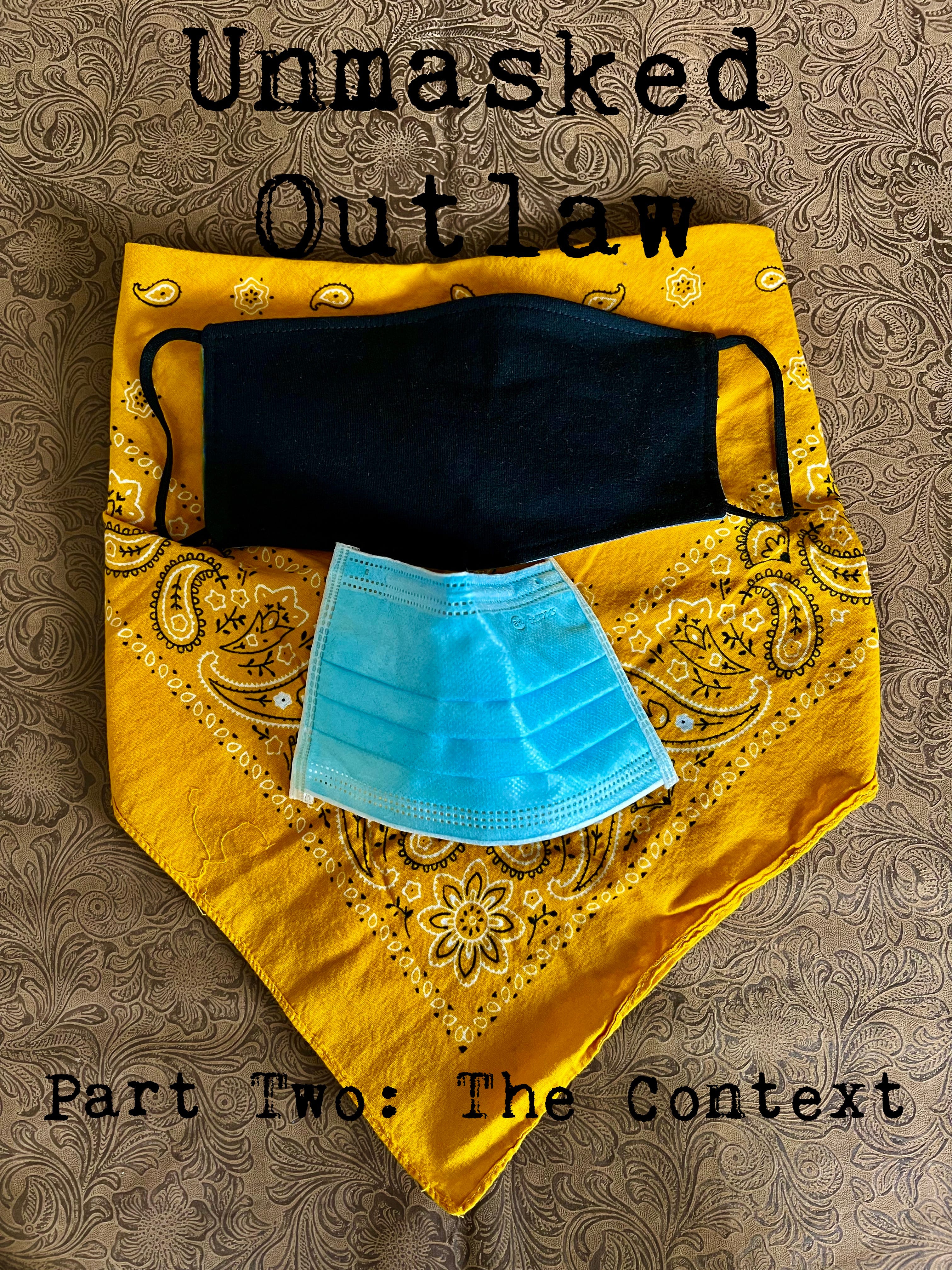
Unmasked Outlaw, Part Two: The Context
from P. A. Ritzer Hosted by P. A. Ritzer
We have now lived in a society in which wearing a mask in response to the Wuhan COVID has been mandated and pervasive. It has been a unique and, what former President Barack Obama might call, a transformative experience for all of us living in the United States. It will be interesting to see what the masking has meant and done to us personally and communally. Whatever the case, we have not masked in a vacuum. We had a cultural context of masking before the pervasive Wuhan COVID masking. Remember at the beginning of The Incredibles when the masked “supers” opine on their secret identities? These supers–like so many other heroes of the fictional, if not mythical, crime-fighter genre–wear masks to hide, and thus protect, their secret identities, which are their true identities, to step into the role of crime fighter. They remove the masks to return to their regular lives. Their masks cover the area around their eyes, and there really is no other purpose for such a mask than to protect identity. Interestingly, in a reversal of the mask and true identity, Superman wears no mask, but dons eyeglasses to, however implausibly, hide his identity in the role of Clark Kent. Thus we might conclude that Superman is his true identity, and Clark Kent is the role he steps into to protect it. Generally, though, the crime-fighter eye mask serves no other purpose than to protect secret, true identities. The Lone Ranger is another crime fighter who masks around his eyes to step into a role and protect his true identity, though it could be argued that the constant role becomes his identity over time. He masks to keep the outlaw Butch Cavendish from realizing that he is the lone Texas Ranger to survive the ambush that Cavendish and his men laid for them, in which the Lone Ranger’s brother and four other Texas Rangers were killed. And so masked, the Lone Ranger sets out to bring Cavendish and his men to justice, and continues his quest for justice beyond that one objective. He is often challenged for wearing a mask in that it is expected that masked men are outlaws. That expectation indicates a context, a history of understanding that those who wear masks do so to protect their identities while committing crimes. Anonymity would thus provide the “darkness” Jesus said “men loved” “because their deeds were evil” (Jn 3:19). In order to do that, the anonymity of the mask helps the outlaw dehumanize his victim, and in so doing, dehumanize himself. And it is true that the outlaws in the Lone Ranger stories do wear masks, but theirs are significantly different from his. They do not mask around their eyes, but pull up their bandanas over their mouths and noses to protect their identities. Unlike the mask around the eyes, this type of mask does have a purpose other than that of hiding identity. I will refer to it as a practical purpose. This practical purpose of the bandana mask pulled up over the mouth and nose is to protect the wearer from breathing in the heavy dust stirred up in the arid West by dust storms, cattle drives, field plowing, grain threshing, etc. So the outlaws employ the mask outside its practical purpose to protect their identities while committing crimes. And what of the effect of hiding identities, making them “secret” identities, providing anonymity? For the eye-masked crime fighter and the mouth-and-nose-masked outlaw the hiding of identities may allow them to protect those identities so that they can live normal lives in their secret, true identities, by hiding their participation in certain deeds, which can shield them from the consequences of that participation. But, of course, one’s deeds are good, the other’s evil, and that makes all the difference in the consequences. And since the consequences of the outlaw’s masked evil deeds include harming others, the anonymity of the mask is sought to save himself from the responsibility of causing that harm. In order to do that, the anonymity of the mask helps the outlaw dehumanize his victim, and in so doing, dehumanize himself. Masking and dehumanization, let’s keep that in mind. These uses for masks have been part of our culture for generations now. Our culture has also included practical protective uses of masks by surgeons (whether effective or not), welders, insulators, athletes, people who work in the cold, and others. Masks are also worn in the theater and other realms of entertainment. They are also commonly worn by people at Halloween, Mardi Gras, Carnevale, or at costume parties to temporarily take on artificial identities, and possibly hide true identities. All of these uses of masks are protective, whether of health or identity. And all have something to do with identity and with anonymity, however incidental. They might hide identity, so wearers can project mystery or intrigue or do good, fun, evil, or mischievous deeds with varying degrees of anonymity. Or they might reveal at least part of one’s identity, even when used practically, by indicating one’s profession or avocation, while at the same time possibly creating some degree of anonymity by making it difficult to identify the individual. I wonder how the COVID mask fits into our cultural experience of masks. Well, for starters, like all the masks considered, the COVID mask is supposed to be protective. That is key. Keep that in mind. We are going to have to come back to that. It is obvious that the COVID mask is not like the crime fighter’s eye mask. The COVID mask does not cover just the area around the eyes but instead covers the mouth and nose area of the face. The COVID mask is also not used for the sole purpose of protecting one’s true identity. Though the COVID mask can hide identity, we are to believe it is worn for a practical purpose. Ah yes. Are the wearers then to be compared to bandana-wearing outlaws who wear the mask over their mouth and nose not for its practical purpose but to hide their identity in committing crime? The COVID mask was recommended, and then imposed, for the practical protective purpose of stopping the spread of Wuhan COVID. But, as was pointed out in “Unmasked Outlaw: Part One,” it is incapable of doing that, though it is capable of causing harm. See the following articles for just a sample of what the evidence reveals about masks: “Is a Mask That Covers the Mouth and Nose Free from Undesirable Side Effects in Everyday Use and Free of Potential Hazards?,” “Masks: The Science & Myths,” “McDonald: Masking Children is Child Abuse,” and the websites for America’s Frontline Doctors, and the Association of American Physicians and Surgeons (AAPS). And remember Dr. Malone’s article “Mass Formation Psychosis.” And Steve Kirsch addresses the mask matter in his Substack newsletter: So, the COVID mask is to be worn over the mouth and nose for a practical protective purpose of stopping the virus. But since the COVID mask is not capable of stopping the spread of the virus, the COVID mask is not being used for a practical purpose after all. Hmm, a mask that covers the mouth and nose not being used for its practical purpose: where have we considered that above? Aha! Are the champions of the COVID mask (the maskists) then to be compared to bandana-wearing outlaws who wear the mask over their mouth and nose not for its practical purpose but to hide their identity in committing crime? Well, no . . . , because the maskists believe that they are wearing the masks to protect themselves and others from the virus . . . even though the masks do not protect them from the virus. OK, so they are wearing the COVID mask for a practical purpose that it is incapable of fulfilling. Because the maskists believe them capable of fulfilling it. So, that erroneous belief in the efficacy of the COVID mask can explain why the maskists are so adamant about wearing them, and far worse, demanding that all of the rest of us wear them. The erroneous belief in the efficacy of the COVID mask leads to a demand that all be … Get full access to P. A. Ritzer at paritzer.substack.com/subscribe
Embed this episode
No transcript yet.