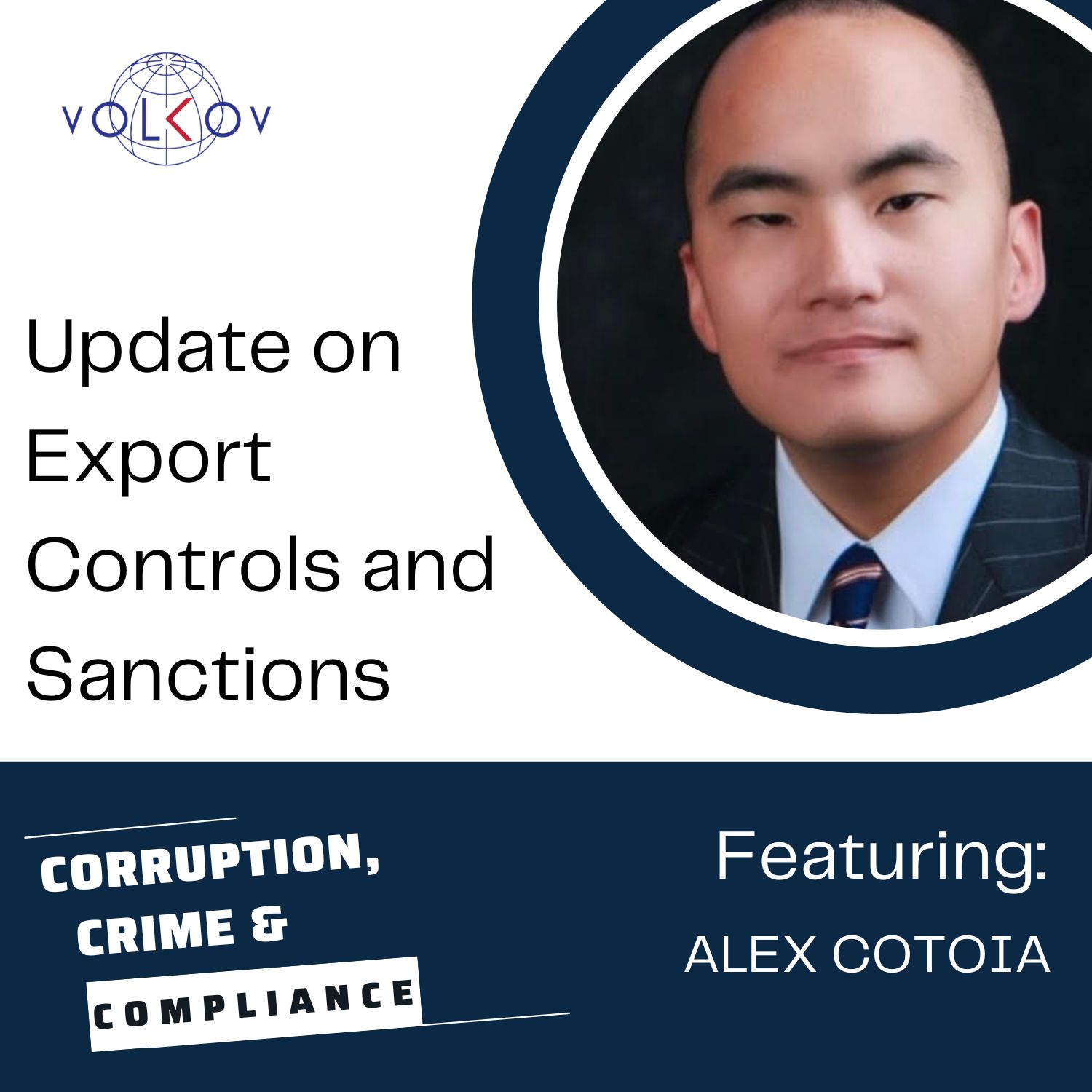
Update on Export Controls and Sanctions: Interview with Alex Cotoia
from Corruption Crime & Compliance Hosted by Michael Volkov
In early October, the BIS announced two rules imposing significant export controls on semiconductor chips transactions for supercomputer end uses. This week’s show discusses recent developments in the sphere of export controls and sanctions. Alexander Cotoia, Regulatory Compliance Manager at the Volkov Law Group, joins Michael Volkov to explore the BIS’ ramping up of export control enforcement, including the new restrictions on China and Russia. Some ideas you’ll hear them explore are: The SQE route for experienced legal professionals aims to democratize the legal profession to include underrepresented minorities and other people who might not have access to the typical training contract required for being a solicitor. In early October, the BIS announced two rules imposing significant export controls on semiconductor chips transactions for supercomputer end uses. Their aim is to obstruct China’s ability to use these supercomputers to upgrade their military capabilities and the propagation of WMDs. Within these new rules, controls on the export of semiconductor manufacturing technology in certain transactions for integrated circuitry were also imposed. Much of the dissent from professionals over these new restrictions stems from a fundamental disagreement in terms of policy rather than implementation, Alexander shares. Many professionals have become accustomed to the free-trade arrangement with China to export sophisticated technologies for integration end uses, and fear that the more stringent controls will compromise that arrangement. The aftermath of Russia’s invasion into Ukraine saw coordinated efforts at the highest levels of US government designed to prevent Russia from acquiring assets and commodities that could be used for military purposes. Alexander believes Matt Axelrod’s guidance about changing the way some administrative violations of EAR99 will be viewed was very instructive. One of the premises underlying that change was using non-monetary resolutions for less serious violations, but also imposing more stringent financial penalties on those who engage in culpable acts. If you have government contracts, or are in the telecommunications industry, you’re not allowed to have Huawei products on your premises. Resources Bureau of Industry Security Ramping Up Export Control Enforcement Alexander Cotoia on LinkedIn Email Alex: [email protected] Email Michael: [email protected] Volkov Law Group
Embed this episode
No transcript yet.