Urologist Explains: What Your Post-Void Residual Means S2E22
from BPH360 Hosted by Man vs Prostate
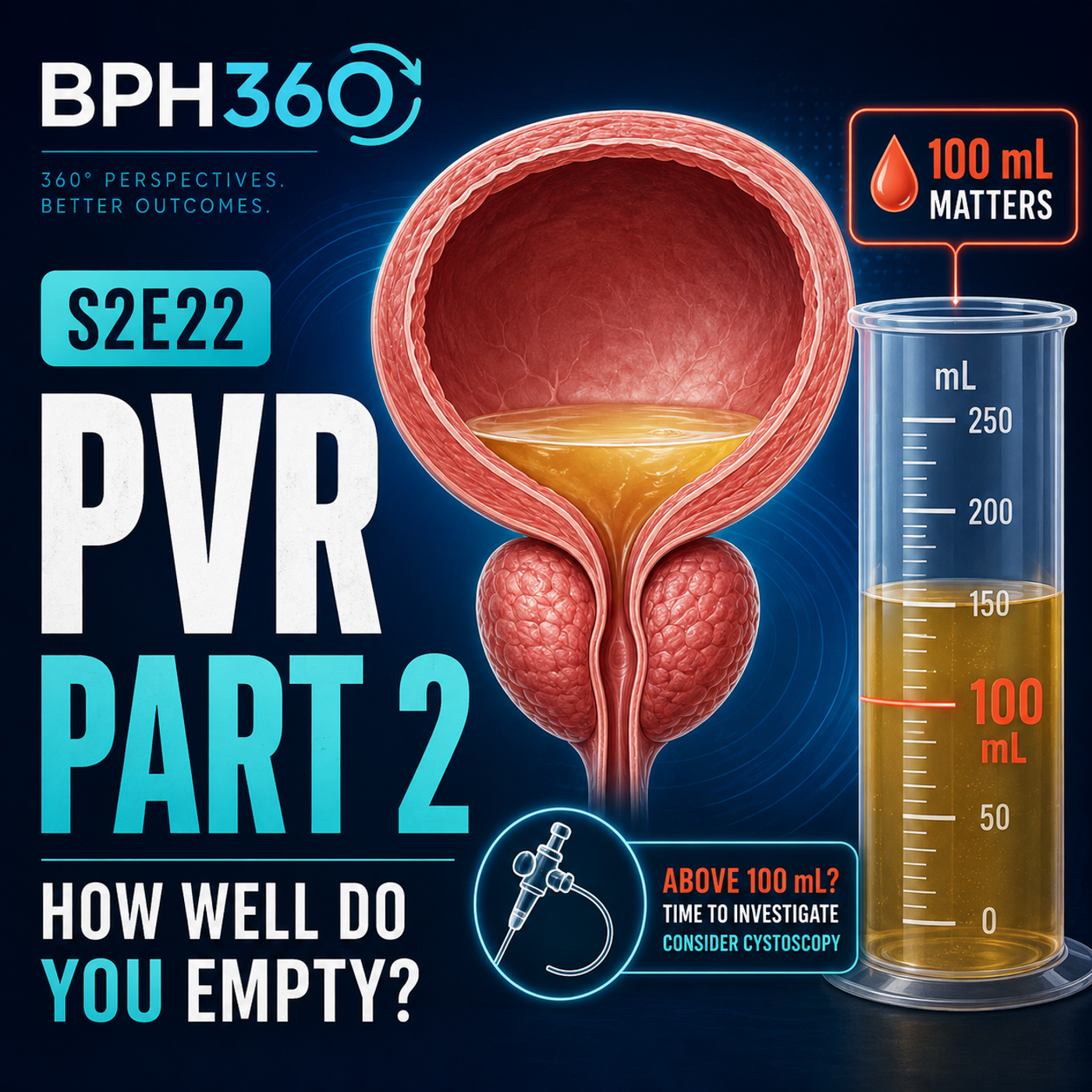
S2E22 — PVR Part 2: How Well Do You Empty? You may feel like you emptied your bladder—but how much urine is actually left behind? First Measure Your Urine Flow Rate Qmax: https://proudp-soundable.app.link/w5rhpKoU7Wb In Part 2 of our discussion on post-void residual (PVR), Dr. Wayne Kuang explains why measuring the urine remaining after you urinate can provide important information about your bladder health. One number deserves attention: 100 mL. A PVR of 100 mL or more does not prove that your bladder is failing, and it does not automatically mean you need surgery or a catheter. But when it occurs together with an IPSS or IBPSS of 8 or greater, it may be a reason to stop assuming and start investigating. The question is: Why aren't you emptying? Is it a pipe problem—your prostate creating resistance to urine flow? Is it a pump problem—your bladder muscle becoming too weak to empty effectively? Or could it be some combination of both? Symptoms alone often cannot answer that question. A slow stream, urgency, frequency, leakage, and incomplete emptying can overlap across different stages of bladder dysfunction. That is why objective data matters. 00:00 Opener 01:26 Intro 01:47 Magic Number: 100mL Threshold 07:31 s Mid Roll 08:04 How to Measure PVR 15:32 Outro 17:09 Outro In this episode: • What PVR actually measures • Why 100 mL is an important threshold in the Triangle of Triage • Why a high PVR does not automatically mean bladder failure • The difference between a pump problem and a pipe problem • Why you cannot judge bladder emptying by how you feel • What PVRs of 100–300 mL and >300 mL may mean • How PVR can be measured with bladder scanners, ultrasound, catheterization, and physical examination • Why an IBPSS/IPSS ≥8 + PVR ≥100 mL should prompt a deeper bladder-health conversation • How cystoscopy may help evaluate the prostate, bladder, stones, scar tissue, tumors, and other possible causes of urinary symptoms • Why Qmax, PVR, and your symptom score should be considered together Know Your Numbers IBPSS/IPSS — How significant are your urinary symptoms? Qmax — How fast is your maximum urinary flow? PVR — How much urine remains after you urinate? No single number tells the whole story. Together, they can help you and your physician better understand what may be happening between your prostate and your bladder. Visit ManVsProstate.com to learn more about the Triangle of Triage, bladder health, IBPSS, Qmax, and the Man vs Prostate® campaign. And remember the golden question: What about my bladder? Please protect your bladder before it is too late. 🎧 Follow BPH360 on YouTube, Spotify, and Apple Podcasts. ✋ Educational content only—not medical advice, diagnosis, or treatment. Discuss your individual condition with a qualified healthcare professional. Some links may be affiliate links, which may generate a small commission at no additional cost to you.
Embed this episode
No transcript yet.