
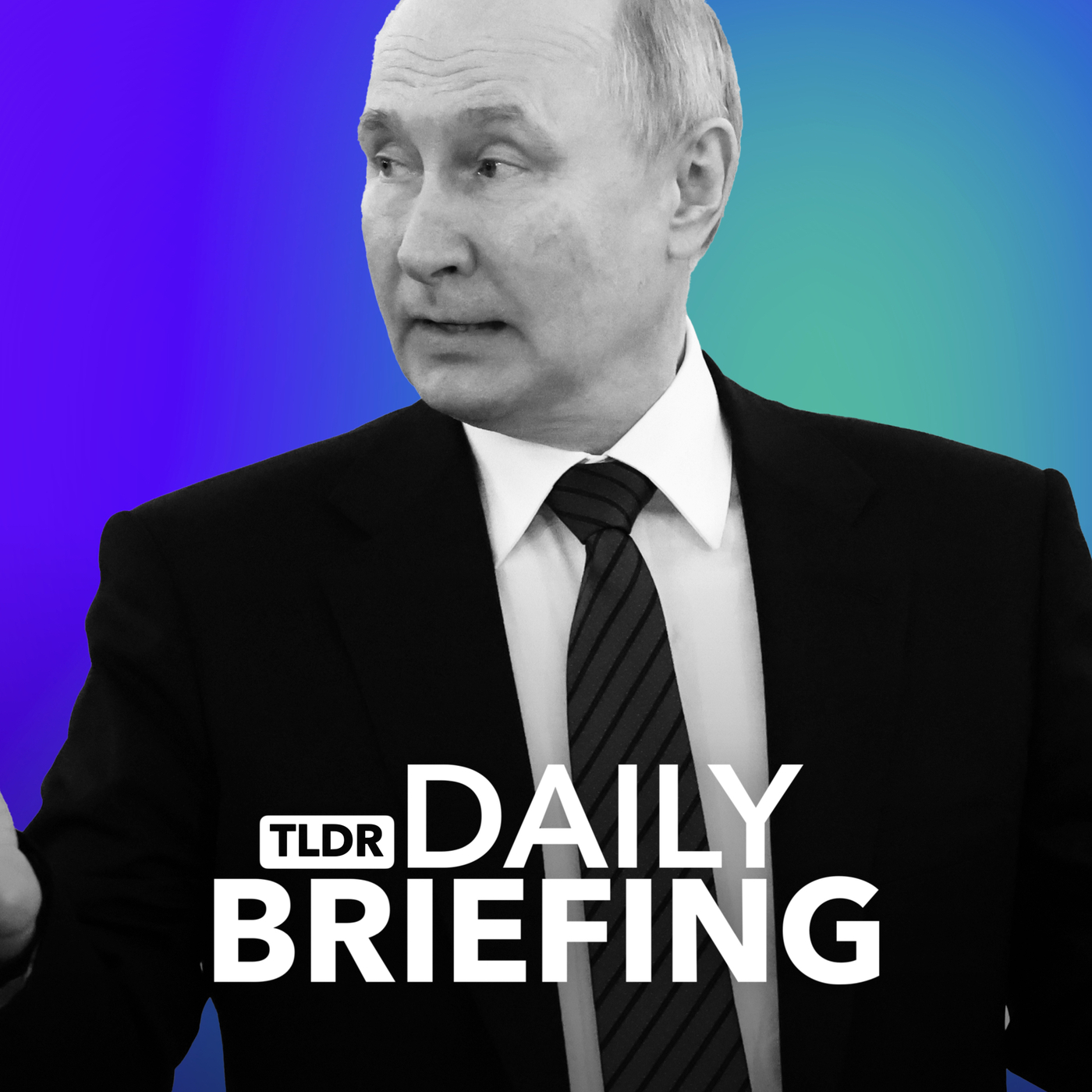
Welcome back to TLDR's Daily Briefing for Tuesday 18 February 2025. In today's episode, we cover EU leaders Ukraine crisis talks, Israeli troops in Lebanon and the Pope's hospitalization. But first, Ukraine peace talks begin between the US and Russia. US and Russian officials met in Riyadh, Saudi Arabia today, marking the highest profile talks since Russia's invasion of Ukraine.
The meeting is largely seen as laying the groundwork for a meeting between Russian President Vladimir Putin and US President Donald Trump in the near future. It was attended by the US Secretary of State Marco Rubio, US National Security Advisor Mike Walts, US Envoy Steve Whitcoff, along with Russian Foreign Minister Sergei Loyan. The Russian Foreign Minister Sergei Lavrov and the Foreign Policy Advisor to Putin. After more than four hours of talks, both sides have reportedly come to an agreement on several topics, which included restoring diplomatic staff, launching a process for continued talks on Ukraine, exploring lifting economic barriers and laying groundwork for a Putin-Trump meeting.
While the meeting was underway, Russia raised a fresh new demand. Not only must NATO not admit Ukraine as a member of the alliance, but NATO must also go further and disavow the promise it made in 2008 that Kyiv would join at a future unspecified date. The goal, and what they have said they have achieved, is to also come up with some sort of mechanism to address what they call irritants in the US-Russia relationship that have occurred since the start of the war. Rubio hailed the quote, extraordinary opportunities for US-Russia ties if the Ukraine conflict ends, while Lavrov called the meeting useful and constructive.
However, markedly excluded from the talks were Ukraine and other European leaders, who are increasingly worried that Trump could cut a hasty deal with Putin that ignores the security and interests of both Europe and Ukraine. Trump's teams have already ruled out NATO membership for Ukraine and have said that Kyiv's desire to win back all of its lost territory is an illusion. Many in Europe now fear that Trump will make major concessions to Russia, that it will leave Putin free to threaten Ukraine or other European countries in the future. US officials, meanwhile, have argued that they are simply recognizing reality.
Many European leaders have said that they will continue providing support to Ukraine. And speaking to Bloomberg over the weekend, German Chancellor Olaf Shorts said his only plea to the US during these talks was this. My plea is that there should be first a message to Putin that Europe and the United States will continue with their support to Ukraine because he has to understand that he cannot hold that we stop our support. Shorts also said that without Ukraine having a seat at the table during these negotiations, there would be no possible solution.
You're listening to TLDR's Daily Briefing. If you want more explainers on what's happening in the world, then you should check out TLDR's YouTube channels. Today, we release videos on a potential European army, as well as Argentinian President Javier Mille's recent meme coin scandal. You can find those videos linked in the description or show notes for this episode, or by searching for TLDR on YouTube.
In other related news, EU leaders are holding Ukraine crisis talks in Paris, but are divided on the issue of sending troops to Ukraine. On Monday, a day after UK Prime Minister Kierz Dahmer said he would be willing to provide a British reassurance force stationed behind, and not on, a future ceasefire line, Germany, Italy, Poland and Spain express reluctance to dispatch peacekeeping forces to Ukraine. Meanwhile, France, which had suggested sending European troops to Ukraine a year ago, also proposed a reassurance force. In response, Germany's Chancellor Olaf Shorts said the discussion is completely premature and it is the wrong time to have it.
Similarly, Italian Prime Minister Georgi Maloney said that sending European troops to Ukraine was, quote, the most complex and least likely to be effective of various options. Moving to the Middle East now, where the Israeli military is keeping troops at five locations in Southern Lebanon, despite today being the deadline for Israel to withdraw its forces from the country, as per the terms of last year's ceasefire. An Israeli military spokesperson said, we need to remain at those points at the moment to defend Israeli citizens, to make sure this process is complete and eventually hand it over to the Lebanese armed forces, adding that the locations are close to or overlook Israeli communities in northern Israel. The UN's Lebanon envoy and peacekeeping force noted today's deadline for withdrawal and said, another delay in this process is not what we hoped would happen, not least because it continues a violation of United Nations Security Council Resolution 1701.
That ended the previous 2006 Israel Hezbollah War. In news from Africa, Rwanda backed M23 rebels have captured another major city in the Eastern Democratic Republic of the Congo, having captured Goma last month, the capital of the North Kiwi Province, M23 pushed south, and have now captured Bukavo, the capital of South Kiwi Province. There are fears that the rebel groups continued offensive, supported militarily by neighbouring Rwanda, could spiral into a wider regional war. M23 now controls more territory in the mineral-rich Eastern DRC than it captured in any of its previous rebellions, a major blow to the Congolese government that's struggling to halt the group's expansion.
M23 is the largest of many dozens of armed groups and militias that operate in the Eastern DRC, which is the site of one of the most complex humanitarian crises in the world. And finally, Pope Francis is spending a fifth day in hospital, suffering from what doctors have called a complex clinical situation, describing it as a polymicrobial infection of the respiratory tract. As such, all public events in the 88-year-old pontiff's calendar have been cancelled through to Sunday. It's not the first time that Pope Francis has faced health setbacks, which include several hospitalizations and surgeries relating to lung problems, knee pain and sciatica.
That's all for today, we'll be back with you tomorrow to make sure you're following us on your preferred podcast app. In the meantime, you can check out our physical magazine Too Long. The next edition, which comes out in April, covers the world's 25 most influential people, as ranked by us, the TLDR team and you, the TLDR audience. And you can find the link for this in the podcast description.
This was a TLDR news production, hosted by Georgina Finley, written by Nadia Lovadinoff and Rory Taylor, and produced by Scarlet Watchon. Thanks for listening and we'll be back again tomorrow.