Usage Based Pricing for AI Products
from The Innovation Attorney Podcast Hosted by The Innovation Attorney
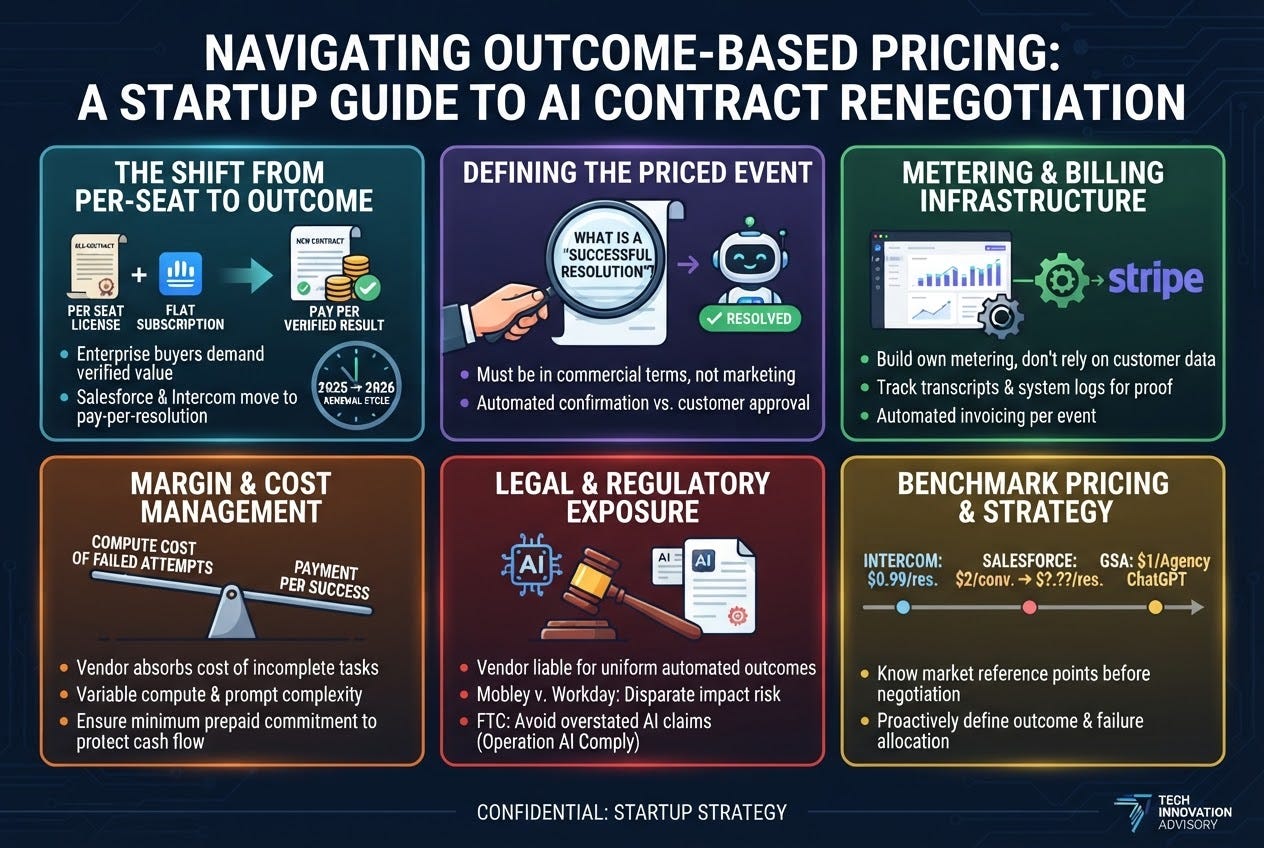
Salesforce, Zendesk, and HubSpot shifted AI pricing toward usage based and outcome based models during 2025 and 2026 because seat based subscriptions could not track token costs or delivered value. A venture funded AI product should move to usage based or hybrid pricing when its inference cost per customer varies by more than roughly three to one across the user base, the threshold several pricing operators use to flag margin risk under flat seat pricing. Salesforce priced Agentforce at $2.00 per conversation at its October 2024 launch, then layered in $0.10 per action Flex Credits in May 2025, and still sells seats starting at $125 per user per month under its Agentic Enterprise License Agreement, because no single model fits every buyer. The right answer depends on gross margin at the ninetieth percentile user, deal size, and how predictably the company can forecast consumption, not on which model draws the most attention. The underlying driver is a token cost collapse that moved faster than most pricing committees tracked it. Input token prices for frontier grade language models fell from $30 per million tokens for GPT-4 in March 2023 to roughly $0.10 per million tokens for comparable capability by early 2026, a decline close to three hundred times in under three years. Anthropic cut its own 2025 gross margin forecast to about 40 percent as inference costs outran its revenue growth, even as 2025 revenue reached approximately $10 billion. A company billing a flat $29 monthly seat against a ninetieth percentile user consuming $21.00 in tokens has already lost money on that account before any other cost is counted. The comparative evidence favors a hybrid structure over either pure model standing alone. Vertice’s second quarter 2026 contract data placed usage based pricing as the single most common primary model at 36.5 percent of software contracts, ahead of per user pricing at 32.4 percent, while L.E.K. Consulting’s April 2025 valuation analysis found hybrid pricing companies carrying a 6.9x mean revenue multiple against 6.5x for pure subscription companies. For an investor, the practical implication is that the pricing model a portfolio company selects in 2026 shows up directly in gross margin, net revenue retention, and the multiple the company commands at its next financing, before any product feature does. Definition, Scope, and Technical Context Usage based pricing charges a customer for the metered quantity of a resource consumed, most commonly the input and output tokens processed by a large language model, while seat based pricing charges a fixed fee per named user regardless of how much of the product that user consumes. This analysis treats outcome based pricing as a third category: a charge triggered by a completed result, such as HubSpot’s $0.50 fee per resolved Breeze Customer Agent conversation after April 14, 2026, or Salesforce’s $2.00 per Agentforce conversation at its October 2024 launch. The analysis covers venture funded, cloud delivered AI products sold to businesses, meaning software companies that purchase frontier model access through an application programming interface rather than companies that train and sell their own foundation models. The analysis excludes consumer facing subscription products such as a standalone chatbot application, because consumer willingness to pay follows different psychology than enterprise procurement, and it excludes open source, self hosted deployments, where the customer bears the inference cost directly and the vendor pricing question does not arise in the same form. The relevant engineering classification is metered cloud services pricing applied to a workload whose unit cost is itself falling rapidly and whose consumption per user varies far more than consumption of a conventional software seat. A seat on a conventional SaaS product, a project management tool or a word processor, consumes a roughly fixed quantity of server compute regardless of how actively the named user works, because the software is deterministic and the marginal cost of an additional click is near zero. An AI agent seat consumes a variable quantity of token generating compute tied directly to how many queries the user submits and how complex each query is, so the cost basis underneath the seat is no longer flat. That difference, not any feature of the product itself, is what forces the pricing question addressed throughout this report. Underlying Scientific and Engineering Principles A large language model generates output one token at a time through autoregressive decoding, and the compute cost of that process is driven by the number of parameters activated per token, the length of the input context the model must attend to, and the hardware generation running the calculation, which is why token price is the correct unit of cost measurement rather than a flat per query or per seat charge. Every additional output token requires a full forward pass through the active parameters of the model, so output tokens cost substantially more per unit than input tokens in nearly every published price list. OpenAI priced GPT-5.2 input tokens at $1.75 per million and output tokens at $14.00 per million in the first quarter of 2026, an eight to one ratio that a flat per seat price cannot reflect without overcharging light users or losing money on heavy ones. Three forces drive the token cost decline that makes usage based pricing newly viable where it was not viable two years earlier. The first is architectural efficiency: mixture of experts designs, such as the one behind DeepSeek’s V3 model released in January 2025, activate only a fraction of total parameters per token, cutting compute per token without cutting model quality by a proportional amount. The second is hardware: NVIDIA’s own estimates put inference cost per token down roughly tenfold from its A100 generation to its B200 generation. The third is competitive pricing pressure among frontier model providers themselves, visible in OpenAI’s December 2024 cut of 60 percent on GPT-4o realtime input pricing and 87.5 percent on output pricing, a reduction driven by competition from Google’s Gemini line and Anthropic’s Claude line rather than by a change in the underlying hardware cost that same week. Some of these constraints are contingent and some are closer to fixed. The decline in cost per unit of model quality is contingent: it depends on continued algorithmic research, continued hardware generations, and continued competitive pressure among several serious frontier labs, any of which could slow. Closer to fixed, at least over a multi year horizon, is the shape of the cost curve itself: output tokens will keep costing more than input tokens because generation is inherently more compute intensive than comprehension, and heavy users will keep costing substantially more than light users because query complexity and token count move together. A pricing model built on the assumption that this variance will disappear is building on a trend that history gives no reason to expect. System Architecture and Process Flow A usage based or hybrid pricing system requires four subsystems that a seat based product does not need in the same form: a metering layer that counts the input and output tokens, application programming interface calls, or completed actions a customer generates; a rating engine that converts that raw count into a customer facing charge; a credit or wallet abstraction that decouples the vendor’s actual model cost from the price the customer sees; and an invoicing and dunning system able to handle postpaid overage charges rather than a single flat monthly draft. Cursor, built by Anysphere, illustrates the credit abstraction directly: each paid plan carries a monthly credit pool sized to roughly match its subscription price, the company’s own models draw down that pool at a favorable internal rate, and third party models such as Claude or GPT draw it down at each model’s actual … This is a public episode. If you'd like to discuss this with other subscribers or get access to bonus episodes, visit theinnovationattorney.substack.com/subscribe
Embed this episode
No transcript yet.