
I was telling my wife, you know, I think I'll be able to do bedtime tonight. Maybe, maybe even dinner and she was like, Whoa, Whoa, Whoa, don't get ahead of yourself. It's not go crazy here. How complicated could it be?
It's index ones and active funds and money market and brokerage and advisory. Yeah. Yeah. Yeah.
But really, it's mostly that's fun. All right. Let's do it. Let's do it.
Bigger. Who got the truth? Is it you? Is it you?
Is it you? Got the truth now? Is it you? Is it you?
Is it you? Shitty down? Say it straight. Another story on the way.
Got the truth. Welcome to the spring, 2026 season of acquired the podcast about great companies and the stories and playbooks behind them. I'm Ben Gilbert. I'm David Rosenthal and we are your hosts.
Today's episode is more relevant for you than any other company we have ever covered. For most of you, you have most of your net worth tied up in this company or the copycats who followed the company is Vanguard, who effectively created the first index fund for individual investors in 1975. And today is the largest provider of index funds in the United States. They manage over $10 trillion in passive index funds.
That means they own an average of almost 10% of every company in the S&P 500. General Motors, Nike, Starbucks, Lockheed Martin, Visa, Apple, you name it. Vanguard is the largest shareholder of most US corporations and together with the other big index funds like BlackRock, State Street and Fidelity, they own 24% of the entire US stock market. It's absolutely incredible.
And none of those other firms would be in this market or doing it in the same way a footwork for Vanguard. No. I mean, the impact is just wild. I mean, millions and millions and millions of people have sent their kids to college, bought homes, retired comfortably because Vanguard and Jack Waggle.
So Vanguard has an incredibly unique corporate structure. If you are an investor in a Vanguard fund, you own a piece of the firm. Vanguard is owned exclusively by its customers and it's not publicly traded. It doesn't have outside shareholders of any other kind.
Even the CEO doesn't have any equity except, of course, then what he has from investing in the funds, just like me and David and all of you in many ways is a different kind of capitalism. Dare we say communist capitalism? Ooh, I like it. A company whose products exclusively serve the interests of its customers and no other shareholders.
And David, as you've been alluding to, the man behind this idea is a visionary, an iconoclast and a pedantic stick in the mud who was as disagreeable as he was right. Jack Bogle. Oh, that's great. I could have written better myself then.
And his story is wild since he didn't start Vanguard until he was 46 years old. And you might think it was started idealistically given the structure we're talking about. And it was sort of, but the story is equal parts idealistic as it is vindictive. But what is clear?
We all owe Jack a giant. Thank you. Because of Vanguard's relentless cost cutting and low fees, Vanguard has saved investors over $500 billion in fees and trading costs since its founding in 1975. And as a recent book, the Bogle effect argues, Vanguard's actions also forced the hand of the rest of the industry to cut their fees, totaling another $500 billion over time.
So Jack Bogle and Vanguard are responsible for a trillion dollars of wealth transfer out of the pockets of Wall Street in the finance industry and into the pockets of individual investors in the form of fees that they didn't have to pay. Absolutely incredible. I was catching up with a good friend of the show Morgan Haussell a couple days ago. Oh, yeah, of course.
And his comment to me was, I view Bogle as an undercover philanthropist. And at a trillion or even half a trillion dollars, that would make him the greatest philanthropist of all time. Wow. Wow.
I love that. Yeah. I mean, a large portion of that trillion dollars could easily have flowed into Jack's own wealth and he made the choice that it didn't. Yeah, maybe, maybe David will get into it.
So listeners, you can join the email list at acquire.femslash email. That's where we're going to send out our big takeaways from each episode, past episode corrections exclusive behind the scenes photos that we find in our research. And it's where you'll get to vote on future episode topics. Plus David writes a little hint each time about next episode's topic.
So come play the guessing game with us at acquired.femslash email. Come talk about this episode with a whole community in the slack after you listen. That's acquired.femslashslash.slash. And before we dive in, we want to thank our presenting partner, JP Morgan.
Yes. And just like how we say, every company has a story, every company's story is powered by payments and JP Morgan is a part of so many other journeys from seed, IPO and beyond. So with that, this show is not investment by David and I may and definitely do this time to have investments in the companies that we discuss. And this show is for informational and entertainment purposes only.
David, where do we begin? Oh, all right. But we start in May of 1929 on the eve of the Great Wall Street crash of October 1929 that would throw America in the world into the Great Depression, wipe out millions of the family savings, ruin countless lives, forever scar an entire generation. We don't often talk about the Great Depression on acquired.
It was truly horrible. I mean, the financial crisis was quaint compared to this. 9,000 banks failed after the Wall Street crash of 1929. 9 million individual family savings accounts were wiped out.
Almost 100,000 businesses failed. Unemployment reached 25%. And it truly did scar an entire generation. I mean, I remember my grandparents still like into the 1990s doing absolutely insane things because of their experience during the depression.
My dad's mom never threw out a plastic bag in her entire life. When she died and we cleaned out her condo, it was like full of tens of thousands of plastic bags. My grandpa was magazines and Tums containers. We found just overflowing amounts in his basement.
But the crazy thing about this, David, is back then only one to two percent of Americans owned stocks. Yes. So all of these things were second order effects from the crash, from the banks being deeply intertwined, a lot of leverage on all these equities. It wasn't like, oh, I own a bunch of stocks and those stocks crashed.
So my life is over. It is the giant interrelated ripples and no safeguards in the economy at that time. Yep, exactly. It was the bank failures.
It was the businesses going under. It was unemployment. It was everything. But on the eve of this great financial calamity, our hero and a financial hero to many is born, John Clifton, Jack Bogle.
And he's born here in May of 1929 as one of two twin boys, along with his twin, David. And together with their older brother, Bud, they form the Bogle boys as they would be known throughout the rest of their youth and indeed the rest of their lives. Now, Jack and David here at the time of their birth are born into a prominent New Jersey family. Their great grandfather had founded a mutual fire insurance company.
Nice foreshadowing their family mutual, mutually owned company as Vanguard would go on to be and their grandfather had then founded a company, which would go on to become part of the American can company, which manufactured tin cans and was one of the largest companies in America for a long time. So it's like a prosperous, well to do, well respected family that they are born into, but during their early childhood here in the Depression, the family loses everything. Their dad becomes an alcoholic, divorces their mom, abandons the family, runs off, basically ends up dying alone on a street corner years later. Their mother, as you can imagine, is equally scarred from all this suffers from severe depression, mental health issues, isn't able to provide for the boys.
And so the Bogle boys, basically from the time they're kids, like before their teenagers, they're kind of left to fend for themselves in the world. So all three of them work several concurrent jobs while they're growing up and going through school. We were talking like paper routes, food service jobs, restaurants, manual labor, like anything that they can do to support themselves and their mom. Jack would talk about how the best job that he ever had as a kid was a 3 a.m.
Paper route that he had because the world was quiet and peaceful in the middle of the night and he could escape the chaos and strife all around him. As you like to say, it was a contrast to the rest of my life growing up. And you got all this from talking with Jack's kids, right? Yeah.
Yeah. I spoke to several members of the Bogle family for research and the story is just incredible. Yeah, it's interesting because kind of through his last name and his great grandfather and his grandfather, they had this sort of family network where they were in high society and he knew other well to do kids. But personally, their families, wealth and relationships were kind of in shambles.
They're both insiders and outsiders at the same time. So as the boys get older and they enter high school, I got the family no longer has any money, but they still have these connections and relatives and friends who have resources. And so they managed to get all of the boys scholarships to go to Blair Academy, one of the sort of prestigious East Coast boarding schools for their junior and senior years of high school. And Jack, especially just like flourishes at Blair.
He becomes a fantastic student. He graduates cum laude. He gets voted both best student and most likely to succeed by his classmates. Graduation.
Obviously he's going places. Yeah. Now, there's just one problem though, as Jack and David are approaching graduation, the boys and the family still have no money, even though they've gone to this prestigious boarding school that they're going to graduate from. And they all need to keep working both to support themselves and their mother who's still alive.
So the three of them get together and decide that, hey, because of our situation, only one of us should actually go to college and the other two need to keep working and providing for the family. And because Jack has been so successful at Blair and is such a good student, he gets chosen as the one of the brothers that's going to get to go to college. And Jack would say that like the weight of that decision just rested on him for the whole rest of his life. Like he alone was given this chance to do something bigger.
And he felt like a tremendous obligation to make good to his family on this opportunity. And the other two never go to college. I mean, all three of them remain close, but David and but never go to college. And it's funny listeners, David, you're referencing the things that Jack would say.
It is incredibly easy to find Jack's words everywhere. There is no shortage of commentary that Jack would give on his own life, on his philosophies. The man gave thousands of speeches. He wrote memoirs.
He wrote 12 books, investment advice, reflections back on Vanguard. He would go on TV and talk to journalists and speaking classes. Anytime anyone would have him. So there is no gaps in historical record of Jack's life.
I love Jack's memory. Yeah. Jack love nothing more than to give a speech. So after graduation from Blair, Jack goes on to college at Princeton.
Once again, on a work scholarship, he's working in like the dining halls. He ends up working in the ticketing office for athletic events and football games. And while he's at Princeton, he becomes fascinated with economics after he takes intro, econ course in the fall of his sophomore year during which he gets a deep plus on the midterm in all speeches, beginning to his finance career. Yeah.
But he loves it. He works already finishes with a C minus in the class. Incredible for like the guy who would go on to revolutionize all of finance. Yeah.
So the next year, during Jack's junior year at Princeton, he's decided that he's going to major in economics or concentrate in Princeton, you know, fancy territory on majors and concentrations. Really? Yeah. Yeah, really.
So every day I learned one more quirky little Princeton. I know. I'm sorry. I'm sorry.
I, of course, went to Princeton. So I went through all this. And specifically, I also went through the rite of passage that Jack has to go through, which is he needs to write a senior thesis. So one of the hallmarks of Princeton is that every single undergraduate must write a senior thesis, which must be a unique piece of scholarly research in order to graduate.
It's like a mini version, a very, very mini version of what you would do as a PhD. Mine, of course, was on the marketing history of champagne being a French letter to a major, which is so funny for a choir. Like it's actually very useful for us in the LVMH. It's incredibly useful.
There you go. David Rosenthal, Jack Boagol, you know the connections found. Okay. Continue the story.
Okay. So one afternoon, Jack's casting about for what would become his thesis topic. He's in Firestone, the main library on campus. And he's reading the current issue of Fortune magazine, where he comes across an article deep in the back of the magazine on page 116 entitled Big Money in Boston.
And it's about the growth of a relatively new industry of open ended public funds, what today we would call mutual funds. That term wasn't even in use yet. And the article centers on this new firm that's leading this innovation, this new sector on Wall Street, even though they're based in Boston, the Massachusetts Investors Trust Company, known and marketed as MIT. No actual connection to the real MIT Massachusetts Institute of Technology.
But this gives you a sense of the marketing to the public of these open ended public funds. We'll see it over and over again on this episode. Appropriating prestige is a signature of the mutual fund industry for really the finance industry. All of this industry, absolutely.
The interesting thing about this, you might say, well, what do you mean mutual funds were new at this point in time? Well, that comment that I made before the Great Depression in the 20s, only one or two percent of Americans own stocks. By 1949, that was still only up to 4.2% of Americans. And what they were doing is they were working with a stock broker to buy individual stocks.
There really hadn't been any academic research around finance of any kind yet, let alone sort of investment and diversification and funds. So this notion of you are going to mutually pool your money with a bunch of other investors into a fund and buy a basket of stocks in that fund and hold it for an open ended period of time, these public equities, that was brand new. Yes. And this is what Jack decides to write his thesis about this new phenomenon.
Now, there are actually two important things to talk about here that you started to leave to Ben. One is this concept of a open end fund versus closed end funds. So this is the real pioneering thing that the Massachusetts fund, we're not going to call it MIT here, pioneered, which is there's no set fund size. It's elastic.
So it's not like they have to write a perspective and go out and say, we are raising a $100 million fund and get everybody in it and then it gets to $100 million and then they close it and they manage it. Nope. Could be $1 million, could be $100 million, could be $5 trillion, we will see approaching towards the end of the end of the year. You keep dumping more dollars in and we'll keep buying more stuff in the basket.
Yep. And that also means that investors in the fund can come and go as they please. There's no lockups, it's enough to be a set number. You buy into the fund, you hold it for a while, hopefully it appreciates, you can sell out of the fund.
It's everything we know today about mutual funds. But until this concept of an open ended fund was pioneered, you couldn't do this. Now, you mentioned if Americans held stocks at all at this point in time, they held individual stocks through brokers, these funds came to be distributed exactly the same way through stock brokers. You would call up your Merrill Lynch broker and instead of saying, Hey, give me five shares of general electric, you'd say, Hey, give me a couple units of the Massachusetts fund, et cetera, et cetera.
Yep. And so the marketing, the distribution, it relies on this broker dealer network to sort of sell the funds on behalf of the fund management company itself. Yep. And the brokers were getting paid by the funds.
Oh, where are they ever? So they would take what's called a sales load of usually like seven and a half to eight and a half percent of every dollar that a client was putting into the fund. The fund manager would then kick back to the broker as a spiff for putting their clients in the fund. And it's a kickback out of the money that was just invested.
So if you're investing $100 into one of these funds, well, actually only $91 and a half dollars are going in as the investment and the rest is going right out as this effectively distribution fee. That's your friendly neighborhood, stock broker. Now, the funny thing is if we didn't have the context that we have today, which is I invest $100 and basically $100 goes into the thing that I'm investing in, or at least that's the way it kind of feels. This was normal paying for distribution is a very normal thing across every business in every sector.
You have to incentivize people to push your product through marketing, through advertising, through sales commissions, through hiring a giant sales force yourself. These are often very large costs. I mean, for example, retailers often double the price of something when they sell it to the public, but the revenue here is not $100. The revenue to the fund is like $2 per year in fees.
So paying $8 to the broker dealers is a giant egregious amount to sell the product. It's like four times the amount that the fund itself actually makes. Right. Okay.
So that's number one to understand about these new open ended mutual funds. Number two, also might be crazy or not crazy, depending on your perspective. These new funds, like the Massachusetts fund, weren't really set up for the benefit of their customer base, the fund holders. Rather, they were created and organized by the investment managers who started and ran them with the express purpose of generating profits for themselves.
Right. It's a business. And the way that that happened was the people who set up the fund created a separate company called the Management Company that had a contractual relationship with the fund to get paid a percentage of assets that would be their revenue. And ultimately, this is a very high margin business, their profits.
This is effectively the way that all finance works today. There's a management company that performs the act of advising all of the investments in each of the individual funds that the principles own and run it like a business. Yep. And that management company would be responsible for three things regarding the fund.
One, making investment decisions, allocating the capital. Two, controlling marketing and distribution, which as we talked about mostly was just turning around to whatever their favorite network of stockbrokers was kicking it over to them for additional fees. And three, managing the like back office and administration of the funds, like the register of the fund holders, the investments, the allocations of shares, tax, et cetera, et cetera. Legal compliance, bookkeeping, making sure to communicate the prices of the assets with the newspapers so they can print out all the administrative stuff.
Yep. And the way that the Massachusetts fund worked is the management company just got paid a fixed percentage of the assets under management that year for the fund. So you can see the immediate conflicts of interest all over the place here. If management of the fund gets paid solely based on the size of the assets in the fund, with no penalties or rewards for actual investment performance, well, you're basically just incentivized to grow the fund as large as possible and market it as best as you can.
And skim a lot of fees off the top. There's a tiny bit of performance benefit built in because if the assets under management grows organically by the investments performing well, the fees grow, but it's very different than the way that a lot of funds would go on to be structured later with carried interest or a promote or some sort of performance incentive. Hurdle rate, you know, it's against a benchmark, et cetera, et cetera. None of that.
Yes. Investment returns are but one sort of arrow in the quiver of management companies at this point in time to grow their profits. And these profits could be very, very, very large. So let's say, for example, you have a hundred million dollar fund, which was reasonable even in that day.
Yeah. And it would have a management fee of like one and a half percent of assets annually for a public equities fund. Right. Right.
So as a management company group in this hypothetical hundred million dollar fund, you'd be taking one and a half million dollars a year home, rain or shine in 1950. That's like 20 million dollars adjusted for inflation today. And sometimes up to two million because I'd seen the number two percent to for mutual funds in this era. And this is again listeners for mutual funds, baskets of publicly traded stocks that are just listed publicly to buy on exchanges and these funds in exchange for picking them, putting them in a basket and administering it are charging 2% to do that.
Yeah. And oftentimes they're not even doing the administration. They're not doing the distribution. They're outsourcing that to stock workers.
They're outsourcing the administration too. So all they're doing is picking stocks and getting a lot of money for it. So the things we talked about so far are the one and a half, 2% management fee. There's the eight and a half percent sales load.
So that bumps you down from whatever your current principle is to even the day one when you enter the fund, you know, being down eight and a half percent. So you have that sort of to overcome. And then there's a third thing too, which is transaction fees at this point in time are very, very high. If the fund needs to go and trade stocks to add things to the fund or take things out of the fund, there were very, very large transaction fees relative to today to make those trades.
So yeah, back to Jack in Firestone Library here, Reading Fortune magazine, big money in Boston, indeed. And you can imagine how this might be attractive to young Jack, who comes from this destitute family. He needs to earn money to support his family. This sounds like a great new industry to get involved in.
So in the spring of 1951, Jack turns in his senior thesis to the economics department entitled the Economic Role of the Investment Company. He gets an A on the thesis and graduates magna cum laude from the economics department. And David, what was the thrust of the piece? I mean, he wrote it like on this concept of big money in Boston, but what was his takeaway?
Well, it's interesting. The thrust of the piece is that this is going to be a big important industry within finance. Yeah. But Jack does also have some idealism in here as a young whipper snapper.
And he recognizes everything that we were just talking about, which is that the fees charged to fund clients are going to be a big drag on performance for these funds. And he doesn't go all the way to say, hey, maybe we should eliminate them. But he does say that probably the best way to maximize returns to fund holders is to try and minimize the fees. And he does even in the thesis go one step further and say, well, it's sort of a tautological conclusion that the aggregate average of all these funds are going to perform in lockstep with the market.
So if you really want to try and beat the market, then reducing fees is the way to do it. Because all of these investors who are trading against each other collectively are the market. If you take all the winners and all the losers and sum them up and don't take out any fees, you come up with zero every positive winner on the other side of a trade has a loser on the other side of the trade. And so in aggregate, all investors together are the market.
Now that is true in theory. And in practice today, that is absolutely true. Back in 1951, Jack was a little ahead of his time because professional fund managers were a small, small minority at the market back then. There were a lot of other players, mostly unsophisticated players, mostly retail traders.
And so it really is not inconceivable that the pitch as a professional fund manager that's going to dedicate their life and all their working days to researching and picking stocks and betting against the market probably does have a good chance of beating the market back in these days. Yeah, the pitch of I cannot perform all this done money in the market, probably right. And probably justifies significant fees. Yep.
Now as graduation approaches, Jack has a goal. He wants to go to work in this new fund management industry and he manages to get his A-grade senior thesis in front of another prestigious Princeton alum in Philadelphia named Walter Morgan, who had founded and was running another early open-ended public investment company in Philadelphia called Wellington Management. Walter Morgan hires Jack as his assistant right out of school, really takes a shine to him. Jack becomes sort of like a surrogate son to him.
You know, Jack didn't really have a dad and Walter didn't have kids. They become really, really close. Now, Wellington and its Wellington Fund was a super conservative and very highly regarded, early mutual fund that pioneered the style that came to be known as balanced investing, i.e. a balance between stocks and bonds all within a single fund.
So the sort of marketing slogan that Walter Morgan had used for the firm and the fund was quote, a complete investment program in one security. You can see how this would be attractive. Sounds great. And the Wellington Fund, by this point here when Jack joins out of school, has attracted 150 million dollars in assets.
So they are smaller than the Massachusetts Fund, which was the largest fund in the world, at that point in time with just under 500 million in assets. But Wellington is still like among the top 10 funds in the industry and super well respected. This is what mid 50s? Early 50s, 1951.
OK, so again, we talked about the economics for the management company. Like I think Morgan and everybody at Wellington and Jack absolutely did have their customers and the fund holders in mind and wanted to do a great job for them. But they are making a lot of money. It's market.
It's industry standard. Yeah, based on fees and that fund size, call it like two to three million dollars a year flowing into a reasonably low headcount high margin business here in 1951. Everybody's doing great. So Jack takes the Wellington into Mr.
Morgan like a pig in mud. He loves it. He rises through the ranks from Morgan's assistant to basically doing like every job in the company. And after a pretty short number of years, he emerges as the clear air apparent to take over Wellington when Morgan was 30 years older than Jack.
And then ultimately in 1965, Morgan retires step back and names Jack, president of the firm at 35 years old. He's made it. Yeah, he's Jack. He's come up in the world.
He's gone from family ruin, essentially an orphan to president of a highly profitable and respected enterprise at age 35. He's got to be an importantly a successful and pretty conservative mutual fund organization here with Wellington at this point in time. Yep, yep, absolutely. But unfortunately, that conservative mindset and pedigree was exactly the wrong thing for this moment here in the mid 1960s for Wellington and its young hot shot new president because Wall Street and the investing world is undergoing a sea change from the hyper conservative mode that emerged after the depression to what would come to be known as the go-go years pioneered by a small investment firm in Boston called the delity.
Yes. But before we tell that story, now is a great time to thank our presenting partner JP Morgan. Yes. And today listeners, we are going to talk about something that we mentioned last season on the Trader Joe's episode, supply chain finance.
Yes. Think about when a buyer gets an invoice from their supplier. They're expected to pay quickly, but often can't or don't want to tie up that cash. Wouldn't it be great if you could have a financing partner come in and fund that gap so the supplier isn't waiting up to 30, 60 or even 90 days to get paid?
Well, that's exactly what a bank can do to bridge that time gap. The buyer gets to hold on to their cash longer and suppliers get paid faster. True win-win. Yep.
And JP Morgan specifically has been doing this kind of work for decades at the world's largest companies. So supply chain finance, receivables, financing, dynamic discounting. All of this is built on top of the trillions in daily payment processing, moving through the system. But the tooling and the teams around it have historically been fragmented.
You've got treasury teams trying to maximize liquidity. You've got procurement wanting everything in one place and IT stuck integrating all of it, not to mention the different portals, static reports and all the manual set up. So this is where JP Morgan payments working capital accelerator platform comes in. You've got one login and one unified view across payables and receivables financing near real time data and it plugs into the ERPs that your team is already running.
And when teams can see their full working capital position in real time, working capital stops being a cash management headache and starts becoming a lever that you can pull as a business. The best business is treated as part of their operating system. And this is the kind of platform that makes it easy. So listeners, if you want to learn more about this new working capital accelerator platform, go to JP Morgan dot com slash acquired or contact your JP Morgan rep and tell them that Ben and David sent you.
And if you want to join us for some live interviews, we will be on the main stage with JP Morgan at the We Are Developers World Congress in San Jose this September. Click the link in the show notes to learn more. All right. So David, the entrance of fidelity into our story.
Yes, and the go-go years, which really were this like violent reaction to all the pent up conservatism and prudence and austerity that had dominated Wall Street and finance for America and the world through the depression and through World War two. The journalist John Brooks would write about it later in the New Yorker that the go-go era was quote, a method of operating in the stock market, a method that was to be sure free, fast and lively and certainly in some cases attended by the joy, merriment and hubbub implied by the go-go term. The method was characterized by a rapid in and out trading of huge blocks of stock with an eye to large profits taken very quickly. So in other words, the exact opposite of Wellington management and Walter Morgan's approach, which is tough because if you grew up as a leader in that previous era and you believed in that philosophy, but this is what all of your customers, the investors want, what do you do?
Yep. And fidelity was the one that pioneered all of this. So fidelity goes all the way back to the early Boston Mutual Fund C and kind of same era as the Massachusetts Fund. They were always though like a kind of small bit player until the legendary Edward Johnson, known as Mr.
Johnson, who had previously been Fidelity's legal counsel, takes over the firm right before the end of World War II. At the time, Fidelity is managing just three million dollars. And the previous owners who I think are retiring, they literally give Fidelity the firm to Edward Johnson for free. Wow.
Because they just don't think it has much value. No, I mean, it was part of that, like, we're here to serve the clients. That sort of ethos. But also it was a three million dollar fund, even with the high economics of how this fund industry works.
If the base that you're pulling a percentage fee off of is three million dollars, you're just kind of limited in how much money you're going to make here. Yeah. But yeah, this is why like spoiler alert, obviously, Fidelity is one of the largest fund complexes in financial companies in the world today. It's still owned by the Johnson family.
It's estimated that their net worth is 40 or 50 billion dollars, thanks to this. Incredible. On a basis of zero because they got it for free. Right.
Right. So when Ed Johnson takes over Fidelity, he starts trying a whole bunch of stuff to grow. He comes from the legal industry. He's not from a Wall Street background, per se.
He's open to different styles. He's not sort of steeped in orthodox, he shall we say. And in 1958, he creates a new fund within the group. I mean, this in and of itself was not unprecedented, but quite rare.
Most of the time, there was just one fund within a group where a management company. So for a long time, Wellington management company just managed the Wellington Fund. Fidelity just had the Fidelity fund. So Johnson creates this new fund called Fidelity Capital Fund, which is going to be a growth fund and he hires a young portfolio manager named Jerry Sy to come in and run it.
And Sy basically ignores all the Wall Street conservative conventions and just starts shooting the lights out with this fund. He's taking big concentrated positions in blue chip companies, trading in and out of the stock, making quick profits. I mean, really like we talked about earlier, he's kind of praying on the unsophisticated retail investors out there. He could move the market by taking a big position, pop a stock and then get out of it and book profits.
There was a lot less regulation at that time and there was a lot less sophistication in your counterparties when you were trading. Yes. So pretty quickly, Sy and Fidelity start to become like a player, like a real player. All the CEOs of all the big companies want to get to know him because he has a power to really move their stocks.
He becomes kind of like a quasi celebrity. And moving or not, he kind of has the power to be a giant shareholder in your company now that he's attracting all this capital because people want to get in on his funds. Exactly. So the Fidelity Capital Fund within just a short number of years goes from basically zero like startup initiative within Fidelity itself already a small firm to a three hundred and forty million dollar fund here by 1965 when Bogle is taking over Wellington from Mr.
Morgan. So this is actually the backdrop to why Morgan decided to hand the firm to Jack here in 1965, even though Jack is still so young, Morgan had a crisis of confidence. He's not sure that he's going to be able to operate and be successful in this new Bogo era. This is uncharted territory to him.
So he actually gives a quote to institutional investor magazine when the handover is happening to Jack. He says, quote, I have been too conservative. And when he hands the firm to Jack, his direction to Bogle is I want you to do whatever it takes to fix this firm. Like we need to do something different.
So he's got the mandate. He's got the clear path to do SEC's fit. So this isn't just succession. This is, hey, you should completely change our strategy to compete in this new era.
Yes, yes. So Wellington and its kind of whole class of funds, the balanced funds that we talked about, stocks and bonds together, a complete investment program in one security. Before the Gogo era, that balanced style was 40 percent of the entire fund market in 1955. That had declined by 1965 all the way down to 17 percent and would just keep dropping by 1975, 10 years after that was down to less than 1 percent of the entire market.
They were going the way of the dough dough, basically. So investors are looking to transition away from this blended stocks and bonds to funds that are only stocks and stocks that are trading often and trying to hit the highest number possible this year in their returns and taking some risk to do so. Well, yeah, and specifically, I think they don't even care that much about the underlying stocks. They want trades that book quick profits.
They want what Fidelity and Jerry Say are doing. Like, I don't care if you trade in and out of the stocks. I don't care if you hold GE for a day or a week or a year. If you buy it at five and you sell it at 10, like hell, yeah, let's go.
It's funny. I associate this with the 80s. I don't think I realized that it was also happening in the kind of 1965 to 1971 era. Yeah, the 80s were an echo of this that happened here in the 60s.
OK. Yeah. So all this is happening right at the same time here in 1965 as Jack is taking the reins at Wellington. Jerry Say, the celebrity fund manager here at Fidelity, he starts to think, all right, you know, Mr.
Johnson here, you're getting older and they got to take over the firm. Of course he does. Of course he does, right? Like he's got the star fund, all the clients he's the bad about town, et cetera.
That was all his time. Yep. Johnson, of course, has other opinions. No, this is my firm.
This is my family business and I'm planning to give it to my son, Ned Johnson, Edward Johnson, the third. So, Say says, OK, fine. Buy me out of the equity that I've accumulated here in Fidelity and the management company through my performance. And I'll go start my own fund.
He does. He leaves. He starts a fun called the Manhattan Fund in a absolutely wild. You cannot make this stuff up.
He would eventually take over the American Can Company, you know, that had been like co-founded by Jack's grandfather. Whoa. Yes. Say would become the CEO of that.
He would transform that into Primera and then sell it to Sandy Wile and Jamie Diamond. And that would be part of the building block of city group. What insane, completely insane. I had no idea.
It's funny. When you were giving the history of the Can Company earlier, I was like, is it really relevant for listeners? The vehicle through which Bogol's grandfather built the family business. Yeah.
And it turns out that becomes city group. That's wild through Fidelity and Jamie Diamond and all of this stuff. You can't make this up. Wow.
So this is the stew that's happening is Jack is taking over. And pretty quickly, he decides that the best course of action for him as the new leader of Wellington is to take the well, if you can't beat him, join him approach or more specifically have them join you. So he goes out and he starts looking for go go style fund managers to merge with and absorb into Wellington and transform Wellington into what Fidelity has done. And I think first he was trying to hire people like this, but he couldn't convince anyone to just join as an employee.
He sort of realized, oh, I'm going to have to buy one of their firms. I mean, hey, if Jerry side just left because he didn't get a big equity piece and Fidelity and take over the firm, like anybody else who thinks they're as good as him, they're going to want an equity piece in the management company. Yeah. So he casts about and eventually Jack finds a small new firm in Boston founded by four young partners, Thorndike, Doran, Payne and Lewis.
And the lead partner there, Nick Thorndike, had just come out of Fidelity. Or he had worked with Jerry Sai and Johnson. And so they've raised a new fund called I vest investing in the go go style. They're young hot shots.
They have $17 million under management in their nascent go go fund. Wellington at this point has $2 billion under management, which is huge as giant market share, even though they're declining in the old style of investments. Yes. But back to the business model of the management companies where you're getting paid fees based on the percentage of assets under management, like the revenue and fees are flowing into Wellington, even though they're declining.
Super high way higher than the startup I vest fund out of Austin. Nonetheless, Wellington and Jack feel like they're in such dire straits and need this merger need to bring this go go blood into the firm so much that he ends up offering 40 percent of the equity in the management company to the four partners coming in from I vest. That's almost a merger of equals. Yeah.
Two billion dollars for Wellington, $17 million from I vest, 60 40 split on the equity. There's a quote in the New York Times in a lead story about this merger. Some observers feel that Wellington paid too high a price for management personnel. Many persons are said to credit the Boston group with a major coup.
Mr. Bogol disagrees with generous offers. He had been unable to hire the man he wanted to point then and he did not want to wait for promising men to develop their skills. This is a big deal.
I mean, Wellington is still even though its style is on the outs. One of the top 10 mutual funds in the entire industry. Institutional investor magazine runs a cover story on the merger titled The Whiz Kids Take Over at Wellington and they have an illustration on the cover you can find this on the internet will include it in email with Jack as a four armed quarterback handing off footballs to each of the four I vest partners as the running backs to take them across the line score touchdowns here. What could go wrong?
What could go wrong? Yeah. Well, as you can predict, after a couple more go go years, the bubble burst. In the 1970s, the oil crazies hit, stagflation hits, the stock market declines 50%.
It is not quite great depression levels, but you and I then have also never lived through anything like the 1970s in the US. It was bad. It was a lost decade. Even 2008 was not the severe.
Certainly the shortly of COVID crash was not the severe software going out of favor in 2022 was not the severe. The dot com bubble burst was not the severe. This is something that very few listeners will sort of understand the magnitude of and feel intrinsically how bad this was. Interest rates went to 21% by the end of this.
I mean, the world basically fell apart a couple years ago when interest rates went to what like five, you imagine? So what was the good years of the go go time and then when did it fall apart? Through the 60s and then probably like 1970, 1971, it starts falling apart. And then once the oil crisis started hitting in 72, 73, 74, go go just completely falls apart.
So the Ives Fund, they ported over the Ives Fund itself into Wellington. It had continued to perform during the go go years. It gets a drawdown of 65% in one year and they ultimately shuttered the fund like they close it down. They closed down the Ives Fund and tied down the Ives.
Oh, wow. Yeah. But hadn't they already shifted the Wellington funds style to look a lot more like Ives. Oh, yes.
Wellington was suffering too, right? The fund? Wellington was suffering too. I mean, really, like Wellington is just a battered ship taking on water on all sides at this point because it had been out of favor during the go go years because it was too conservative and too balanced.
It was underperforming the market, underperforming the market. Then it transformed basically into a go go fund. Took on a lot more risk. A lot more risk than that falls off a cliff.
By 1973, the assets of the Wellington Fund have fallen all the way from $2 billion at the time of the merger down to $480 million. So over three quarters of the assets in the fund and thus three quarters of the revenue to the management company. Poof, up and smoke. Now, all of that wasn't because of the assets decreasing in value.
A lot of that was redemption. Yes. But it doesn't matter to the management company for them. AUM is AUM.
And this is somebody made this point to me in research. Management companies of investment firms have phenomenal operating leverage, as we talked about earlier. As you are growing your funds under management, you don't have to scale your headcount or your operations or your costs in the same way. And so you can get this amazing operating leverage and profits.
Much like a software business. Much like a software business. Unfortunately, that works in both directions. So if your assets under management ever start to shrink, that goes away very quickly.
You still have almost all the exact same operational responsibility that you did when you had lots of assets when you have a smaller number of assets. And thanks to the merger, there are now four new partners around the table with Mao's defeat who owned 40% of the management company. So then in the midst of all this, to complicate things even further, Jack starts to develop a crisis of conscience as all these losses are piling up at Wellington and clients are withdrawing and they're shutting down the I-Vest fund. He starts wondering first to himself and then allowed to his partners.
Guys, what are we doing here? Like we're still taking fees from our fund clients. Yes, our assets under management are shrinking. So our fees are shrinking.
But for the clients who are sticking with us, we're not lowering our costs. We're still getting paid pretty well and we're just incinerating their capital. Something feels wrong here. I've heard this referred to as his Jerry McGuire moment in the book, The Bocal Effect, where a famous scene in Jerry McGuire, where he loses confidence in the entire industry of being a sports agent and writes a letter and says, guys, we're going to do this right.
We should change everything and blow up our whole business. And as usual, you know, how that is received. Well, so, Jax, Jerry McGuire moment here is he gives a speech to the whole firm, where he throws out this idea that, hey, maybe we should actually mutualize the firms funds, dissolve the management company or have the fund itself acquire the management company and eliminate all of the excess profits that we are making and just solely serve our fund holders operate at cost and at least reduce or get as close to eliminate as possible the fees that they are paying for this frankly not very good service that we are providing them a mutually owned group of mutual funds or a mutual mutual as Jack would love to say. Yes, indeed.
Now, by it out, why would they have to do that if Jack and potentially his partners out of their goodness of their hearts were going to give it to the fund holders? Well, before Mr. Morgan retired, he had taken the management company public, like floated it on the stock exchange. There were public shareholders there in the management company, in Wellington management company along with Jack and along with the four high-best partners.
So you not only have to get your camp, the Philadelphia camp to agree, but you need the Boston guys to get on board two that are a big voting block at 40 percent and all these public shareholders. And why would anyone do this? Because it's not rational or economic. It's charity.
Let's take this business that generates a bunch of cash and has enterprise value. Let's stop generating the cash and let's take its enterprise value and effectively call it zero now and give it to the funds itself. Commits suicide with the company, effectively. And just to really highlight this again, it's kind of easy in retrospect to look at this and be like, oh, Jack, he was so morally upstanding and he stood up against Wall Street and all of the crooks and fees out there.
That's not the case. This was how the industry operated. Nobody was asking for this. No other firm changed how they operated.
No other firm reduced their fees or mutualized. No clients got mad about it. The government was fine with it. There were not protest groups outside of headquarters.
There's no occupy Wall Street in the 1970s. Purely him saying nobody's asking, but I think we should do this. This is the right thing to do. It is really lunatic fringe to the extent there is a moral conflict.
It exists solely in Jack's head and in his heart. So then as you can imagine, this goes over like a lead balloon within the partnership, which is already quite stressed with all of the problems going on. So after Jack proposes this on January 23rd, 1974 at the Wellington Management Company Board meeting, the four I best partners band together rally enough votes from the public shareholders and they fire Jack as CEO of Wellington Management Company. And this is a few years after his original proposal for mutualization, for making the the fun cell phoning.
There is this multi-year drawn out sort of struggle between them where they just don't see eye on anything. They have completely different philosophies and it gets so contentious. They ask Jack to quit. He says, I refuse, he even writes a many, many page memo speech, gives it to the whole board of directors, espousing how much he refuses.
And then they formally actually do fire him. Yeah, this is an extreme event. Yes, an extreme event. And from Jack's perspective, he partnered with these guys.
They came in, it was a Fox in the head house and they forced him out of his own company. That is sort of how he is viewing it. And from their perspective, this guy lost his marbles. We had public shareholders to look after.
So January 23rd, 1974, Jack is fired as CEO of Wellington Management Company. But now here's the thing. Wellington Management Company and the actual Wellington fund and at this point in time the funds, they had several funds, are technically separate legal entities. So Jack was CEO of Wellington Management Company.
He was also the chairman of each of the individual funds, which collectively together had their own separate board of directors for the funds. There was one board of directors that represented all the funds and Jack is chairman of that board of directors. Now, up until this point in time in the history of American financial organizations, that's a footnote. That doesn't matter.
That's like a legal technicality. Yeah, yeah, the funds have their own directors. But like really the management company, the funds, it's all kind of one thing run by the same group of people. They were about to find out just how powerful that technicality was.
Or Jack was about to test it, shall we? Yes. So he had just a plan. He's like, all right.
Well, you guys going to kick me out of the management company and think I'm just going to go quietly into the night. You don't know Jack Vogel. And for anyone who is not in finance, PE, venture, anywhere in the financial ecosystem, the funds traditionally have the right to select what investment manager they want. And the investors in the fund who elect a board of directors of the fund rely on that board of the fund or the management of the fund to pick the investor.
So the funds actually do have the power to pick whether or not they want to stay with Wellington management or go find a new company that could advise them on how to invest this pool of capital or do something different, et cetera. Nobody had ever tested this idea before, though. Yes. Yes.
So the next day after Jack is fired, a CEO of the management company, he calls a special meeting of the board of directors of the funds, which is his prerogative as chairman, and he proposes that they, as the board of the funds, vote to one, do just what you said then, sever the management company relationship with Wellington management company. And two, do Jack's fever dream idea, mutualize all the management and operations of the funds, hire their own staff and run it all directly within the fund with no separate external management company or fees. The phrase that comes to mind here, although it is used completely differently in this context than its original context, is your margin is my opportunity, Jeff Bezos. And in this case, it's not the Amazonian comment, which is, Hey, you're charging high margins.
I'm going to charge a lower margin. So I'm going to get your customers. It's, Hey, I'm going to slash margins as close to zero as possible. I'm going to mutualize the ownership.
Actually, two zero, not as close to zero as possible. There are, there's not no longer going to be any profits. There will still be costs. We operate a cost, but we will forgo all profits.
Right. It's effectively like a poison pill. Like they're not going to get rich. I'm not going to get rich.
There's these high margins and I'm going to use the fact that you're making high margins as my opportunity to come in and say, nobody's going to make any money. We're going to shift it all to this new organization that I'm going to create. And nobody's making anything. Yep.
So how do the fund board of directors react to this? Perhaps not quite as negatively as the management company partners and board of directors, but they're still pretty shocked. They're like, wow, okay, Jack, you know, we've heard you talk about this before. Obviously we're in a cute situation here.
And you're kind of conflicted, buddy. Yeah. Are you being vindictive, maybe? Is there anything motivating you really pressing us to take all the profits and slash into zero and go with your brand new company that you're proposing here?
Yeah, but here's the thing. Jack does have a very good point, especially to the directors of the fund, whose fiduciary duty is to do what's in the best interest of the fund holders. What he's proposing is pretty obviously in the best interest of the fund holders. Right.
He's making the pitch to sort of a non conflicted group. The board of the funds theoretically is only looking after the investors and the funds and not to the shareholders of the management company. So the fund board says, like, okay, we need a pause. We need a recess.
We need a little more time for the dust to settle and figure out what to do here. Let's take a month and Jack, we will direct you, since you want to do this, to go prepare a study, a feasibility study of like, what are the available options to us as the fund and the board of the funds? Because you're kind of just proposing the nuclear one here. Can we get a whole gradient?
Give us the full gradient. Because it is kind of nice relying on Wellington. I mean, they've built out a lot of infrastructure here on the management company. For us to do what we do, it'd be a little bit nuts to just say, sorry, we're starting something new from Holcomb.
From scratch. So Jack goes away, prepares a 250 page report. Of course. It's like he's back in his carol at Firestone, you know, a library, writing his senior thesis again.
And it's full of data. I mean, he has really, really done the research done the math. He is making a extremely well formed pitch here. Yeah.
So the thesis statement of this report that he presents to the board the next month in February reads, quote, the present structure has been the accepted norm for the mutual fund industry for 50 years. The issue we face is whether a structure is so traditional, so long accepted, so satisfactory for an infant industry as it grew during a time of less stringent ethical and legal standards is really the optimum structure for these times and for the future and for the Wellington group of investment companies, or rather, should the funds seek greater control over their own destiny? Obviously, Jack's answer to the question is yes. I mean, fire and brimstone.
He's got a preacher in him. He's motivated. He is motivated here. And he actually has a telling quote in his memoir that I think speaks to his mind set at the time.
He says, yes, mutualization of the fund and funds activities was totally my idea. And I realized that a mutual company would never provide me with a personal fortune that so many denizens of Wall Street would earn, but it offered, I believe, my last best chance to resume my career. Obviously, it's both. Jack is idealistic.
And this is a chance to save his career. This is his opportunity of last resort. Yes. Ultimately, the fun board comes back and does vote with Jack barely.
Infantesimally, barely. They carve out a small job for him to do, but not the whole thing that he had asked for. They say, OK, you can remain chairman of the funds and we will endorse some very, very small degree of separation from Wellington Management Company, but not everything and not to start. We will empower you to go form a new subsidiary company of the funds collectively owned by the funds and thus the clients in the funds.
And we will authorize that company to take over fund administration only. So not investment management, not marketing distribution. Those will remain with Wellington Management Company, but we will run a little experiment, all the back office, tax, accounting, legal, fund holder, registers, etc. Which is Jack's least favorite thing to do.
Yeah. Which is everyone's least favorite thing to do. The fun stuff is picking what to invest in and seeing if you can then go out and you know, sell clients and bring in new money. Traditionally, it's fun to be the stock picker or it's fun to be the salesperson.
It's not fun to be the person making sure the accounting checks out. And indeed, most management companies outsource this. They don't do it themselves. Yep.
And technically, he was explicitly precluded from offering investment advisory services to the funds. Yes, to the funds. Yes. So we're that away listeners.
Keep that in mind. And Jack logs the win. He's like, cool, I got something. Yeah.
So I mean, hey, look, it was either his career is over and he's out on the street perverbially, although wealthy. I mean, he's like medium wealthy by this point. He's had a 20 year career during a great era running a finance company when the finance company had pretty fat profits. So he's made, I'm going to guess, five million dollars and he wasn't a big spender.
So doing pretty well. Yeah. Depends how much salary and draw he was taking from the management company. But of course, he's going to take this opportunity, whatever.
So he's like, great, let's do it. He writes in his memoirs, I knew a rough road lay ahead for my goal. Ultimately was to build a broad based firm. In other words, take over everything fully cut well into now.
And I took on my new leadership role in the same way I had left my previous leadership role fired with enthusiasm. Boy, fired with great fire and brimstone would be a better way to put it. Yes. So once the fund board votes for this other people in the industry hear about it, of course, and Wellington, even though they're much smaller now, is still a widely known, well respected, big firm in the industry.
The reaction is severe. So Forbes magazine runs a piece about all of this infighting happening at Wellington with the headline borrowing from the famous curse from Romeo and Juliet of a plague on both houses, they declare these guys, they're ruining it for everybody. Jack tells an anecdote at the beginning of the book's state of course, which is memoirs that around this time he travels out to Los Angeles when while he's there, he gets an urgent message from the head of Capital Group out there, big active fund manager in Los Angeles, John Lovelace, Jr. The head of Capital Group says he needs to meet with Jack privately.
Jack's like, well, my schedule's pretty booked. I got a lot going on here right now. I'm flying out of LAX tomorrow. The only time I could do would be like a 6-am breakfast at LAX tomorrow before my flight home to Philadelphia.
Lovelace is like, OK, fine, I'm there. Jack shows up, Lovelace is already sitting down. He's like stone cold. He says, I hear you're planning to mutualize the Wellington fund and Texas.
Yes, John, that's right. In fact, I got the votes were starting the process. Yes, yes, yes, yes. And John turns to him and says, if you do that, you will destroy this entire industry.
Now, of course, what's fascinating is that Capital Group and active management today has never been better. Capital Group manages 3 trillion assets. You can see why they had the fear, which is if you provide this existence proof that you can run this business at cost and you don't need to pay huge sums of money to the people managing this, then our customers will demand the same from us, which is sort of right because you can buy an S&P 500 index fund from basically anyone today at basically no cost, but also sort of wrong because Capital Group, BlackRock, Fidelity, these are all giant profitable companies. And so I think the interesting thing to sort of tease out across the rest of this episode is the competitors were probably right to be terrified of this sort of communist act where they took a crown jewel of capitalism and and communized it.
But at the same time, kind of like the NFL, it ended up being great for everybody. Right. So yes. So Jack, starting down the path, the first thing that this new subsidiary company needs is a name.
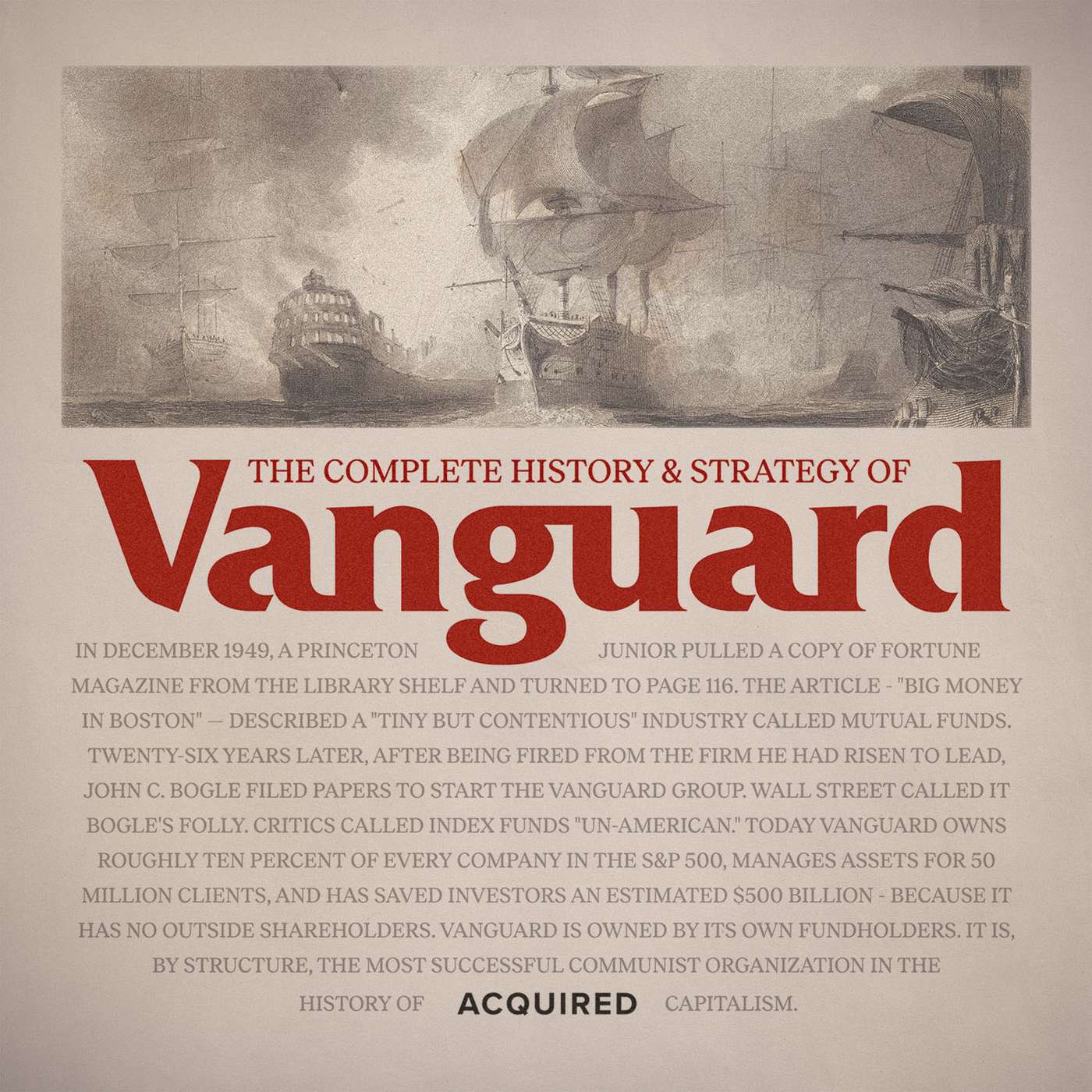
So right as this is happening, Jack gets a visit from an antique stealer. You can't make this stuff up who offers him some prints of British naval ships from the Duke of Wellington era. The Duke of Wellington was the British Prime Minister and military leader for whom Walter Morgan had named the Wellington firm. Jack is looking to the Prince and one of them is of a ship, the HMS Vanguard, which was the flagship in the naval battle of the Nile where the British forces defeated Napoleon and insured British independence and the state of Europe for centuries to come.
And so on the spot, he decides Vanguard is the name, which is hilarious because Vanguard is a great name. It is steadfast, trustworthy, everything we think of it today. Short, memorable, exactly memorable. It's also, you know, it's the Vanguard.