Like people, our pets can be diagnosed with cancer. Animal cancer treatments can be expensive. A UT's College of Veterinary Medicine makes it possible for pets and their owners to seek a cure without accumulating a huge bill. Hello, I'm Charles Denny.
This is Agcast, brought to you by the University of Tennessee Institute of Agriculture. Boo Boo, the bulldog is a sweet 10-year-old female who's had it rough lately. A few months back, she had a large tumor on the side of her face. It was surgically removed by doctors at UTCBM, and she lost an eye.
But now the dog is having additional radiation done. But her treatment isn't costing owner Jennifer Harrington much out of pocket. Of course, my name is not Hero, but Shero. She's my Shero.
So we're just... I tell everybody, every day's a blessing. This has been... you know, every day that I can have Boo Boo one more day is a blessing for this.
So I'm grateful to UT, I'm grateful to the grant. That grant helping Jennifer is from the Petco Foundation and Blue Buffalo Pet Foods. The two organizations gave UTCBM $350,000 and it runs through 2018. It pays for cancer patients like Boo Boo to get the life-saving care they need.
You know, dogs don't have insurance like people do, and it's so expensive for people to do that. And the reality is, is that you have to make a decision. You can't afford to do it. And I fortunately have this benefit to be able to give Boo Boo a second chance.
That difficult decision Jennifer talks about comes when pet owners must weigh their pets' chances for a better life against the expense of treatment. And curing a dog of cancer can be pricey. Dr. Olya Martin is with UTCBM.
On average, treatment for a medium-sized dog, so roughly 50-pound dog, and it runs up to $4,000 or $5,000 for a course of chemotherapy or a course of radiation therapy. So it's not cheap. So far, UT's vet school has treated about 25 animals in this program, saving pet owners about $100,000. Dr.
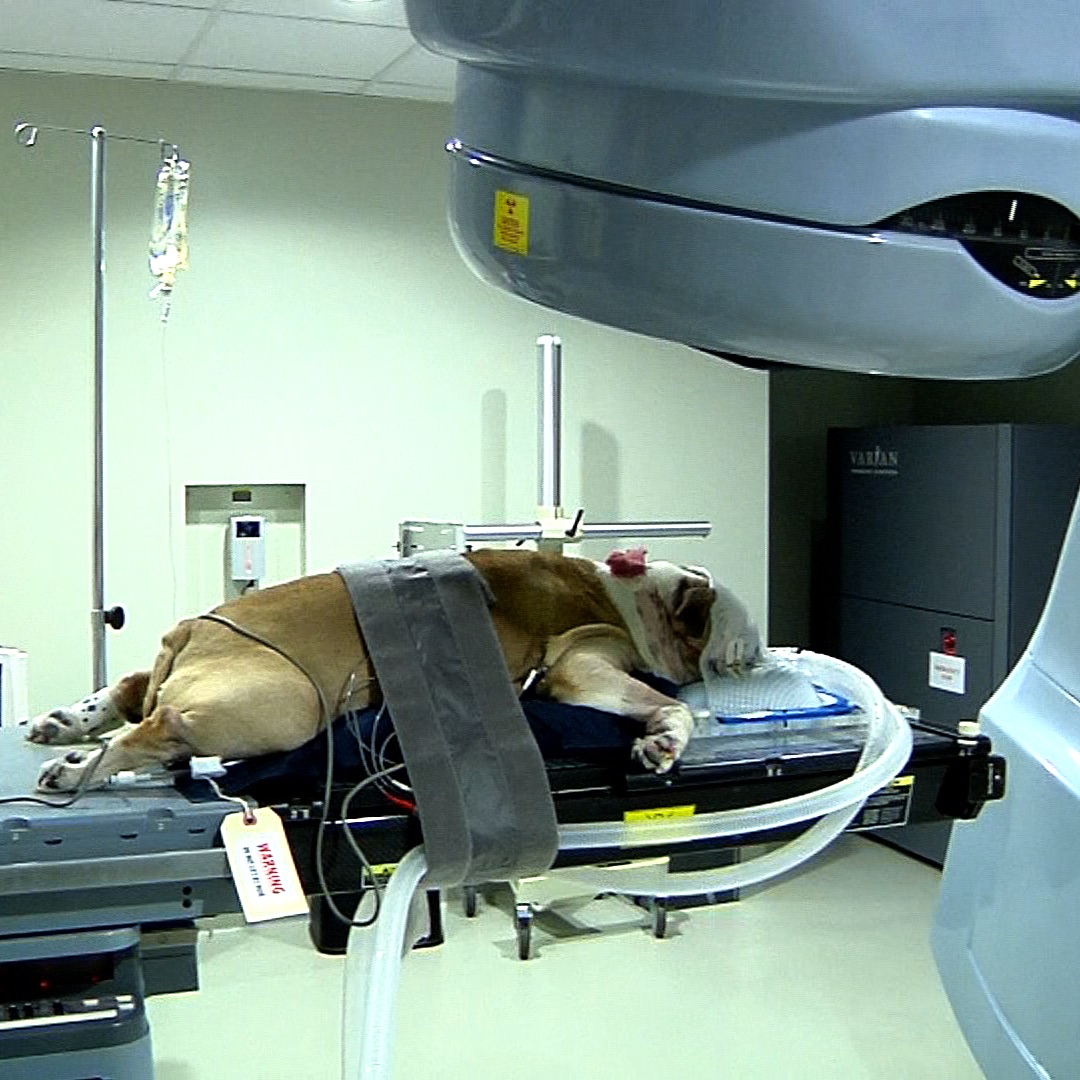
Martin says to qualify for the program, vets have to determine the prognosis for the animal, and their owners must demonstrate a financial need. One of the requirements is that the owners commit to a certain amount of money, whatever that is, that they're comfortable contributing to their pet's care, and the best is covered by the fund. Obviously, financial need has to be demonstrated by the owners of pet's care seeking assistance. This morning, Boo Boo is put under a linear accelerator, which beams x-ray like rays from below and above, aimed at microscopic portions of the tumor not removed by the surgery.
The linear accelerator is pretty much an x-ray machine on steroids. Dr. Isabelle Pfeiffer is working to cure Boo Boo, and says the dog is a fighter who's been through a lot from a medical standpoint. Full blood work, chest x-rays, abdominal x-rays, and ultra sound.
We did a CT scan to connect the terminal, is that tumor removable, yes or no, which alone is almost $2,000. Then she went to surgery, which usually is another $25 to $35, depending on what you do. And the next and final step is radiation treatment, and that's where we are today. Boo Boo receives the 10th of 16 scheduled sessions.
Dr. Pfeiffer says her outlook is good. We know the cancer that Boo Boo has called a multi-lobular tumor of bone is very treatable. It has a low rate of spread to other organs, so if we can't get local control, she must likely be cured from that cancer.
After a short session, minutes only, it's time for our groggy patient to wake up. Then Boo Boo Boo and Jennifer are reunited in a waiting area. The future looks promising for Boo Boo several more happy years on the horizon, and she and her human can focus now on fighting her disease without having to fight the cost. Thanks for listening.
I'm Charles Denney. For more real-life solutions provided by the UT Institute of Agriculture, go to our website at ag.tenacy.edu.