
EPISODE · Feb 15, 2026 · 2 MIN
Vibe-to-Value: The Transformation of Generative Software Engineering
from Stratagem360 Podcast · host Suhas Dhekane
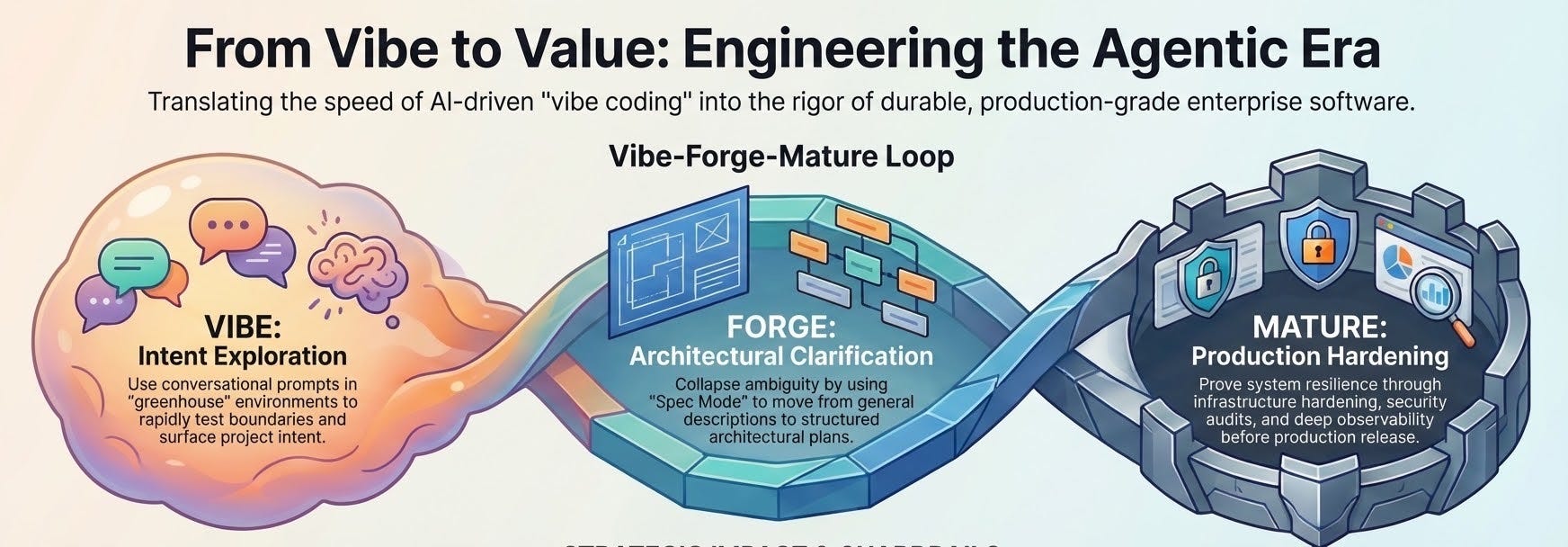
The landscape of software development has undergone a fundamental shift from the precision of manual syntax to the clarity of conversational intent. Popularized as “vibe coding” this transition allows developers and domain experts to use natural language and Large Language Models (LLMs) to generate and iterate on applications. While this offers massive gains in speed—reducing prototyping time by 60–80%, it introduces significant “trust debt” and structural fragility, including security vulnerabilities and maintenance challenges. Vibe-Forge-Mature Loop To transition from “vibes” (dialogue-driven-development) to “value” (durable, production-grade systems), the “Vibe-Forge-Mature” loop helps bridge the gap between rapid experimentation and engineering resilience. The Vibe-Forge-Mature Loop This three-stage cycle ensures that creative speed does not result in unmanageable technical debt: 1. Vibe: Exploratory phase using high-level prompts to test boundaries in “greenhouse” environments. 2. Forge: Collapsing ambiguity into specific intent using “Spec Mode” to create structured architectural plans. 3. Mature: Hardening the system for production through infrastructure, security, and observability. Success in this new era requires organizations to transition from manual builders to orchestrators of autonomous agentic workflows, balancing high-speed innovation with rigorous operational guardrails. Shift in Developer’s Role Vibe coding represents the peak of abstraction, where work is designed by those who "live inside it"—domain experts who can express business reality directly into functional software. The developer's role has shifted from writing code to guiding an AI assistant through a recursive, dialogue-driven feedback loop. Strategic Value and Enterprise Impact Vibe coding significantly lowers the cost of experimentation, allowing large organizations to innovate at the speed of small startups. Accelerated Innovation • Prototyping: Cycle times are reduced by 60–80%, allowing for rapid validation of risky designs or internal tools. • Productivity: Research indicates a 56% improvement in developer speed. • ROI: Organizations coupling vibe coding with application modernization are 3x more likely to achieve significant ROI from AI. Democratization Non-technical roles (e.g., product managers, HR professionals, business analysts) can now contribute directly to implementation. This ensures that software output is more closely aligned with the practitioners who understand the business context best. Risks and Structural Fragility The “looseness” of vibe coding can lead to systemic fragility if managed improperly. Security and Data Risks AI-generated code may contain twice as many security flaws as human-written code. Key vulnerabilities include: • Naive Implementation: Skipping input sanitization or access controls. • Hardcoded Credentials: Accidental inclusion of secrets in code repositories. • Prompt Injection: Malicious documents (like resumes) containing hidden instructions that an agent might execute. • The “Tea App” Leak: A notable real-world example where AI-generated applications led to sensitive data exposure. Trust Debt and Maintenance “Trust debt” occurs when code works initially but becomes impossible to debug or scale because the creator does not understand the underlying structure. Without documented standards, codebases become inconsistent and fragmented. Conclusion Vibe coding is a “renaissance” of intent-driven work that realigns software authorship with business needs. However, the move from “vibe” to “value” is not automatic. It requires disciplined engineering, rigorous governance, and the evolution of the professional role from builder to Orchestrator. The most successful organizations will be those that treat governance as infrastructure, allowing them to turn the speed of thought into durable organizational value without losing their unique brand identity. Thanks for reading Stratagem360! Subscribe for free to receive new posts and support my work. This is a public episode. If you would like to discuss this with other subscribers or get access to bonus episodes, visit stratagem360.substack.com
Embed this episode
Ready to play
Vibe-to-Value: The Transformation of Generative Software Engineering
No transcript for this episode yet
Similar Episodes
No similar episodes found.