
EPISODE · Oct 13, 2023 · 11 MIN
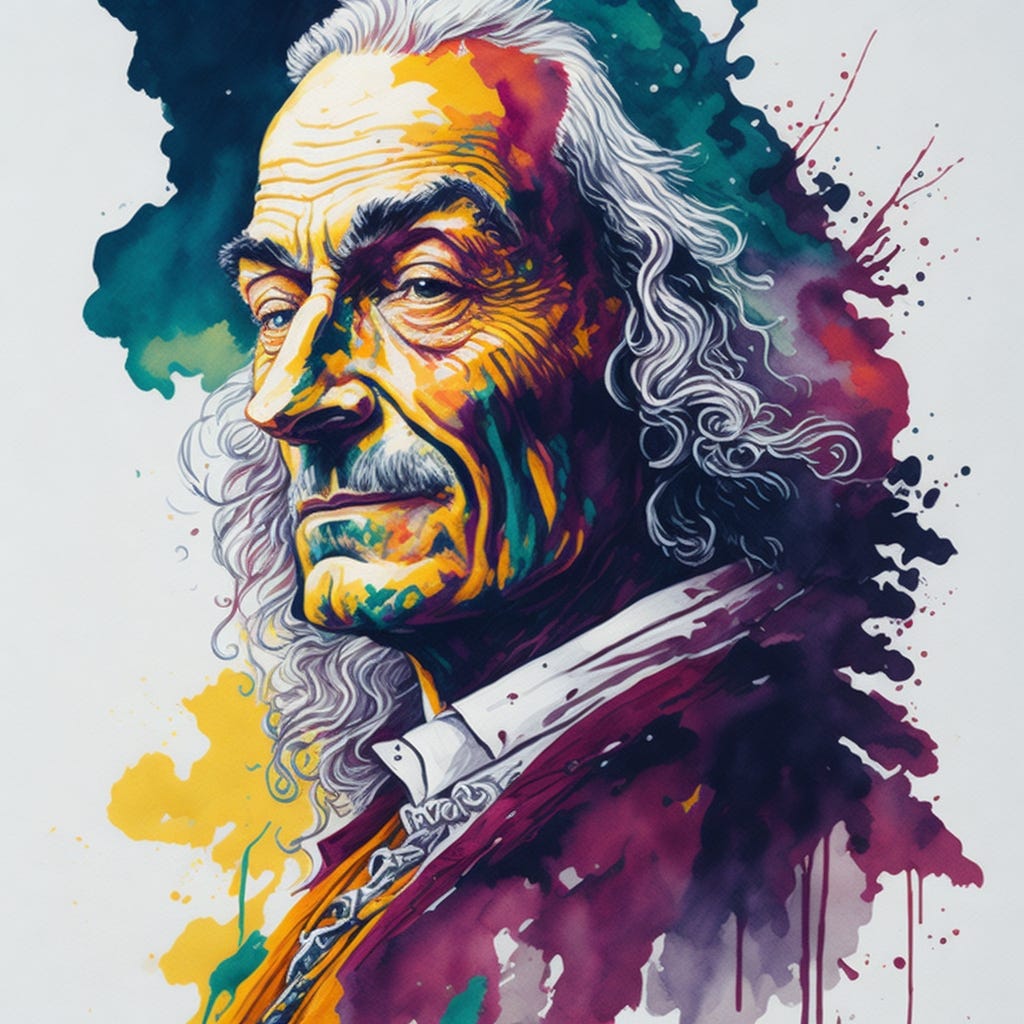
Voltaire Unveiled: The Satirist Who Lit the Enlightenment's Fuse, Part 1
from The Cogitating Ceviché Podcast · host Conrad T Hannon
PrefaceIn the history of satire, few figures loom as large as Voltaire, a man whose pen was as sharp as any surgeon's scalpel, dissecting the absurdities and injustices of his era with unparalleled wit and insight. As we present the tenth installment in our series, we invite you to step into the world of this Enlightenment giant, a world where satire is not merely a literary device but a weapon of intellectual revolution.In this special two-part edition, Part 1 will traverse the rich tapestry of Voltaire's early life, from his formative years in the politically volatile environment of 17th-century Paris to his initial confrontations with the powers that be. Voltaire's story is not just a chronicle of a life lived fully but a testament to the enduring power of critical thought in shaping history.But this narrative aims to be more than a mere tribute to Voltaire's literary and philosophical prowess; it's an exploration into the psyche of a man who never shied away from challenging the status quo, who used satire not just to entertain but to enlighten, to provoke, and to inspire. Through this lens, we hope to offer our readers a glimpse into the captivating universe of a true Enlightenment virtuoso, where every quip carries the weight of wisdom, and every satire serves as a clarion call for change.As with each chapter in our series, our mission is to celebrate the trailblazers who have left an indelible mark on our cultural and intellectual landscape. We aim to kindle the fires of curiosity and passion in the next generation of thinkers, writers, and readers by sharing these compelling narratives. So, let us embark on this enlightening voyage, tracing the footsteps of Voltaire, a man whose legacy continues to reverberate through the corridors of thought and action.Stay tuned for Part 2, where we will delve deeper into Voltaire's transformative years in England, his groundbreaking works, and the philosophical ideals that made him a beacon of the Enlightenment.~ConradThe Cogitating Ceviché is a reader-supported publication. To receive new posts and support my work, consider becoming a free or paid subscriber.IntroductionFrançois-Marie Arouet, better known by his pen name Voltaire, was a towering figure in the Enlightenment, a period that marked a seismic shift in Western thought. Born in 1694, Voltaire lived through a century that witnessed absolute monarchy's decline, modern science's rise, and the spread of democratic ideals. But unlike many of his contemporaries who were cautious in their criticisms of established institutions, Voltaire was audacious, sparing no one—be it the Church, the monarchy, or societal norms—from his scathing wit and incisive commentary.Voltaire's influence was not limited to any single domain. He was a prolific writer, churning out plays, poems, novels, essays, historical and scientific works, over 20,000 letters, and even two dictionaries. It's as if the man had an allergic reaction to idleness. His writings were disseminated far and wide, thanks to the printing press, a relatively new invention that Voltaire adored for its ability to spread ideas at an unprecedented scale. He was one of the first to recognize the power of public opinion and used it to his advantage, often bypassing traditional channels of intellectual discourse and taking his arguments directly to the people.While many Enlightenment thinkers, such as John Locke and Montesquieu, focused on political and philosophical theories, Voltaire was more of a cultural critic. He was deeply concerned with the practical implications of Enlightenment ideals. For instance, while Locke was laying down the theoretical foundations of liberalism, Voltaire was busy using his writings to campaign against the injustices of the day, such as religious intolerance and judicial corruption. His approach was less about constructing abstract theories and more about pointing out society's glaring inconsistencies and hypocrisies.Voltaire's satire was his weapon of choice, and oh, how masterfully he wielded it. His wit was not just for entertainment; it was a tool of social criticism. He used humor to make his audience more receptive to his ideas. By making people laugh, he disarmed them, making it easier to expose the absurdities and contradictions of the society he lived in. His satire was not just biting but also incredibly sophisticated, often employing irony, exaggeration, and parody to make his point.But let's not mistake his humor for mere jest. Voltaire was deeply serious about the issues he tackled. His satire aimed to provoke a response by shaking people out of their complacency. He wanted his readers to not just chuckle at his clever turns of phrase but to question the status quo and, why things were the way they were and if they had to be that way.Voltaire's audacity often got him into trouble, but it also made him immensely popular, especially among the younger generation of Enlightenment thinkers. He became a mentor to many, corresponding with them, encouraging their works, and often intervening when they faced persecution. His home became a hub of intellectual activity, where ideas were discussed and passionately debated.In essence, Voltaire was not a man you could easily ignore. Whether you agreed with him or not, he demanded your attention. His words, often controversial but never dull, forced people to take a stand. And that, perhaps, is his most enduring legacy: Voltaire made indifference impossible. Through his writings, he challenged us to engage critically with the world, question, debate, and, most importantly, think.Parisian Beginnings: Voltaire's Formative YearsIn 1694, Voltaire entered a world that was as complex as it was contradictory. Paris, the city of his birth, was a melting pot of ideas where the Enlightenment was beginning to dawn, even as it clung to medieval traditions. The city was a paradox, embodying the promise of new intellectual freedoms and the constraints of longstanding social hierarchies. It was a place where philosophers could dream of utopias while beggars languished in the streets, a city of salons where intellectuals debated the nature of liberty, even as the monarchy exerted its absolute rule.Voltaire's family was well-to-do but not aristocratic. His father was a notary, a respectable profession providing the family with a comfortable life but not opulence. This middle-class upbringing would later influence Voltaire's perspectives on social mobility and class structures. He was not born into the kind of poverty that would make him a revolutionary, nor was he born into the kind of wealth that could blind him to the common man's struggles. He occupied a social middle ground, which allowed him a unique vantage point from which to critique the elites and the downtrodden.His early education was entrusted to the Jesuits at the Collège Louis-le-Grand, one of France's most prestigious educational institutions at the time. The Jesuits were known for their rigorous academic program but were staunch defenders of Catholic orthodoxy. It was a place where young men were trained to become leaders in a deeply hierarchical and overwhelmingly Catholic society. Here, Voltaire was exposed to a curriculum that included Latin, Greek, rhetoric, and theology. The classics, from Homer to Cicero, were drilled into him, shaping his literary style and imbuing him with a deep appreciation for the power of language.However, the Jesuit education was not just about intellectual development; it was also designed to instill a certain worldview that upheld the tenets of Catholicism and the divine right of kings. But Voltaire, ever the contrarian, was not one to accept ideas blindly. Even as a young student, he began to question the teachings of his instructors, particularly those that pertained to religion. His skepticism was not well-received, and he often found himself at odds with his teachers, foreshadowing the many conflicts that would mark his later life.Voltaire's time at the Collège Louis-le-Grand coincided with a period of intense political and religious upheaval in France. The late 17th century was a time when the ideas of the Enlightenment were beginning to percolate through the intellectual circles of Paris but had not yet penetrated the corridors of power. Under Louis XIV's rule, the monarchy was at the height of its absolutist phase, and the Catholic Church wielded enormous influence. This was a society where questioning the established order could have serious repercussions. Yet, it was also a society ripe for change.Voltaire's intellectual identity was forged in this crucible of contradictions. The young François-Marie Arouet was a product of his times, but he was also a harbinger of the changes to come. His formative years were marked by tension between the old and the new, tradition and progress, authority and individualism. This tension would not only shape his intellectual pursuits but also define the trajectory of his life. From his earliest days, Voltaire was destined to be an agent of change, a role he embraced with enthusiasm and trepidation.A Pen Name and Imprisonment: Voltaire's Early ControversiesThe name "Voltaire" was not something François-Marie Arouet was born with; instead, it was a carefully chosen pseudonym, an anagram of "Arovet li," a Latinized version of his surname and the abbreviation of the Latin word 'le jeune' (the young). The name change was not merely cosmetic; it was a tactical maneuver. In a society where the wrong word could land you in prison, anonymity—or at least the semblance of it—could be a valuable asset. But the name was more than just a disguise; it was a statement, a declaration of independence from a stifling social and intellectual milieu.Voltaire's adoption of this nom de plume coincided with a period of intense personal and professional turmoil. He had penned a satirical verse that mocked the French Regent, Philippe II, Duke of Orléans. The verse was not well-received by the powers that be, and Voltaire found himself imprisoned in the Bastille for nearly a year. This was his first, but certainly not his last, run-in with the French legal system. His time in the Bastille was a formative experience that exposed him to the harsh realities of state power. It was also a productive period, during which he began work on his play "Œdipe," which would later become his first theatrical success.The Bastille was not just a prison but a symbol of the arbitrary power of the French monarchy. It was where individuals could be detained without trial on the mere suspicion of dissent. Voltaire's imprisonment was a stark reminder of the limits of free expression in a society governed by absolutism and religious orthodoxy. But rather than cowing him into submission, the experience only emboldened him. Instead of confining him, it was as if the Bastille walls had the opposite effect, expanding the horizons of his intellectual ambitions.Upon his release, Voltaire did not retreat into obscurity, choosing instead to double down on his criticisms of the French establishment. He continued to write, albeit more cautiously, often employing pseudonyms and relying on a network of like-minded intellectuals and publishers to disseminate his works. His writings from this period are tinged with a sense of urgency, a realization that the issues he was tackling were not just abstract debates but matters of life and death.Voltaire's early controversies set the stage for a lifetime of intellectual rebellion. His run-ins with the authorities were not isolated incidents but part of a larger pattern, a sustained campaign against the injustices and absurdities of his society. Whether it was challenging the dogmas of the Catholic Church, critiquing the policies of the monarchy, or advocating for judicial reform, Voltaire was relentless in his pursuit of a more rational, more tolerant, and more just society.His willingness to confront authority figures, often at significant personal risk, earned him admirers and enemies. He was a hero to his supporters, a champion of Enlightenment values in a darkened world. To his detractors, he was a troublemaker, a corrosive influence that threatened to undermine the social and moral fabric of society. But whether you loved him or hated him, one thing was clear: Voltaire was not a man who could be easily silenced. His voice, amplified by the power of the pen and the courage of his convictions, would continue to resonate, challenging us to question, to doubt, and to seek the truth, no matter the cost.Postscript for Part 1Thank you for joining us on this journey through the early life and initial controversies of Voltaire, a figure whose wit and wisdom have left an indelible mark on the Enlightenment era. But rest assured, this is merely the tip of the iceberg. In Part 2, we'll explore Voltaire's transformative years in England, his groundbreaking works, and the philosophical ideals that made him a beacon of the Enlightenment. Stay tuned for the continuation of this captivating narrative as we delve deeper into the life and legacy of a true intellectual revolutionary.~ConradThe Cogitating Ceviché is a reader-supported publication. To receive new posts and support my work, consider becoming a free or paid subscriber.Do you like what you read but aren’t yet ready or able to get a paid subscription? Then consider a one-time tip at:https://www.venmo.com/u/TheCogitatingCevicheKo-fi.com/thecogitatingceviche This is a public episode. If you'd like to discuss this with other subscribers or get access to bonus episodes, visit thecogitatingceviche.substack.com/subscribe
Embed this episode
NOW PLAYING
Voltaire Unveiled: The Satirist Who Lit the Enlightenment's Fuse, Part 1
No transcript for this episode yet
Similar Episodes
No similar episodes found.
Similar Podcasts
No similar podcasts found.