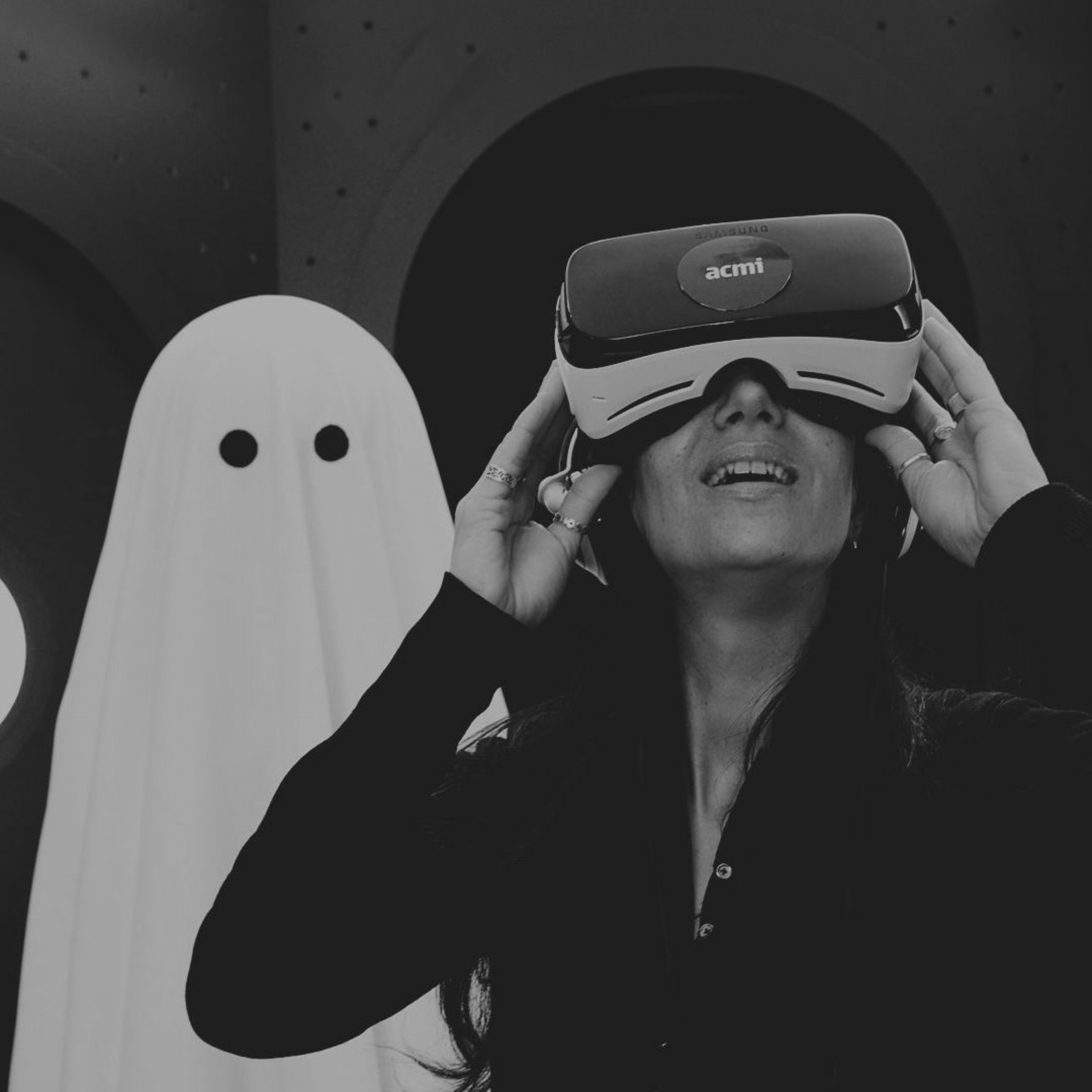
Thank you. My name is Sarah Tutton and I'm Senior Curator here at ACMI. I am moderating the conversation this afternoon, which is called VR, Hype, Hope or Just Heart. What we're going to do is have two presentations and then we're going to have a conversation. The conversation is going to be between us on stage and between you people out there. So I think what we'll do is get the microphones roving out there after the presentations and we can all do it together.
I should give you a bit of background about ACMI's relationship to VR. It's been quite a long relationship. I work in exhibitions and my relationship with VR has actually been over probably the last two years. But our public programs team and our education team have been engaging with VR with students for quite a long time and making some really interesting work. For us in exhibitions, it's really been about commissioning work and presenting work in the last few years, some of which we will talk about today and some of which has actually been in collaboration with our second speaker, T.
But we can talk about that as things get going. So, some introductions. Our first speaker, and I'm going to read these bios out, is Nils Pakel, who is from, or his title is a Digital Experience Manager at Auckland Wall Memorial Museum, where he's working both on permanent gallery development and temporary exhibitions. He consults with teams across the organisation, working on a range of different, often storytelling, VR experiences. He is the resident futurist and has been driving the digital R&D program at Auckland Museum over the last few years.
Our second speaker is T Oglo, who is based in Sydney. T has worked at Google for nearly 10 years, starting Google's creative lab in Europe and since 2012, being a creative lab for the Asia-Pacific region in Sydney, Australia. She works with cultural organisations and practitioners to enable artists, writers and performers to look at new ways in which we can use digital technology to augment traditional art, theatre and music. And T is one of the few people in this conference who has actually participated in making work. So I think that's interesting and I think it would be nice in this conversation this afternoon to talk about it, not just about presenting VR works in the museum context, but also making and commissioning works in that context.
Okay, so we hope to be a little bit controversial to look both, I suppose, at the hype and the reality of VR. And I'm hoping that these two presentations draws that out a little bit. We can talk about it. It's up to you, Niels. Right. Good, everyone. Thank you for the introductions. Okay, so I'm going to... I thought of this maybe giving a bit of a primer on VR, where we are at Auckland Museum and where the kind of thinking is that is informing some of the stuff that we do.
And I'm mostly going to be talking about VR and if I say VR, that's either real-time rendered experiences using game engines, which can be interactive or non-interactive, or linear 360 video experiences. So those are basically the two types that we're dealing with. We also have been doing quite some interesting work in the sort of AR and MR space, augmented reality and mixed reality space, which I'm mostly going to be skipping over in the slide just to kind of keep it a bit confined, but happy to talk about that more on the panel. So, as you might have noticed, VR has had a bit of a moment lately. That very seductive illusion, as John put it earlier today, has generated quite a bit of hype. And let's talk about that. So 2016 was dubbed the year of VR, and it generated an incredible amount of public interest and media coverage. And that was mainly fueled by the release of a range of VR-capable devices to retailers for everyone to buy, first as development kits, and then as a thing that anyone who had enough cash could buy.
And what we see now is that there is a market with multiple competitors emerging, and a lot of business sectors are really pushing into VR from all sorts of directions and wanting to get a piece of the pie. And we can see that nicely demonstrated in this Google search trends graph over the last couple of years, and you can clearly see that huge spike there, which coincides with the release of said devices. Also do note that the curve is going down, which is an interesting thing to bear in mind for later. Unfortunately, the Google search trends doesn't go back further than five years, but if it would, we would see additional smaller spikes in the past where VR had a cautious attempt to get somewhere. And I believe this time around it's a bit different from those attempts in the past.
because the technology is increasingly catching up with the vision. So we're getting more powerful computers and overcoming some of the teething problems of the head-mounted devices, the goggles, and the things are becoming a bit more affordable. And I think anyone here who has tried one of those current-generation devices will agree that actually they are pretty amazing, and the resolution and the response is really impressive. Now... I don't know how many of you are familiar with the emerging tech hype cycle. I love this. Basically, what it does is takes the current buzzwords every year and maps them across a number of phases that they all go through. So it starts with an innovation trigger, and then we're all hitting that peak of inflated expectations, which gets us right up there to the top, and then all the way down into the trough of disillusionment, making our way up the slope of enlightenment until we finally reach that plateau of productivity. And in 2016, Gartner predicted that mainstream adoption...
of VR and AR is around about five to 10 years away. So that's kind of where that is. Once we've made our way up the slope of enlightenment, everybody thinks it's a good idea and they all start using it. So what does this mean? And I think to get a better idea of what mainstream adoption can look like, I'm not saying it's the same for this, but I think it's interesting to look at smartphone penetration today. And a recent poll suggested that this year, 92% of New Zealand adults, I live in New Zealand, will have a smartphone, 92%.
So as I said, I don't expect that in five to ten years everyone's going to wear head-mounted devices. Maybe they will. But what we do know is that a lot of people will be using these sorts of devices on a daily basis for stuff that we probably don't have any idea of today. And that begs the question what that means for us as museums and for the world that we live in. I mean, I hope it's not going to come to that vision that we saw earlier from Keiichi Matsuda that shows an overly saturated augmented world. It's a beautiful piece of work if you want to check it out.
But I think it is safe to assume, that's a bold assumption, I'm gonna be throwing a few bold assumptions around, this is one of them, that wearables are the new frontier of BYOD. So assuming that a lot of people will be carrying these devices with them, it means that, with a caveat, sorry, that there is always gonna be a digital divide, and that's always gonna be an issue, so not everyone is actually gonna be able to afford these sorts of devices. begs the question how ready museums are for these really truly disruptive shifts in visitor behavior and expectations, demands, changes in learning models that come with a generation that is growing up with this technology. And, you know, just ask yourself the question, if someone would come to your institution with a HoloLens on their head today, what sort of services would you be able to provide, should you be able to provide for them to have an experience or none is a perfectly viable answer.
But also consider that today we're developing new permanent galleries with a development lifecycle of maybe two to five years of planning, and then they have a lifespan of 10 plus years. Does that mean that we have to front foot the trend here, or is it just a big fad? I think if we do accept that AR and VR or 3D-based experiences are an additional endpoint in the future, whatever that looks like, it means that we need to start planning for it today. At the same time, we mustn't be starry about the whole thing. I mean, that old mantra of don't use tech for tech's sake obviously applies to this as well. And it will quickly lose its wow factor as it becomes a mature product. So we need to think about what we left with beyond the hype and focus on that and trying to do eventually that. And I think that's a nice segue to some of the hopes that I think are associated with this tech from a museum perspective.
So why are we museum folks interested in virtual reality in the first place? I mean, talking about this, I'm always very mindful that we're still riding on that peak of inflated expectations. I certainly am. I admit to that. But I think there's a reason for it, and there's a promise in it. And the reason is that VR, or the hope is that VR will become an equal tool in our holistic storytelling and educational toolbox alongside our objects, our labels, our kiosks, et cetera, all telling that one story or even enabling entirely new ways of storytelling.
using those unique traits that VR brings to the table that we can't do with any other forms of interpret at this point in time. And there's a few examples for those. I mean, the biggest one is this ability to convey a true first-person view, this idea of empathy machines, really being able to place people in a different... person's point of view. And one of the most haunting examples I've come across is this app by The Guardian and Amnesty International. It was released early last year, I think. And it places users inside a solitary confinement cell to invoke that feeling of being locked up inside there. And I can tell you it's a very haunting and scary experience because you're sitting there and it's very tight and you imagine yourself, oh God, this is not good. I don't want to spend years in the cell. And that's an effect that is very hard to convey in any other way.
Secondly, VR enables full immersion. So the ability to take visitors to a different time or to a different place. And this is a beautiful example from Stanford Uni where the user takes the perspective of a coral to feel what ocean acidification looks like through the perspective of a coral reef. That's quite interesting. And another trait that comes with VR is the ability to overcome physical constraints of our gallery. So being able to show objects at scale,
or bringing them to life within context, placing them within a context. And I love this example from Google Arts and Culture where they've remodeled a museum space, as it is, as a 3D model. And as you put on your goggles, the space fills with water, and the skeleton on the wall comes to life, floats away, and then eventually comes back, eyes you out, and scares you a bit. And that's an amazing experience. And it's a great example for how I think how VR can work inside a gallery environment where it really extends the spatial experience that people already have, that visitors have. And then, of course, there's also the promise or the threat that it overcomes the physical constraints of our buildings as such. Because, of course, you don't have to be in the museum. You don't have to be in the gallery to have that experience. Anyone can download that and check it out on their phones. Again, just something to be mindful of and something we can talk about.
One thing that is very clear to us, that at least at our museums, in the two times that we've had major installations of VR, is that visitors love it. They love it. And we have some hard numbers on that that support that. So it's, you know, all sort of fears aside, obviously there's something in there. There's a need there that we can service. And we're still yet to find out whether that is still the lure of the technology as such, or whether it's the added experience that this enables.
Now, I think also as museum people, we are attracted to VR as it actually utilizes some of the core disciplines that we stand for as museums and are really good at. So there's obviously the content side of the objects. There's the curation of these objects and the storytelling using these objects and our ability to design experiences. So there's actually quite a bit of overlap in terms of the things that we do. And consequently, a lot of museums, including ours, are experimenting with this stuff. And we're all learning as we go. And frankly, I think as we all follow that slope of enlightenment, there is a lot of experimentation going on everywhere, really, which is not limited to our sector. And that's because it's new to us, to most of us anyway. And it ain't always easy. And that kind of brings me to the hardships. Basically, there are two dimensions to this. There is the visitor experience, the experiential side of it. And then there's the stuff that needs to happen behind the scenes to enable those experiences. And I want you to meet Steve. This is Steve.
A very approachable guy, actually. He's our ICT infrastructure manager. But sometimes he hates my guts. Basically, every time I wave that VR flag in his face, and for a reason, because he's worried about super bespoke content that is stored in a compiled app, which is very difficult to maintain over time to tweak, to debug. It's basically, once it's deployed, it's a black box. It's very expensive to put on the floor because it needs high-end gaming computers, and it needs one computer per headset.
and high-end graphics cards and so forth. So one of those computers can easily clock in at sort of three, four grand each, plus the headset on top of it. And it doesn't scale. It's very hard to integrate. So there's no remote device management that maybe checks whether those goggles still work because they notoriously break down. I'll get to that. There's no central content management system for VR experiences yet where I can say, if I roll this out across the entire museum and I have one VR experience in that gallery and one there and one there, there's no central way for anyone to manage that content yet.
And then sometimes his buddies from the AV and display team join him in hating my guts, and that's because the hardware doesn't stack up. It's very delicate and laborious to maintain and to keep going. I mean, this pile of junk that you're looking at there is a result of only a couple of weeks on the floor with normal sort of visitor use. So we had, in this one gallery, we had four units with the VR, and we churned through 15 headsets, I think. and then kind of started to piecemeal them together and using the bits that still worked and kind of sold it and stuff because it was becoming unaffordable. So that's a big consideration. Then moving on to the experiential side of it, the exhibition developers have concerns as well because VR is very much still considered to be a single-user experience and probably is in many cases, though there are clever ways around that, and again, we can talk about those later on. Usually, these experiences are still tethered, so there's a cable attached to the droggle that goes into the computer, which means that people have to be seated. Plus, it works best in an empty room.
But then if you look at this, which one of these two looks more like a museum environment to you? Probably the right one. And that's from the Oculus Rift health and safety requirements, right? So that tells a story. So that means that VR comes with some really hard sort of spatial requirements. You don't want any objects or cases to bump into. You need to be able to install sensors that track the head movement of the devices, which are notoriously bad at playing nice together if you have more than one headset in a room. That's what we found anyway. And then there's the general fear that visitors may struggle.
This is just one of many, many poor souls on YouTube that are filmed having their first VR experience. So I really feel sorry for her, hey. But so there's things like sim sickness, this idea of coming off the boat and getting really sick, and disorientation like we just seen there. There's a really interesting phenomenon that I didn't realize was a problem until it happened, and VMR showed that it was an issue. It's this idea of being disconnected.
from your physical body as you are immersed in the virtual. So you're looking around the virtual world, but you don't see your own body and you don't know what's going on around you. And that apparently creates anxiety in some visitors because there is a disconnect between your physical body and your sensory experience, your visual experience. And then, of course, hygiene. So this is lint, hair and skin particles and grease and all that stuff that built up over just a few weeks as well.
Even though we had visitor hosts cleaning these things, but it's stuff that just goes into those little cracks and crevices that you can't clean that easily or visitor hosts at some point just kind of brush over. So would you want any of this anywhere near your eyes or your visitor's eyes? Probably not. And I was grossed out taking this photo because I had to touch these things. And they don't get better all the time. And then, I mean, health and safety in general is a concern. So the headsets themselves come with a whole rafter of warnings from the manufacturer, which can sound pretty great if you look at them. Luckily, in those two installations that we had and any of the powering stuff that we did, none of our visitors experienced any of these things. So we had no interferences with pacemakers or anything like that.
Thank goodness. But I think it should nevertheless be considered a risk and be added to your risk register when you plan for using it. But all those things aside, I think I have a few hunches of where it might go and why it might still be good to be interested in it. So let's assume one of those world assumptions again that AR, VR is here to stay and it will grow. That means we need to embrace it. If it's an unstoppable force, we need to roll with it. We need to try with it. We need to play with it. We need to evangelize it internally, create an awareness and be in that space and be part of that conversation because we don't really know where it's going.
So I think it's important to position ourselves as a contributor in that space because it can lead to some amazing projects. And the HoloLens, the Holocano project is one of those, is an example of one of those, where we just kind of were in that space, went to those events and talked to startups and stuff and came to develop a HoloLens app, our first HoloLens app, which will literally augment our educational programming around volcanoes. So you can place a virtual volcano on a desk and lava will come out and it will flow down the desk and flow on the floor and then you can change the viscosity and the pressure of the volcano and it does stuff. Watch the space because it's not done yet. So my advice is to get in there and experiment and plan for that mainstream adoption, really. Get a kit, at least a gear or a cardboard. They're very, very cheap to get and just start playing with it and see what comes out of it and be able to talk that talk to be ready for the discussion. And ultimately, because this is a conference about risk, is we are going to kill museums. Tentative no.
I don't think so. But I think another way of looking at it is if our core discipline of our people is to curate objects and tell stories to them, maybe we are the ideal people to create VR experiences. Maybe in a not-too-distant future, there's a job of a VR exhibition developer or a VR curator on the horizon, which would certainly be preferable from a conservation point of view, and probably also better paid. Thank you. I'm going to try the roaming mic. It's been a very long day, hasn't it?
I do really appreciate you all staying. It has been a day full of information and thoughts and stuff to think about. It's very nice. Sarah pointed out that I'm a maker. I'm also corporate. And I think I'm only one of two speakers who are outside of institutional...
institutional and organizational kind of museum making. And I'm quite a long way outside of that. But I'm also quite a long way outside of Google. So you'll be glad to know that I'm not actually here to talk about Google or what Google does or how Google should do it. I'm going to talk a little bit about a few of the projects that I've worked on and how they interact with museums and very much...
sort of, I'd like to actually just play a counterpoint to Niels. So we'll see, all right? You can tell me whether I hit an effective counterpoint. So when I have to come into the country, I have to write down what I do, and I have to say that I'm a designer for Google, and that's about as designing as I get. I draw whiteboards, and then I find very talented people, and I ask them to make them into things. And it's one of the greatest problems I have is being asked what I do for Google, and the second greatest problem I have is being asked why I'm allowed to do that.
So along with whiteboards, I tend to do, I talk a lot. So I have a little, quite well watched talk about physicality and digital and how we can hide digital in the world we live in, even as we move through. And I'll show a couple of examples of that. And a little book about what we don't know and how valuable that is. And of course, I now increasingly, something of a spokesman for trans rights because I'm transgender. And if you haven't noticed that, it's probably time to shut the laptop. But mainly I do this.
I take artists and writers and people who dream and create, the people that make the art that we end up archiving, documenting, recording, presenting in this extraordinary array of ways that you've all been speaking about today, which has been so fascinating. I mean, it is so fascinating to listen to this discussion which starts, what is a museum? because I'm there thinking, what is art? What is culture? What are plays? What are literature? What is these things? And how does the technology affect it? So over the last 10 years, I have been playing with these ideas in this space. And I'm not going to talk to any of those, but there are a lot.
One of the very first projects we did was a very little experiment, which really came from a completely crazy girl called Clara in Madrid. And she wanted to use Google Earth to zoom right down on top of the Prado and go into the Prado so then you could look around the Prado whilst you're inside the Prado and see all of the art. And we thought this was a completely bonkers idea. And we did an experiment on the internet, which you can still find, actually. So that's 2007, 2008. Street View then came along. It became valuable for Google to play with this idea. A group of people, we have this thing called 20% Project. They turned it into the very first art project, which involved talking to a lot of museums who thought it was a bad idea as well.
That then turned into a cultural institute, and that has recently turned into arts and culture, which we just saw this extraordinary example from. It is very much more about this idea of archiving, documenting. It is more the anachronistic idea, or perhaps, of what a museum is online. I don't really do that. And so I sit slightly again outside of that space and that I'm working with curators to create the kind of work that we can do. This is the nearest project that I have to a kind of classic museum project. We did a year-long exhibition at the Science Museum, which was really about this idea of whether it is possible to touch the internet. How do we turn the internet into a physical experience that people can physically examine and get into? But this is the title. And my answer is kind of like, yes.
Charlie, it's exactly the same illustration as you saw in the animated GIF, but Charlie Mucha, who runs Future Storytelling, has this lovely line, which is, good VR is not cheap, and cheap VR is not good. And the article's probably worth reading, I can't say, but I really like the quote. And what it speaks to me about is this obsession with VR as a technical experience at the moment. Because it is. We're very obsessed with the technical side of this. And everything we've just been talking about has been very technical. It's all been about headsets and things. And all of these things, virtual reality, augmented reality, mixed reality, non-linear reality, and just like normal reality, they're all reality. You can take a shed load of drugs. It's still reality. I was saying to someone earlier, once you've had a baby, that is still reality. But believe me, it is a very different reality.
So with that in mind, I'm going to show you a performance, a play that we created with Sandpit and Grumpy Saylor, who you may have heard about, who work with the State Library, one of those small teams that are doing these extraordinary work and they've come out of my laboratory. I'm going to show you a short film, which is a couple of minutes long, because there's no way to explain it. And then you can tell me what sort of reality that is. The central idea of the project that I think we all got really excited by was what if, as an audience member, you had the ability to be able to read the thoughts of the performers that you would be watching. And that became a really compelling conceit for us. Relax your face. It's showing around your face. Your forehead is all screwed up. Relax your forehead. Relax your... Just breathe. We put together a workshop to discuss ways in which we can produce a play that has digital at its core, but doesn't feel that it's led by a device or a screen. We created a number of prototypes using a gyroscope and the accelerometer, trying to get that down to a really narrow focus while playing synced audio tracks simultaneously.
I'll mention it once he's sat down, once he's had his tea. Should get that on. Is there enough milk? Oh, darn, I forgot. Toast! Watch out. All right, settle down, Morty. Settle down. Jane, Jane, Jane, Jane. My ring? What are you... Oh, my goodness, where is my ring? Where's my ring? I don't know. I just do enough to do the dishes. Oh, my God, it's gone. Technology has always been coming in and making important changes ever since the time of Shakespeare. And I think it's very interesting to see the areas in which we can use the technology that we know about, which is digital technology and information, to allow other theatre makers to understand what is possible. That was me as a boy, by the way, just in case.
Now, that experience was... augmented reality. You're in that reality. There's no virtual reality. You're not wearing a virtual reality machine. We're allowing the sound to be both ambient and directed. There's a lot of different kinds of ways in which we're playing with technology. But because we filmed it in 360, and it is a 360 experience, even though you have several different narratives moving around, it felt, actually, frankly, with Katrina and Seb's support, it was possible to turn that into a VR experience. And we did turn it into a VR experience, and we brought it down to Acme, and I think we can say it was very successful. I don't know if any of you got to see it.
One of the things that was very important about it, which actually came from Katrina, was that it still needed to be an experience, a theatrical experience. It needed to be experiential rather than simply sitting on a stool and being taken somewhere. And I think that's a very important part of when we do do those kind of VR things. And here's the thing about reality. There's lots of different aspects to it. It is not just visual.
It is not called visual reality. The virtual reality is obsessed with the visual. Despite the fact that even with visual reality, you don't even get a 180. I don't know what your range of vision is, but you certainly have no idea what's going on behind you. Oral reality, on the other hand, is 360.
Oral reality is very, very interesting indeed. Physical reality is quite fascinating. Location and orientation are like the really key things which have come up again and again and again as people try and work out what happens when they are in your spaces and you want to give them personalised experiences which are variegated and can lead people down the paths and roots and tell them the stories and narratives that make the work that they're looking at interesting. One of the real challenges is actually location and orientation. Not just where they are, but which direction they're looking in.
So just a bit of history. A long time ago, I did a play with RSC, which I think was mixed reality, because it happened across three days in real time, and was also on the internet as another reality. There was a reality of the play that we did through social media. But I don't think anyone thought up mixed reality at the time, so it was just a bit weird. And then here's another project that we end up bringing down to ACMI, and I like to show this video because it's very, very early days. This is basically, there was a phone in that cardboard box.
We're using the JavaScript in the phone to control a video, a cube, an HTML cube, which has six videos playing on either side, and those videos synchronize the sound. But James thinks it's magic, because that idea of having a physical object. Even though you actually know that there's a phone in there, even with that knowledge, the idea of having a physical object that somehow has this synchronicity of physical experience, it turned out to be really rather remarkable. And then we took that to various different places and various different content. And it was not a platform the world was not ready for. If you think about it in a weird way, it's basically virtual reality, but wrapped around the wrong way. So you still can't see what's behind you. It's just it's behind you on a cube. And you still have this fear of missing out because you don't know. And you still have this problem where the users are in control of what they're looking at. So if they're really looking in the wrong direction, they're really looking in the wrong direction. And you can't do anything about that if the action is happening behind them. And so as you see...
we bought it to acne for white knight and it was very popular and that made me very very happy indeed and as you see like actually with a lot of VR stuff at the moment what's happening is we're trying to build these old anachronistic models in we're basically trying to direct your attention so that you are always looking we're going to move you so that you're always looking but what we're really doing is moving that little square box that we're so used to using around you rather than this idea of having a physical or virtual experience this is a project that I really like it came up it was basically a wand it was basically this location tracking thing it was basically this idea that as you move through space you have We know where you are. And we have a device. It's not a computer. It's a wand. It's a stick. It guides you with haptics. And then it talks to you. And it was a failure. And I like to talk about my failures because it was too expensive. I mean, there was the amount of money that we spent working out what we were doing. And that's a sunk cost. That's something that I have to take on the chin. And then there's this understanding that you actually get to that point. You're like, it's going to cost a lot to put on. Every single time we want to do it. We can't.
And then you have to do the awful thing of cutting the string and going, no. We went back to the drawing board a little bit, and this is what we're working on right at the moment. The next time we've been looking at this idea of how do we give people this layering of reality, this opportunity to have alternative versions of stories, of narratives within their physical space, the opportunity to take all this extraordinary information, and going right back to what Elaine said, the opportunity to bring the stories that people want to pursue into the experience that they're in, rather than a didactic or linear-led story. And we end up with this little...
with this little project called xWiFi, and we're using it for lots of different ways. So effectively what it does, and this is using a screen, basically it takes the fact that you've got your gyroscope, everyone's got their computer in their pocket, and if you point it, rather than it being a phone, you just turn it into a magic sort of pointy thing. And then as long as you're pointing at the right thing... then that thing can happen. And if you've got your headphones on, or if you've got your wireless headphones on, which is even better, then you have your own personalized experience, which means you can join in. If you want to keep it, then you can keep it and drag it. This is one version of how this works. The really interesting problem, so the point is that I'm not pointing at a screen.
The phone doesn't, there's no real connection. It just uses Wi-Fi. So it just uses captive portal and some very old technology. So it works on all the phones and a web page, basically, and your touch. And it isn't pointing at anything. It's just starting from zero. So wherever you start pointing at, that is zero, zero. And then you have 360 degrees. Except you don't have 360 degrees. You've got like however many degrees there are in a sphere.
which is a lot. They're called steridians or something, and it gets quite complicated with the maths. But I'm very, very geeky. And this little GIF is just a couple of people using it to paint on a very, very small mock-up. I'm not sure why we made the mock-up quite so small. But that could be the size of a shop window, I think was the original idea. You are just really giving people an opportunity to switch something. Whether you want to project what it is that they're switching is neither here nor there. It may as well be a light switch. You can be turning a light switch on, or you can be turning on some audio, or you can be...
channeling a different path because you have your computer in front of you. So if you are actually really at a very top surface level, you're not terribly interested in this, you can keep that at a top surface level and we can begin to give people that layering of information. And the main reason I'm working on it is because it's sort of cheap. I'm increasingly frustrated by technology which wants us to do this layering of complexity. at an extraordinary kind of technical cost. And it is, like, digital is ephemeral. It's going to go. People turn servers off. Everyone thinks it's forever, and it just isn't. So we have an activation of this, which launches tomorrow. And I just left this in here because up until half an hour ago, I was going to go, yeah, so we're doing a project, another project down in Adelaide. It launches tomorrow.
if you happen to live in Adelaide. It's on for six weeks. It's part of the Fringe. It has five screens in which you move around the space and you are able to use your phone to control which side of the story you want to watch. So it's basically sort of an Annie Hall-ish sort of thing. It's all very farcical and comedic about a couple who failed to fall in love over a long period of time. And as you can see, we've still got that very kind of experiential thing. You are in and doing something because we discovered that actually if you just put stuff somewhere, everyone just walks straight past it. But if you give them something to do, then they're right on point and they'll queue up.
There are many different kinds of reality and when we begin this journey into VR, virtual reality, that is about taking a layer of the virtual and bringing it to people. It doesn't necessarily need to be this close to their face. Thank you very much. I wanted to ask you both a question to start off with which is something that as a curator working with this kind of work we struggle with quite a lot and that's about putting something in a museum or a gallery which is a quite isolated singular experience.
A lot of what we talk about, about making shows, is that it's something which is a social interactive experience. But we're asking people to come into a gallery and be alone and it's an experience that they could have alone somewhere else. And I think Ghost Toast is a really fantastic example of something that actually you couldn't, the way we presented it here was very much, it was an experience for two people in the conversation. Here we are, thank you. The experience was completed in a way when you came out of the work and you spoke to the person that you had seen it with. But I think that that...
That's a quite choreographed experience in a museum or a gallery. So I just wanted to throw that to you both about the isolation of it versus the shared experience and how we think about it. There have been a couple of examples today of people talking about shared experiences, especially with audio. Kia was talking about how effective it is when everyone is following the same audio because it creates a communal sense. Personally, I'm very keen on the idea of ambient. Speakers that allow you to hear but are also off the ear so that you get ambient sound because ambient sound is just as essential as directed sound. And this project, yes, we don't...
It's very complicated. Basically, there are two separate narratives going on for the two participants. One is Steve and one is Maud. So it's actually only when you come out, ideally, that you then talk to each other about your experience and you realise that actually you have basically watched a slightly different play. You've got half the story. You've got half the story. And it's when you speak to the other person that you understand this sort of tragedy that's happened in this relationship, which is a sort of misunderstanding in a way. Yeah, we don't flag it up. It happens or it doesn't happen.
Which is an artist's indulgence, I think. It's probably not something you were doing. But it is a very effective way of making it a personal experience. Totally. I mean, for me, I'd been working with Dan on how we would present it and I hadn't had an opportunity to watch it beforehand and I went to see it with Katrina. And it was really the conversation that we had walking back to our offices where I went, oh, that's what it's about. And that was really lovely. Because that's what we would like. Yeah. But, I mean, you don't know that the people will have that conversation. No.
No, you don't. And we showed another work, which I think... I'm pretty sure Jess, who may well be in the audience, said that she took, who claimed to be in Adelaide, they went to a bar and spent two hours talking to a complete stranger. See, that's even better. Yeah. But you can't choreograph that and you shouldn't choreograph that. And that is the slight difference between art and... I think, I mean, well, this is... That's the thing that I think would be interesting to discuss. How didactic should this be? How instructive should it be? How layered should this be?
I mean, I think there is ways how you can turn it into a more social experience. Yes, the actual visual experience is singular in the sense that only that person who wears that headset can look around in 3D. But what we've discovered coincidentally, as per usual with this sort of stuff, is that we had an experience on the floor where people could navigate freely in an open kind of world and fly around and explore it. And we were worried, or the exhibition developers were worried about parents being worried about not seeing what the kids are doing while they're flying around in that world. So what we did is we put a tethered screen next to it so that everyone could see what they're doing. And another thing that we didn't expect or didn't anticipate was that, okay, we gave them a joystick, like a little hacked thing that they could fly around with, but of course they couldn't see that in VR because they had the goggles on their head, right? And then what happened is that groups would assemble around this little unit, this little station there, and they would fly each other through it.
So somebody would take the controls and see, and then go, but hi, go, but hi, oh, let's fly in that tunnel there. And they could even relay some of, so we had beautiful conversations happening between, intergenerational conversations happening between kids explaining the technology to their parents as their parents flew them through the thing. And the parents could relay the content that, you know, the stuff that they were seeing on the screen back to the labels and the interrupt that we had on the walls, which the kids likely didn't interact with, right? So it became a, you know, unwantly so, or unexpectedly so, it became a social experience for small groups. And, you know, you get...
groups of five or six kids screaming together, go, go up, drop them, drop them, drop them in the water. And then they would fall down. So there's ways around it, I think. We did a work called Stuck in the Middle with You, which Gideon Abazanek and Matt Bates did. This is an image of what you would see inside the headset. But it had a performative element like that. We created a stage where people would walk up. There was actually a ballet bar behind them and they would lean against that, put the headset on, and then they would enter the world at the Sydney Theatre Company and the Sydney Dance Company.
And there's a moment, I won't ruin it too much because I think you can actually go and see it in screen worlds at the moment, but there's a moment where you realise that everybody's looking at you. And in a way, they are because we had set up sort of chairs like this in front of the stage where you were doing it. So there was a kind of really fun, interactive, laughing at your friends part of it. Because you do always look dorky with us. You do. And you're doing these dances. You're being asked. I think the thing that was interesting about that was that...
People totally loved it and like a lot of this work, people flocked to it and it was great. It would be very hard to have that set up over a long amount of time. So it's very much a festival content kind of work. I do think that museums are going to be in a place where they have the content to export, to publish to people's living rooms, where they are willing to have those experiences. And that's going to be very powerful.
But I'm not, I think we've all talked about, like the actual technical, logistical and experiential experience of coming into a social environment filled with objects. I mean, there's a real reason why the physicality of this space is much more powerful than us just being on a screen talking to you from wherever we were, which would have saved on some airfares, by the way. But we are here, not because you wouldn't be able to see us or hear us, but because there is something that means that we had this with the art project. convincing galleries that actually taking incredibly high-res versions of their paintings and putting them on the internet took quite a lot of bravery because they genuinely believed that people then wouldn't want to come and see the works, whereas what happened was people desperately wanted to come and see the works. So I do think that this is a rather interesting thing. As a publisher of curated experiences, I think museums are in a very, very strong position for the VR thing, but as a kind of...
having manifestations, which is where we are right now. I mean, for me, the exciting thing is that we're actively commissioning work, which we don't know how or where we'll show it. And that's not something that you usually get to do as a curator. And I think that that's, you know, really exciting. When we're talking to artists about the kind of works that we want to make with them, I don't have to say things like that's going to be in gallery two between the 2nd of August and the whatever. I'm not having that type of conversation. So it's a new type of conversation that I'm having with artists about making work. And that's great. That sort of openness to it.
to that sort of conversation in the first place, I think, is what we need to do at this point in time, you know, to be open to whatever this leads to. And even if that's nothing, you know. Yeah, totally. Even if it's a fad and then at least we've, you know, we've been on the journey. You will be learning. There are valuable things that happen. An awful lot of the information, a lot of the things you learn through, the reason I always stick up something which went disastrously wrong is because that's basically normally what leads us into our next stage. And working with the institutions that I've been lucky enough to work with, that ability to take
a chance on something that might not work out works out in the end maybe not with that one but it's not that's it's progress it is a progressive stance rather than a kind of like bastion stance of like this is what culture is and this is how we present it and this is how it is done that's what this entire day appears to have been about and it's been very interesting for me we haven't got much time left do people have questions yes do we have microphones i'm going to just put another picture up of something we've shown this is lynette paul was collisions oh do we have to pass it okay it's all right Thank you. I just wanted to find out more about the commissioning work process. I didn't realise that that was something that was done. I just wanted to just get a bit more insight into that. Okay. We have been commissioning work actually largely by theatre makers. So I think the sandpit work and...
I mean, it's very cross-disciplinary. And the Stuck in the Middle with You was made by a sort of dancer, choreographer, filmmaker collaboration. What we've found that's been interesting about that is that people who are used to working on the stage have had a natural affinity to working in VR. Having said that, I don't know if people saw Jess Johnson's work, which was at the NGV last year. Jess is a New Zealand artist, was living in Australia, is now living in New York. She very much comes from the visual arts world. And for me, that was one of the most successful VR works that I've seen.
We are, you know, I mean, I think a lot of museums and galleries are interested in making work in this space and are having lots of conversations and developing work and commissioning work with people. I think, you know, obviously Sundance have been doing that sort of in a very cross-disciplinary way as well through their New Frontiers program. I think we do. I mean, look, it's hard. So did everyone hear that question? The question was about the physical space that these works, particularly in a contemporary visual arts context, take. Look, I think, although I think Ghost Toast is probably fits between visual arts, theatre, various things, I think that that was the work that resolved that incredibly well. I think it is important. I think we're making exhibitions.
I don't know who managed to visit the Sydney Biennale this year, but there was a work there, I don't know the artist's name, I'm going to forget, about Japan, about the nuclear zone, and where the actual headsets themselves had become, had been created into objects. And the first time I went on it, on our kind of important tour, we all didn't realise we were allowed to touch the things. So they were presented as art objects, and you had to have an image later to come up with something you were actually meant to put it on. And that was a very interesting challenge, because we were in exactly that space. It's like...
The curators had treated them like art objects. It felt like an art object moment, even though there were stools, and it was clearly meant for that. So it can, and then sometimes, like the Bjerg exhibition, it's just a bunch of headsets in a room, and sometimes it can't. What's going to be absolutely fascinating is how this stuff, as Neil said, is archived, because we've already lost two generations of digital art because museums and institutions have had no interest. I'm afraid, except perhaps maybe something in the lobby, in showing and preserving work. So it is going to be really interesting to see whether this work will stay in that space, which is that it is on a slightly consumerish base because it doesn't work within systems of galleries and private ownership and organizational and institutional collections. I think from a museum point of view, the space is critical to museum experience. And I think...
that VR can be, as I said in my talk, can extend just a toolkit that we use when we tell stories within our buildings. I think it's important to really honor the fact that we are a physical building and that we stand for certain things. But at the same time, we can extend and add that additional layer of reality on top of those physical galleries, which is why I showed that example of that dinosaur there, that you can do things in the physical space that we can't physically do in the space using this tool. But it's still important to be in that space. Does that make sense? Yeah. Excellent. Thank you. Now, thank you, everybody. Thank you, T. Thank you, Nils. You have been listening to an ACMI podcast. For more recordings, go to soundcloud.com slash ACMI online or the ACMI website.