Your Uncle Dale is the undisputed king of hot takes. Buffalo, they're a lot because it's barber sets, though. Don't listen to Dale. Go with the score bet. Breaking news, live odds, and real-time stats right at your fingertips. Everything you need for game day is one tap away. Don't go with hot takes. Go with the score bet. 19 years or older. Ontario only. If you or someone you know has gambling concerns, call Connex Ontario 24-7-9-1-8-6-6-5-3-1-2-6-0-0. Text us at 247-247 or chat with us at www.connexontario.ca. Standard messaging data rates may apply.
Welcome to It's All About The Questions, where learning to ask the right questions can help you achieve lifelong success. Now, here to help you ask all the right questions is award-winning author, international speaker, and business strategist, Laura Stewart. Good morning, afternoon, and evening, everyone. And welcome, welcome, welcome to the show. If you're joining us live, I am an hour earlier than normal because that's what worked for my guest and I to do today. And she is a total trooper because last night...
Some stuff happened. My guest couldn't be here. So I said, Katie, can you come on the show? I've been wanting to have you back on the show. And she said, absolutely, yes, but I can't do 11 a.m. Eastern. So I said, OK, we'll do 10 a.m. That works just fine. That is the beauty of being in control of everything that you're doing now that I'm no longer on broadcast for over the last year and a half. I get to be a lot more flexible. And since you all know that I rarely pre-record episodes, I do stuff live. So you just kind of have to roll with the flow, which is a great lesson in life and something that.
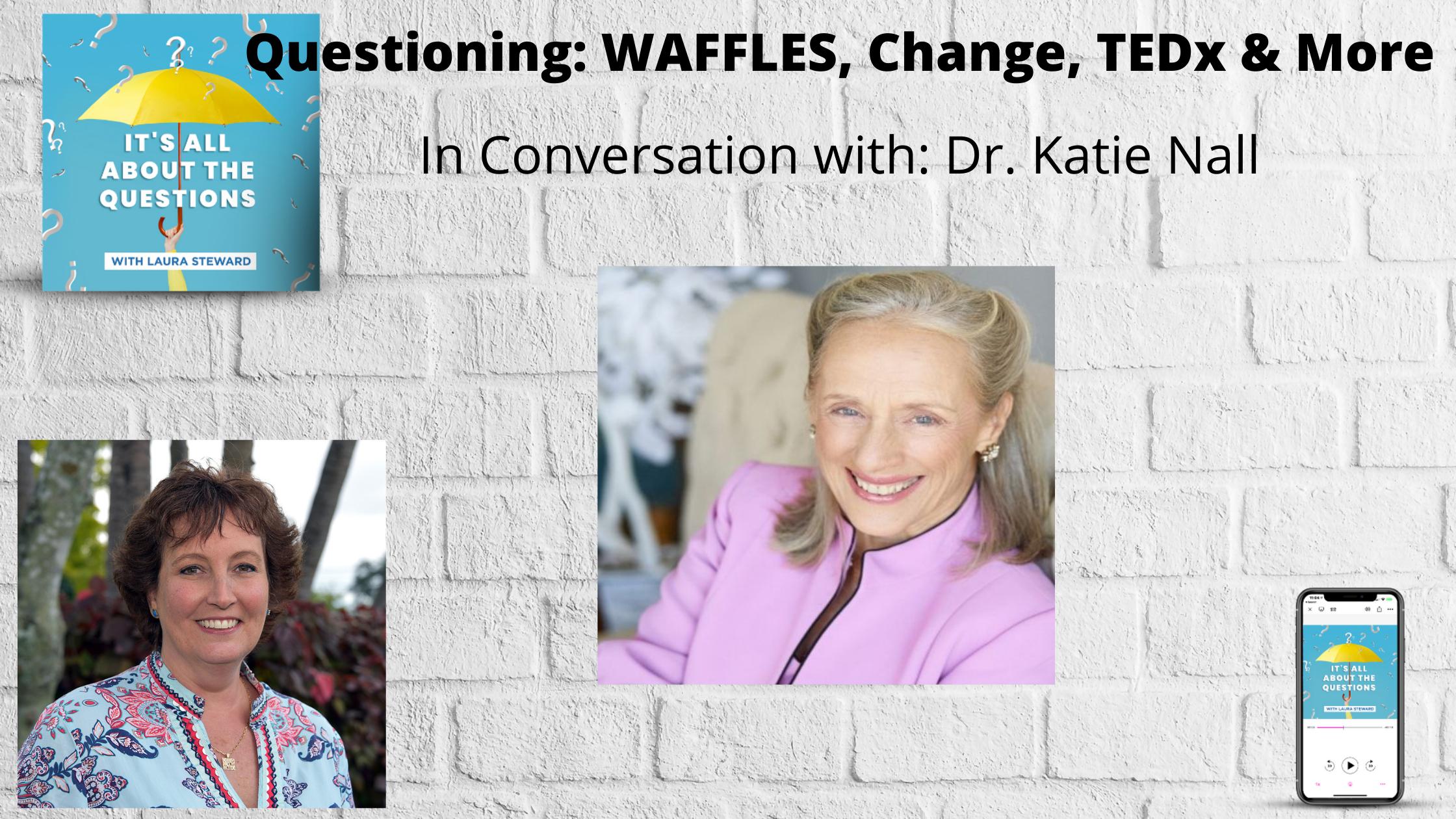
my guest, Dr. Katie Nall, is actually quite awesome at. She's a TEDx speaker. She has a PhD in mathematics. And one of the things that she does is help people get through math anxiety. And, you know, I've always been really good at math. Yes, you know, I'm a geek and computer scientist. I love calculus. Kind of defeated me. Just did not like calculus for whatever reason, but could have just been the professor. But beyond all that, Dr. Katie Nall is one of those people that you're glad to call a friend. She just seems to...
I wouldn't say that she has no fear, but she doesn't let fear or worry control her. And if it starts to, she has a lot of tips and techniques for how to move past it. She did a TEDx talk and she's got another one coming up in January. And today we're going to talk about a lot of different things. So let's welcome the one and only, the awesome Dr.
Katie Nall to the show. Thank you so much, Laura. That was so inspiring. Well, you know, I want to thank you so much for last minute jumping in on the show. And I was just like, oh my God, wait, I haven't talked to Katie in a really long time. She's done so much great stuff. I love the stuff you're doing around waffles, which we'll talk about. And you have on your, for those watching on video, she has on her little thing that says what her name is, says Dr. Katie Nall, waffles dissolver. And we're going to talk about that. But we met.
years ago because you heard my show when i was on broadcast you tracked me down via linkedin and some other social called me and just invited me out to lunch and we haven't seen a lot of each other in the last few years but i always feel as if like last night if i just needed you i could just call that's the kind of friendship i feel we created and you just recently retired from teaching And administrating at Indian River State College. So tell me what's going on and what keeps you going? I mean, you're like this dynamo. I mean, you didn't even get your PhD till later in life.
Well, Laura, first of all, thank you, one, for your show and all the amazing things that you do, and two, for this invitation. I'm just very honored. I appreciate that. Yeah, I don't know what drives me to tell you the truth, and you do ask the best questions. I did retire from the college. We had a new president come in, and he looked around and said, you, you, and you, we will pay you to leave, and I'm like, done. This is good. So that was nice, and then it allowed me to spend time on the things that I've been doing on the side anyway, a professional speaker with National Speakers Association, and now a
I have to get all the words in accredited, certified master trainer of emotional freedom technique. It took me four years working at the college, Laura, to earn my PhD. It took me eight years working at the college to be able to become a master trainer in emotional freedom technique. And for those of my listeners who may not know it as EFT, you may know it as tapping. That's right. Another name for it, which is really, it's wonderful, wonderful work. And I do do a lot of consulting and coaching of people with that. So keep going. Tell me some more about, I mean, you.
got this opportunity to leave the college, which is how actually I left Corporate Light and started my own tech services company, where they were like, well, we're having a voluntary package. And if you want it, and I was like, gee, a year's medical and six months pay, why would I not try it? Right? Yeah. What was that like that moment he said it? And what was the first thing you did? So the first thing I did was said yes. And the second thing I did was call my husband to see what he thought. Okay.
And I've been working for about eight years on my side things, on nights, weekends, vacations, and really enjoying it. It was my passion, Laura. And to be able to do it full time. was just a real blessing. Now, in terms of how do I keep going? I'm a big believer in nature. And in nature, if you watch nature, right, things are either growing or decaying. So if you're not growing, you're decaying. And so I'm always looking, I'm always learning, I'm always looking for new ideas. And I have a life goal. I don't know if I've told you this or not, Laura. So this is, I don't think so. So one of my life goals, which you mentioned, was to earn my PhD. And I was in my mid-50s when I started.
And did finish it before my 60th birthday. But another life goal I have is to dance at every one of our five granddaughters weddings. Now, the youngest one is one. So that means I have to stay in good shape for the next 30 years or else get them all married off at 13. And truthfully, I don't care. I'm dancing at their weddings.
I was like, you said five grandchildren, like, wait a minute, what did I miss? And then you just said one's one year old and I'm going, oh my gosh, you know, when you don't spend a lot of time on social to talk to people, these amazing things happen. Yeah, yeah, yeah. So we have five of them and we call, I call them team legal because the first letter of their name spells out the word legal. So I have five legal, adorable granddaughters and, and they're just fabulous, obviously.
And I want to dance at their wedding. So that led me to always learning, always doing new things. In fact, I just this year, I became a master trainer in emotional freedom technique. I became certified in Qigong and now I offer Qigong lessons. And yesterday I just finished all the classwork to do painting tapping, which is picture tapping, which is a whole new area. And I'm very excited about it. Now, the people on the podcast couldn't see the weird expression on my face. Painting tapping, picture tapping. I've never heard of that. I know. I know. I'm very excited about. Well, I do work with a lot of clients. I have clients all over the world. And I do have clients that when I say.
you know, what is the issue? What emotion are you feeling with it? And they're just speechless. They can't identify the emotion. And so instead, if I ask them to, here's a collection of colors. I usually like to use markers. Here's a collection of markers. If you could draw a picture of how you're feeling, go ahead and draw it now. And don't worry about it. Anybody can do it. It's just marks of the pen. It's just a pen talking for you. And it's fascinating. Absolutely fascinating.
Art therapy has been around for a really, really long time to help people connect to the emotion because sometimes the physical act, right, of actually drawing or writing something down can help unlock things. Once you unlock, once you do that, then you go back to the traditional tapping to help release the emotion. OK, so it's just a way of helping them connect if they can't find the words. Exactly. And we don't have to talk about what the ramifications of the issue are. So for people who've had really traumatic issues and who hasn't. Right. But to be able to write down on paper what the issue is and then put that paper aside to take a piece of paper and draw how that how you feel right now about the issue. And then we tap on that. And then.
Turn that paper over. Now, how do you feel about the issue? And you go through it. And for some people, it's two or three pictures that they have to draw. And for some people, it's 10. And it doesn't matter. But it's a way, a softer, gentler way to kind of go through the tapping exercise. That's really, I love how, let's use your nature analogy. Things are either growing or they're decaying. Although I would add sometimes they're in sort of stasis, right? You can't see that they're growing, I guess, in a way they are growing while they're dormant or whatever they're doing.
The work that you do has evolved over the years. And I'm not just talking about tapping. I mean, you as a human being have evolved. I mean, changing careers multiple times, getting your PhD, you moved, you embraced, what was the book? Life-changing things of tidying up or whatever, Marie Kondo. I remember when you did that. And you always seem like you go all in. When you see something that resonates with you, you go all in. And I know that for a lot of listeners, the idea,
of going all in can be exhausting for them. They say, I just don't have the energy for that. I want to do that, but I just don't have the energy. There's so many other things going on in my life. I've got my family. I've got this. I've got health issues. In the past, I've tried to do something and it failed or I get started, but my health won't let me continue it. So what do you say to somebody like that? Because I'm sure in your life, there are times where you backed off on something, but from what I see of you,
It's rare I ever see you not complete something. Oh my gosh, you should see my linen closet. Anyway, you're right. When I do have a goal, Laura, I do like really focus. There was a period in my life, six years to be exact.
six years where I did not have the energy. I actually was diagnosed with anemia and I went from doctor to doctor to doctor and had one intrusive test after another all along the way until they finally said, who is your favorite oncologist? And I said, oh, those two words don't belong together. And why would you even know an oncologist? Right. Yeah.
And as this process was going through, my hemoglobin, which actually measures the amount of iron I have in my blood, continued to decrease. It's supposed to be in the range of, I think, 12 to 14, and it had gotten to a low of 4. That's really, really severely low. I mean, we're transfusing blood and giving you iron infusions. Right. So I would wake up in the morning and look at the bed and say, well, I can either make the bed or not drive, but ride into work with my husband. I just didn't have the energy. And at the time, I was helping my husband with his law practice. And there would be many times during the day where he couldn't find me in his very small four-room office because I would be sleeping underneath the table, on the conference table. I just had no energy. I would walk into the doctor's office and they'd say, how were you able to walk into here?
And I have to tell you the power of affirmations, Laura. Bob, my husband and I were laying in bed one night and I was like, I don't know what this is. And no doctor had any answers for me. I couldn't figure out what it was, what was happening. And he was so sweet. He was laying there next to me and he said, he closed his eyes and he said, I can see where your hemoglobin is at 13. And I turned to him, I'm like, really? And he said, oh yeah, I can see it.
And I said, okay. And I went to sleep and really his, I have no idea if he was lying or not, but it doesn't matter. Right. It gave me such hope, such, such a great feeling of I can be better. I could be better. Now, what was interesting, Laura, is during that time, it was actually before a lot of the social media got taken off, but I dropped back from all my volunteers. I dropped back from things and it was very interesting. I didn't tell a lot of people what was going on because I didn't know what was going on. I just, I had no energy, but it was very interesting that the number of people or the few number of people who would call to check on me.
And that was a very interesting process. I had another period of time for about five years where my husband and I didn't talk to one another. We just didn't talk. The only thing we might say is I might snarl at him and say, are you still here? It was just really awful. Considering how much I know of you guys, that's just shocking to hear. Yeah.
It was life. You know, we both had very active careers. We had three fabulous children. And, you know, all of that goes into it. I had my mother-in-law who basically lived next door to us or lived with us. And it was really wonderful. But it was very, very stressful at the time. And so I kept asking for a divorce from one of the best divorce attorneys in town, my husband. And he was not giving me a divorce. And I said, look, I'm going to make this easy for you. All I want are the three kids and your mother. He said, you can't have my mother. Why don't you have her?
She does all the cooking and the cleaning. I mean, we paid her handsomely. And so every day it would be, are you still here? I need a divorce. I want the kids. I want your mother. Yeah, it was horrible until I actually got a book. We were in a bookstore in much the same way that I found your book. And I got a book. And my husband was looking at the book. And he said, oh, this looks interesting. I think I'd like to read it. I said, really? You'd read this? Because he's not as big a reader as I am. And he said, yeah, I'd read it. So we got it home. He never read it. I read it. OK. It was The Power of a Praying Husband.
I'm not a husband. Okay. It was by Stormy O'Martin. And so I thought, huh. So I went out and bought the power of the prayer in life. And again, it was through an affirmation. And this is only two times in my life that I've seen affirmations actually work. Because for the most part, when I use affirmations or, you know, things from the secret or things, I haven't seen them come into fruition. And I know why now, but these two things actually happen. And one of the things in the power of praying life, it said every day.
say what you want from your relationship. And so I would look in the mirror and the first few times I did it, Laura, I was just laughing hysterically. I was like, yeah, mirror work can be really hard. It's hard. And then having to say the statement, which I felt was so untrue. And I would look into the mirror and say, I love my husband and my husband loves me. And I'd laugh and laugh and laugh, but I did it every morning. And I said it every morning to the mirror until about a year later, I was in the shower and I realized my cheeks were not wet from the shower water. I was just crying hysterically because it was that point that I realized how much my husband really did love me.
And, yeah, and everything changed from then. So you just told two powerful stories about moments when, like, all hope felt lost, right? That you needed to make some changes. In both cases, you didn't know how to make the change, especially the health one. You keep going, you know, you go to doctors trying to get answers, and you literally feel like you're a guinea pig. And you're like, this shouldn't be that hard. And as a woman with medical health issues, we both know that oftentimes they're not really paying attention.
they're just like always hormones it's this it's whatever it may be the i'm twice divorced so your second story resonates you know you can try and try and try and sometimes you just can't get past it what do you think it was inside of you that enabled you to have the stick-to-itiveness whatever you want to call it that five years to be in a marriage where you're unhappy is a really long time. Six years of health issues, I can relate, is something that takes a really long time. You know, it's just defeating. So how during those times was there, you said these affirmations, your husband did this one affirmation, but to my listeners, they're going, oh, well, she just must be unique in that she was able to do it. I mean, she got her PhD in her 50s. So her personality is just, I will overcome. Oh, so Laura, the...
The part about the divorce, every time, first of all, I was the oldest child of a single mom back when there were no other single moms. My mother married and divorced four times. I have a whole staircase full of parents and siblings. So I knew what it was going to be like. I knew, first of all, that the standard of living was going to be different. And I always used to tell when my husband first got into family law and I would hear about the dynamics of the case, it dawned on me. I said, nobody wants a divorce. What everybody wants is for the other person to just completely disappear off the face of the earth and for them to maintain their standard of living.
Which is not the reality of what actually happens. It's rarely what actually happens. That's a good story. And so every time I asked for a divorce, something would show up on my email. Something would show up back when we were reading newspapers and magazines. I would get a phone call. I would hear another story reminding me of what it was going to be like for me and the kids if I went through a divorce. And I was like, oh, yeah, I remember. I know what that's like. And so I was like, OK, I'll give it one more day. And really, that same philosophy got me through my health issue. I'm going to try one more day.
I just I just all I can do is one more day because I can't I can't think that much further. I mean, we had we had kids in college when I was so sick and I want to go to graduation. I'm going to try one more day and just see. And every day my hemoglobin levels would go down and down, down. It's like I'm going to try one more day. I'm just going to try one more day. And that's that's all I had the energy to do. That's all I had the energy to do. Do you think that.
Let's change the question. Is that where your work around waffles came from? Those lessons that you learned going through all of that? Wouldn't that be a great story? But no. No, my waffles came from, you know, my husband hates it when I say I'm lazy, but let me just say I'm streamlined. Okay. I'm very streamlined. You're efficient. Efficient. There we go. Efficient.
And when I was looking, doing research for the dissertation topic that I wanted, I was looking for a way to help the students who came into the college office saying, I have one class left to finish. And I'd be like, great, let's get you registered. And they're saying, it's math. And I'm like, great idea. Save the best for last. And they're like, no, you don't understand.
I wanted to help them overcome their fear and anxiety about math. So I did all of this research and I found nothing that said it was going to help students overcome fear and anxiety. I thought even registering, I couldn't even get them to register for the class. So recognizing this as a word problem and in word problems, you just extract what's important. I went back and said, how do you get rid of fear and anxiety? And that was in the year 2010.
And I caught Nick Hortner's summit, tapping summit. And I watched all 10 days. I bought the book, I bought the DVD. I went back to the students who are absolutely desperate. And Laura, we both know desperate clients are the best, right? Oh, yeah, absolutely. Because they're the most open to trying something. So I said, let's try this. And they're like, whatever, let's just do it. So I had them in my office and we were tapping. And then they would come back after class and they go.
I think I passed my math class. Laura, I had no idea who was more surprised, them or me. This stuff works. Oh my gosh. So I realized, I recognized that I was self-taught and I thought, I better get certified because I have no idea what I'm doing. A lot of careers start, right? So I went back and I got certified level one, level two, level three, trauma, quantum.
That's very interesting going back into past lives. Supervisor, mentor, and now I'm a trainer, which I'm very excited about. And I'm finishing up my picture tapping. So I've been able to offer these kinds of services to people all over the world. I have, obviously, I have clients who come to me for math and test anxiety. I have a great story about a student who's given me permission to share the story. She had taken her SAT test and had done very well. She could probably get into the school she was interested in. And for my international listeners, SATs are a standardized test that every high school student needs to take if they want to get into college. Thank you for that update. It's a scholastic aptitude test, I believe. And it covers math, English, and I think a general kind of thing. But she scored well.
And but she she wanted to do better on her scores for scholarship opportunities. So she signed up and paid for a second one, studied every day up until that second test, took the second test. And Laura, her score went down. Oh, I hate when that happens. Oh, I know. We've all done that. And she said, my gosh, I'm going to get that. So she registered and paid for the third time.
and you know she was a senior in high school life got busy and the saturday the week before her test she panicked and she said i haven't studied at all and her mother knew me and so she hired me and we tapped on a monday morning on a wednesday and on a friday she took her standardized test again on that following saturday raised her points 90 points that's a significant jump yeah and it was all due to the tapping The whole idea of anxiety is how it manifests in the body, right? It's like a chemical, total chemical thing that happens. And I mean, I know I've dealt with it when my ear triggers, which it did last Thursday. I had to drive to a dermatology appointment and whatever was going on with the car and the road noise and whatever, it triggered my sound induced vertigo while I was driving, which then within seconds cascades all of the norepinephrine, epinephrine, cortisol.
you know, all of that. So anxiety is real in terms of how it happens in the body. But in some cases, it gets exacerbated by the mental part of it, right? In my particular case, it immediately triggers because my body has this external stimulus that if I can shut it off, you know, if I just block all hearing, I don't get the symptoms. So I don't go into the anxiety. The work you do around waffles, and I wrote down because I didn't want to forget this. So waffles are worry, anxiety, fear, frustration, lethargy, exhaustion, and stress.
I know tapping can help with a lot of that, but last night I didn't sleep. I think I dropped off around six or seven o'clock this morning. It's a pretty regular thing for me. Sleeping can be very, very difficult. I don't know why. It's just my body gets triggered somehow with too much chemical, whatever. And I don't drink caffeine or anything like that. So it's not like a caffeinated response. And in the middle of the tossing and the turning and the watching the TV, and I'm like, oh, I should get up. No, I shouldn't get up. You know, all of that. I'm going, I should probably tap. I'm going to have Katie on the show tomorrow. I should probably tap. But I didn't. And I just want to ask you this question around that. How do you help somebody who is stuck in a loop?
and they know that something will help them. But whatever's going on, there's just, because I get this from my listeners often, and even some of my clients, why do I keep repeating the same things over and over again? And I know that if I don't eat X, or if I take five minutes and I take a few deep breaths, that this response won't happen anymore. But I don't do it. So what do you say to that? And how do you help somebody break past that?
That is a powerful question, Laura, and I would expect nothing less from you. So there are, first of all, let's talk a little bit about what you touched on, the difference between the sympathetic and the parasympathetic nerves that we have in our body. When we are feeling waffled, worried, anxious, fearful, frustrated, lethargic, exhausted, or stressed, we have no control over what happens to our body. It's immediate, and the purpose is to keep us alive. Survival.
So just like all the things you said, it is a time where all of our energy goes to our muscle groups. We really can't digest food. We can't think clearly. We can't do any of that because our body is getting ready for fight, flight, freeze, or fawn. The way that we can counter it is by invoking our parasympathetic or our peaceful nervous system. And that has to be done on our own.
And we have to modify it. We have to moderate it. We have to make it happen. And we do it through a variety of techniques. You mentioned breathing, tapping. There's actually a great riding exercise that I have people do where they just make, they call them lace eights, where you just make an eight for people to be walking in nature. It could be anything. The sympathetic nervous system, the stress one, takes over immediately. And it takes a long time for it to naturally get into the parasympathetic or the peace mode.
But when we interrupt it by using something like tapping, and we can accelerate that so that it goes back to a peaceful. Now, what happens is that if you have been, studies have found that if as a child you had a turbulent and traumatic childhood, you may be used to having a high level of adrenaline in your body, which is what you get, right? Right. Sympathetic nervous system. And so when you get used to something, it's almost like a drug, right? Yeah.
Yeah. And so trying to counter it doesn't feel right. It just, it doesn't feel right. It doesn't, it doesn't feel like what I'm used to. And so you have to take a much more conscious effort to it and deal with it one, a little bit at a time. So first of all, I applaud you for recognizing that in yourself, because that's huge. You can't fix something you can't recognize. And so for recognizing it is huge. And then taking small steps, right? I'm going to call it the case on nothing, taking small steps. I had the thought I should do something. I just didn't do anything. Okay. So now we're talking about mindfulness.
And so having the thought is huge, right? Because then the next time that happens, you might go into the next step of, okay, I'm going to land it and maybe I'm not going to physically tap, but I'm going to remember what it feels like. You close your eyes. I remember what it feels like to tap on the top of my head. Okay. I remember what it feels like to tap on the edge of my eyebrow, right above my nose. Okay. I remember what it feels like. And so go through the tapping points on yourself because when you're so tired at six in the morning, the idea of like tapping on yourself is another energy expenditure that you may not be ready to do. Especially when you're not feeling well to begin with and whatever. And then you're so exhausted. So you're like, okay, what can I eat that will give me some energy? Cause I've got to do whatever I have to do the next day. Those kinds of things that just.
cycle through. I mean, it's reality in life. Right, right, right. So short answer to that question is apples. Apples will give you more energy than a cup of coffee. So, but what that's worth. Me on coffee, not pretty. Good, good, good. Not pretty. It's really ugly. I'm the same way. I used to work at a place that would have coffee, you know, every morning. And I would take, maybe I'd take a third of a cup or something. And one morning they changed it to espresso. Nobody wanted to be around me that day. It was so bad. What was it? Speedy Gonzalez when we were growing up the cartoon? Don't do that again.
But people get used to certain states, right? And it really takes a lot of effort to modify that state, to work on one little thing at a time. So bravo to you. Bravo to you for recognizing that. Great. So I recognize it. I have a lot of listeners that go, oh, I love your show. I learned so much. Why can't I shift my habit? I can do it for a couple of days or a week and then things start to feel better. So I stopped doing it.
because I feel like things are better. And then over time, things go back to how they were or worse. So how do you help people like that, Katie? Actually, I've had clients like that. I had a client from Mexico, and he's given me permission to share the story, who lost, I think, like 60 pounds. I mean, a lot of weight. But every time he sat down to eat, he was terrified that he might eat too much and gain all that weight back. And so he was always on his own nerves. He was nervous about eating all the time. And it was actually through tapping that we were able to get rid of that. So when we do things and can't break through them, it's because the amygdala, the small part.
in the back of our brain, the reptilian part of our brain is trying to keep us safe. We may have experienced something in our childhood that we don't remember. Hypnotists have told me before that we can recall the print of the wallpaper of the room we were born in. I don't know if anyone was born with wallpaper on the wall, but the point is our brain can recall all of that stuff. And if we were in a room where, let's say, a fire broke out, and in the corner there was a red trash can, and as we left the room, whatever age we were, you know, one-year-old, two-year-old, five-year-old, 50-year-old, every time we came into a room with a red trash can, our brain would signal and say, danger, danger, danger, fire coming when there's no fire coming. And have you ever been in that situation, Laura, where you walk into a room or you meet somebody or you have some experience and you go, wow, this feels familiar and uncomfortable? Yeah, I've had it happen many times. And that's your brain saying, there's something about this that reminds me of the last time we had a traumatic experience and I'm here to save you. And so what tapping does is it goes back to the amygdala. I mean, this is my interpretation of what it does. We really don't know what it does. My interpretation is it goes back to the amygdala and says, thank you.
for keeping me safe all of this time. But what you didn't know is that I now have tools in the prefrontal cortex of my brain where I can deal with the fact of being in a room with a red trash can and understand that the building's not going to catch fire. And the amygdala doesn't know that because the amygdala is just trying to keep us safe. And so it's doing whatever it feels like it needs to do, whether it's to keep you up all night because something might happen in the middle of the night. Something may have happened in the middle of the night, but whatever, I don't know. But tapping can relieve that and let it go.
I'm sitting here going, okay, I need to schedule a session with you over this sleep crap. It's really good. All these thoughts went through my mind, including staircases with green carpets, which was the carpet in my house growing up. Isn't that interesting? When I found out my brother died. Oh, that's right. I remember. Yeah. So that was interesting. I haven't thought about that in ages. Yeah. Lots of emotion. Kind of coming up right now. Very short demo right now.
Yeah, that would be great because I know that a lot of my listeners have heard of EFT or tapping. They've never experienced it. Although the first time I had you on my show, which was on radio so that people couldn't actually see what you're doing. And we were talking people through tapping. And I think this was the funniest part. I had to remind my listeners because it was broadcast radio. Do not do this while you're driving your car.
if you want to do this please pull over and be safe and because people listen to podcasts uh while they're driving and stuff too so um let's just put the warning back out there because this is powerful work that happens everybody you're gonna want to Stop what you're doing if you want to go through the exercise that Dr. Nall is about to do with us. Or you can play this back later. But I'm just going to let everybody know that just listening to somebody talking through tapping shifts things. Whether you actually do the tapping yourself or not, just being in the presence of somebody who is doing the tapping themselves, trying to help a client or somebody else, will...
potentially have an impact on you. I know for me, it's calmed me down and I'm just watching, you know, so I just want to let everybody know that in case you are actively doing something while you're listening to this next part. Okay, go ahead. Go for it. Okay. So I asked clients five questions, many more questions before that, but when we're ready to tap, I asked them five questions. One is what is the issue? So if you could think of a small issue and you don't have to say what it is, just think of what it is. You got it. Okay. Okay. Where were you and when was it when that issue happened?
I was 10 and I was in my house growing up. Okay. This isn't a big one, is it? Yeah, actually, that one is a big one. Yeah, I think I was. That's a big one. Can we talk about maybe when you were driving to the. Oh, yeah, yeah. Although that feels big because it's like constant freaking stuff with my ear. But okay, let's just do that on Thursday. Are you sure? Oh, actually, no, let's pick something else. I was so angry the other day. There we go. And I was like, I have no idea where this came from. And I was just cursing up a storm. I didn't know what the heck was going on. It was just.
I went to do something and I couldn't do it. And I got an email that really annoyed me and the anger just lashed out. I don't know where it came from, but I know that the trigger was not the incident at the moment, but I don't know where it came from, but it took me days to get past the anger. Okay. And when you think of it now, how do you feel?
Oh, I can start that anger right now. Okay. So that's an important part that I want your listeners to know is that we focus on what you're feeling right now. And crazy enough, but it has to be a negative emotion. And a lot of people struggle with that because we've always been told to be positive. But positive can't fit in if we have negative bubbling up. So we're going to release some of the negatives. So it's anger about email that you received on Thursday. And from zero to 10, where zero is like, oh, no big deal. And 10 is the most angry you've been in your entire life. Oh, it was 10 because something broke. Like I got the email, then something broke. Then I noticed that something that was supposed to be fixed didn't stay fixed.
And it was just this sense of can't I complete anything? Got it. Okay. Okay. And when you think about the anger of can't you complete anything from the top of your head to the bottom of your toes, where do you feel it in your body? At the top of my head and right in the middle of my chest. Okay. Good, good, good. And is this a true statement? Right here, right now, I feel safe. No. Okay. Is this a true statement? Right here, right now, I accept the way I feel.
I want it to be. Okay. Okay. Right here, right now. I want to accept the way I feel. Is that true? Yes. Okay. So what your listeners are hearing is that everything that we are tapping on, it has to be true for them. Okay. Okay. Okay. So we start on the side of the hand between the wrist and the little finger, and we use the other hand and use all four fingers to tap right in that meaty part between the wrist and the little fingers. And we say, even though.
Even though. When I think about Thursday. When I think about Thursday. I got that email. And I got that email. I still have anger in my head in the, would you say, the center of your chest? Right. I still have anger in my head in the center of my chest. And someday. And someday. I hope to accept the way I feel. I hope to accept the way I feel. Even though. Even though. I have this anger in my head in the center of my chest. I have this anger in my head in the center of my chest. I always love being a guinea pig.
Thinking about that email. Thinking about that email. And all this anger. And all this anger. Right here, right now. I feel right now. Someday I want to accept the way I feel. Someday I want to accept the way I feel. Even though. Even though. I have this anger in my head and the center of my chest. I have this anger in my head and the center of my chest.
Someday. Someday. I hope to accept the way I feel. I hope to accept the way I feel. And then tap on the center of your head and say, this anger in my head and the center of my chest. This anger in my head and the center of my chest. And then we tap on, I'm going to go in for a close-up. I'm warning you. On the edge of my eyebrow above my nose. Okay, everybody who's just on audio, you know, you're missing out because it's quite funny to watch the two of us doing this. And say, this anger in my head and the center of my chest. This anger in my head and the center of my chest. And then on the side of your eye, between your eye and your hairline.
This anger in the center of my chest. This anger in the center of my chest. And then where I keep my bags for a quick getaway, under my eye. This anger in the center of my chest and my head. Under the nose. This anger in the center of my chest and my head. This anger in the center of my chest and my head. And then under the lips. This anger in the center of my chest and my head. This anger in the center of my chest and my head. And then on your collarbone. This anger in the center of my chest and my head. And then on your collarbone. This anger in the center of my chest and my head. This anger in the center of my chest and my head.
And then four inches below your arm, slap on your ribs, this anger in the center of my chest and my head. This anger in the center of my chest and my head. And then blow all your air out. I already feel calmer. Now, I mean, you guided me through that. And I know there's tons of stuff from Nick Ortner online with different routines for different things.
that people can do on their own. I mean, there's even apps and stuff like that. How do you help somebody, if they can't get to you or somebody else, how do they start it? If they don't even know what it is they should tap on, do they just start tapping on the side of their wrist saying, I have no idea how I feel, but I don't like how I feel? I mean, is that something somebody could just start with? Or, I mean, how do you start if you're alone in the middle of the night?
That's a great suggestion, Laura. Clinical studies around the world have shown that tapping by itself or saying the words by themselves are helpful. They're not as helpful as a combination of the two. And yes, there are many clients that I work with that start off with, I have no idea why I feel this way or what's causing it. And usually by the time we finish what's called one round, we did one round together here, they're like, oh, I remember. And just like you, you know, just in talking, remembered green carpeting on the stairs. A memory will come up. And frequently, what's really interesting.
After we do a round, I always ask a client, so what came up that was related or not related at all? And they'll say, well, you know, I remember when I was eight years old and the dog came in the backyard and blah, blah, blah, blah. And it may have nothing at all to do with what we're tapping on. But what we do is we go down that path to find out what is at the core of this, what's happening here and how can we unwind it and release it? And that's the whole idea because emotions should be energy in motion. And if you think about love or joy or happiness, we have those emotions and then what happens? They dissipate.
Why do we hold on to anger and overwhelm and frustration? And I have a theory. Just from thinking about my parenting skills and watching the amazing job my kids are doing parenting is that when my kids were young and another kid would come up and take their toy away, I would scold them about, hey, you should be sharing those things. And what's wrong with you? So the frustration that my two-year-old may have felt, that first emotion, is now covered with, oh, mom's yelling at me. I wonder if she still loves me. I'm kind of embarrassed. And all these other emotions that are kind of compounded on the frustration of having to give up a toy.
or being bullied or whatever. And so I think our negative emotions are there because we have not been told and had not had the ability to release them when they came up before. Yeah. And I know that negative emotions often get stuck in the body, in different parts of the body. I do Pilates from home since COVID started and everything and the ear because I can't go to my friend Jenny Murphy's studio. So we do it remotely. And after my gallbladder surgery, when I was finally allowed to start doing stuff again this last month,
She just had me on the mat and she's talking to me and she had me do this movement and she just said, okay, we're going to do this. And I just started crying out of nowhere. And she goes, oh, I was expecting that. I said, I don't know if I was expecting it or not, but I'm glad it released because she got me into a movement space that manipulated where that emotion was. And it just poured out. And I know that happens a lot with yoga, with Qigong, Tai Chi. You allow energy to move through your body and EFT tapping helps you move energy through your body. We're starting to run low on time because I know you've got another call you've got to get to right after this.
I love everything you've shared today. I want to make sure that my guests can find you. I know you have a new TEDx talk coming up in January, but how can people find you any resources that you have that can help them on their journey? If they want to get rid of waffles, as we call Dr. Katie and all the waffle dissolver and waffles are worry, anxiety, fear, frustration, lethargy, exhaustion, and stress.
Well, thank you for that offering. I appreciate that, Laura. I challenge your readers. I've been doing this recently and I've been getting some really interesting calls. Go ahead and call me. My number is 772-480-0541. If I can't take a call, leave a message. I'll call you back. And I'd love to hear from your listeners. They can also email me at hello at drnall.com. That's H-E-L-L-O at D-R-N-A-L-L.com. And I'm a bit of a punster. My last name is Nall, N-A-L-L.
so the name of my company is my last name followed by the word edge e d g e company so my website is knowledgecompany.com n a l l i never put that together I can't believe I never put that together. Okay, so they can call you, they can email you, they can go to your website. And are there resources and different things that they can have up there? I know you hold some masterminds and different things like that as well. Yeah, they have, first of all, they can get a copy of the tapping chart on the front page of my website. If they just scroll down to the bottom and click there, they can get my tapping chart sent to them. I do facilitate masterminds that have been...
surpassed everything I ever thought they would be, but they're financial masterminds on increasing wealth and abundance. And I also do coaching and yeah. They can contact me and find out how I can help them. Awesome. Last thought you want to leave my listeners with. Yeah. You know, we have good days and we have bad days. And I just want to remind them, especially on the bad days, this too shall pass. One of my favorite things that I do when I have those down days, as we all do, is there's a band by the name of OK Go. And they play a song called This Too Shall Pass. And I have to watch it a couple of times, but it just lifts my spirits every time.
I think one of the things since my ear injury that I miss the most is music. Music will just trigger it because of the up and down frequencies of it all the time. And you having said this too shall pass, that was my mom's favorite phrase. Really? Oh, I did not know that. No matter what was going on, she would go, this too shall pass. And I know she totally believed it. Even if it took years, she'll be like, this too shall pass. It will change. It will shift. So thank you for that nice reminder. And thank you for being on my show. And as always, just being the wonderful you. Thank you so much, Laura.
All right, everybody. You know, I always put myself out there as a guinea pig, as you saw. I brought up some emotions that were going on, and Dr. Katie and I will talk me through a tapping that I just feel better. I don't know if those who are watching on the video can see, but I can feel the difference in my posture, in my face, just from a very short round of...
It's relatively generic tapping because it didn't go really deep because we just didn't have the time to do it. If you need some help with something, please reach out to Dr. Nall and see if she can help you. There's great resources on our website. Go check out her TED Talk, which is about anxiety and different things like that, mouth anxiety and stuff. And she's got a new one coming up in January. I love doing the show. I love hearing from you, my listeners. And thank you for making the show one of the top 5% globally of all podcasts. It's because of you that I do this because I love helping you make a difference in your life, shifting your perspective, teaching you some new questions, or just even getting you thinking.
about a question you want to ask. Because at the end of the day, remember, the right questions can change your life. So what are you asking today? Have a great day, everyone. You've been listening to It's All About The Questions, starring Laura Stewart. Connect with Laura at itsallaboutthequestions.com and download a free workbook that will help you ask better questions starting today. Your Uncle Dale is the undisputed king of hot takes. Buffalo, they're a lot because his barber said so. Don't listen to Dale, go with the score bet. Breaking news, live odds, and real-time stats right at your fingertips. Everything you need for game day is one tap away. Don't go with hot takes, go with the score bet. 19 years or older, Ontario only.
Uncle Bob can fix just about anything around the house, at least according to him. But when it comes to natural gas appliances, they should always be inspected by a qualified professional. Learn more at embridgegas.com slash safety.