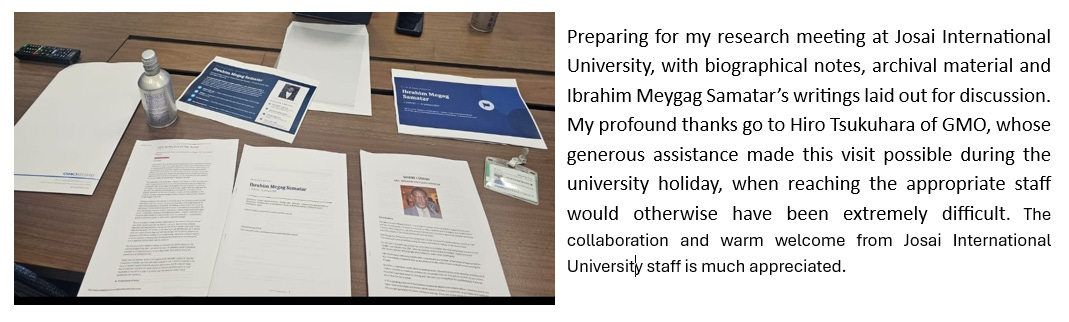
Walking through Ibrahim Meygag Samatar’s final chapter
from Somali Waa kuma Podcast Hosted by MI
MI’s 5 Minutes of Fame - Week 34 of 2026 This week’s MI’s 5 Minutes of Fame is different. It concerns someone who is no longer with us. It therefore calls for a sober tone, particular care and respect for the dignity of the deceased. Before sharing anything further, I must also make one point clear. The detailed information and personal recollections shared with me by staff at Josai International University (https://www.jiu.ac.jp/) will be published only after everyone involved in this research has reviewed the relevant material and given their clearance and consent. Respect for those who trusted me, for the university, for Samatar’s family and for Samatar’s memory must come before publication. My approach to life and scholarship is to remain positive, neutral and optimistic. Neutrality does not mean avoiding difficult questions. It means examining them without hostility or a predetermined political conclusion. My purpose is neither to glorify nor condemn Ibrahim Meygag Samatar. It is to understand his life honestly and follow the evidence wherever it leads. A visit that changed my book My forthcoming book, Somaliland for Beginners, was almost ready for publication. Then I visited Josai International University in Chiba Prefecture, Japan. I went there as part of my academic research into Ibrahim Meygag Samatar, a major figure in modern Somali and Somaliland history. According to information provided by university staff, his period of service at Josai International University is recorded as extending from 1997 until 11 March 2011. Public sources commonly report that he died in Tōgane, Chiba, on 31 January 2011, while a few give 1 February. The difference between those dates and the university’s record must be investigated carefully. It may concern his administrative period of service, but I will not reach that conclusion without documentary confirmation. This is exactly why historical research cannot rely on information being repeatedly copied online. Dates, memories and claims must be checked against primary records and the testimony of people directly involved. More than a name in political history Samatar’s public life crossed several important periods of Somali history. He studied economics in the United States, including at Yale University, before returning to Somalia and working in the Ministry of Finance. He became Minister of Finance in 1970, later served as Minister of Industry, and represented Somalia as ambassador to West Germany. In 1981, he broke with the government of Mohamed Siad Barre and defected to the United States. He later became active in the Somali National Movement, serving as its North American representative and chairman of its Central Committee. He played an important role during the 1991 Burao conference and became the first Speaker of Somaliland’s House of Representatives. After withdrawing from formal politics, he eventually moved to Japan and began the least documented chapter of his life. Most accounts focus on Samatar the minister, diplomat and political leader. Far less has been written about Samatar the researcher, teacher, colleague and private individual who spent his final professional years in Japan. It is this lesser-known human and academic side of Samatar that I want to understand. Walking where he walked My visit to the university was more emotional than I had expected. I saw his office. I walked through the same corridors he had walked. I spoke with university staff who had known him personally and professionally. Most movingly, I met the head of his department, whose memories brought Samatar’s final days in Japan into sharper human focus. Listening to those memories in the place where he had spent so much of his working life was deeply affecting. For a researcher, there is a profound difference between reading about a person and standing in the place where that person worked. Samatar suddenly became more than a list of political positions and historical events. He became a man remembered by those who had worked alongside him, and a scholar whose final years unfolded far from the Somali political world. That experience made clear how little we know about his years in Japan. A new chapter for Somaliland for Beginners I have therefore decided to delay publication and add a chapter examining Samatar’s life, work and intellectual development. The chapter will explore his role at Josai International University, his relationships with Japanese academics and researchers, and his later thinking about democracy, governance, Islam, Somalia and Somaliland. His 2008 statement, “Where I Stand,” will be important. Written from Japan after years of relative political silence, it addressed sovereignty, democracy, decentralisation, corruption, religion and moral leadership. Whether we agree with him is secondary. The academic task is to understand what shaped his ideas and what they reveal about Somali political history. This will not be political propaganda. Respect does not require uncritical praise, and neutrality does not mean indifference. Honest scholarship must examine achievements, contradictions, difficult decisions and historical context. A personal connection My interest also has a personal side. As a school student in Mogadishu, I remember visiting the Samatar bookshop. Years later, as an adult, I visited the family’s modest one-room library in Hargeisa. Those memories represent a wider family contribution to Somali education. In a society where conflict has destroyed libraries, archives and institutions, preserving and sharing books is itself a form of national service. Why the book must wait Delaying a book that was almost ready is inconvenient. But the integrity of the book matters more than its original publication schedule. After visiting Josai International University, I knew that publishing Somaliland for Beginners without properly examining Samatar’s years in Japan would leave the story incomplete. The new chapter will draw on institutional records, archival evidence, Samatar’s writings and the memories of those who knew him. It will not attempt to settle every political argument surrounding his legacy. Its purpose is more fundamental: to document his life carefully, examine competing accounts and preserve a part of Somali intellectual history that might otherwise disappear. My visit reminded me that history does not survive only in political declarations and official documents. It also survives in offices, corridors, books and human memory. Ibrahim Meygag Samatar’s final professional chapter was written in Japan. That chapter now belongs in Somaliland for Beginners. Preliminary public sources * Ibrahim Megag Samatar, Wikipedia * Ibrahim Megag Samater, Yale Class of 1965 remembrance * “Where I Stand,” Ibrahim Meygag Samatar This is a public episode. If you would like to discuss this with other subscribers or get access to bonus episodes, visit somalia.substack.com
Embed this episode
No transcript yet.