
EPISODE · Feb 10, 2026 · 5 MIN
We Are a Part of the Problem
from James Maconochie | Architecture & Attention Podcast · host James Maconochie
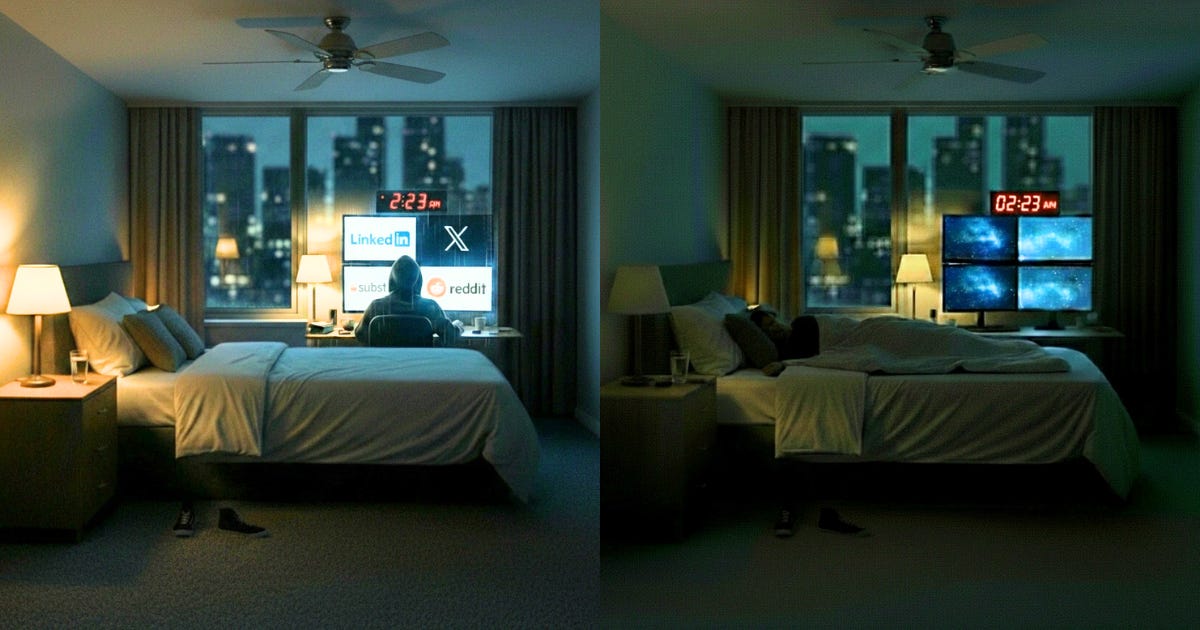
I’ve just finished a three-part series arguing that wisdom, in our current moment, means constraint-awareness. One of the core practices I advocate is generative restraint: resisting the impulse to add to the noise, valuing thought before speech, and recognizing that not every reaction needs to be published.And yet.Thanks for reading James Maconochie | Architecture & Attention! Subscribe for free to receive new posts and support my work.Over the past three months, I’ve been building a publishing cadence. Website, Substack, LinkedIn, X. The goal was one substantial essay per week, reasonable, intentional, aligned with the very restraint I was preaching.But on multiple occasions, I’ve felt the pull to do more. To post more frequently. To engage more visibly. To hit LinkedIn’s little recommendation boxes for commenting, reacting, and connecting.Why? Because I can. Because everyone else seems to be doing it. Because the platform actively encourages it, nudging me toward behaviors that serve its interests (more engagement, more time on site, more data) rather than mine.A few days ago, I saw a post from someone explaining why they’re leaving LinkedIn. The reason: the signal-to-noise ratio has collapsed. The feed is now synthetic content, engagement farming, posts optimized for clicks rather than insight.Reading it, I recognized the problem immediately.Then I recognized myself as part of it.The Systemic TrapThis is the thing about systemic problems: they’re made of us.Every individual making a locally rational choice (post more, engage more, feed the algorithm) produces a collectively irrational outcome. We’re all contributing to a flood that’s drowning us all.You can understand the dynamic completely and still be caught in it. That’s what makes it a trap.A few weeks ago, I reached out to Gary Marcus, one of the sharpest critics of AI hype, to ask if he might review something I was working on. He graciously replied that he was sorry, but overwhelmed.When I asked if he could recommend someone else, he said something that’s stayed with me:“We are all overwhelmed.”Think about that.Here is someone who understands the attention economy and AI-generated content better than almost anyone. Someone who has built a career diagnosing these very dynamics.And he’s telling me that he and his peers are drowning.If the experts who study this problem are themselves overwhelmed by it, that’s not irony. That’s the signature of a genuine systemic trap.The Gap Between Knowing and DoingIn my series, I argued that the collapse of external constraints (throughput, gatekeepers, locality, friction) has left us navigating an infinite-language world with finite attention.The algorithm isn’t forcing me to post. It’s nudging me. And I’ve been following the nudge, even while writing about the importance of not following it.The Greeks had a word for this gap between knowing and doing: akrasia, the act of acting against your own better judgment. It’s not hypocrisy. It’s the human condition when incentives and wisdom point in opposite directions.The platform rewards volume. Wisdom counsels restraint. And the platform is right there, every day, with its little dopamine hits and recommendation checklists, while wisdom is quiet and offers no metrics.A Small Commitment in a Large SystemI don’t have a complete solution to the collective action problem. I can’t fix the algorithm or convince everyone to post less.But I’m starting to wonder whether the same tools flooding us with content might help us navigate the flood, whether there’s a way to fight fire with fire, carefully. I’ll have more to say about that soon.For now, I can decide on my own contribution.So here’s my commitment, stated publicly so I’m accountable to it:One Substack essay per week, if I have something worth saying. If I don’t, I skip the week. No posting for the sake of posting. No engagement farming. No, letting the platform’s goals become my goals.This is modest. It won’t change the system. But constraint-awareness has to start somewhere, and it might as well start with the person advocating for it.We are the problem. Which means we’re also, in small ways, the beginning of any solution.An InvitationI urge you to consider your own relationship to the feed. Are you posting because you have something to contribute, or because the algorithm told you to? Are you adding signal, or noise?The attention commons is finite. Every one of us is either stewarding it or depleting it.Choose carefully.And maybe, just maybe, join me in practicing a little generative restraint. Not as a boycott, but as a quiet act of repair.Because the flood won’t stop until enough of us decide to build our own dams.This essay stands alongside my three-part series on language, constraints, and the crisis of shared meaning: [Part I: The Constraints We Lost] • [Part II: Serviceability Failure] • [Part III: Wisdom in an Infinite-Language World]Thanks for reading James Maconochie | Architecture & Attention! Subscribe for free to receive new posts and support my work. This is a public episode. If you would like to discuss this with other subscribers or get access to bonus episodes, visit jamesmaconochie.substack.com
Embed this episode
Ready to play
We Are a Part of the Problem
No transcript for this episode yet
Similar Episodes
No similar episodes found.
Similar Podcasts
No similar podcasts found.