
EPISODE · Jul 30, 2026 · 16 MIN
"We have to make strategic national investments in children and families."
from The Forum with Josh Cowen Podcast · host Josh Cowen
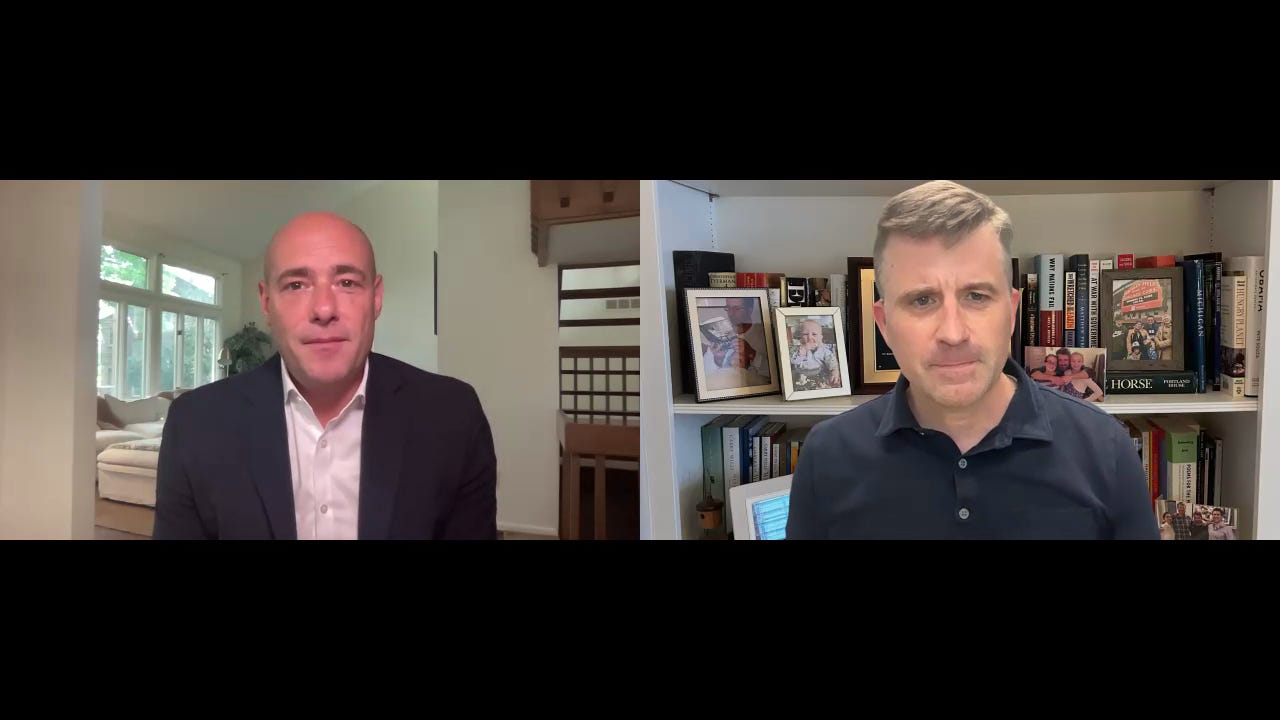
This week, we’re continuing our series with elected officials and candidates prioritizing policy solutions for kids and families. Today is my conversation is with Congressman Greg Landsman, the Democrat representing Ohio’s 1st District. That’s basically Cincinnati, on the Ohio River, and the northeast suburbs. Before coming to Congress in 2023, Congressman Landsman served on the Cincinnati city council, and ran an organization that helped fund preschool for all three and four-year-olds in the city. He’s a former public school educator, teaching both Spanish and math at the high school level.In Congress, Rep. Landsman working on a bill called the Child Care Small Business Insight and Improvement Act, which would help support small businesses operating child care provision across the country. Like many districts across the midwest, Ohio’s 1st District is a swing seat, where broad appeal across the political spectrum is necessary not just to win elections but to help govern as well. Congressman Landsman is running in a tough re-election campaign to serve a third term for the district. A Conversation with Congressman Greg LandsmanCongressman Landsman, welcome to The Forum, where we talk all things on kids and family policy. You come to this conversation differently than most members of Congress — you were actually in the classroom, and you grew up watching your parents do this work. When you’re sitting in a committee hearing or negotiating a bill, how much does that experience actually shape how you think about what’s in front of you?It’s a great question. I think it probably entirely shapes the way I’m understanding what’s being presented and thinking about the issues and the policy. One of my big issues or passions is the idea that we should be creating a community or society, or country where everyone gets a shot. And for me, that means that you look at policy from that angle: Does this help ensure that more and more people are getting opportunities? Or is this hindering folks and their ability to make progress? So this is one of the reasons why I’m so passionate about early childhood education education in general, because it’s, as has been said, the great equalizer, right? No matter where you’re born, or who or what kind of family you’re born into, or circumstances you’re born into. If every kid gets great prenatal care, or every expecting mom is much more likely to have an on time, healthy birth— developmentally that’s a huge deal.And then, if you get time with your parents because they have paid family leave that makes a huge difference. And then access to high quality childcare and preschool that helps a kid get totally ready for school. All of those things, you know, mean opportunity. And if you can extend those things to every child, then everyone has a shot. So I absolutely think about that, and then my experiences as a teacher. The way I was raised. My parents were teachers, just all of that comes into play, for sure.You got Cincinnati voters to fund two years of quality preschool — the first city in the country to do it. That’s a real proof of concept. But what did it take to actually make the quality part true, not just the access part? “Preschool” can mean a lot of things, and the difference between a good program and a mediocre one is enormous.Again, starting with the why, which we did a lot of when we were running the campaign. It was a lot of years of organizing house parties and just events all over. We got 10,000 people to sign this pledge that every child deserves two years of quality preschool.And that was such a big motivator. This was before I was on council. This was a ballot measure. So I was just a citizen and a parent. My kids were in preschool. I saw what a difference it made for them. They had quality preschool.And then I was living in a city, which is the case in most cities, all cities, where most kids don’t. And those kids are typically not ready for school, or they’re not ready enough. And so, you know, we wanted to make a major investment as a city in preschool—quality preschool in particular. And so the question was, how do you measure quality in Ohio? We have a rating system, and that rating system is based on the things that would be sort of intuitive, maybe maybe or maybe not. But I think they’re intuitive, which is: if you know class sizes, for example. If you’ve got a ton of kids and only one instructor, that’s going to be challenging for those kids. It’s not. It’s not as as good as it could be. And so you look at a low teacher-to-student ratio that helps with quality that the the teacher does. Then, does he or she have the training in early childhood? And if they have that training, that’s that’s the difference between high quality and and less. Then, the curriculum, is it evidence-based curriculum? And those are 3 of the biggest things. And you can do that achieve that in a in a center based program or home based. And so.We decided to invest—as we assumed voters would want—their dollars going to quality preschool. And so, one, the tuition assistance that families get here, they can use it in any quality preschool, public or community-based, center-based or home- based.And then there are additional grants for those providers to help them get that curriculum, or hire additional staff, or get them trained so that they can achieve higher quality.Both parties really need to prioritize child care for our economy, for our kids, for our families. It’s got to be at the top of the list.—Congressman Greg LandsmanWalk me through your bipartisan child care bill. Who are your Republican partners, and what did you have to give up — or hold firm on — to get them there? I want to understand what bipartisan actually looks like in practice right now, not just as a talking point.The first thing, for those folks who aren’t as familiar with this world: a lot of these childcare providers and and preschools childcare is usually the 1st couple of years infant and toddlers. Essentially 0 to 3. Preschool is 3 and 4 year olds, and that’s a particular kind of curriculum. Some of these are public entities, but a lot of them are private centers or programs, meaning, you know, they’re for profit. And they don’t make a lot of money, and in some instances it’s really hard to make any. And so a lot of these small businesses need additional help. And the Small Business Administration is supposed to help all of us. All of our small businesses.Childcare was not at the top of their list when it came to be, and so we are pushing really hard for the SBA, the Small Business Administration, to invest more in helping childcare businesses, those folks that are providing childcare, giving them the technical assistance and additional resources so that they can grow. And this happens to be bipartisan. It’s not exactly a top priority, quite honestly, in my opinion, for either party. Both parties really need to prioritize it for our economy, for our kids, for our families. It’s got to be at the top of the list. But a Republican congressman from Pennsylvania, [Dan] Meuser, he is my partner on this. I served on the Small Business Committee with him. And we’ve got a lot of bipartisan support. The key is just getting the chair of the committee to mark it up and get it to the floor.I ask a version of this to a lot of Members, governors, and candidates. I worry that Democrats have struggled to find a coherent K-12 message, and the polling backs that up. You’ve got real credibility here as a former educator. Do you think the party has earned back teachers’ trust — and separately, parents’ trust — or is there still work to do?We haven’t had a national vision for education in 25, 30 years. Someone has to lead on it, and my hope is that in the next [year] there are members of Congress like me and others who are leading on this.But you really need this to be something that those who have really high profiles, and in particular, the next [presidential] nominee should say I’m going to lead on this. Like, this is not just something we’re gonna leave to the states when we need a national strategy to ensure that our kids, every single one of our kids is getting the best possible education. I would love to see that be a major part of the debate as Democrats pick a nominee. And I have laid out what I think is a major education reform bill that would ensure every kid has what they need.My argument is a little different than most. I believe that the vision has to be one that includes or expands education so that it includes brain development and early childhood so that we’re not just stuck in sort of thinking about education in that sort of myopic K-12 way, even though it’s incredibly important and we need to have a better strategy and I’m happy to talk about it. But I would love to see us say: look, we’re going to reboot the Department of Education, and we’re going to have it follow brain development and make sure that kids get what they need, which means that we’re going to include prenatal care in our system of education, because it’s key to a kid who’s developmentally on track the same with quality childcare and preschool. I’d argue, paid family leave needs to be a part of that. Even if it’s just what we’re measuring. And then, when you get to K-12, the first goal has to be every kid shows up prepared, because if every kid shows up prepared, you’re gonna see better outcomes. Then you have to invest in teachers and classrooms and curriculum. And then I would argue that there should be some adjusting of high school so that kids can get into careers much faster. I don’t think we have to continue to accept the idea that everyone needs to have that that senior year. If, in fact they want to go to college or they want to go right into career training. We should be able to save some money at the end, invest it early, and let kids go get that college and career training as soon as they can at 17.If you want to grow an economy where everyone’s got a shot, you have to make strategic national investments in children and families.—Congressman Greg LandsmanThe administration has been cutting everything that touches kids and families — Head Start, Title I, IDEA funding. As someone who led a local ballot measure to fill gaps the state and federal government weren’t filling, what’s your honest assessment of how much of this damage cities and counties can actually absorb on their own?I think they’re at their limit. And this has been going on. It’s been accelerated under Trump—the sort of pulling back of federal support, and quite frankly, in Ohio, state support. And so local communities have tried to patch and piece things together. And most communities, unfortunately, have had to turn to taxpayers and say the State is, or the Federal Government is, no longer working on these issues that we care deeply about, that matter to our community. So we’ve gotta we gotta put something on the ballot and raise people’s taxes. And so people are paying more in taxes, even though federally, and here in Ohio, politicians are like, “well, we lowered taxes.” No, you didn’t. You lowered taxes for the super wealthy and these corporations. But, the everyday, Ohioan—this is true in most parts of America—Americans are paying more because their local property taxes went up because they have to fund the things that are no longer being supported by state and federal budgets, and that is hugely problematic for folks, I think, at least here in this community, they’re running out of room in terms of the capacity of local taxpayers, and it’s a scary proposition because we have to provide healthcare and education and housing, and these local communities can’t do it on their own. That’s why we’ve always invested in these things at the federal level, too. It’s not entirely at the federal level, but if you want to grow an economy where everyone’s got a shot, you have to make strategic national investments in children and families. And that’s childcare and preschool and schools and housing and health care, all of those things. And when you pull back on it, it’s going to cost local communities more, and ultimately, they’re gonna run out of room and our economy is going to just fall off a cliff.You’re a former teacher leading a bipartisan child care bill in one of the most dysfunctional Congresses in modern history. What’s the path for this kind of work to be sustained where, say, kids in Cincinnati and everywhere else are better off five years from now?I think there’s a path in the sense that it’s still, you know, relatively bipartisan. I mean, there’s some partisan arguments about where the dollars go, but I think supporting children and families is something that should be bipartisan. The issue is lawmakers like me have to be able to like punch through this chaos and the dysfunction. And, you know, we would be better served with a speaker that wants to see bipartisan work, and work that’s actually going to improve people’s lives, as opposed to the political, hyper-partisan political theater that we get day in and day out with this current crew.Congessman Greg Landsman represents Ohio’s 1st District. You can read more about him here, or on his campaign page. This is a public episode. If you'd like to discuss this with other subscribers or get access to bonus episodes, visit joshcowen.substack.com/subscribe
Embed this episode
Ready to play
"We have to make strategic national investments in children and families."
No transcript for this episode yet
Similar Episodes
No similar episodes found.
Similar Podcasts
No similar podcasts found.