
EPISODE · Jun 14, 2026 · 2 MIN
We Keep Platforming People Who Are Destroying Democracy
from The Lucas Bean Show · host Lucas Bean
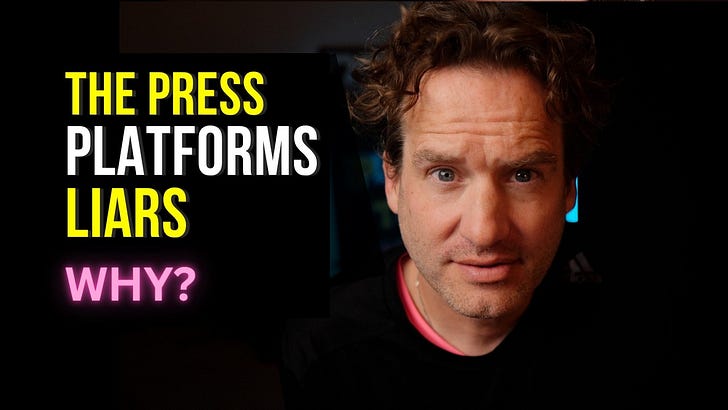
There is a moment you have seen a thousand times and probably never named.A news anchor introduces two guests. On one side, a scientist with thirty years of peer reviewed research. On the other, a man with a podcast and a financial relationship with an industry that profits from people not believing the scientist.The anchor says: let’s hear both sides.The chyron at the bottom of the screen gives them equal billing.The segment runs four minutes. Each guest gets two.And somewhere in living rooms across the country, a viewer watches and walks away thinking: well, I guess scientists and conspiracy theorists both have a point.That is not journalism. That is not fairness. That is not balance.That is the deliberate destruction of the public’s ability to tell the difference between facts and lies. And there is peer reviewed research that proves it.The ResearchIn 2022, psychologist David Rapp at Northwestern University published a study in the Journal of Applied Research in Memory and Cognition examining exactly what happens to a viewer’s brain when a journalist gives equal platform to an expert and someone with no evidence behind them.The findings were not subtle.It does not matter that one side has all the evidence. The moment you put them on screen together, the audience’s brain treats them as equals. The visual equivalence overrides the evidentiary reality. Two people on a split screen with equal time and equal billing register in the brain as two equally valid positions, regardless of what either of them is actually saying.Rapp called this false balance reporting.False balance reporting is when the media gives equal airtime and equal credibility to opposing views even when one view has the full weight of scientific consensus behind it and the other has none. The result is not an informed audience. The result is an audience that has been systematically trained to doubt what the evidence actually shows.This is not a minor formatting issue. It is not a stylistic choice about how to structure a segment. It is a mechanism that actively damages the public’s ability to process reality. And it has been running at scale in American media for decades.What It Actually Looks LikeNinety eight percent of climate scientists agree that the planet is warming due to human activity. This is not a contested scientific question. It has not been a contested scientific question for a long time. The media puts one of these scientists on television with one of the handful of paid climate deniers whose research is funded by fossil fuel industries and calls it a debate.It is not a debate. One side has the evidence. One side has a check.Ninety nine doctors tell you that you need surgery to save your life. The media finds the one doctor who disagrees and frames it as a medical controversy. The viewer goes home and decides to wait and see. The delay costs them their life.A man with no evidence and no legal standing claims an election was stolen. Sixty one courts reviewed the claim and rejected it. Republican judges, Democratic judges, Trump appointed judges: all of them reached the same conclusion. The media puts this man next to an election official and gives them equal time. The viewer walks away thinking both sides have a point.One of them does not have a point. One of them is lying. And the camera treated them identically.Why The Media Does ThisThe tempting explanation is incompetence. That journalists are confused about what balance means. That they have been trained to present both sides and never learned to distinguish between a genuine disagreement and a manufactured one.That explanation lets the media off too easily.The people running these networks are not confused. They know exactly what a climate scientist is. They know exactly what a paid denier is. They understand the difference between a peer reviewed study and a talking point funded by an industry lobby. They make the booking decision anyway.Because conflict drives views. Because outrage drives engagement. Because a four minute segment where two people agree with each other performs worse than a four minute segment where two people argue. Because the algorithm rewards heat over light and the networks have decided to feed the algorithm.They are not being naive. They are choosing revenue over reality. They are choosing clicks over the public’s ability to understand what is happening to them. And they are doing it every single day in front of millions of people who trust them to tell the truth.What False Balance Actually ProducesRapp’s research did not just document the problem. It documented the damage.Audiences exposed to false balance reporting showed measurably reduced ability to identify scientific consensus. They were more likely to believe that contested questions were genuinely open when they were not. They were more likely to distrust expert conclusions after seeing those conclusions presented alongside fringe positions with equal credibility.In other words: false balance does not just confuse people about specific issues. It degrades their ability to evaluate evidence at all. It trains them, over time and repeated exposure, to treat all positions as equally valid regardless of what the evidence shows.This is how a population loses its grip on shared reality. Not through one dramatic moment. Through thousands of small moments where the camera said: both sides have a point. Both sides deserve equal time. Both sides are worth hearing.Until the viewer stops asking which side has the evidence. Until the question itself stops feeling relevant.Until a man with no evidence and a man with thirty years of research look, on television, exactly the same.What Needs to ChangeThere is no balance between facts and lies.There is only one side with evidence and one side without it.Giving equal platform to both does not make a network fair. It makes them complicit in the erosion of the one thing a democracy cannot function without.The truth.Platforming far right figures alongside credible experts does not inform the public. It normalizes the idea that expertise and denial are equivalent positions. It tells every viewer watching that reality is negotiable. That science is one opinion among many. That the man with thirty years of peer reviewed research and the man with a podcast funded by an industry lobby both deserve your consideration.They do not.Stop booking them. Stop giving them segments. Stop calling it balance when one side has the evidence and the other has a financial relationship with the people who profit from doubt.You are not being fair.You are not protecting free speech.You are running a propaganda operation with better lighting.And calling it news.Watch on YouTubeSourcesImundo, M. N., and Rapp, D. N. (2022). When fairness is flawed: Effects of false balance reporting and weight-of-evidence statements on beliefs and perceptions of climate change. Journal of Applied Research in Memory and Cognition, 11, 258-271.Cook, J., Nuccitelli, D., Green, S. A., Richardson, M., Winkler, B., Painting, R., Way, R., Jacobs, P., and Skuce, A. (2013). Quantifying the consensus on anthropogenic global warming in the scientific literature. Environmental Research Letters, 8(2).Lewandowsky, S., Ecker, U. K. H., Seifert, C. M., Schwarz, N., and Cook, J. (2012). Misinformation and its correction: Continued influence and successful debiasing. Psychological Science in the Public Interest, 13(3), 106-131.Paul, C., and Matthews, M. (2016). The Russian firehose of falsehood propaganda model. RAND Corporation. PE-198-OSD.Nyhan, B., and Reifler, J. (2010). When corrections fail: The persistence of political misperceptions. Political Behavior, 32(2), 303-330. This is a public episode. If you'd like to discuss this with other subscribers or get access to bonus episodes, visit lucasbean.substack.com/subscribe
Embed this episode
Ready to play
We Keep Platforming People Who Are Destroying Democracy
No transcript for this episode yet
Similar Episodes
No similar episodes found.
Similar Podcasts
No similar podcasts found.