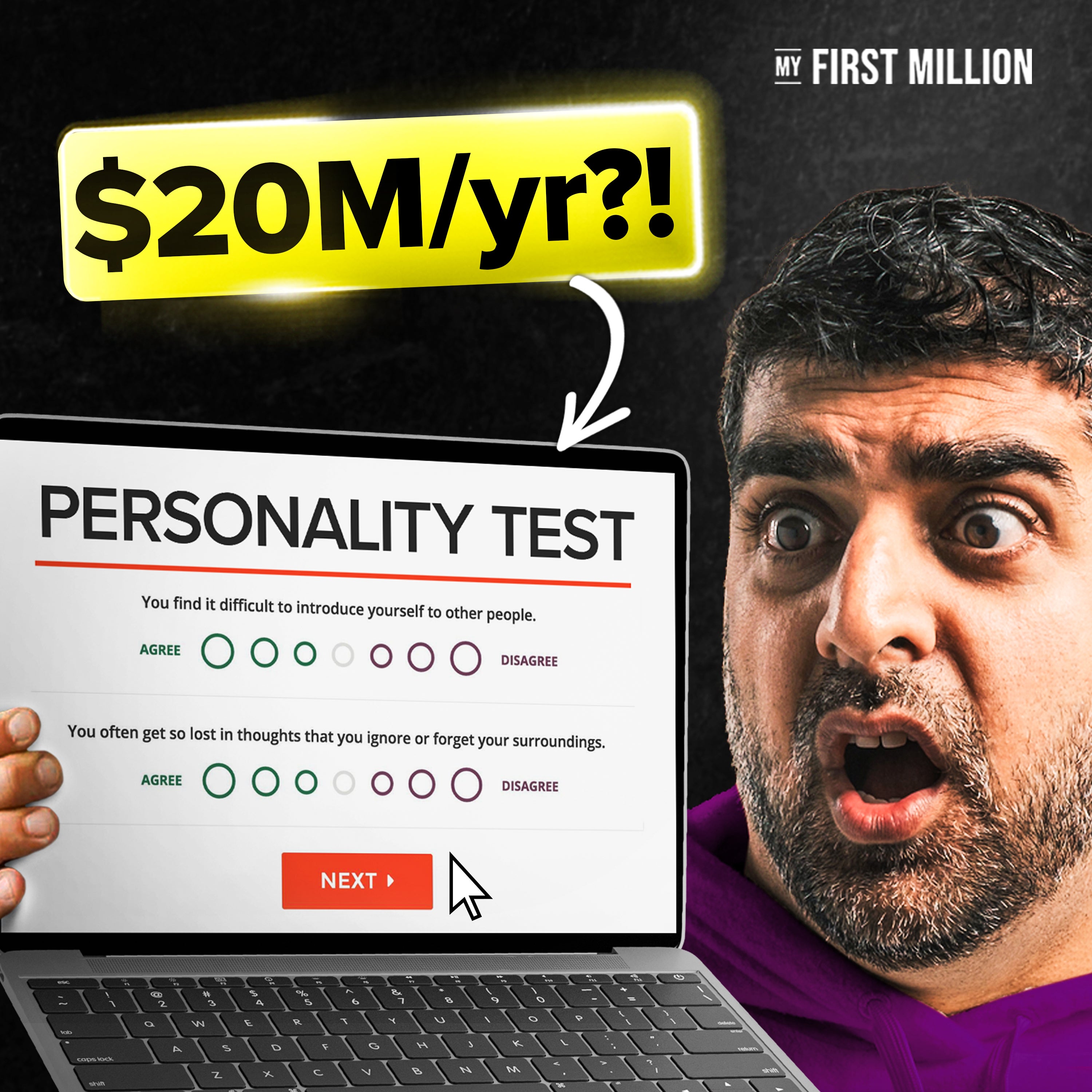
Now the grid score goes, I think it's zero to 10. I want you to guess my grid score. 10 is super gritty. Gritty as it gets.
I would say I would put you six, six, seven. You're pretty gritty. Appreciate your faith in me. I scored a 2.5 on this grid test, bro.
Did you just take it again? I'm so happy. I feel like I could rule the world. I know I could be what I want to.
Put my own in it like days off. I'm gonna roll. Let's travel. All right, Sean, you're back.
I was a trip. My trip was great. Me and Ben went to Phoenix. And I'm not gonna share all the details, but it was a dope experience.
Don't like experience. I think one great thing to share, by the way, wins like, what's the last dope life experience you had? Something you didn't have to do, but you did anyways. Probably camp MFM two years ago.
Don't let that happen. Don't let too much time go by. I think like every three months or so should try to do something that's a little extra curricular, if you know what I mean. Just something that's outside of the routine, outside of what you have to do.
So I did that anyway. So we went to Phoenix because Matt Ispia, who is the owner of the sun, the Phoenix suns basketball team there, we had got in touch with them and he was like, Hey, if you guys are going to come check out a game, come hang out. So we go down to Phoenix and we meet Matt. We meet the team.
We get to go sit courts on do like live life as an NBA owner, which is awesome because I was dreaming of doing that. Now what I want to tell you though, it's not about Matt. What I want to tell you out is actually much more in the weeds. So here's a little in the weeds story.
So I think Ben emailed him when he bought the team and was just like, Hey, congrats buddy. And then thank you. Thank you, Ben Levy. Goodbye.
And then that was the first touch point. Second touch point was we invited to camp and family. Hey, he used to be a college basketball player. So he was a college basketball player.
Now he's a multi billionaire who owns an NBA team. Well, that's a mix of basketball and entrepreneurship. That's what we tried to invite to the camp. And so we invited him.
He was like, Oh, I'd love to come. Couldn't end up making the dates. But his kind of make good was, listen, sorry, I couldn't make it. But if you guys are ever in town, let me know.
We'll hang out. We'll check out a game. Hey, what do you know, Matt? We're in town.
What are you in town? Because that's when we're in town. And so we worked for the assistants to be like, when do you think we should be in town? And we did that.
So this is the rule of reciprocity, by the way. You offered someone something. And regardless if they take you up or not, they now owe you, we should just host events that aren't ever going to happen. And we make sure we follow the person online like, they're out of town that they already busy.
What's that? Go. We're hosting a charity event honoring you. So yes, we did that.
Now, the funny thing is, the background here is that what's the random is here? Ben is a diehard Phoenix Suns fan. He loves Phoenix Suns more than you love your child. He loves the Phoenix Suns with a deeper passion than Romeo loved Juliet.
And he was a ballboy for four or five years. So like literally was with a team every day volunteer ball boy, basically just to give you a sense of this guy. So when every year when there's an all-star game, the way it works in the NBA is the fans vote on who gets to be named an all-star. So Ben, supporting his guys being the loyal supportive guy that he is, takes literally 100,000 ballots home, forces his family every night to sit there and punch the ballots to vote the Phoenix Suns guys in and himself over the course of a couple months, they churn through 100,000 ballots to try to support the team.
The players didn't care. They didn't know about this. He just did it because he's that big of a dire fan. So that's ridiculous.
Ben obviously does a lot for me. I was like, can I? What's a what's a how can I make a band appreciation weekend? And that's what this was go and let him live a little bit of a childhood dream out.
So he goes down there. We watch the game. It's all good. One of the cool things was that this happens all the time, by the way, you think you're there to meet the famous person, and it's actually this other thing that's really interesting.
That's more accessible. That ends up being the fascinating thing. You would have known it until you showed up. So similarly, we go and we have this great conversation with one of the guys in their kind of like data department.
So it's like analytics data that's become a big part of sports. And so Ben is really my guy. Ben's like, the guy came down to say nice to meet you. And Ben's like, cool, I have 1000 questions for you.
Have a seat. And he's like, in the year 2013, you picked this guy. Why? I'd like to know.
What would tell you that? What is like what are the metrics that matter right now for us when we play game? Obviously besides the score, like, you know, what leads to the score? He's asking all these detailed questions.
And when Ben asks questions, sometimes I've noticed the person will even finish it. And he's like, I got what I need next. Like, he's like, he's great because everybody needs a place where they're shameless. Like for me and you, like, I'm shameless about like I'm a monologue.
OK, I got something interesting to say. I know that's not how this is supposed to work, but I'm a monologue because that's I just need to get this off. I just trust me, you're going to like it by the end. Your thing is like, you'll just ask a blood question.
You'll just be like, well, dude, you keep saying this. Like, what is it? How much? What's in your pocket right now?
And they're like, yes, what was the answer? Here's the answer. Ben's thing is that he's like, oh, we're we're supposed to be at dinner. I'm going to ask you all of the questions.
So I will I might be as endless and like, I don't care what the social situation is. Like, we'll be playing basketball and he'll be guarding a guy and he'll be like, he'll be like, what's revenue like nowadays? And I'm like, you got to let it go for this moment in time. Like, just give it a rest for you guys.
And he doesn't do it. Anyway, we're doing that with this guy. And one of the fascinating questions that he asked, we were like, what's your the data guy? What's the data you wish you had that you don't currently have?
Like, what data would help you do this? Because he's showing us these cameras in the gym where if you're just shooting around, there's cameras out that will it does facial recognition. It'll track OK, Sam is shooting in the practice session. It'll record the length of the session, the number of shots, the exact arc on every shot is exact field goal percentage without anybody having to be there to keep track.
So cool. Right. His answer is very interesting. So he was like, you know, we test for we can we know everything you've ever done on the court.
But what we've learned is what everybody knows is that the difference between the Michael Jordan's and the, you know, our Isaiah writers or the Kobe Bryant versus the when he broke says like, what's up top what's in your mindset and the guys who are completely obsessed, extreme discipline. They're able to work harder than the next guy. They don't take those days off. They are receptive to coaching and they're going to improve on their weaknesses.
They're going to double down on their strengths. They can keep their confidence even when something goes back. It's all about the mental, right? Like every athlete, every great athlete, you tell me how much on the sword is mental, but they have no way of measuring the mental.
And so we said, interesting. What would be the way that you would want to do that? He's like, great. Great.
Well, you mean great. Well, there's this book that came out. I don't know. Have you ever read this book?
Love it. Angela Duckworth. Duckworth. Exactly.
So I went down the rabbit hole. That was just my segue into me going down this rabbit hole on these mindset tests. So first I actually want to tell you about a different test, which you've probably done in the past. And that's the Myers-Briggs test.
Have you done this test? Yeah. Do you know the backstory of this? You know where this came from?
No, but is it even real? Our horoscopes real, right? Our pop readers, really like there's a lot of bullshit in this interview, which is why I'm fascinated by it. So let me I'm not saying it's completely bullshit, but there's a lot of handling stuff.
Here's the story. There's a woman and her name is Isabel Isabelle in 1942. I think World War II is going on and Isabelle's reading readers digest. And she reads in readers digest this article about people sorting, people sorting.
And basically it's how companies are using tests to do people sorts. And so she reads that Locky, Locky, the aircraft company was using it to locate like a possible troublemakers. They're like, we need to do some screening so that we can identify who's going to be a troublemaker who's going to have some mischief in them. Another company was using it for finding a yellow brush.
That's what Henpecked husbands and they were basically the argument was that if the man is under the thumb at home, then he'll easily also be submissive at work. That's it. Like people were legitimately doing this. They're like trying to figure out like who's got that alpha, who's got that dog in them.
And so all right. Well, so she writes to her mom, Catherine. She's like, this is fascinating. Companies are doing this blah, blah, blah.
She's interested in psychology. Her mom writes back and says, you should make your own test and you should do it. You won't tell me that guy, Carl John. You should, Carl Young, young, I don't know.
He's like, you should do it on those principles. So she ends up creating and their last names of Briggs and Myers. And she ends up creating the, the, uh, for God, it's called the Briggs Myers type indicator or something like that. Right.
Like that's, that's how this test started. And she creates a test and basically he had this theory. This college is theory that there's like people branch out in this like decision tree. It's like, you're either a thinker or a feeler.
And then if you just go down the tree, it ends up with 16 possibilities and they gave each of the 16 like kind of a positive affirmation name. So there's no bad, there's no bad score. Yeah, they give you a fortune cookie. Everybody gets a trophy.
And so they were like, oh, you are an executive. You are a caregiver. You are a scientist. You are an idealist and they just had all these labels for the 16 categories.
Now, of course, the funny thing is if you end up taking the test, you'll get one score and on average, if you take the same test weeks later, 50% people will end up completely different labels. So yeah, I don't know how reliable these things are. And then, you know, people who criticize it, they say this takes advantage of something called the for effect. Have you heard of the thing, the for effect?
It's basically the same thing that astrologers, fortune tellers and other pseudoscience is used where they kind of cold read something general about you like you're the type of person who you don't let everybody in. But once you get close to somebody, you really open up or like you're the type of person who, you know, sometimes when things get hard, you're able to really, you know, you're able to really stand up and make it happen. It's like, I do have a little bit of that in me. You know, you're right.
I just know. Here's the money. And so, anyways, they create the test. It's not that popular at the beginning, but it ends up getting picked up by fast forward many, many years.
It gets picked up by a company called CPP, the consulting psychologist press CPP. And so they picked up the distribution rights and they're like, hey, we are going to market this to American businesses. We are going to tell American businesses about this. When you say picked up, do you mean, was this a publication that promoted it or bought it?
It was a publishing company and they buy the licensing rights to market it. And there is a lot of her mom are just going to get a royalty. And basically right as she dies, she dies at 82, sales are taken off by 1983. Almost a million people are taking the Myers-Briggs test annually.
Is it free? No. So the way it works is it's kind of a brilliant business model. So basically to take the test is somewhere between 15 and 40 bucks.
So everybody takes a test, you get, you know, let's say on average 30 bucks for them. But then when you catch a take the test has to be given to you by practitioner. Well, the practitioners have to pay $2,000 to become a certified practitioner. That's the only way you can take this test.
And so like last year, they enrolled 5,000 practitioners who each paid, you know, about $1,500 to $2,000 each, 8 to 10 million bucks in revenue off of just a practitioners. And then each of the practitioners, then distribute the test and they get paid by distributing the test. So they kind of like a multi-level marketing team, right? The practitioner makes 30 bucks a test.
And then the extra royalty, the extra 10 bucks on top goes back to the parent company, the publisher. And so this thing, they don't know the revenue because it's still private. It's been private for like, you know, since, you know, the 80s. And they once said their number was over 20 million revenue, I suspect it's higher than that.
There's been millions of people who have taken this test and Myers Briggs is that company. It's their biggest earner. It's that that's their cash cow. And so it's insane.
Dude, it's used by the government. It's used by 200 federal agencies use this, you know, just the EPA itself. They use it on the quarter of their 20,000 employees. I think 80% of the fortune, 89, 89 of the fortune 100 use this test.
89% of the fortune 100 is that insane. There's a few things that are insane about it. One, to create something. So when did you create it in 42?
1942? Yeah. So we're coming up 80 years now as we're going to be close to 100 years soon. That's amazing to create something that lasts that long.
I mean, that's it's such a reputable brand, even though I think it's nonsense, but many people think it's reputable that it at this point in annuity. So you just like, it's predictable revenue all the time. We talked about was it Gallup Gallup pulling and they own Clifton strengths, which is famous for a strength finder 2.0. And I tried to find how much revenue they did.
And I could not find anything. I believe Gallup. We did this two years ago. I don't remember.
I believe Gallup does something like a billion a year in revenue or hundreds of millions. But if you go to the strengths finder website and you look at their traffic, it's huge. It's a huge, huge, huge thing. And it costs the same thing, 20 or $40 for one of these tests.
I loved this business because the test business is so fun because you're desperate to know, like when you're in a hard time, you're desperate to know. You just want affirmation that things are going to be okay. And I loved it. I loved it.
And I used to do these all the time and I would even game them. I'd be like, well, that's not right. I should take it again. I probably answered a few of you wrong.
So check this out. So I read about that. Now, when we meet this guy, he tells me about the mental makeup, the grit, the mindset and being important. I'm like, he's totally right.
The mindset thing is super important. And so I'm like, what was that book, grit, Angela Duckworth? What was that all about? I believe it's a you could put off desire with that call or you could put off a notification delayed gratification.
It's like the one that's the part of it. But the one that I think they had is basically its ability. So like your talent, basically your ability times zeal, which is like your passion or enthusiasm about something times capacity for hard labor is the formula for success. And with what with grit specifically, it's around zeal and the perseverance.
So it's basically your enthusiasm, your passion times, your time for experience. Okay. So here's what's interesting about this thing. So he tells me about this.
And I'm like, all right, dog, like, what's my grit score? Let me go. Let me test it. Now the grit score goes, I think it's zero to 10.
I want you to guess my grit score. 10 is super gritty. Gritty as it gets. Who's the 10?
David Goggins is the 10. I would say I would put you six, six, seven. You're pretty great. Appreciate your faith in me.
I scored a 2.5 on this grit test, bro. I am I'm in the bottom 10 percentile of grit. So what were the questions? You should check this out.
I'm going to read you some of the tests. And this is why I was like, this is bullshit. Why is this bullshit? Okay.
So here's what the claims, the she writes his book and becomes a bestseller. You see Keith, boys, maybe like our grits, most important thing. All you CEOs like grits, most important thing. They're not wrong.
It's just that like many of these best selling books, it's like pop science, right? Like the principles not wrong, but the depth of the evidence is actually quite shallow. And so here's what it says. So it says, uh, so she starts off by saying, well, showing up, you know, what's that old quote?
80% of success is just showing up. And you know, and people realize, well, yeah, like if you give up that almost guarantees failure, if you give up and they looked around, they said, well, 50% of soldiers quit the army during the selection process, 50% of marriages and divorce, 25% of students drop out of high school sales jobs, 50% of people will turn over every every year in sales jobs. And, um, they noticed that like, uh, there was a counterpoint, the counterpoint is basically what they looked at was West Point. And I don't know if you know much about the school West Point, but it's got a pretty like, uh, pretty high bar, right?
It's like being a guest on this podcast. It's a high bar. And so what they do is they say to get into West Point, you don't apply when you're a senior in high school. You apply when you're a junior.
You're applying 11th grade. And you don't just apply with your test scores. You have to be nominated by a member of Congress to get into West Point. You have to hustle your way to get a Congress member to vouch for you in order to do this.
You have to do a leadership interview. You have to do a fitness test and out of 14,000 applicants and also like a thousand people to come join this thing. And even after they filter with all that, like you have to run through walls to get here, 20% drop out during the seven week orientation period. That's called the beast is West Point free.
I don't think so. So you got to pay money to do all this and then go to the RV like all the best things in life. All right. The beast is a rotation of calisthenics, marching, classes, weapons training, athletics.
You go five AM to 10 PM with no breaks, no weekends, no contact with family or friends. And you have to be subscribed to this YouTube channel in order to get in. And so even if you're not going to do all the other things, you should go to YouTube right now. My first million, you should subscribe to our podcast.
All right. So basically grit was a higher predictor with this grit score. They say it was a higher predictor of West Point success than your ST score that your high school rank, then the leadership interview and all the other things. And so anyways, I thought here's the grit test.
I can just give it to you. So here's some of the questions I asked on this thing. It says new ideas and projects sometimes distract me from previous ones. Basically do get distracted by new ideas and projects from your current one.
Does that very much like me, mostly like me or not at all like me? That's what is very much like me. Okay. Another one set back.
Don't discourage me. I don't give up easily. Okay. Now I scored well now.
I set a goal, but later choose to pursue a different one. I am a hard worker. Like, come on. This is not science.
This is this is what I call nothing. That's what this does. No, there's some stuff here. I finished whenever I begin.
So for example, bro, do you trust people's self assessment of this? No, here. Do you have any unfinished Lego sets in your home? I don't even have a Lego set.
No, but I did. I would. I got a box of unset up furniture right over here. I have a half half written book over there.
Yes, of course. And so you. The thing is, I can think of examples where I'm not like that. I can think of 10 examples where I am like that.
This is, you know what? I'm low and grit. I'm high in honesty. And to somebody who's like, I'm really high on the grit score.
I'm like, is this real? Like, is this is as honest? Is this an honest assessment? I think you're but her.
I think that you got. I think change comes from within brother. I think that you got to be you got to be. You just I'm in denial right now.
I'm bargaining. Yeah, is there like grits anonymous? You need to like go through the 12 steps, my friend. You're in September one.
If there's anyone else that was opposite of grit, by the way, just like. Yeah, just green cheese. Soft. Damn.
Soft. Sorry. All right. The marshmallow scale.
So yeah, well, you know what? I want you to take this. Actually, just take it right now. Let's take it together.
Let's see what your grit score is. All right. It's a new language. Okay.
Here we go. All right. I'm going to give you the grit the grit test. Okay, Sam, you have to just say true or false.
I say, yeah, very true, very false. So new ideas and projects sometimes distract me from previous ones. False. False.
All right. Very false, which is a not much like me. False. Not much like that.
Setbacks don't discourage me. I don't give up easily. I often set a goal, but later choose to pursue a different one mostly like me. I am a hard worker somewhat.
I have difficulty maintaining my focus on projects that take me more than a few months to complete. That's not much like me. I finish whatever I begin very much. My interest change from year to year.
Not much. I have diligent. I never give up somewhat. I have been obsessed with a certain idea or project for a short period of time and later lost interest somewhat.
I have overcome setbacks to conquer an important challenge. Not much like me. I have not had that many setbacks. I'm just so good.
It just works. I just try easy stuff. Wow. All right.
That's a grit score of 3.5. Correct. So you got a 3.5. Okay.
I had it wrong. The scale is to five. You're a 3.5 out of five. You scored higher than 40% of Americans.
What does that mean? I mean the 60th percentile? No, you're in the 40th percentile. Right.
I don't fucking know. I'm between 40 and 60% so I'm not that good. You're like above average. No way.
You scored higher than 40%. So you're actually average to below average. Great. Yeah.
That's just as stupid. What if it a lot better if I was a four or something? Yeah. The segment needed you to be amazing and we'd be terrible.
You're for the average and I'm way below average. So anyway, can I take your grit score? You just go to just search for and take this thing and then post it in the comments on YouTube. I want to know who is the greatest YouTube commenter of them all.
It's probably the spammers that never go away that keep impersonating us and being like to everybody who comments like DME. That's not us. We're not telling you something like that. If we try to sell you something, you'll know it.
Trust me. That's not the way we would do it. I want to tell you about someone who would score a 5 out of 5 on the grid score. Can I tell you about this person?
Tell me. Do you remember a few years ago in 16 or 17? I think there was this company called Lunch Club. It was basically like the social platform where you I guess meet up with people for lunch.
I thought it was really done. I used to do that. I used to when I moved to San Francisco, that's how I made friends. I joined the Lunch Club and I would go get lunch with random stranger tech rose.
I thought that that was a stupid idea. I thought it was very stupid. I never used it, but not I was alone on that one. I think that you didn't have set back.
So I always have friends and I never have set back. I scored low on the small. But here's the thing. Not everyone else thought it was a good idea.
In fact, they raised $30 million from Andreessen Horowitz and all these like really smart people. And I don't think it ever became a bad thing of a company, but they raised $30 million at $100 million valuation. I have no idea what happened to it today because it's not really relevant anymore. However, the guy who started it is amazing.
And this is just proof that smart people sometimes do like they got silly things that are just stepping stones until the real thing. And so the guy who started it, his name is Scott Wu. And recently, I think yesterday was he launched something that's pretty amazing and we're going to do another episode. We talk in depth about what he's launched.
But basically what it is, is it's called Cognition Labs. That's the name of the company. The product is called Devin. The summary of it is you just tell Devin, make me a website that looks like Yelp, except it's just for agencies or something or make me a website that's like Airbnb, but for cars.
And what Devin does is it gives you a checklist of all the things it's going to do. And then it does it and it builds the website for you. And this is like game changing technology because it basically makes coders obsolete. It's AI software, G or programmer.
Yes, in many really smart people, Patrick Allison, the CEO of Stripe, they're basically saying, all right, this is the first time I've ever seen anything like this actually be as good or better than a human. And it's amazing. Whatever the product. Awesome.
We're going to talk about it. But what's more interesting to me is Bloomberg did this article on the three. It's basically three co-founders and then they have a main CEO, his brother also works there. They did this amazing profile on the 10 person company that created this and they are magnificent.
Everything about these guys are beautiful. The magnificent 10 should we call them? Yes, the magnificent 10. Everything about this company is the greatest thing I've ever seen in my life.
So check this out. It's 10 employees. They've raised $21 million amongst the 10 employees. They have 10 gold medals that they've won from top coding competitions.
And many of the people on Twitter when they when they came out with this, they go, I remembered Scott. Scott was the guy who was waiting all of the math competitions and I used to go to as I sat in the crowd wondering how on earth this guy did this and this one guy named by by fan, his name. He tweeted out this thing. He goes, I want to show you all some Tiger Mom porn.
And it's basically and it's basically this young guy. I got judging off his name. I guess Scott Wu, I guess he's Chinese. He there's this video of him when he's like 12 or 13 years old and he's at a math competition.
We got to do this. We got to do this. I have the thing. Here's the question.
The question says, if the pattern continues, what is the letter in the 2010 position? And it just says, math, leap, math, leap, math, leap and it's a dot dot dot. What letter will be the 2010 letter in this sequence? And he goes, boom.
A. You know how like in jeopardy? He looks like he's like 12 years old in this video. Yeah.
He's a kid. And then you know how in jeopardy, they show you the question as they're reading it. So you can read along with it. He answers one of the questions where it's like, what's like 352 to the fourth power times like this other 384 to the eighth power to answer the question before the announcer finished reading it?
Like he literally hit the beat. All right. So Sam, the digits one, two, three, four, five can be arranged for many five digit positive interest with five digits. And how many such integers is the digit one to the left of the digit two?
Two such integers include 14,352 and two thousand two or three four. Go ahead. Just walk me through your process here. I feel like an integer is like an appetizer.
I'm like an appetizer. I ordered last night with a little bit of Parmesan cheese. It sounds like an influencer mom on Instagram. I'm like coming up with a cool name for their baby.
We have Bronx and integer. They're going to math today. It sounds like an amazing roller coaster ride at Six Flags. I don't know what an integer is.
I can't even answer this question. But these guys were crushing at these at these at these questions. And there's three of them. And so listen to the third.
Listen to the segment from the article. So this guy named Ashley Vance. He's the one I think he wrote. He wrote the biography of Elon Musk.
He wrote this article and he goes the third co-founder. He's currently the CPO. He asked me that I not explicitly say what his current status is, his enrollment status at Harvard is because he doesn't want his parents to fully understand what he's done. Basically, the CPO, the co-founder of this company that now is worth hundreds of millions of dollars, has yet to tell his mother that he's dropped out of Harvard, even though he's now worth tens of millions of dollars because he's too afraid to break her heart.
And in the article, the author goes, I just want to let you know you've raised a wonderful son and this can work out wonderfully. It's okay if he's me. I may not be enrolled in Harvard anymore. And this article, it's the greatest thing I've seen.
I just go over the guy's name Scott Wu. And the top eight is a Reddit post from 18 hours ago. And they're subreddit r slash next fucking level, which is an amazing subreddit by the way. I go there all the time.
It's just next level shit. And he goes, here's Scott Wu, the C of Cognition Labs in a math quiz 14 years ago. It's a clip. This thing has 5,000 upvotes.
And the first, first of all, I was wondering here's the tricks that they use here, you know, for question three, standard permutations of 5, 4, 3, 2, 1, and then the top comment of that is, it took me longer to read your explanation than it took him to actually do it and answer the question. It goes to parentheses. I just had read, not even understand what you just said. So anyway, these guys are ridiculous.
And what's, it's just amazing that, hey, there's young people that are like self gathering and to like, this is like, to me, like truly like that Facebook shit, like that movie of Facebook when they're just in the dorm room doing it, these guys are doing it right now. They range between ages 20 and 27. It was so inspiring to read about these guys. And I'm so happy that freaks like these guys exist.
It was an awesome article about this company. The company I'm sure is great. The story behind these guys is even better. This is like the American dream to me.
Yeah, I don't know if it's the American dream or like a robot dream or like the math wet dream. I don't know what this, what dream this is, what it's the Chinese mother. It's the Chinese mother. It's the Chinese tiger mom dream for sure.
Except for the dropping out part. Exactly. You know, it's not too late, son. You can still go back.
That's what they'll say. The Harvard's launch a tiger extension school, which is you get to remain as dude or you get to graduate or just dropping out by graduating early because we're like, you're done here. Your mom will be fine. We just get 0.1% equity in your company.
Thank you. And all they have to do and we get 0.1% and what you get son is you get a photo of you wearing that gown and we're going to go get one of our teachers to shake your hand on us. We have this guy Charles. He'll shake your hand.
He looks like the dean. We have a green screen here. It'll look like you graduated and your mom, it'll make your parents proud. This is the Harvard version of a fake idea of some guy running a scam.
Anyway, I wanted to bring that up. I thought these guys are amazing. What do you got? You have a thrill of a shill right now, don't you?
Oh, I have something cool I'm doing. Okay. So this is not really a shill. It's just a thrill to be honest with you.
It's actually costing me a lot of money. It is not making me any money. So I have an idea, which is wouldn't it be amazing if you like this podcast, you like listening to us, maybe you're running me up last night. That's cool.
People got to meet you. Would anybody like to text with me? Because I got a number that you can text. And if you text me, I'll text you back.
And so what I'm going to do is I create a number. So all you got to do is just text me. So we'll go to 650-334-0790. I think we got to work on that number.
Yeah. But if we do that 650-334-0790, I'm just going to send out text of stuff that we're doing that's cool. I'm going to share stuff that's on my web board throughout the day, random stuff that I think is interesting, or let's say the main thing I wanted to do, the reason we had this idea was after every podcast, after every podcast, Ben Levy's usually not listening on the recording. He's usually like, oh, yeah, you guys have Gary Vyone.
Like what did he say? But he doesn't want the full hour long podcast. He's like, can you send it like a voice note of like the two or three most interesting bits? And so I do that, and I've been doing that for like three months now.
where after every episode, I'm like, oh yeah, me and Sam talked about that company that's doing the AI software engineer and how that dude, the founder, actually is like this mass genius. And I also shared like Myers Briggs does 20,000 a year and how it was kind of bullshit. We did that. And I'll just give him a two minute voice up of the thing.
And so he loves it. He's like, dude, he's been telling me for months. This needs to be like a thing. But we didn't know how to do it.
And so everything we looked into was like, you could try to create a giant telegram group, but not everybody uses telegram. I was like, dude, I just want to like, just the way I get it, right? You just text me this as a voice note or as a photo. That's what I want.
What did you use? And so maybe I don't know exactly what the limit is. I'm thinking just like the first thousand people on the cut it off because it's going to cost me tens of thousands of dollars a month to do this, but I think it's going to be great. So the number is 650-334-0790.
That's right. I'll put it in the description so you can just tap it and just send a text. You just have to say hi to the thing that will last your name and then it shows me. So when you reply to me, I can see, oh, it's Jeff from Cincinnati or whatever it is.
I can see who it is and I can reply back. And so I'm going to try this out. I want to try it with a thousand fans. I'm looking for it.
Don't do it if you're just like super casual with it. Like this is your first time listening. I said don't bother. But like if you're like all about MFM and you've been listening this for years and you know, you're cool, do this.
That's so funny. This cost me a lot of money. So please only do it if you really care. I only like a thousand people do this.
I don't really want more than that to do this because it's quite expensive. But you know, leave it to me to cut it off at a certain point. Tell me about your friend walking back. You have on here walking backwards and speedrunning.
Is it speedrunning just sprinting? No. So we did a part with Gary V yesterday and it's not going to come out for a couple of months. Two months I think it's going to come out when his book comes out or whatever.
But he says something very interesting. I don't know if this is out to you. But you would ask them a great question. You go, Gary, you started with like a family business mom and pop or actually before that.
You were just flipping baseball cards as a team. Then you joined your family business and it's like a family shop. And then as you started growing your brand now, like you have all these business owners who listen to you, but also your brand has grown so much. You now get to you know, rub shoulders, elbows.
I don't know what people rub. You rub against. You rub against the chest with a bunch of partners. And you were like, what I want to know is, have you observed any difference between the guys who end up, the guys who end up making it to the highest tier of winning a business, the billion dollar club let's say versus the small business owner, the convenience owner versus the solopreneur web.
What do you notice is the biggest difference? He instantly answered something that I thought was not what I would have expected. He goes, the willingness to walk backwards. What do you mean?
And he said, he didn't fully explain it, but he explained two things. He goes, number one, the great ones always reinvent themselves. You know, Elon Musk starts out doing zip two and then he creates PayPal and he's like, he's like, he's like, he's the internet entrepreneur. And then after that, he was willing to walk backwards and go back to zero.
And he was like, cool, I'm going to now try hardware, which is a completely different game. It would be easier for him to just stay with PayPal, keep growing that or do another software company, internet company, but he was willing to walk backwards. And so he started a rocket company, something he didn't know anything about at the time, but he's like, I'm going to start from zero today. I can't tell you how to build a rocket in the fast forward.
So today he's got self-landing rockets that can go up and come back and land on himself. It's kind of amazing. He was also willing to walk backwards financially. So he invested everything that he made from Zetu and PayPal into Tesla and SpaceX to the point where it would have gone to zero if those companies had failed, which they almost did.
So the willingness to walk backwards, both in terms of where you're at in the mountain, can you go back to being a beginner? And the second thing is, can you go back? Are you willing to risk it? Gary told us that he has a safety net.
You were like, I have a safety net, some of that about either that I just don't touch. If everything else goes to zero, I always got that. He's like, me too. And you're like, how much is it?
And he, what did you expect that he would say? And what did he say? I expected, I mean, he seems pretty wealthy. I expected 10 or 20.
He said $1 million. So he said $1 million. He said a safety net was $1 million, which if I had to guess, that would cover his life expenses for like less than six months. Right.
And his current life. Yeah, exactly. As I say, for that, that's a safety loss, my friend. That's a great, you're going to land on there.
Obviously, it's a lot of money. The grand scheme of things, but like relative to his level of success. Well, that's a lot less than I would have expected. But he's like, that's all I need.
And he's like, that's all I need. I'm willing to roll everything else. And I thought that was very fascinating. And then I've seen, so I thought that was cool.
And Naval has said a very similar thing. He goes, one of the hardest things to do is you start to climb the mountain. And when you're 20, you don't know anything. So you just start going up the trail that you see as you start going up.
And the problem is, let's say you're ambition, you're dream is to get to the top of the mountain. But halfway up, you learn that the trail you're on is not the path that gets you there. And so what do you do? It's like the reality is that most people, you're now 33 years old.
You've realized that the path you're in, though, is not the lifestyle or the path that you want. But it is very hard to say, I'm going to walk back to the bottom of them and pick a different path. And what most people do is they just settle. They say, I guess, I guess I don't need to get to the top.
I'll just, this is high enough. And they're not saying it because they actually want that. They're saying it because the thought of starting over is so hard mentally. But the great musicians, the great actors, the great entrepreneurs, the great scientists, they reinvent themselves.
They go into new fields, new studies, new beginnings. And they start again. And so I find that pretty inspiring. And I've seen that so many times in the people of my life that people who aren't willing to walk backwards aren't willing to go back to being a beginner again, it's really tough.
I've met multiple people who have started something and sold it and then went back to college, darn, that's being one of them. He started hubs in college after he made the name we want to say. He's not even dying to say. Brett Atticock did the same thing.
Our friend, Siva did the same thing. That's right. And it was hard at the time when your whole friend group is doing one thing, when your own success does one. I mean, I've even felt it in the smallest ways.
This podcast does pretty well. I know that if I come on here, we're going to put out some content, a lot of people can consume it. The thought of doing TikTok, which A, I didn't even know how to edit a TikTok. B, I'm not good at that style of content.
C, I got zero followers over there. But I was like, all right, well, I need to be somebody who can go back to the beginning. So TikTok is like your Tesla? Exactly.
Now you get it and I'm just like, you know, so what about these guys? Then there's the opposite speed runner. So I'm going to tell you about, I saw the story and I want to tell you about three friends. So the story I saw was that the founder of R.S.
Speedrunning is such a better term for sprinting. For running. Yeah. So speedrunning, what is speedrunning?
Speedrunning is the opposite. Speedrunning is where you don't go back to that beginner's mind. You don't go back to the bottom. You literally hike the same trail again.
And now you know that trail so well, you can do it so much faster. They do it faster, faster. It's a video gaming term. I don't know if you've seen it.