
EPISODE · Oct 7, 2026 · 15 MIN
We Will Come for You
from The David Burnell Podcast · host David Burnell
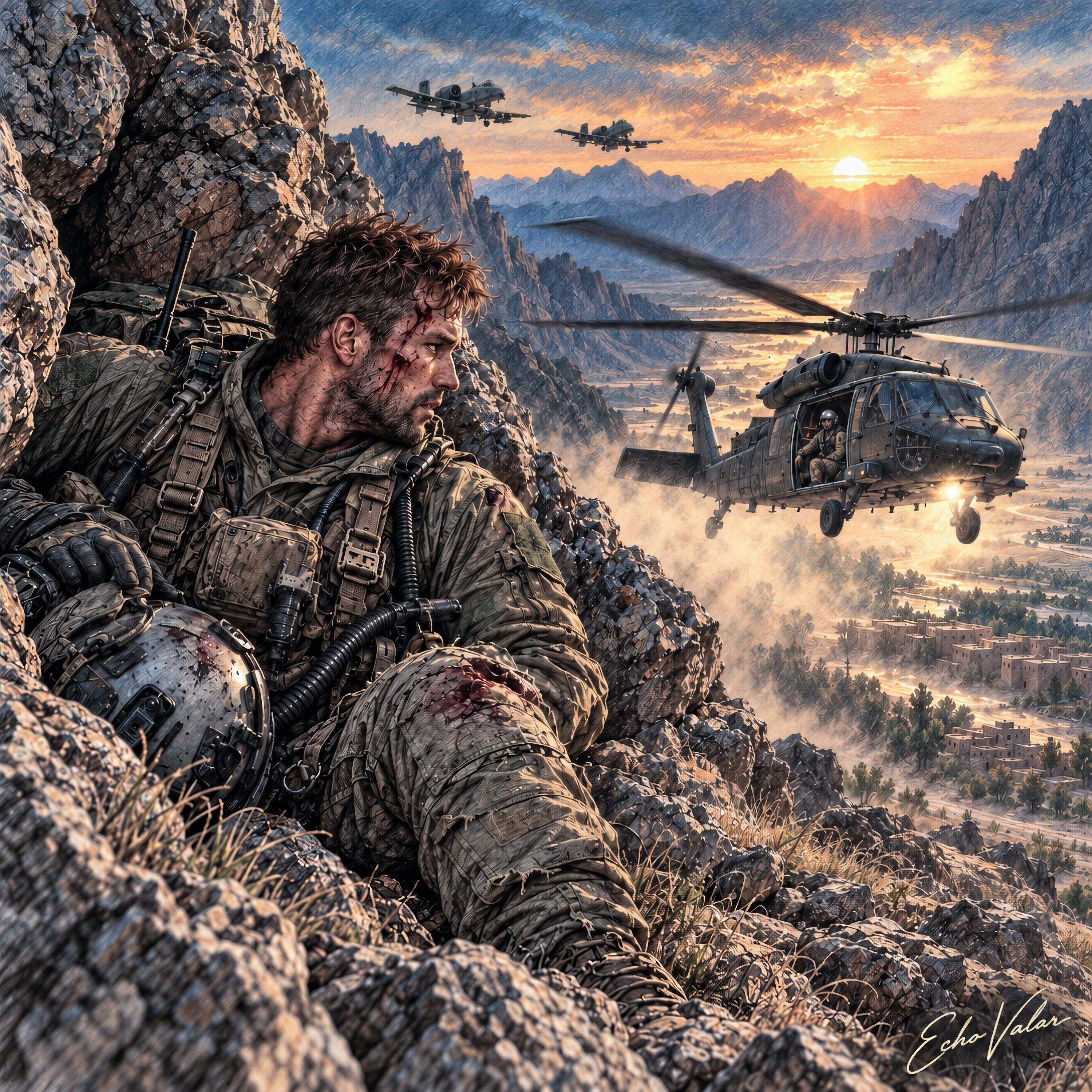
I’m David Burnell, and this is Echo Valor. Stories of courage, service, resilience, and faith. Let’s get started. Before a rescue helicopter reaches a downed airman, another fight is already underway. A wounded man has to stay alive. He has to make decisions through pain, exhaustion, and uncertainty while the people searching for him intend to capture him. Beyond his sight, others are working to find him, protect him, and bring him home. In early April 2026, that fight unfolded during the war involving the United States, Israel, and Iran. The conflict had begun on February twenty-eighth with U.S. and Israeli strikes against Iran. By the time this rescue took place, the war had entered its sixth week. On April third, an American F-15E Strike Eagle was shot down over southwestern Iran. Its pilot and weapons systems officer ejected into hostile territory. Both survived, but reaching them required two separate rescue operations. The pilot was recovered first. The injured weapons systems officer remained behind, evading capture while American military and intelligence personnel worked to locate him. This episode is called “We Will Come for You.” It is the story of the rescue of Dude 44, the aircraft’s call sign, and the preparation, endurance, and collective effort that brought its crew home. This account draws on public reporting and the April sixth briefing by American military and intelligence leaders. Some details remain undisclosed, but the public account reveals an extraordinary connection between a survivor’s determination and the people working to reach him. After the crew ejected, their mission changed immediately. Their aircraft could no longer carry them to safety. They had to survive on the ground, avoid capture, establish contact, and make recovery possible. General Dan Caine, chairman of the Joint Chiefs of Staff, said the Joint Personnel Recovery Center declared the emergency early that morning in Iran. After confirming active rescue beacons, American forces launched the recovery effort. In the public account, the pilot was identified as Dude 44 Alpha. The weapons systems officer was Dude 44 Bravo. The preparation for those hours had begun long before the aircraft went down. At Fairchild Air Force Base in Washington, the Air Force’s survival school prepares personnel for isolation and possible capture. The familiar acronym is SERE: survival, evasion, resistance, and escape. Survival means keeping yourself alive when the environment offers little support. Evasion means avoiding capture while working toward recovery. Resistance prepares personnel to uphold their obligations if captured. Escape addresses the possibility of getting out of captivity when circumstances permit. Air Force SERE specialists prepare aircrews and others whose duties place them at risk of isolation. Their work includes survival equipment, communication, signaling, concealment, and support to personnel recovery. The instructors undergo specialized training themselves before taking on the responsibility of preparing others. There is a practical reason to rehearse these skills before an emergency. Under stress, unfamiliar tasks compete for attention. Equipment that seemed simple in a classroom can become difficult to use when your hands are shaking, visibility is poor, or an injury limits movement. Practice gives you something dependable to return to. The individual training records of these two airmen are not part of this public account. We cannot say which exercise they remembered or which instructor’s lesson came back to them. We can recognize that surviving isolation and making recovery possible are precisely what this preparation is intended to support. To me, preparation is a responsibility we carry toward ourselves and the people who may someday have to help us. Every useful decision a survivor makes can improve the rescue force’s opportunity to reach him. The people coming for these airmen had their own years of preparation behind them. Air Force pararescuemen, commonly called PJs, train for both recovery and medicine. Their preparation includes demanding physical training, diving, parachuting, survival skills, emergency medical education, and specialized rescue training. The Air Force’s published pipeline includes a thirty-nine-week medical phase and a twenty-two-week pararescue apprentice phase, alongside the other schools. Qualification is followed by continued training with an operational team. That investment matters because a rescuer must be able to treat an injured person in circumstances where reaching the patient may be as difficult as providing the care. Combat rescue officers help lead recovery operations. Helicopter crews work with the rescuers and supporting aircraft. Each element has to understand its responsibility and how it connects with everyone else. Consider the repetition behind that capability. A pilot practices an emergency procedure. A medic rehearses an intervention. A team works through communication failures. People inspect equipment, revise plans, and learn where mistakes can occur. Much of that work happens without an audience. Its value becomes visible when someone’s life depends on it. The first rescue took place in daylight. Caine described a force that included A-10 Warthogs, HC-130 Combat King II aircraft, Jolly Green II rescue helicopters, combat rescue officers, and pararescuemen. Supporting aircraft protected the operation, and the helicopters refueled in flight as they pressed into Iran. The A-10s were performing the combat rescue mission known as Sandy. That role includes protecting and communicating with the survivor while helping the recovery force reach him. During the operation, an A-10 was hit by enemy fire. Its pilot continued the mission, then reached friendly territory and ejected when the damaged aircraft could not safely land. That pilot was also recovered. The Strike Eagle pilot was brought out aboard a rescue helicopter. The helicopters faced gunfire, and Caine reported minor injuries aboard a damaged aircraft. Dude 44 Alpha was recovered on Friday. The people coming to help were vulnerable themselves. Their aircraft could be hit. Their crews could be injured. Bringing someone home required accepting danger, managing it, and continuing to perform under pressure. But Dude 44 Bravo was still inside Iran. Public accounts described him as an injured colonel who had landed apart from the pilot. According to President Trump’s account, the officer moved away from his ejection area and climbed into difficult mountain terrain despite his wounds. He eventually concealed himself in a mountain crevice while Iranian forces searched for him. This is the part of the story I want us to slow down and consider. We know how it ended. While he was evading, he could not see the complete rescue plan or know every problem the people searching for him were trying to solve. His immediate responsibility was to keep himself alive and preserve the possibility of recovery. His private thoughts belong to him. His actions give us enough to recognize the endurance involved. Injury makes ordinary movement harder. Isolation removes the reassurance of another person beside you. Being hunted adds urgency to decisions that already carry serious consequences. His survival was an active contribution to the mission. Every hour he remained alive and uncaptured gave the people searching another opportunity. On Saturday, American officials established positive communications and confirmed his location. Caine emphasized that the officer’s determination to survive had helped make the rescue possible. That relationship is the heart of this story. The officer needed the recovery force, and the recovery force needed him to keep going. Locating him involved intelligence work as well as the military search. CIA Director John Ratcliffe said the agency used human assets and advanced technical capabilities to help find the missing officer. The specific methods were not fully disclosed. Intelligence personnel also worked to misdirect the Iranian search. Reuters reported, citing a senior administration official, that the deception campaign spread a false account inside Iran: American forces had already found the officer and were moving him overland for extraction. The intended effect was to confuse the people hunting him while the actual recovery effort continued. The president also described aircraft activity at different locations designed to obscure where the rescue would take place. Those accounts explain the purpose of the deception without revealing every method or showing precisely how each Iranian unit responded. Information became part of the protection around a wounded man. Uncertainty on the opposing side could preserve time and opportunity for the people trying to reach him. That work deserves recognition alongside the rescuers who physically recovered him. An analyst may never meet the survivor. A communications specialist may never see the mountain. Their contribution can still help determine whether the rescue force arrives at the right place in time. Reuters also reported that Israel said it assisted the operation. The public account does not provide a complete description of that assistance, but it belongs among the acknowledged contributions to the recovery. The second rescue required a larger force. At the April sixth briefing, President Trump said it involved one hundred fifty-five aircraft, including fighters, bombers, refueling tankers, and rescue aircraft. That was the administration’s stated total for the operation; it did not mean every aircraft was gathered above the officer at once. The scale reflects how many responsibilities had to be coordinated. Crews protected the recovery force, provided fuel, supported surveillance, and transported personnel. Command teams had to manage an operation that continued to change. Behind the flying missions stood the work that makes aircraft available: maintenance, supply, planning, and support. The public account does not name every contributor. Aviation depends on people whose responsibilities are fulfilled long before a crew takes off. As darkness fell on Saturday and the operation continued into Sunday, the recovery force went in for Dude 44 Bravo. American aircraft protected the rescuers while forces engaged threats and worked through contingencies. They reached the officer. But the mission was not finished. NPR’s reporting described a helicopter pickup followed by movement to a makeshift airstrip. There, two transport aircraft became stuck in wet, sandy ground and could not depart as planned. Replacement aircraft had to be brought in. The disabled transports were destroyed to prevent their capture. Consider the demand of that moment. The survivor has finally been recovered, yet the route out has developed a serious problem. The team has to keep functioning while the plan changes and the danger remains. Preparation has to leave room for adaptation. People need enough knowledge of their equipment, their mission, and one another to make a new solution work. A rehearsed plan provides a foundation. Judgment and experience help a team respond when circumstances move beyond it. The objective remained clear: get the people out. The replacement extraction succeeded. By early Sunday on the U.S. East Coast, Caine said both Strike Eagle crew members had returned to friendly territory, more than fifty hours after the operation began. American officials reported that no U.S. personnel were killed during the rescues, although injuries and aircraft losses were part of the cost. Both members of Dude 44 came home. As an Air Force veteran and someone whose work has included rescue and instruction, I see a chain of responsibilities in this story. The aircrew prepared. The wounded officer endured. Intelligence personnel searched and worked to confuse the opposing force. Aircrews protected, transported, and refueled. Rescuers reached the survivor. The extraction force adapted when the original plan could no longer be completed. Every link mattered. It is tempting to remember only the final moment of a rescue. The aircraft lifts away, the danger begins to recede, and everyone breathes again. That moment rests on years of disciplined work and hours of difficult decisions. This is why we tell these stories at Echo Valor. Courage deserves to be remembered alongside the preparation, patience, skill, and trust that allow people to act when the consequences are real. Most of us will never evade capture in a mountain crevice or fly a helicopter into hostile territory. We can still learn from the people who did. We can prepare for the responsibilities we already have, take training seriously, and become more dependable to the people who count on us. We can also remember that accepting help is part of resilience. The officer’s effort kept the opportunity alive. The commitment of others brought him home. And responsibility continues after a rescue. The public announcement closes one chapter. Recovery from injury and the experience itself may take longer. Our gratitude should leave room for that continuing work. To the crew of Dude 44 and everyone who helped recover them, thank you. To the instructors who prepared people for those hours, the support personnel who helped make the operation possible, and the families who stood behind them through years of service, your contributions deserve remembrance too. The rescue of Dude 44 during the 2026 Iran war reminds us what preparation and commitment can accomplish when people depend on one another. Thanks for listening to Echo Valor with David Burnell. Share this episode, subscribe wherever you listen, and visit EchoValor.com. Until next time, keep showing up for the people who count on you. Get full access to Echo Valor with David Burnell at davidburnell.substack.com/subscribe
Embed this episode
Ready to play
We Will Come for You
No transcript for this episode yet
Similar Episodes
No similar episodes found.