
EPISODE · Jul 5, 2026 · 13 MIN
Weekend Update - W2627
from Telltales · host Mike Nicoletti
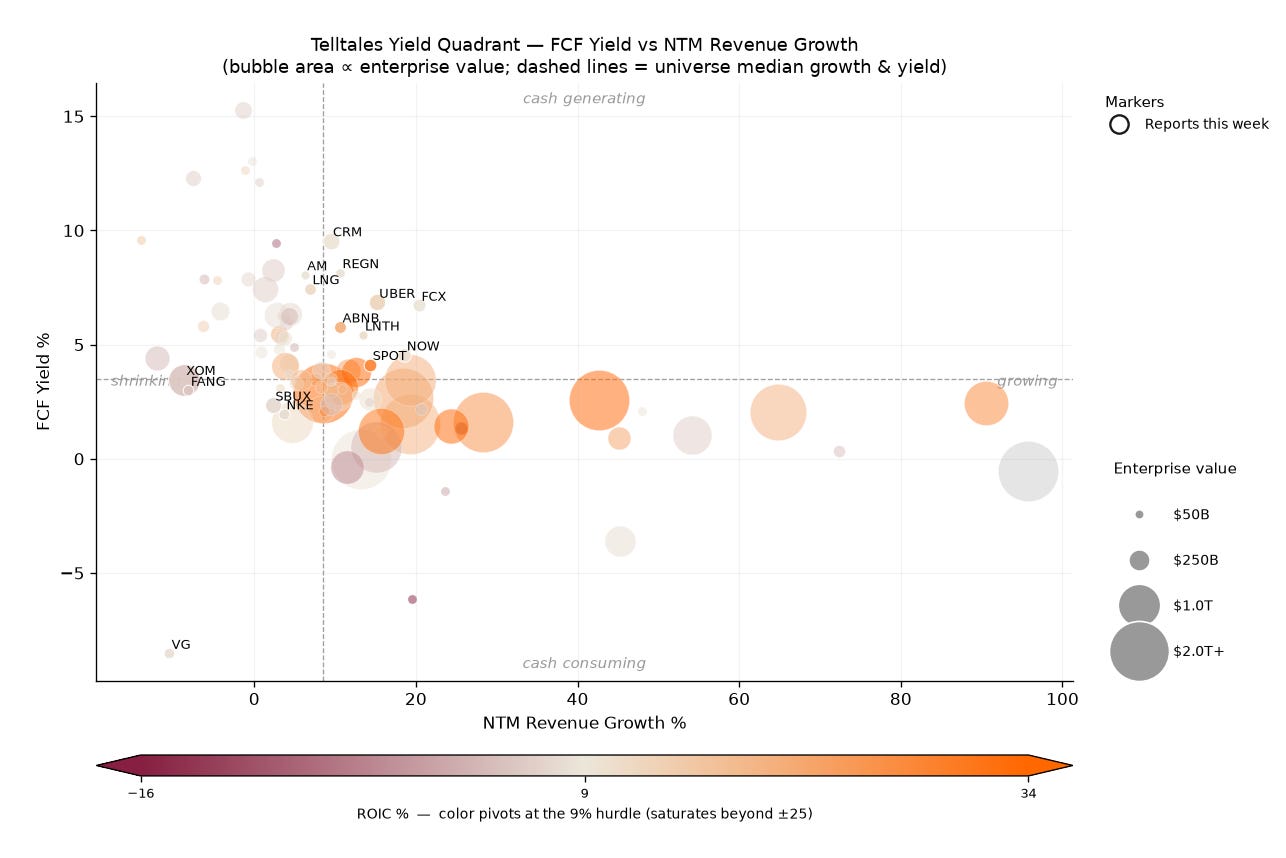
▶ Explore this week’s Tape — live, sortable, drill-down → Microsoft Is Funding the Next AI Layer With the Last One Enterprise AI stopped being a story about models this week and became a story about invoices. On July second, Microsoft — page one of the Cash Flow Memo — stood up a unit called Frontier Co.: two and a half billion dollars, six thousand people, one job, which is to take AI products the last mile into enterprise deployment.¹ Two days later it moved to cut up to five thousand roles from sales, consulting, and Xbox.² The new layer is being paid for with the headcount of the old one. That is not a hiring plan. It is a company rebuilding itself around the part of AI that actually sends a bill. The model layer got three years of narrative. The deployment layer — the boring work of installing the thing, retraining the seat, wiring it into the workflow — is where the money changes hands, and the market has not repriced for that yet. Microsoft just showed you how the transition lands in a real profit-and-loss statement before it lands in a revenue line: deployment headcount up, legacy headcount down, net headcount roughly flat, and the revenue you are supposedly buying still not visible. The screens know how to price a growth story. They do not know how to price a margin-mix reallocation that hasn’t reached the top line. We have watched Microsoft run this exact play once before. The last decade’s version was the move from packaged software to subscription — the company retooled its sales motion and its cost base around the cloud years ahead of the recurring revenue, wore an ex-growth multiple through the gap, and re-rated hard only once the ARR became legible. Frontier Co. is the same bet, one rung up the stack. The reorg comes first. The revenue is the lagging indicator. The interval between them is exactly where a name gets mispriced. The pricing tells landed the same week, on both ends of the stack. Microsoft made the Copilot Business seat a permanent product at twenty-one dollars a month³ — the output price, now fixed. And AWS, per a Yahoo Finance report, raised GPU instance prices about twenty percent on July first⁴ — the input price, moving up. Read those two together and you are watching enterprise-AI unit economics get discovered in real time: the cost of compute rising, the price of the seat set. The names that compound from here are the ones that can lift the output price faster than the input cost climbs. Microsoft, sitting on the seat, can. Most of the memo, buying the compute, cannot. One honest caveat on the input side, because it is doing a lot of work: the AWS move is one vendor’s list price on specific instances. Azure and Google have not publicly matched, and a list price is not what a committed customer actually pays. Whether it holds through the next wave of capacity — the sixty-five-to-seventy-five-billion-dollars-per-gigawatt data-center builds Hunt, Jason, and Mike walked through on Wednesday⁵ — is the tell for whether this is structural scarcity or a headline. Don’t let one instance-price line stand in for the whole compute market. The cashflow read is in Marcus’s column below — short version, Microsoft is paying about thirty-eight times trailing free cash flow⁶ for a deployment curve that isn’t in the numbers yet, on capex already running close to a hundred billion a year.⁷ Palantir, the pure-play version of the same government-and-enterprise bet, asks a hundred and eight.⁸ What changes the read is retention, not growth. The test on the next print, due late this month, is whether Copilot seat retention and attach start to show up inside Microsoft Cloud growth before the capex compounds past them. If deployment headcount grows and the seats don’t stick, that is the tell that enterprises are buying the org, not the outcome — and the whole bet inverts. Watch the AWS price too: if Azure and Google haven’t matched within a quarter, the twenty-percent move was a one-vendor list-price event, not the scarcity signal it read as. Mark the calendar for both. Wall Street’s consensus on enterprise AI: show us the revenue, then we’ll pay for it. But the org charts and the price tags moved this week, and the revenue line always arrives last. The last time Microsoft reorganized ahead of its own revenue, the people who waited for the number paid up for the wait. The Tape — W2627 Universe of 94 cashflow-memo names, snap dates 2026-07-02 → 2026-07-03. Composite is rank-sum percentile of FCF Yield + NTM Revenue Growth (higher = better balance). Banks and finance-book names shown separately. Telltales Yield — Top 10 From the Cashflow Desk — Marcus Graham The enterprise-AI trade got expensive this week, and the cheapest way to own it is sitting at number four on the board. Salesforce already licenses a seat inside nearly every enterprise now buying AI deployment — and the memo has it at 10.5x trailing free cash flow, a 9.5% FCF yield, against single-digit NTM growth. Palantir asks ~108x for a version of the same government-and-enterprise AI story. That gap is either the market correctly pricing Salesforce as ex-growth, or an unpriced option on Agentforce turning installed seats into AI attach. The table can’t tell you which. The test on the next print is whether agent adoption shows up in current RPO and net seat expansion — or whether single-digit growth is the new ceiling. Telltales Yield — Bottom 10 This Week’s Reporters No universe names reporting in the coming 7 days. Sector Medians Debt / FCF Watch (highest leverage on TTM FCF) Weekly Price Movement Top 5 (week-over-week price) Bottom 5 (week-over-week price) Banks (shown separately — FCF metric not meaningful) Finance-book — FCF not comparable Customer-float / captive-finance / reserve businesses (IBKR broker float, KMX CarMax Auto Finance, PYPL customer funds, CRCL stablecoin reserves). The memo’s operating-FCF method overstates their FCF, so they are held off the ranked leaderboard pending the P&L-waterfall rebuild. Data Gaps 91 of 91 ranked-eligible names ranked. 0 dropped for missing FCF yield or NTM revenue growth; 7 shown separately (banks + finance-book, FCF not comparable). Source: cashflow-memo master_2026-07-03.csv. NTM growth from analyst-estimates consensus. Composite is a percentile rank, not a recommendation. The Issue — This Week's Brief The Cashflow Memo W2627 — Tesla Blew Past Delivery Estimates, Comcast Split Itself into Cash, and Enterprise AI Started Setting Prices Tesla blew past delivery estimates, Comcast split itself into cash, and enterprise AI started setting prices. The Telltales Weekend Update. Ava Cabot and analyst Marcus Graham walk through what happened this week — and what’s coming next — across the companies in the Cash Flow Memo. About 14 minutes. No filler. Download the memo at telltales.us. Hunt, Jason, and Mike are back Wednesday on episode E2628. Chapter markers * Time | Segment * 0:00 | Opening disclaimer * 0:15 | Cold open — throughline + prior-Wed callback * 0:45 | Theme — AI Goes to Work (Microsoft, Palantir) * 4:45 | Deep dive — Two Multiples (Tesla, Comcast) * 8:45 | Rapid-fire (Walmart, Harrow, Eli Lilly) * 11:45 | Close — Consensus Watch + earnings season preview * 12:30 | Closing disclaimer Full transcript Opening disclaimer Ava: The following conversation is intended for informational purposes only. You should always do your own work to determine if an investment is suitable for you. Cold open Ava: You’re listening to the Telltales Weekend Update. I’m Ava Cabot. Marcus: And I’m Marcus Graham — the cashflow desk. Ava: Quick note: the show is produced entirely with AI tools, and both voices you’re hearing are AI-generated. Send feedback through the Substack. Ava: Enterprise AI went from story to price action this week. Microsoft committed $2.5 billion and 6,000 employees to a dedicated AI implementation unit — and simultaneously flagged cuts to up to 5,000 more in legacy functions. Palantir won the U.S. Army’s data backbone contract for its highest-priority modernization program. And AWS quietly raised GPU instance prices 20% on July 1[^amzn-gpu-pricing-20260701] — the first open, on-record pricing signal that compute scarcity is structural, not cyclic. Meanwhile, two companies at opposite ends of the Cash Flow Memo’s valuation spectrum each delivered exactly what they promised. And the market’s reaction told you what it’s currently willing to pay for. Ava: On Wednesday, Hunt, Jason, and Mike worked through the cost of building the AI infrastructure itself — data center builds now running $65–75 billion per gigawatt, memory running at 30–40% of the total buildout cost[^ep-e2627]. This weekend, we pick up on the demand side: who is deploying that infrastructure, at what scale, and what the cash flow math says about what the market believes will pay for it. Theme — AI Goes to Work Ava: On page one of the Cash Flow Memo this week — Microsoft moved. Not in the abstract direction of AI, but in the direction of paying for it organizationally. On July 2, Microsoft committed $2.5 billion and is deploying 6,000 employees into a new entity called Frontier Co. — a dedicated AI implementation unit built specifically to take AI products from development into enterprise deployment[^msft-frontier-ai-20260702]. On July 1, Microsoft also made Copilot Business a permanent SKU at $21 per user per month[^msft-copilot-sku-20260701], the pricing structure that the deployment unit is built around. And on July 3, the company announced it is cutting up to 5,000 employees from sales, consulting, and Xbox[^msft-layoffs-20260703]. Microsoft is funding the AI deployment bet with the headcount from the pre-AI org. That is a choice. Marcus — the cashflow frame. Marcus: Microsoft just put a price tag on the deployment layer — and it’s the capex number that makes this interesting. The memo had Microsoft at about 38 times trailing free cash flow on roughly $76 billion of trailing FCF going into this[^memo-msft-evfcf-20260331][^memo-msft-fcf-20260331]. Capex is running close to $100 billion trailing twelve[^memo-msft-capex-20260331]. That’s not a rounding error — that’s a declared bet on infrastructure before the Copilot revenue compounding is visible in the numbers. The test on the next print: whether Copilot dollar retention starts to justify the capex ahead of it. 38 times is what you pay when you believe the deployment curve is real. This week Microsoft told you it believes. Ava: On the government side of the same argument: Palantir. The U.S. Army this month selected Palantir Foundry as the cloud data layer for NGC2 — Next Generation Command and Control — described by the Army as its highest-priority modernization effort[^pltr-army-ngc2-20260622]. On June 29, Palantir and Nvidia launched an engine for deploying Nvidia’s Nemotron open models in sovereign, air-gapped government environments[^pltr-nvidia-sovereign-ai-20260629]. The market digested all of it on July 1: Palantir up 7.8%, adding about $22 billion to its market value in a single session[^pltr-stock-rally-20260701]. DA Davidson followed on July 2 with a Buy upgrade and a $175 target[^pltr-da-davidson-upgrade-20260702]. Marcus — at 108 times free cash flow, what exactly is the market paying for? Marcus: Palantir is the closest thing the memo has to a pure-play on government AI becoming mandatory infrastructure rather than optional tooling. The memo has Palantir at about 108 times trailing free cash flow on roughly $2.7 billion of trailing FCF[^memo-pltr-evfcf-20260331][^memo-pltr-fcf-20260331]. Revenue ran about 85% growth year over year[^memo-pltr-rev-20260331]. That growth rate is real — but at this multiple, you are paying for every NATO-adjacent government following the Army’s architecture choice. NGC2 makes that thesis credibly possible. It doesn’t make it certain. The difference between possible and certain is where the risk lives. Ava: That’s the theme this week. AI isn’t just being built anymore — it’s going to work. AWS pricing compute as a scarce resource. Microsoft organizing its headcount around deployment. Palantir wiring the Army’s command layer into Foundry. The abstract investment argument just became a series of operating decisions with dollar amounts attached. Deep dive — Two Multiples, One Week Ava: The deep dive this week is a comparison. Two companies moved on the same week for completely different reasons — and they sit at opposite ends of what the market is currently willing to pay for. Tesla — also on page one of the memo this week — at just under 200 times trailing free cash flow. Comcast at 6.5 times trailing free cash flow. One company delivered a delivery beat. One delivered a restructuring announcement. The market applauded both. But the questions each answer are completely different. Ava: Tesla reported Q2 deliveries of 480,000 vehicles — up 25% year over year and marking the company’s first year-over-year delivery growth since 2023[^tsla-q2-deliveries-20260702]. That beat sell-side consensus by 74,000 units, or about 18% above where even the most bullish estimates were sitting[^tsla-deliveries-beat-20260702]. Comcast on June 29 announced it would spin off NBCUniversal and Sky into a new, separate publicly traded entity via a tax-free split expected to complete in approximately one year[^cmcsa-nbcu-spinoff-20260629]. Comcast is retaining a 19.9% stake in NBCUniversal for up to a year before monetizing[^cmcsa-ownership-20260629]. Comcast shares surged 21% in premarket on the announcement[^cmcsa-stock-surge-20260629]. Two very different proofs of value. Marcus — start with Tesla. Marcus: Tesla just proved the car business still works. Going into the Q2 financial print — which lands July 22[^tsla-earnings-schedule-20260702] — the memo had Tesla at just under 200 times trailing free cash flow on about $7 billion of trailing FCF, up more than double from the prior 12 months[^memo-tsla-evfcf-20260331][^memo-tsla-fcf-20260331]. The delivery beat answers one question: the demand is real, the business isn’t broken. The multiple asks a second question the delivery print does not answer: whether the autonomy layer scales into a standalone revenue stream. Those are different theses. One was validated this week. The other is what you are paying 200 times cash flow to believe. Ava: 200 times. Take a moment with that number. Marcus: On Comcast — the spinoff unlocks something the combined company had been hiding for years. The memo had Comcast at 6.5 times trailing free cash flow at about a 15% yield, on roughly $25 billion of trailing FCF going into the announcement[^memo-cmcsa-evfcf-20260331][^memo-cmcsa-fcf-20260331]. The broadband and cable infrastructure stays at Comcast — that’s the cash machine. The content SpinCo gets the narrative and the hype. How the debt distributes between the two entities during separation determines which stub actually screens cheaper at the stub level — that’s the number to watch during the 12 months of separation. The swing factor is whether broadband subscribers hold through the streaming transition once the content discount is removed. Ava: Goldman Sachs cut their price target to $26 this week[^cmcsa-gs-downgrade-20260702]. The broadband company was always 6.5 times — the content assets were the noise that obscured it. Marcus: That’s the argument. And it’s the cleanest sum-of-the-parts unlock in the memo universe right now. A 15% free cash flow yield on a broadband business with over 60 million subscribers is a different conversation once you don’t have to price it alongside Peacock. Ava: One name at nearly 200 times trailing free cash flow. One at 6.5 times. Both moved meaningfully on the same week. What the comparison says is something about where narrative premium lives right now versus where current cash generation prices. Tesla delivery beats don’t price autonomy — they confirm the baseline. Comcast restructurings don’t create cash — they reveal it. The market decided this week exactly how it wants to pay for each kind of proof. Rapid-fire Ava: Rapid-fire. Three names, no deep analytical beat — just the week’s signal. Ava: Walmart. Cleveland Research flagged slowing U.S. comparable store sales and raised questions about whether Walmart is lowering prices aggressively to clear excess inventory, raising doubts on near-term sales guidance and merchandise margins[^wmt-comps-slowdown-20260701]. The stock dropped 8.5% on the note[^wmt-margin-strategy-20260701]. Then June non-farm payrolls came in significantly below economist projections on July 2 — eased rate concerns, institutional buyers stepped in, and Walmart bounced 3%[^wmt-rebound-payrolls-20260702]. The memo has Walmart at 62 times trailing free cash flow at a 1.5% yield. At 62 times, you are priced for flawless execution at 4% revenue growth. A Cleveland Research comp note is not a blip. It’s a thesis stress test. The bounce doesn’t resolve the question; it just means the question waits for next quarter. Ava: Harrow. The BYOOVIZ commercial launch happened July 1 — an FDA-approved interchangeable biosimilar referencing Lucentis, commercialized through Harrow’s exclusive agreement with Samsung Bioepis[^hrow-byooviz-launch-20260701]. BYOOVIZ is Harrow’s entry into the anti-VEGF market, which runs roughly $9 billion annually. Harrow’s full-year revenue guidance is $350–$365 million — the BYOOVIZ ramp is load-bearing for that number. At 48 times trailing free cash flow on a smaller-cap name, the launch velocity matters. The first signal on the ramp arrives with the Q2 print. Ava: Eli Lilly. The Medicare GLP-1 Bridge Program launched July 1, giving eligible Medicare Part D patients access to Foundayo — that’s orforglipron — and Zepbound at a $50 monthly copay[^lly-medicare-glp1-20260701]. The same week, the FDA selected Lilly for its PreCheck manufacturing fast-lane pilot, with Lilly’s active pharmaceutical ingredient plant in Indiana now in the program[^lly-fda-precheck-20260629]. Lilly’s full-year revenue guide is $82–$85 billion[^lly-q1-2026-20260430]. The memo has it at 81 times trailing free cash flow. The access expansion thesis just got two pieces of infrastructure in one week. The ramp is what the multiple is betting on — and a House investigation into China clinical trials with a July 17 deadline is the counter-catalyst to watch. Close Ava: That’s the show. Wall Street’s consensus on Tesla: the delivery beat validates the autonomy thesis. It validates the car thesis. But those are different theses at very different prices. A delivery beat confirms the baseline business isn’t broken. It doesn’t price the autonomy layer — that’s a separate bet, and it’s still a bet. Ava: Earnings season opens this coming week. JPMorgan and Goldman Sachs both report Tuesday[^earn-jpm][^earn-gs]. ASML drops Wednesday — which means the export control story and the Netherlands joining the Pax Silica alliance get a revenue number attached to them, with China at roughly 20% of projected 2026 systems revenue[^asml-decline-20260701]. Morgan Stanley also Wednesday[^earn-ms]. Thursday is stacked: Netflix, TSM, and UnitedHealth all in one session[^earn-nflx][^earn-tsm][^earn-unh]. Seven reports in four days. The opening bell of Q2 earnings season. Hunt, Jason, and Mike promised the mid-year predictions scorecard on Wednesday — and Hunt’s exact words were, next week we’ll all be kind of embarrassed by how poorly our predictions went[^ep-e2627]. Looking forward to it. They’re back Wednesday on episode E2628. Download the Cash Flow Memo at telltales.us. Closing disclaimer Ava: The views expressed on this podcast are the host alone and do not constitute an offer to sell or a recommendation to purchase, or a solicitation of an offer to buy any security, nor a recommendation for any investment product or service. While certain information contained herein has been obtained from sources believed to be reliable, neither the host nor any of their employers or their affiliates have independently verified this information, and its accuracy and completeness cannot be guaranteed. Accordingly, no representation or warranty, express or implied, is made as to, and no reliance should be placed on, the fairness, accuracy, timeliness, or completeness of this information. The host and all employers and their affiliated persons assume no liability for this information and no obligation to update the information or analysis contained herein in the future, and may or may not hold positions in the securities mentioned. Sources * AWS raising GPU instance prices 20% on July 1. (2026, July 1). Yahoo Finance. https://finance.yahoo.com/technology/ai/articles/aws-raising-gpu-instance-prices-134420295.html * ASML Holding NV Stock (ASML) Moved Down by 6.02% on Jul 1: What Investors Need To Know. (2026, July 1). TradingKey. https://www.tradingkey.com/news/market-movers/262004606-market-movers-asml-20260701 * Comcast announces it will spin off NBCUniversal and Sky from cable business. (2026, June 29). CNBC. https://www.cnbc.com/2026/06/29/comcast-announces-it-will-spin-off-media-and-tech-wings-into-separate-public-companies.html * Comcast (NASDAQ:CMCSA) Given New $26.00 Price Target at The Goldman Sachs Group. (2026, July 2). Markets Daily. https://www.themarketsdaily.com/2026/07/02/comcast-nasdaqcmcsa-given-new-26-00-price-target-at-the-goldman-sachs-group.html * Comcast NBCUniversal Spinoff Splits 65 Million Subscribers Across Two New Companies. (2026, June 29). Tech Times. https://www.techtimes.com/articles/319337/20260629/comcast-nbcuniversal-spinoff-splits-65-million-subscribers-across-two-new-companies.htm * Comcast stock surges as cable giant announces company split. (2026, June 29). Yahoo Finance. https://finance.yahoo.com/markets/article/comcast-stock-surges-as-cable-giant-announces-company-split-123931766.html * Eli Lilly and Company. (2026, April 30). Lilly reports first-quarter 2026 financial results, raises full year guidance, and highlights momentum of new medicines [Press release]. Eli Lilly Investor Relations. https://investor.lilly.com/news-releases/news-release-details/lilly-reports-first-quarter-2026-financial-results-raises-full * GlobeNewswire. (2026, July 1). Harrow Announces Commercial Launch of BYOOVIZ® in the United States [Press release]. https://www.globenewswire.com/news-release/2026/07/01/3320502/0/en/Harrow-Announces-Commercial-Launch-of-BYOOVIZ-in-the-United-States.html * Microsoft 365 Business Plans With Copilot Go Permanent for SMBs (July 2026). (2026, July 1). Windows Forum. https://windowsforum.com/threads/microsoft-365-business-plans-with-copilot-go-permanent-for-smbs-july-2026.425116/ * Microsoft commits $2.5 billion and 6,000 employees to new AI implementation unit. (2026, July 2). CNBC. https://www.cnbc.com/2026/07/02/microsoft-commits-2point5-billion-6000-employees-ai-implementation-unit.html * Microsoft eyes another wave of layoffs that could hit 5,000 workers next week. (2026, July 3). Fox Business. https://www.foxbusiness.com/economy/microsoft-eyes-another-wave-layoffs-hit-5000-workers-next-week * Palantir Technologies. (2026, June 22). Palantir Secures Foundational Role in NGC2 Data Layer [Press release]. Palantir Investor Relations. https://investors.palantir.com/news-details/2026/Palantir-Secures-Foundational-Role-in-NGC2-Data-Layer/ * Palantir Technologies. (2026, June 29). Palantir Launches Engine for Deploying NVIDIA Nemotron Open Models in Sovereign Environments [Press release]. Palantir Investor Relations. https://investors.palantir.com/news-details/2026/Palantir-Launches-Engine-for-Deploying-NVIDIA-Nemotron-Open-Models-in-Sovereign-Environments/ * Palantir shares have struggled this year. D.A. Davidson says buy the dip. (2026, July 2). CNBC. https://www.cnbc.com/2026/07/02/palantir-shares-have-struggled-this-year-da-davidson-says-buy-the-dip.html * Palantir (NASDAQ: PLTR) Wins Role As Data Architecture Backbone For US Army’s NGC2 Command Program. (2026, June 27). Foreign Policy Journal. https://www.foreignpolicyjournal.com/2026/06/27/palantir-nasdaq-pltr-wins-role-as-data-architecture-backbone-for-us-armys-ngc2-command-program/ * PR Newswire. (2026, July 1). What Medicare Part D patients need to know about accessing Foundayo (orforglipron) and Zepbound (tirzepatide) for weight management [Press release]. https://www.prnewswire.com/news-releases/what-medicare-part-d-patients-need-to-know-about-accessing-foundayo-orforglipron-and-zepbound-tirzepatide-for-weight-management-302810143.html * Tesla, Inc. (2026, July 2). Tesla Second Quarter 2026 Production, Deliveries and Deployments [Press release]. Tesla Investor Relations. https://ir.tesla.com/press-release/tesla-second-quarter-2026-production-deliveries-and-deployments * U.S. Food and Drug Administration. (2026, June 29). FDA Selects Seven Participants for PreCheck Pilot Program to Advance U.S. Drug Manufacturing. https://www.fda.gov/news-events/press-announcements/fda-selects-seven-participants-precheck-pilot-program-advance-us-drug-manufacturing * Walmart (WMT) Is Down 8.6% After Slowing U.S. Comps Raise Questions On Margin Strategy. (2026, July 1). Yahoo Finance. https://finance.yahoo.com/markets/stocks/articles/walmart-wmt-down-8-6-051142700.html * Walmart Inc Stock (WMT) Moved Up by 3.15% on Jul 2: What Investors Need To Know. (2026, July 2). TradingKey. https://www.tradingkey.com/news/market-movers/262007772-market-movers-wmt-20260702 * Why Walmart Plunged Today. (2026, July 1). Yahoo Finance. https://finance.yahoo.com/markets/stocks/articles/why-walmart-plunged-today-185051907.html Earnings slate references Earnings dates sourced from the W2627 earnings slate (04. Publishing/shows/weekend-update/W2627/dryrun/earnings_slate.md), pulled 2026-07-04. * JPMorgan Chase (JPM) — 2026-07-14 (Tuesday), consensus EPS $5.61, consensus revenue $49.82B * Goldman Sachs (GS) — 2026-07-14 (Tuesday), consensus EPS $14.01, consensus revenue $16.02B * ASML (ASML) — 2026-07-15 (Wednesday), consensus EPS $7.98, consensus revenue $10.37B * Morgan Stanley (MS) — 2026-07-15 (Wednesday), consensus EPS $2.83, consensus revenue $19.29B * Netflix (NFLX) — 2026-07-16 (Thursday), consensus EPS $0.79, consensus revenue $12.58B * Taiwan Semiconductor (TSM) — 2026-07-16 (Thursday), consensus EPS $3.77, consensus revenue $40.02B * UnitedHealth (UNH) — 2026-07-16 (Thursday), consensus EPS $4.84, consensus revenue $110.76B Internal data Internal data is provided on a best efforts basis. This is a public episode. If you would like to discuss this with other subscribers or get access to bonus episodes, visit telltales.substack.com
Embed this episode
Ready to play
Weekend Update - W2627
No transcript for this episode yet
Similar Episodes
No similar episodes found.
Similar Podcasts
No similar podcasts found.