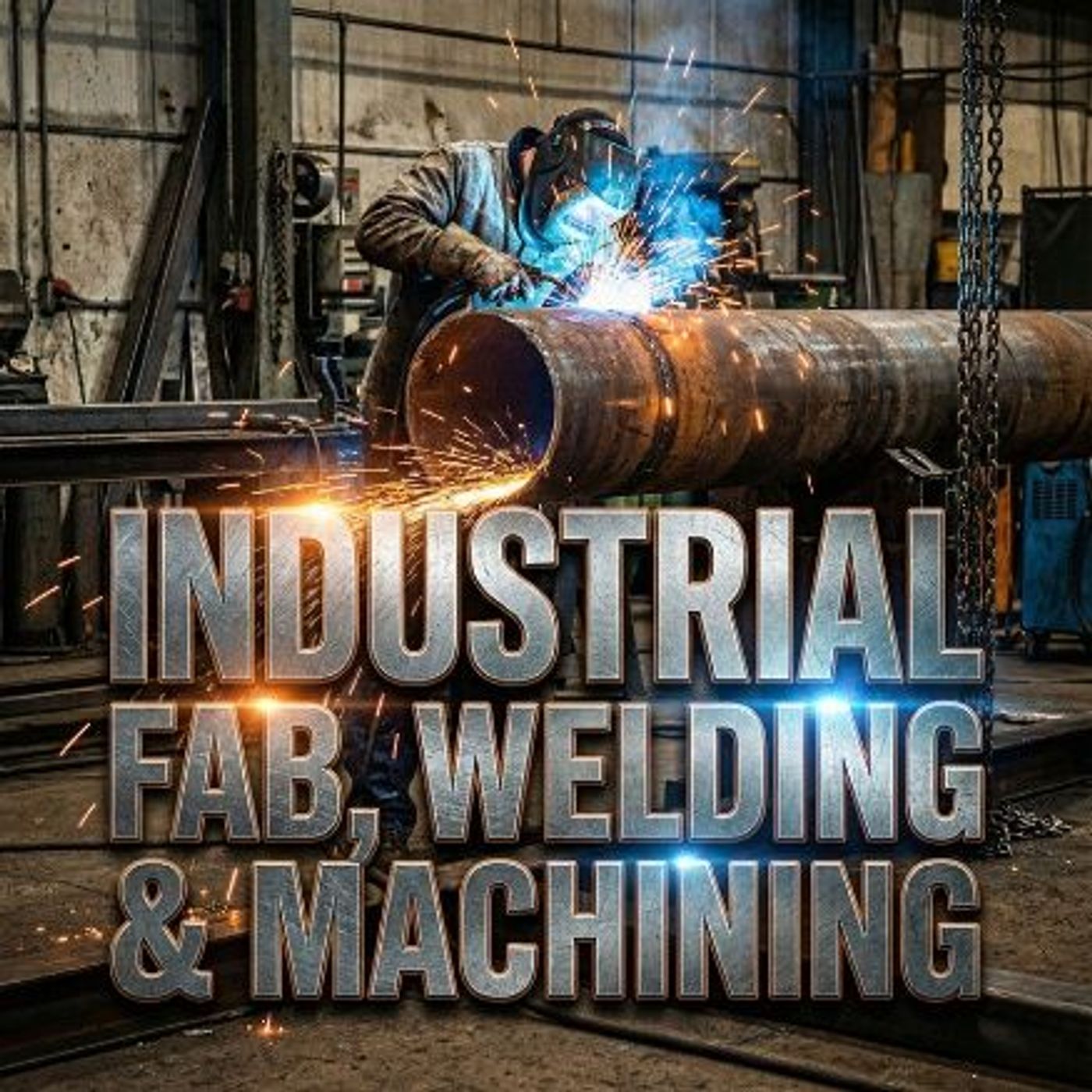
Welding Experts: Essential Insights for Industrial Success
from Industrial Fab, Welding & Machining Hosted by Aaron Sova
While the global welding market accounts for tens of billions of dollars annually, the specialized trade professionals behind structural integrity remain essential to modern industrial infrastructure. Far beyond simply joining two pieces of metal, certified welding experts function as applied metallurgists, field problem solvers, and safety leaders. From high-pressure oilfield pipelines to heavy aggregate crushers, master welders ensure operational continuity under severe environmental and mechanical stress. On this episode of Industrial Fab, Welding & Machining, the engineering team at LTJ Industrial Services examines the multidimensional expertise of master welders, field deployment challenges, AI-driven automation, and non-destructive quality control. Key Episode Highlights The Multidisciplinary Mastery of Welding Experts: Metallurgical Competency: Understanding thermal conductivity, grain structure expansion, phase transformations, and heat-affected zone ($\text{HAZ}$) behavior across carbon steels, duplex stainless alloys, aluminum, and titanium. Process Versatility: Fluency across multi-process arc applications—precision Gas Tungsten Arc Welding ($\text{GTAW / TIG}$) for cleanroom or aerospace tubing, Gas Metal Arc Welding ($\text{GMAW / MIG}$) for production speed, and Shielded Metal Arc Welding ($\text{SMAW / Stick}$) for heavy field structural repairs. Environmental Adaptation: Mitigating ambient humidity, wind velocities disrupting shielding gas envelopes, and thermal shock during cold-weather field deployments. Industry-Specific Field Challenges: Oil & Gas: High-pressure piping systems ($\text{ASME B31.3}$) and exotic sour-service alloys requiring exact pre-heat, interpass temperature control, and $100\%$ radiographic inspection. Aggregate & Mining: Severe impact and gouging abrasion on excavator buckets, hopper liners, and crusher jaws requiring specialized hardfacing overlays ($\text{Chromium Carbide}$ / $\text{Tungsten Carbide}$) to prevent catastrophic structural failure. Next-Generation Technologies & Human Augmentation: AI-Enhanced Robotic Cells: Machine learning algorithms monitor real-time arc voltage, wire-feed consistency, and puddle geometry to correct micro-defects during high-speed production runs. Human experts program, calibrate, and oversee these automated systems. Augmented Reality (AR) Training: Accelerates skill acquisition by overlaying real-time feedback on travel speed, torch angle, and arc length during training simulations. Non-Destructive Testing ($\text{NDT}$): Utilizing Ultrasonic Testing ($\text{UT}$), Radiographic Testing ($\text{RT}$), and Magnetic Particle Inspection ($\text{MT}$) to ensure complete volumetric seam integrity. Expertise Comparison: Shop Fabrication vs. High-Risk Field Welding Environmental Control Controlled Shop Fabrication: Climate-controlled bays; draft-free shielding gas envelopes; ideal ergonomics and positioning fixtures. High-Risk Field Welding: Exposed to weather, wind, and extreme temperatures; requires portable draft shields and manual positioning. Metallurgical Challenges Controlled Shop Fabrication: Standardized material prep; pre-cleaned mill scale; automated heat-treat ovens. High-Risk Field Welding: Contaminated substrates (oil, rust, slurry); unknown metal compositions requiring field spark/hardness testing; torch preheating. Quality Control & Code Verification Controlled Shop Fabrication: Multi-stage quality gates; scheduled NDT testing; automated dimensional scanning. High-Risk Field Welding: $100\%$ visual and NDT verification under tight deadline pressure where unexpected downtime costs thousands per hour. Safety & Hazard Protocols Controlled Shop Fabrication: Stationary local exhaust ventilation; clear overhead crane paths; fixed electrical grounding. High-Risk Field Welding: Confined space entries ($\text{OSHA}$ protocols); hot-work permits in explosive gas atmospheres; portable fall protection. Actionable 4-Step Technical Audit for Heavy Equipment & Piping RepairTo ensure high-stress field welds meet code specifications and prevent premature structural failure, execute this four-step engineering audit: Verify Material Composition & Chemistry: Review Certified Material Test Reports ($\text{CMTRs}$) or conduct field chemical analysis to determine carbon equivalency ($\text{CE}$) and select the correct filler wire and preheat temperatures. Execute Mandatory Joint Preparation: Mechanically bevel joint edges to specified angles ($30^\circ\text{ to }37.5^\circ$), removing all paint, grease, rust, and moisture within $2\text{ inches}$ of the weld zone. Monitor Thermal Input During Execution: Utilize digital infrared thermometers or tempil sticks to ensure preheat and interpass temperatures stay strictly within the qualified Welding Procedure Specification ($\text{WPS}$). Perform Volumetric Non-Destructive Testing: Conduct dye-penetrant ($\text{PT}$) testing on root passes and perform phased-array ultrasonic ($\text{PAUT}$) or radiographic ($\text{RT}$) inspection on final caps for high-pressure or heavy-load joints. Partner with Master Craftsmen at LTJ Industrial Services Relying on unvetted field welders or non-compliant repair procedures exposes your oilfield piping, aggregate plants, and heavy machinery to catastrophic cracking, structural failure, and expensive downtime. Based at 22505 US-6, Rifle, Colorado, LTJ Industrial Services brings over 60 years of combined team experience across certified multi-code welding ($\text{ASME Section IX}$, $\text{AWS D1.1/D1.6}$, $\text{API 1104}$), precision $\text{CNC}$ machining, custom structural fabrication, and 24/7 mobile field service.Our master welders and field service crews deliver end-to-end manufacturing and emergency repair solutions—from heavy equipment bucket hardfacing and pipeline tie-ins to portable line-boring and structural retrofits.Protect your capital assets with certified welding expertise. Call our Rifle engineering desk today at (970) 625-9353 or visit LTJIndustrial.com to submit your drawings or request immediate field dispatch. Click here to read more Learn more about LTJ Industrial Services at www.ltjindustrial.com/
Embed this episode
What this episode covers
While the global welding market accounts for tens of billions of dollars annually, the specialized trade professionals behind structural integrity remain essential to modern industrial infrastructure. Far beyond simply joining two pieces of metal, certified welding experts function as applied metallurgists, field problem solvers, and safety leaders. From high-pressure oilfield pipelines to heavy aggregate crushers, master welders ensure operational continuity under severe environmental and mechanical stress. On this episode of Industrial Fab, Welding & Machining, the engineering team at LTJ Industrial Services examines the multidimensional expertise of master welders, field deployment challenges, AI-driven automation, and non-destructive quality control. Key Episode Highlights The Multidisciplinary Mastery of Welding Experts: Metallurgical Competency: Understanding thermal conductivity, grain structure expansion, phase transformations, and heat-affected zone ($\text{HAZ}$) behavior across carbon steels, duplex stainless alloys, aluminum, and titanium. Process Versatility: Fluency across multi-process arc applications—precision Gas Tungsten Arc Welding ($\text{GTAW / TIG}$) for cleanroom or aerospace tubing, Gas Metal Arc Welding ($\text{GMAW / MIG}$) for production speed, and Shielded Metal Arc Welding ($\text{SMAW / Stick}$) for heavy field structural repairs. Environmental Adaptation: Mitigating ambient humidity, wind velocities disrupting shielding gas envelopes, and thermal shock during cold-weather field deployments. Industry-Specific Field Challenges: Oil & Gas: High-pressure piping systems ($\text{ASME B31.3}$) and exotic sour-service alloys requiring exact pre-heat, interpass temperature control, and $100\%$ radiographic inspection. Aggregate & Mining: Severe impact and gouging abrasion on excavator buckets, hopper liners, and crusher jaws requiring specialized hardfacing overlays ($\text{Chromium Carbide}$ / $\text{Tungsten Carbide}$) to prevent catastrophic structural failure. Next-Generation Technologies & Human Augmentation: AI-Enhanced Robotic Cells: Machine learning algorithms monitor real-time arc voltage, wire-feed consistency, and puddle geometry to correct micro-defects during high-speed production runs. Human experts program, calibrate, and oversee these automated systems. Augmented Reality (AR) Training: Accelerates skill acquisition by overlaying real-time feedback on travel speed, torch angle, and arc length during training simulations. Non-Destructive Testing ($\text{NDT}$): Utilizing Ultrasonic Testing ($\text{UT}$), Radiographic Testing ($\text{RT}$), and Magnetic Particle Inspection ($\text{MT}$) to ensure complete volumetric seam integrity. Expertise Comparison: Shop Fabrication vs. High-Risk Field Welding Environmental Control Controlled Shop Fabrication: Climate-controlled bays; draft-free shielding gas envelopes; ideal ergonomics and positioning fixtures. High-Risk Field Welding: Exposed to weather, wind, and extreme temperatures; requires portable draft shields and manual positioning. Metallurgical Challenges Controlled Shop Fabrication: Standardized material prep; pre-cleaned mill scale; automated heat-treat ovens. High-Risk Field Welding: Contaminated substrates (oil, rust, slurry); unknown metal compositions requiring field spark/hardness testing; torch preheating. Quality Control & Code Verification Controlled Shop Fabrication: Multi-stage quality gates; scheduled NDT testing; automated dimensional scanning. High-Risk Field Welding: $100\%$ visual and NDT verification under...
No transcript yet.