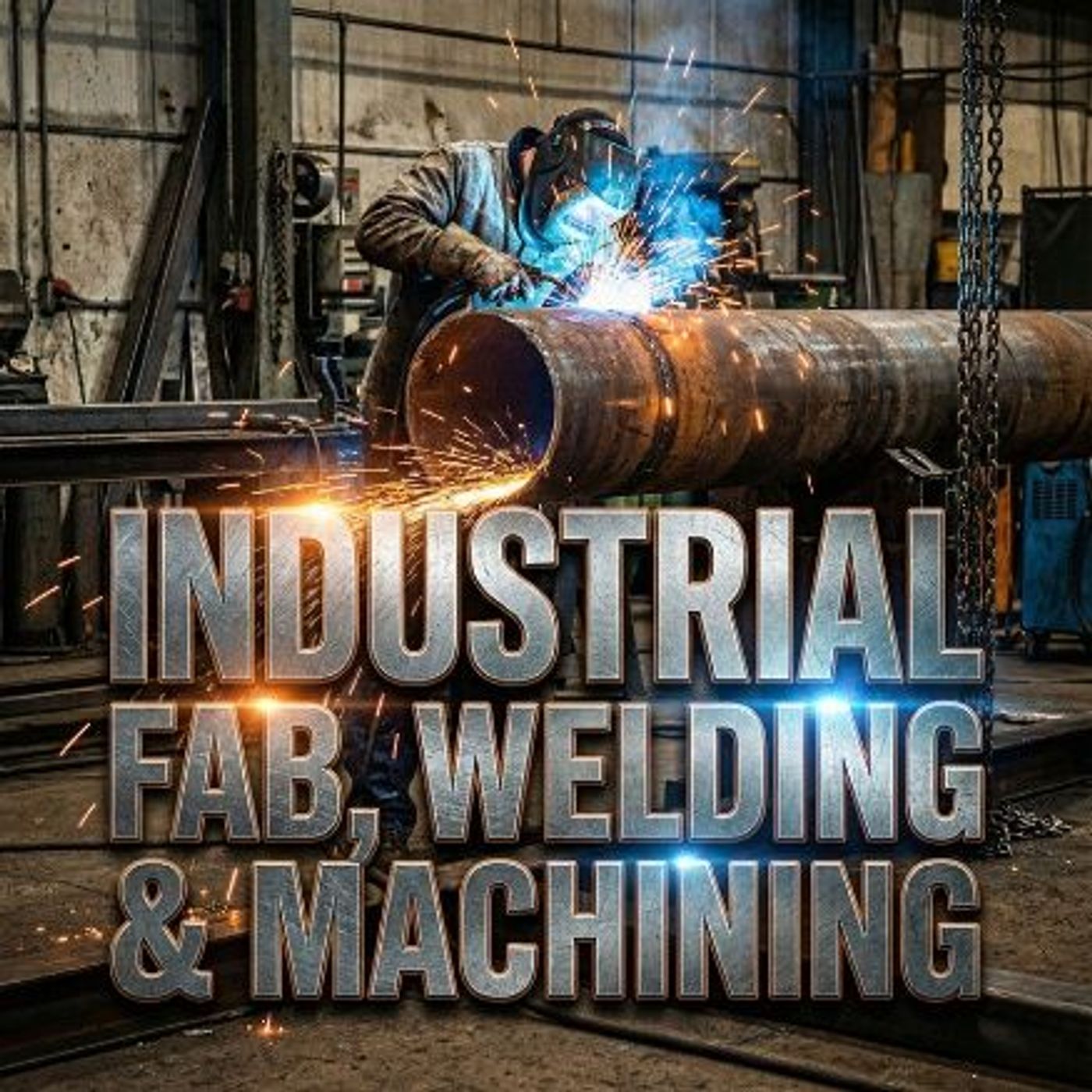
Welding Specifications: Standards & Best Practices 2026
from Industrial Fab, Welding & Machining Hosted by Aaron Sova
In high-consequence energy transmission, heavy equipment maintenance, and structural steel fabrication, structural failures carry severe safety, environmental, and financial risks. The Welding Procedure Specification (WPS) acts as the definitive engineering blueprint, establishing rigid, documented parameter windows to ensure every weld deposit achieves code compliance and mechanical reliability.On this episode of Industrial Fab, Welding & Machining, the fabrication specialists at LTJ Industrial Services examine the technical anatomy of a WPS, destructive Procedure Qualification Records (PQR), thermal cycling controls, and code qualification protocols.Technical Comparison: Standard SWPS vs. Custom Engineered WPS Material Versatility & Joint Geometry: Standard SWPS: Restricted to common structural steel grades, standard thickness envelopes, and pre-approved joint configurations; cannot be modified without formal testing. Custom Engineered WPS: Developed for non-standard alloys, high-strength quenched and tempered steels, and specialized joint bevels across heavy pressure vessels and pipeline tie-ins. Thermal Management & Hydrogen Control: Standard SWPS: Mandates generic preheat baselines suitable for standard shop fabrication. Custom Engineered WPS: Specifies precise preheat and Post-Weld Heat Treatment (PWHT) soak cycles via induction or ceramic blankets, controlling cooling rates to diffuse hydrogen and prevent Heat-Affected Zone (HAZ) cracking. Mechanical Validation Protocols: Standard SWPS: Pre-validated by standard AWS consensus, requiring no initial laboratory coupon destruction. Custom Engineered WPS: Backed by an authenticated PQR detailing destructive transverse tensile, guided bend, and Charpy V-notch impact testing to verify ductility and yield strength. Actionable Execution Playbook for Industrial Operators Enforce Direct PQR Traceability: Validate that all active shop and field WPS documents cite authenticated supporting PQR mechanical test data prior to striking an arc. Monitor Interpass & Preheat Windows: Track thermal parameters with calibrated pyrometers to maintain HAZ ductility and eliminate delayed cold cracking. Verify Welder Process Continuity: Maintain six-month continuity logs for all qualified welders to preserve their Welder Performance Qualifications (WPQ) under ASME Section IX and AWS D1.1. Partner with LTJ Industrial ServicesEliminate structural weld defects and costly turnaround downtime. Located at 22505 US-6, Rifle, CO 81650, LTJ Industrial Services provides ASME Section IX and AWS D1.1 certified welding, mobile field repair rigs, CNC precision machining, and custom heavy fabrication across Western Colorado.Deploy code-certified welding to your operation. Visit LTJindustrial.com or call (970) 625-9353 to request a project estimate. Click here Learn more about LTJ Industrial Services at www.ltjindustrial.com/
Embed this episode
No transcript yet.