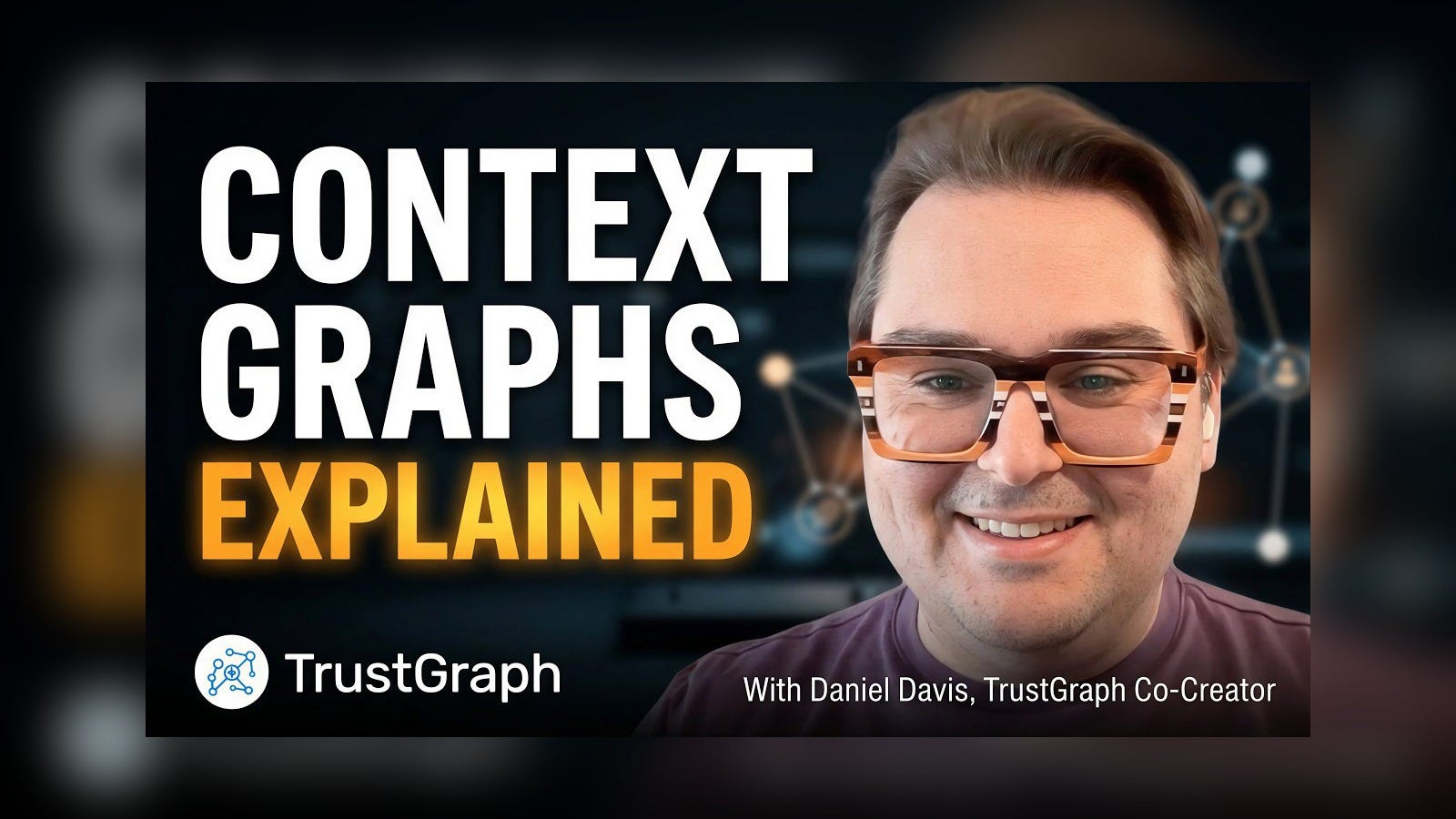
What a Context Graph Really Is | Daniel Davis of TrustGraph
from TwoSetAI: Decoding AI Builders Hosted by Angelina Yang
Daniel Davis is the co-creator of TrustGraph, which Angelina introduces as the open-source context backend for AI agents. He says he found knowledge graphs very hard to learn, and that what he knows came from his co-creator Mark Adams, who wrote him a guide that builds a knowledge graph out of three statements about his cat, Fred. By his account the term context graph exploded around November or December, and he has since given his "what is a context graph" talk three times in the Bay Area, where he estimates about 10% of the audience had worked with graph systems. In this episode, Daniel joins TwoSetAI to say what a context graph is, where the term comes from, and why he is skeptical of most of the companies now using the label. He says the phrase goes back 20 years in the academic literature, credits Vicky Froyen with the first use he has found in today's sense, in a 2019 talk, and argues that the ideas underneath it are decades old. Asked whether a context graph is the same concept as a knowledge graph, he gives a direct answer. TrustGraph is open source. You can find it here. We go deep on how graphs work for AI: property graphs versus RDF, where ontologies come from, and the best definition of reification Daniel says he has seen, "statements about statements." Angelina describes how she would build a context graph herself, with chunks, embeddings, a vector database and Neo4j on top, and he explains what TrustGraph did at first: a flat triple store, with vector embeddings mapped to the graph for subgraph retrieval. He covers decision traces, what to do when data changes, and what he calls the elephant in the room, time: what was observed, when, and whether it changed. He also explains why TrustGraph 2.0 no longer supports Neo4j as its graph store, why the roadmap is designed around RDF 1.2 with Cassandra for storage and Qdrant for vector embeddings, and why he compares the result to Supabase for AI context. We also get into the harder parts. Daniel asked the major AI services which former NHL head coaches are not currently coaching a team, and says every one of them made mistakes; Perplexity, by his account, gave him 13 names, two of them wrong. He tells a story from his Department of Defense days that he calls "when nine out of 10 experts were wrong." He makes pointed claims about how Wikipedia articles get edited and how much weight AI services give them, and Angelina adds her own example of an AI answer that led back to a blog post with wrong data. He closes with what scares him, people accepting information based on who has the most social media followers, and with a book about appearance versus reality. We discuss: * The NHL head coach question that, by his count, every major AI service got wrong * Why "context graph" is suddenly everywhere, and why he is skeptical of most companies using the label * Where the term comes from: 20 years of academic literature and a 2019 talk by Vicky Froyen * Graphs, knowledge graphs, RDF, property graphs and DAGs as one family * Learning graphs from Mark Adams, and Fred the cat * Is a context graph just a rebranded knowledge graph? * Vocabularies, taxonomies, schemas and ontologies * Why he says 2025 was the year AI POCs failed * Grading the answers: is 11 out of 13 good enough to trust? * "When nine out of 10 experts were wrong": a story from his DoD days * Why confident answers are hardest to catch on questions you cannot check yourself * The Metallica top 10 list that he says no service got right * Angelina's example of compounding misinformation * His claims about how Wikipedia edits work, and how AI services use it as a source * Angelina's build with embeddings, a vector database and Neo4j, and what he does differently * Property graphs vs. RDF, and where each has been used: fraud detection, KYC, search and cyber security * Reification: "statements about statements" * Decision traces, and adding an agent's behavior back to the graph * What happens when the data changes, and observations over time * Why he says old information is not always the worse source * TrustGraph 2.0 without Neo4j: RDF 1.2, Cassandra and Qdrant * "Supabase for AI context" * Idiocracy, Wag the Dog, Brazil, and the two things he sees converging * Ike's Bluff, and appearance versus reality Daniel Davis * LinkedIn: https://www.linkedin.com/in/graphrag/ * TrustGraph: https://trustgraph.ai * GitHub: https://github.com/trustgraph-ai/trustgraph * Mentioned in the episode: Ike's Bluff, the book he recommends; the films Idiocracy, Wag the Dog and Brazil; and his podcast conversation with Vicky Froyen about the term context graph Timestamps 00:00:00 Can AI get simple facts right? 00:01:35 What is a context graph, and who's faking it? 00:09:29 Is a context graph just a rebranded knowledge graph? 00:14:26 Why 2025 was the year AI POCs failed 00:18:07 When 9 out of 10 experts were wrong 00:25:17 How Wikipedia gets weaponized to poison AI 00:29:23 Is my RAG + Neo4j approach actually correct? 00:36:07 What are "statements about statements"? 00:41:03 What happens when your data changes over time? 00:49:12 Why TrustGraph dropped Neo4j entirely 00:52:42 His doomsday prediction for AI 00:55:23 The one book every leader should read 00:59:03 Outro Get full access to Decoding AI Builders By Angelina Yang at angelinayang.substack.com/subscribe
Embed this episode
No transcript yet.