
EPISODE · May 21, 2026 · 8 MIN
What a Creek Can Tell Us About Hidden Chemistry Underground
from Waterlines: How Water Shapes Our World · host jaywen
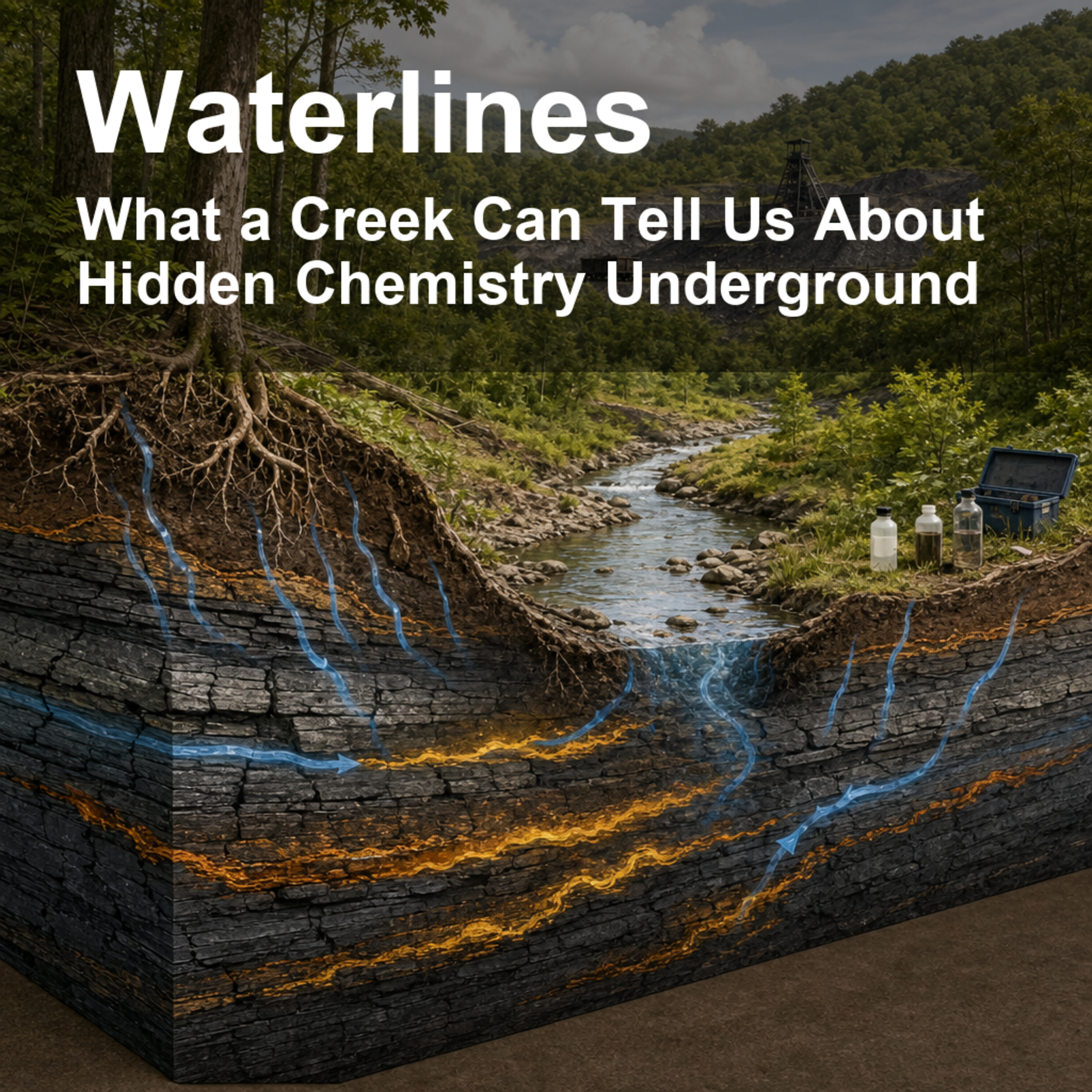
Clean water problems often start in places we cannot see: cracks, minerals, old groundwater, buried reaction zones, and the long memory of land use. This episode follows a study that asks whether ordinary river chemistry can reveal the hidden “redox architecture” beneath a watershed, meaning the underground pattern of oxygen-rich and oxygen-poor zones that helps decide how contaminants move, linger, or break down. We focus on pyrite, a common iron-sulfide mineral sometimes called fool’s gold. When oxygenated water reaches pyrite underground, it produces sulfate, leaving a chemical clue in streams. By tracking how sulfate changes as rivers rise and fall, the researchers connect stream samples to buried weathering fronts, watershed size, and the legacy of coal mining. Along the way, we unpack machine learning source separation, field sampling in Pennsylvania’s Shale Hills and Susquehanna River Basin, comparisons with western U.S. watersheds, and why this matters for nitrate pollution, mine drainage, and future water-quality forecasting. Citation: Shaughnessy, A. R., Forgeng, M. J., Wen, T., Gu, X., Hemingway, J. D., & Brantley, S. L. (2023). Linking stream chemistry to subsurface redox architecture. Water Resources Research, 59, e2022WR033445. https://doi.org/10.1029/2022WR033445. Disclosure: this Waterlines episode uses AI-generated voices for the hosts.
Embed this episode
NOW PLAYING
What a Creek Can Tell Us About Hidden Chemistry Underground
No transcript for this episode yet
Similar Episodes
No similar episodes found.
Similar Podcasts
No similar podcasts found.