
EPISODE · Aug 9, 2025 · 3 MIN
“What are the Classifications of Third Molars?”
from Dr. Gallagher's Podcast · host Brendan Gallagher, DDS
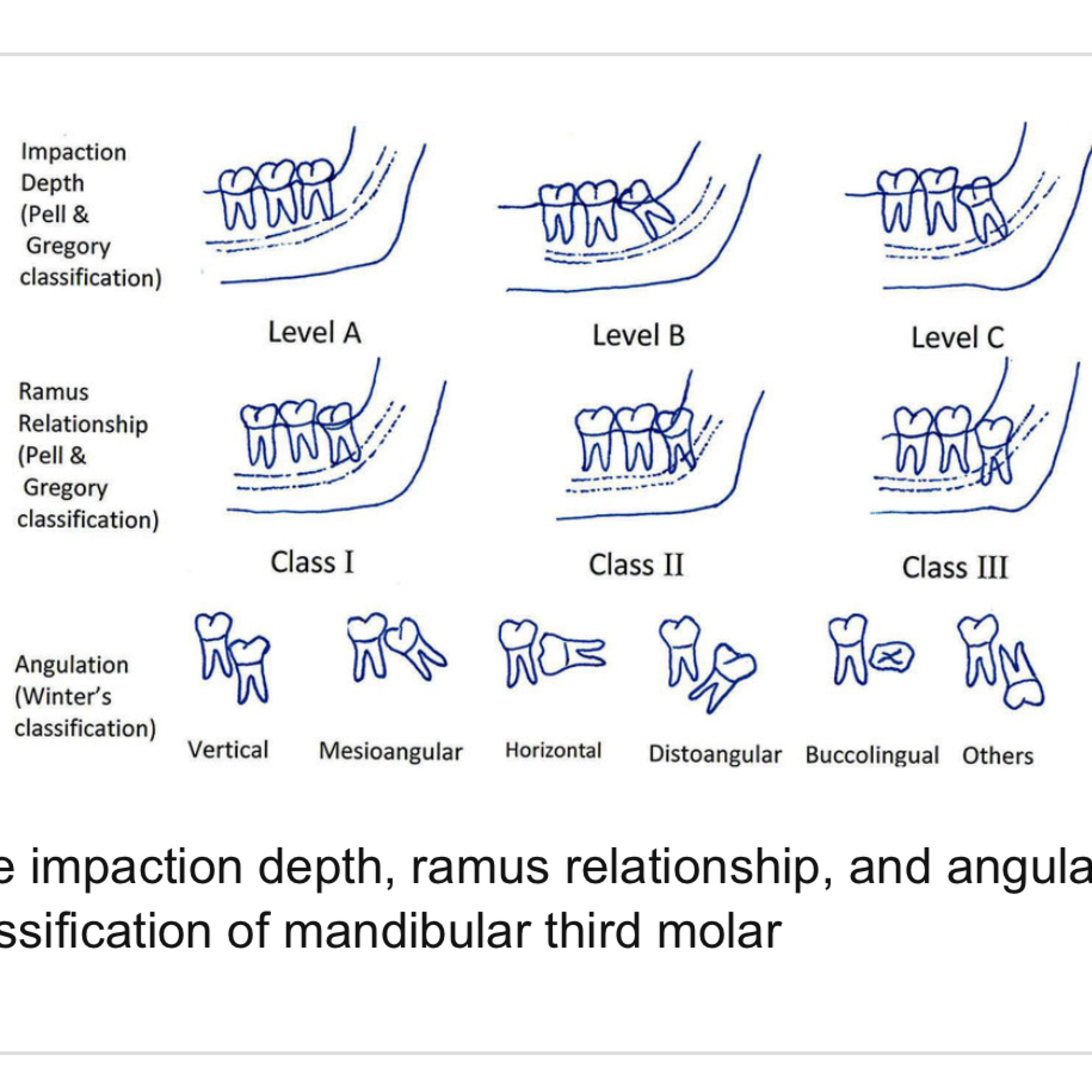
Quick Review #279 - #dental #dentist #dentistry #dentalstudent #dentalschool #teeth #cavity #wisdomteeth #extraction #oralsurgery #oralsurgeon #implant #implants #dentalimplant #dentalimplants 8.9.25 Third molars, commonly known as wisdom teeth, are frequently impacted and often require removal due to complications such as pericoronitis, infection, or difficulty in eruption. Pell and Gregory Classification The Pell and Gregory system is based on the spatial relationship of the third molar to the second molar and the mandible. Class I: The third molar is fully erupted into the oral cavity with enough space between the ramus and the second molar. Class II: The third molar is partially impacted, with the mesiodistal width of the tooth partially covered by the ramus. Class III: The third molar is fully impacted within the ramus of the mandible, with little to no space for eruption. For the Position: Position A: The third molar is at or above the level of the occlusal plane of the second molar. Position B: The third molar is positioned between the occlusal plane and the cervical line. Position C: The third molar is positioned below the cervical line, deeply embedded in bone. Winter’s Classification Winter’s Classification focuses on the angle of the third molar’s long axis in relation to the second molar. Vertical impaction: The long axis of the third molar is aligned with the second molar, making it relatively easier to remove (Winter’s Class I). Mesioangular impaction: The long axis of the third molar is tilted toward the second molar. It often requires more bone removal but is still relatively manageable (Winter’s Class II). Distoangular impaction: The third molar is angled away from the second molar. This is one of the most difficult types of impaction, as it often requires extensive bone removal and increases the risk of nerve injury (Winter’s Class III). Horizontal impaction: The third molar is fully impacted with its long axis perpendicular to the second molar. This is a particularly challenging case with extensive bone involvement and significant surgical difficulty (Winter’s Class IV). References: Chaudhry, R. M. (2020). The impaction depth, ramus relationship, and angulation classification of mandibular third molar [Figure]. In Pattern of mandibular third molar impaction: A radiographic study. ResearchGate. https://lnkd.in/eH-vKx_X Miloro, M., Ghali, G. E., Larsen, P. E., & Waite, P. (Eds.). (2022). Peterson’s Principles of Oral and Maxillofacial Surgery (4th ed.). Springer. Neville, B. W., Damm, D. D., Allen, C. M., & Chi, A. C. (2022). Oral and Maxillofacial Pathology (4th ed.). Saunders ChatGPT.5. 2025. #podcast #dentalpodcast #doctorgallagherpodcast #doctorgallagherspodcast #doctor #dentist #dentistry #oralsurgery #dental #dentalschool #dentalstudent #doctorlife #dentistlife #oralsurgeon #doctorgallagher
Embed this episode
Ready to play
“What are the Classifications of Third Molars?”
No transcript for this episode yet
Similar Episodes
No similar episodes found.
Similar Podcasts
No similar podcasts found.