What Can We Learn from Lorenzetti?
from Liminal Dialogues Hosted by Gabriele Pizzi and Nicolas Delgado Alcega
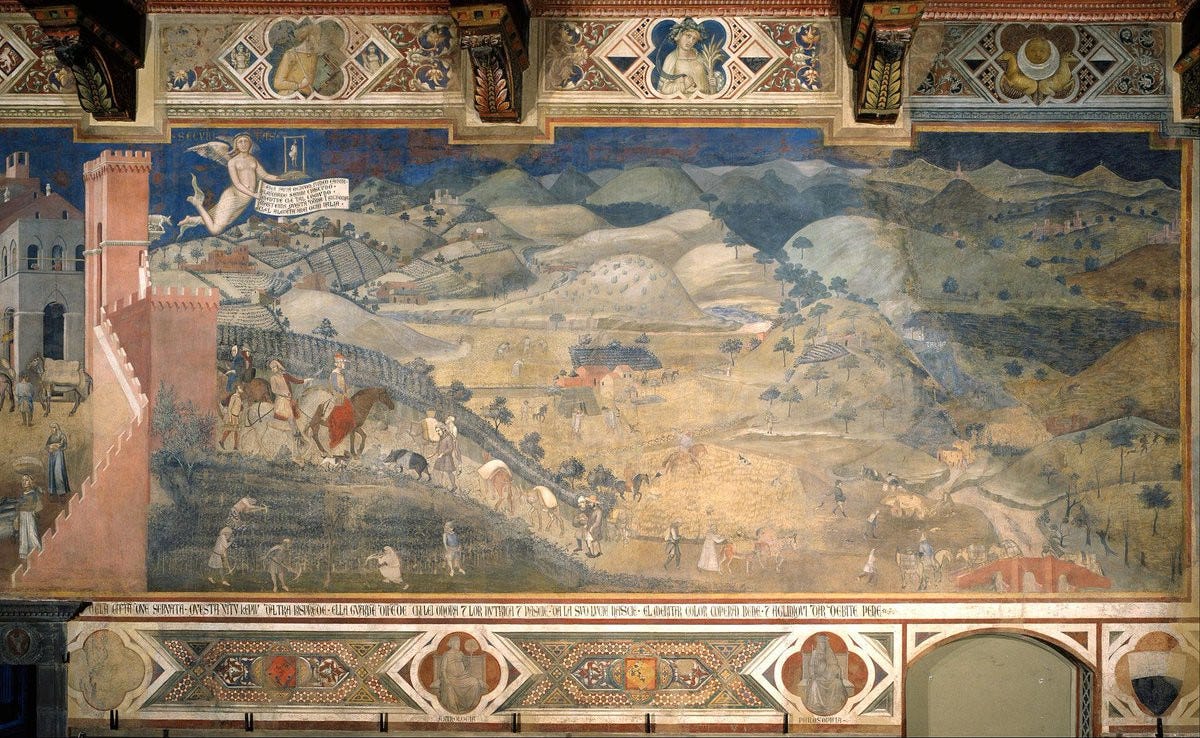
This conversation between Nicolas Delgado Alcega and Gabriele Pizzi argues that the territory is the largest scale at which governance is still corrected by reality, and thus the best one at which the craft of governing can currently be experimented with. Their starting point is Lorenzetti’s Allegory of Good and Bad Government, read as a six-century-old prototype of a territorial dashboard installed in the room where the governing happens. From the fresco they draw a working definition of what Liminal calls territorial statecraft: human flourishing secured through the protocols that generate a place, not the forms imposed upon it. The act of governing, in this account, is less the execution of bird’s eye strategies than the gardening of processes that are continuously in flux, where the beauty of a territory becomes the signal that the garden is being properly tended to. NDA: Okay, so let’s get into, once and for all, the Lorenzetti discussion on the Allegory of Good and Bad Government — which is really just a conversation about what we mean by territorial statecraft, as the sort of work that we’re doing more generally. And why, for us, that work is motivated by the ambition of trying to secure, or increase, human flourishing in territorial contexts through this act of what we’re calling good government. Coming from not good governance, maybe — which would perhaps be the more technocratic term used today — but good government in the sense of buon governo. What Italians would call buon governo, and what Lorenzetti calls buon governo. Maybe the best place to start — at the risk of being hated by all the art historians for our description — is to try to describe it. I mean, you’ve been there, right? We’ve talked about it so many times, but… GP: I haven’t, actually. I studied it many times in my Italian art school cyclical curriculum, where you go through it at least three times before you turn fifteen. But I haven’t been. No, I haven’t. NDA: I thought you had gone when you did that slow trip from Rome up to the north. GP: I went to Siena, but I couldn’t get in. I don’t remember why. NDA: Well, a lot of us have a similar experience with that fresco. We take it for granted as being something that’s pretty well known, but in reality it isn’t necessarily. In my case — and in Ginevra’s case — it’s another one of those hammered references from an American architecture school about what architecture is. You hear it so many times that it starts to become a drag. But then the more you think about it, the more you come back to it, the more it really is an extraordinary work of art. And I think it has shaped the way a lot of us think about the work that we’re doing. So let’s try to describe it and see if we understand what it is. The Allegory of Good and Bad Government is a sequence of frescoes in a room that I think is called the Room of the Nine — essentially a room in the public palace of Siena, which was a medieval city-state in central Italy. And in this palace of government is where, I think there was a sort of — I don’t know if one would call it an oligarchy — but there was a group of governors that were elected and would meet in this space. And in the 1300s they commissioned Ambrogio Lorenzetti, who is probably the most famous fresco painter of the Sienese school, and they asked him to do this fresco. The fresco surrounds these four walls of this hall, and it contains essentially two parts, divided into four images. On the one hand you have two representations of the virtues on one side, the vices on the other, and then the polities that result from those virtues and those vices. So on one wall we might see prudence, or courage, and then we’ll see the form of government that the commune of Siena represented. And then on the other one we’ll see the vices, and then the sort of government that results from that. So you have the principles, and then the polity that those principles create. And then the other two walls are essentially a representation of the territory — a representation of the city and its countryside, in which you see how these principles that produce a polity affect the physical environment. Related to the scene of good government, you’ll see that scene represented in a flourishing city: a city with well-kept buildings, plenty of activity, debate in the public square, commerce, liveliness, well-kept perimeters. And then you also see a countryside that is actively tended to and managed, that is farmed, that has active paths — that essentially has a sort of what we would call a landscaped quality. And then if we look at the representation of the territory for bad government, you’ll see the opposite: a city in ruin, crime, fire, things falling apart, discord. And then you’ll also see a countryside plagued by that — I think there are mercenaries, and buildings on fire, and a countryside that is unkempt and messy. And full of darkness. So it’s a really fascinating fresco, I think for us in two ways. The first is this artistic exercise in which you represent the two consequences of two tendencies of governing, in the room where the government of that territory happens. Those governors, whoever they are at a specific moment in time, are continuously confronted in their decision-making with these two options. And with the reminder that the way in which you govern has a direct impact not only on human life but on the appearance of the territory — the appearance of the territory somehow tells us what kind of government we have, and based on what kinds of principles. So it’s interesting as a device to, in a way, control the governors, or to encourage certain behaviors. And the other is this piece I already touched upon: the correlation between physical space, or the built environment, which I think would be the correct term today, and the way in which we control the processes that are at play. Is that how you see it too? Am I missing anything? GP: For me, an aspect that you touched upon but that’s central — and it’s often taken for granted amongst us, but in general it’s not so obvious — is that the core idea is not so prescriptive on the form of the territory. It is not saying build your territory like this because it is beautiful. It’s talking about the meta-rules that generate the territory. And maybe that’s also a bit unusual in the way we think about the Renaissance and all that. It’s maybe the opposite of how we think about certain things, especially in design school. It doesn’t focus on form and the power of form to generate a good life. It focuses on the good government, and on form as a symptom of a good life. Which removes some power from the built environment itself, but I think it’s more honest about how things actually work in most cases — although there is a feedback loop there, and there is probably some circularity: in the same way that having the fresco influences your action, the environment definitely does too. But maybe it’s about the way it starts, or the way it accelerates or changes things. NDA: Our space, the built environment, is artificial in the sense that it is this manipulated creation of our interaction with other forces on the planet. And so our ability to manipulate and shape it according to certain principles has to have some effect upon the people who then live inside of what we can call a fiction. That’s not necessarily how it’s framed for a typical architect, but that’s the big picture. And that’s not what Lorenzetti is trying to show — which is actually what’s interesting about it. If you shape the built environment in a certain way, then maybe it creates a path dependency for how people think of the world when they live inside these spaces. In a way, when you’re in architecture school and you see this fresco — not that everyone does — you get excited about this idea that architecture and shaping space can be edifying when met with the right patrons. I thin… This is a public episode. If you would like to discuss this with other subscribers or get access to bonus episodes, visit liminalfutures.substack.com
Embed this episode
No transcript yet.