
EPISODE · May 27, 2026 · 11 MIN
What Deep Oil Fluids Can Teach Us About Water, Rocks, and Energy Choices
from Waterlines: How Water Shapes Our World · host jaywen
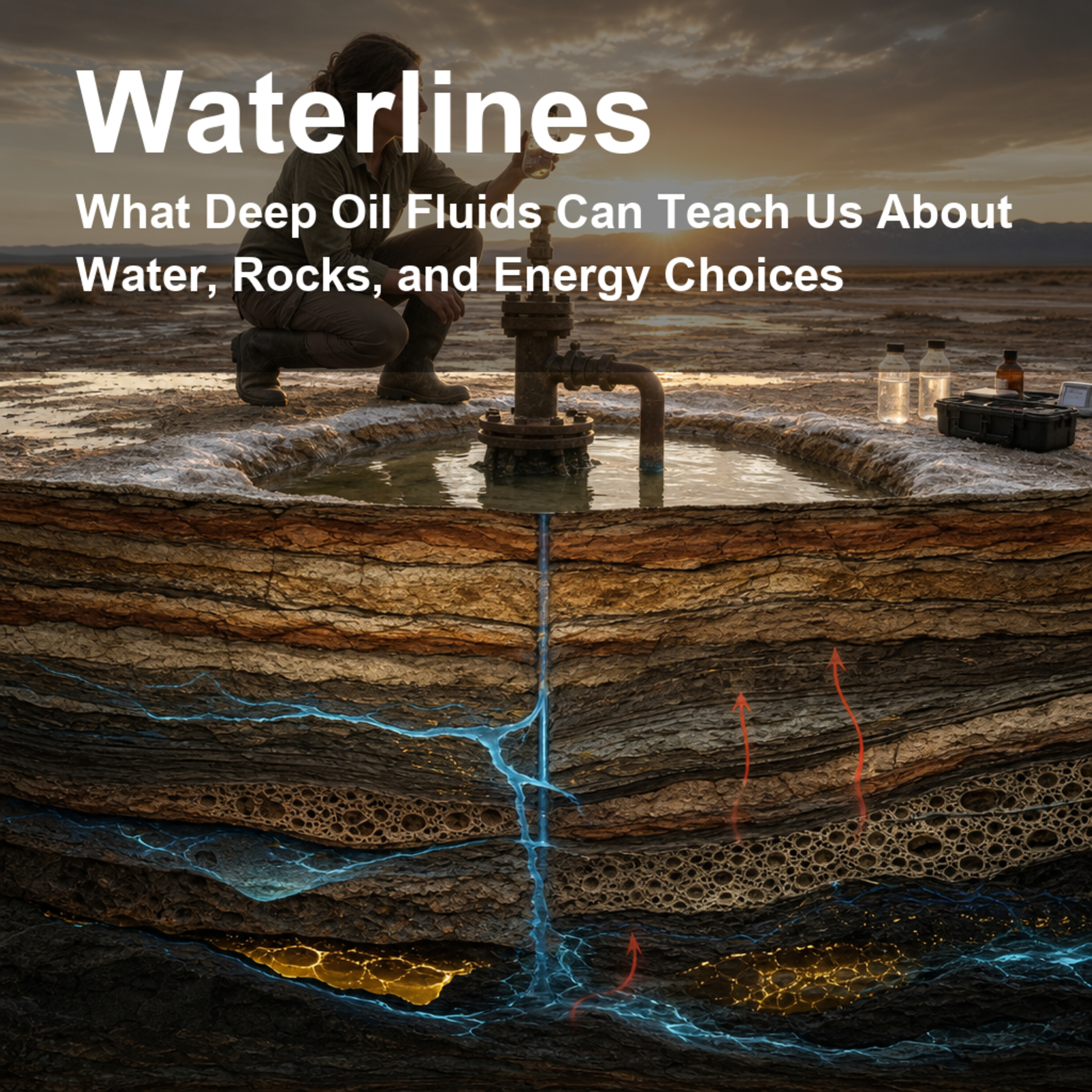
Energy decisions, groundwater protection, and climate policy all depend on knowing what is moving through the deep subsurface. This episode uses a short editorial on light oil and condensate geochemistry as a doorway into a water story: how ancient organic matter, rock pores smaller than viruses, formation water, gases, and heat interact kilometers below our feet. We explain why these hard-to-read fluids matter for exploration, well management, environmental risk, and the bigger question of how societies handle fossil resources while moving toward lower-carbon futures.The paper is not a single field experiment; it is an editorial introducing a research collection. That makes it useful as a map of today’s questions: Where do light oils and condensates come from? How do scientists identify their source when the usual chemical fingerprints are faint? What can noble gases, isotopes, shale pore spaces, and associated waters reveal about migration, storage, and recovery? We translate those tools into everyday analogies, while keeping the uncertainties clear.Full paper citation: Cheng P, Xiao X, Ren B, Wen T and Yu S (2022), Editorial: New advances in light oil/condensate geochemistry. Frontiers in Earth Science 10:1079834. doi: 10.3389/feart.2022.1079834.Disclosure: This Waterlines episode package is written for public science communication and is intended to be performed with AI-generated voices.
Embed this episode
NOW PLAYING
What Deep Oil Fluids Can Teach Us About Water, Rocks, and Energy Choices
No transcript for this episode yet
Similar Episodes
No similar episodes found.
Similar Podcasts
No similar podcasts found.