
EPISODE · Jun 16, 2026 · 55 MIN
What if a Space War Started Above Earth?
from Orbital Estimate · host Lohengrin
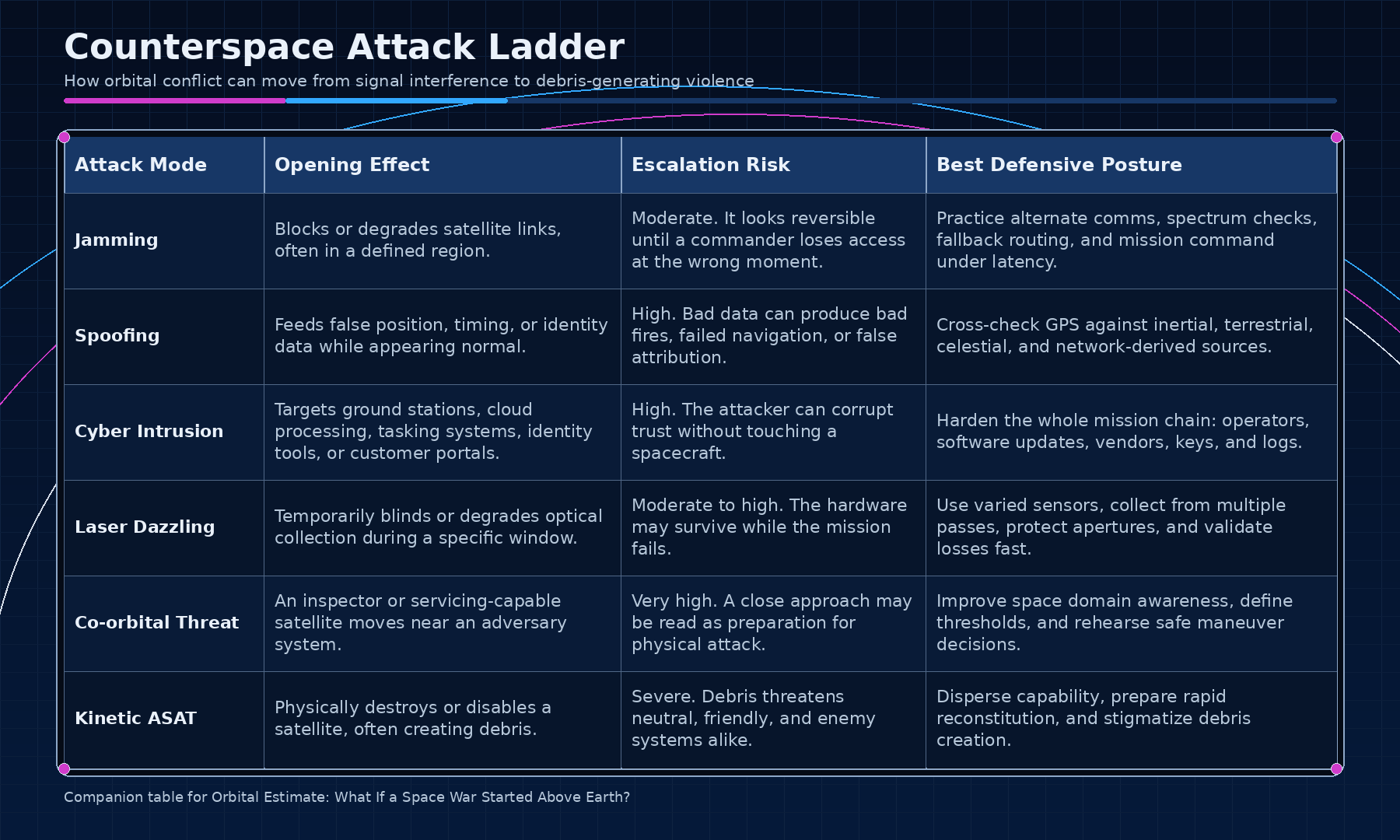
AbstractA war above Earth would likely begin through interference rather than destruction. The initial indicators would appear as degraded satellite communications, anomalous telemetry, corrupted positioning signals, delayed intelligence delivery, or cyber compromise of ground-segment infrastructure. Modern military power depends on orbital systems for missile warning, intelligence, surveillance, reconnaissance, command and control, precision navigation, weather data, and long-haul communications. This dependence makes satellites attractive targets, but the shared and fragile character of orbital infrastructure makes debris-generating attacks strategically hazardous. The central problem of space warfare is therefore functional: belligerents would seek to degrade an adversary’s kill chain without rendering orbital regimes unusable for their own forces.This essay argues that the first space war would likely unfold through reversible counterspace operations before crossing into kinetic destruction. Electronic warfare, cyber intrusion, spoofing, dazzling, and ground-segment attacks would provide states with usable options below the threshold of overt orbital violence. Co-orbital systems and direct-ascent anti-satellite weapons would remain available as coercive or escalatory tools, but debris risk would limit their early employment. The resulting conflict would be a contest over timing, confidence, and attribution. The first target would be neither a city nor a spacecraft in isolation. It would be the adversary’s ability to see, communicate, decide, and strike.The Strategic Problem: Space as Military Nervous SystemThe modern joint force relies on orbital infrastructure as a core element of military power. The United States Space Force Doctrine Document 1 frames spacepower as a necessary condition for joint force effectiveness, connecting space control, mission operations, battle management, and global force projection. This doctrinal shift reflects a material fact: satellites no longer support war from the margins. They shape the tempo, reach, precision, and survivability of terrestrial forces.A space war would therefore be a war against military cognition. Orbital systems allow a state to detect missile launches, monitor oceans, track maneuver forces, route communications, synchronize operations, and guide precision weapons. An adversary that degrades these functions can slow the decision cycle without destroying large formations. The operational aim would be to interrupt the sequence by which sensors produce targets, commanders issue orders, and weapons reach coordinates.This dependence creates a vulnerability that every major space power now studies. The CSIS Space Threat Assessment 2025 identifies foreign counterspace capabilities across cyber, electronic warfare, directed energy, co-orbital, and direct-ascent systems. These are not separate curiosities. They are tools for attacking the connective tissue of modern war.The most plausible opening phase would be calibrated, reversible, and deniable. A state could jam satellite communications during a maritime operation, spoof positioning signals near a forward airbase, intrude into a commercial ground network, or dazzle an optical imaging satellite during a force deployment. Each action imposes military cost while allowing political space for denial, delay, or escalation management.Thanks for reading Orbital Estimate! Subscribe for free to receive new posts and support my work.Orbital Geography and the Physics of VulnerabilityLow Earth orbit would be the most immediate zone of conflict. LEO hosts large numbers of communications, remote-sensing, weather, scientific, and military-support satellites. Its value comes from proximity: lower latency, stronger signal geometry, and favorable imaging conditions. Its weakness comes from congestion, rapid orbital motion, and collision risk. A spacecraft in LEO may complete an orbit in roughly ninety minutes, which makes coverage dependent on constellation design, orbital inclination, revisit rate, ground terminals, and inter-satellite links.Geosynchronous orbit presents a different strategic profile. GEO satellites, located roughly 35,786 kilometers above the equator, appear fixed over a given region of Earth. This makes them valuable for missile warning, weather observation, strategic communications, and theater command links. Their distance from Earth reduces some direct-ascent attack options, but their scarcity and cost make them strategically sensitive. A successful attack against a high-value GEO asset could have effects beyond the immediate loss of capacity because replacement timelines are long and the mission functions are often specialized.Medium Earth orbit contains major positioning, navigation, and timing systems. A disruption of GNSS services would affect precision weapons, aircraft routing, maritime traffic, telecommunications, power-grid timing, financial networks, and logistics systems. This dual-use dependence complicates targeting. A signal used by a missile can also support civil aviation or emergency services. The same orbital function can serve a brigade, a hospital, and a port authority within the same hour.Orbital mechanics further constrain combat. Spacecraft cannot maneuver like aircraft. Their motion follows orbital energy, plane geometry, propellant limits, thrust constraints, sensor coverage, and command latency. A satellite can evade, but every maneuver spends finite fuel and may degrade mission life. Co-orbital threats must solve rendezvous, proximity navigation, relative motion, and timing. Direct-ascent weapons must intercept a moving target at precise geometry. Electronic and cyber attacks bypass many of these physical constraints, which explains their probable prominence in the opening phase.The First Phase: Reversible Counterspace OperationsThe initial phase of a space war would likely center on reversible counterspace operations. The Secure World Foundation’s 2026 Global Counterspace Capabilities report organizes counterspace systems into five major categories: co-orbital, direct-ascent, electronic warfare, directed energy, and cyber. The first phase would favor the last three because they can degrade capability while limiting debris, public attribution, and immediate strategic shock.Electronic warfare would target links. Uplink jamming can interfere with signals sent to satellites. Downlink jamming can deny users access to satellite data. Spoofing can inject false positioning, navigation, or timing information into receivers. These attacks can be local, theater-wide, episodic, or sustained. Their strategic appeal lies in controllability. A state can deny a region, test responses, retreat from attribution, and resume pressure when useful.Cyber operations would target the ground segment and mission chain. Satellites depend on control centers, antennas, user terminals, cloud infrastructure, software repositories, contractor access, encryption management, and data distribution networks. A cyber operation could corrupt mission tasking, delay imagery, manipulate telemetry, compromise operator credentials, or force a spacecraft into safe mode. The satellite may remain physically intact while the function it provides becomes unreliable.Directed-energy systems would extend the ladder of pressure. A laser can dazzle or damage optical sensors depending on power, dwell time, beam quality, atmospheric conditions, and target vulnerability. In a crisis, even temporary dazzling can matter if it prevents collection during a missile movement, naval sortie, or air-defense repositioning. The military value lies in timing. A satellite that misses the relevant window has failed its operational purpose.Co-Orbital Systems and the Dual-Use ProblemThe second phase of escalation would involve proximity. Rendezvous and proximity operations are technically legitimate in civil and commercial contexts. Inspection, satellite servicing, refueling, repair, life extension, and debris removal all require the ability to approach another object in orbit. The same capabilities also create military risk. A spacecraft capable of inspection can maneuver into threatening range. A servicing vehicle can become a grappling system. A debris-removal platform can resemble a capture weapon.This dual-use problem is central to space security. Intent is difficult to verify before hostile action. A satellite approaching another spacecraft may be conducting inspection, intelligence collection, coercive signaling, or preparation for attack. The same maneuver can support several explanations. During crisis, the burden of interpretation shifts onto the target state, which must decide whether to maneuver, protest, reveal intelligence sources, or prepare a response.Co-orbital pressure can impose cost without immediate destruction. A hostile satellite can force evasive maneuvers, consume the target’s propellant, interfere with sensor operations, or create uncertainty around critical mission windows. In GEO, where high-value assets occupy strategically important orbital slots, a suspicious nearby spacecraft could carry immediate political significance. In LEO, proximity operations may be harder to sustain across large proliferated constellations, but the threat remains relevant for specialized assets.Attribution would remain difficult. Space domain awareness can track objects and maneuvers, but proving intent and damage mechanism in public can be challenging. This gives co-orbital systems coercive value. They allow a state to threaten without necessarily firing.Kinetic Attack and the Debris ThresholdThe most escalatory phase would involve kinetic attack. Direct-ascent anti-satellite weapons can destroy spacecraft by intercepting them from Earth. Co-orbital systems can also destroy or disable satellites through collision, grappling, or released objects. These methods provide visible effects, but they carry the central risk of orbital debris.Debris is not an environmental abstraction in military planning. It is an operational hazard. Fragments in LEO can threaten friendly, adversary, allied, neutral, and commercial spacecraft. The persistence of debris depends on altitude, solar activity, fragment size, and orbital parameters, but the strategic point is constant: debris-generating attacks impose costs beyond the original target. A state that destroys a satellite may degrade the orbital regime it also needs.This risk does not eliminate kinetic attack. It makes kinetic attack a threshold choice. A state might cross that threshold if the target enables an immediate military threat, if the political leadership wants a visible demonstration of resolve, or if the attacker believes the adversary is more dependent on the affected orbital regime. In asymmetric space dependence, shared-domain damage may favor the actor with less to lose.The history of debris-producing anti-satellite tests has already shaped diplomatic pressure. The Secure World Foundation has tracked the counterspace capabilities of major powers, including direct-ascent systems and past debris-generating tests. These events showed that physical destruction in space creates strategic signaling value and long-term hazard at the same time.Thanks for reading Orbital Estimate! Subscribe for free to receive new posts and support my work.Law, Norms, and Strategic AmbiguityThe Outer Space Treaty remains the foundational legal instrument for military activity in space. Article IV prohibits placing nuclear weapons or other weapons of mass destruction in orbit, stationing them in outer space, or placing them on celestial bodies. The treaty also establishes principles of state responsibility, peaceful use, and international accountability.Yet the treaty does not prohibit every military use of space. It does not ban military satellites, conventional counterspace systems, electronic warfare, cyber operations, or all dual-use proximity activities. The result is a legal structure that constrains some forms of militarization while leaving large operational areas contested. This ambiguity is not incidental. It is part of the strategic environment.In a space conflict, law would function as a tool of statecraft. States would use treaty language to condemn adversaries, justify their own conduct, rally partners, and shape neutral opinion. Legal claims would matter most when paired with attribution, coalition leverage, and credible response options. Without enforcement power, legal argument becomes one instrument within a wider contest over legitimacy and strategic advantage.The commercial sector sharpens the legal problem. A private remote-sensing satellite may support military targeting. A commercial communications constellation may carry military traffic. A cloud provider may process battlefield data derived from space systems. These relationships blur the distinction between civilian infrastructure and military support. In a crisis, adversaries may treat commercial systems as part of the opposing war architecture.Strategic RecommendationsU.S. and allied planners should treat the ground segment as a primary battlespace. Satellite control networks, user terminals, cloud environments, contractor systems, data-processing pipelines, and mission operations centers require defensive planning comparable to that applied to military command networks. The first attack may not touch a spacecraft. It may compromise the architecture that makes the spacecraft useful.They should also build proportional response options below the kinetic threshold. Space deterrence cannot depend on declarations of massive response or diplomatic protest. Credible deterrence requires graduated tools: public attribution, electronic countermeasures, cyber responses, sanctions, export controls, allied exposure of hostile activity, and selective denial of adversary space support. A usable ladder of response reduces the chance that leaders must choose between passivity and strategic escalation.The United States and its allies should accelerate proliferated and replaceable architectures. Exquisite satellites will remain necessary for specialized missions, especially missile warning and advanced intelligence collection. Yet resilience increasingly requires distributed constellations, hosted payloads, rapid launch, modular satellite buses, allied ground stations, and commercial surge capacity. The purpose is to reduce the military payoff of any single attack.Finally, thresholds should be communicated before crisis. Ambiguity has value, but excessive ambiguity invites probing. The United States and allied governments should identify categories of behavior likely to trigger response, including destructive anti-satellite attacks, interference with missile warning, cyber intrusion into satellite command systems, broad GNSS disruption, and attacks on commercial systems supporting military operations. Deterrence requires the adversary to understand that reversible attacks may still produce consequences.Forecast: A War of Function Before DestructionThe first space war would probably be partially invisible to the public. Operators would see it first as interference, data loss, signal corruption, suspicious proximity maneuvers, and degraded confidence in satellite-derived information. The decisive question would be whether commanders can trust the systems that sustain the kill chain. Can the image be trusted? Can the coordinates be trusted? Can the warning feed be trusted? Can the communications path be trusted?Over the next decade, space conflict will become more likely because orbital systems are becoming more important to terrestrial military power. China will seek ways to degrade U.S. intervention capacity in the Indo-Pacific. Russia will continue to favor disruptive and coercive tools that exploit allied dependence on space-enabled systems. The United States will retain major advantages in commercial depth, launch capacity, doctrine, and alliance structure, but those advantages will require hardened networks, faster recovery, and clearer deterrent thresholds.If a space war began above Earth, the first decisive effects would occur through the loss of timing, communication, targeting, and confidence. Physical destruction would remain possible, but it would likely follow a prior campaign of reversible degradation. The sky would not fail all at once. It would fail by function.Thanks for reading Orbital Estimate! Subscribe for free to receive new posts and support my work.BibliographySamson, Victoria, and Kathleen Brett, eds. Global Counterspace Capabilities: An Open Source Assessment. Broomfield, CO: Secure World Foundation, 2026.Swope, Clayton, Kari A. Bingen, Makena Young, and Kendra LaFave. Space Threat Assessment 2025. Washington, DC: Center for Strategic and International Studies, 2025.United Nations. Treaty on Principles Governing the Activities of States in the Exploration and Use of Outer Space, Including the Moon and Other Celestial Bodies. Opened for signature January 27, 1967. Entered into force October 10, 1967.United States Space Force. Space Force Doctrine Document 1: The Space Force. Washington, DC: United States Space Force, 2025. This is a public episode. If you would like to discuss this with other subscribers or get access to bonus episodes, visit orbitest.substack.com
Embed this episode
NOW PLAYING
What if a Space War Started Above Earth?
No transcript for this episode yet
Similar Episodes
No similar episodes found.
Similar Podcasts
No similar podcasts found.