
EPISODE · Apr 5, 2025 · 5 MIN
📝 “What is the Canthal-Tragal Line?”
from Dr. Gallagher's Podcast · host Brendan Gallagher, DDS
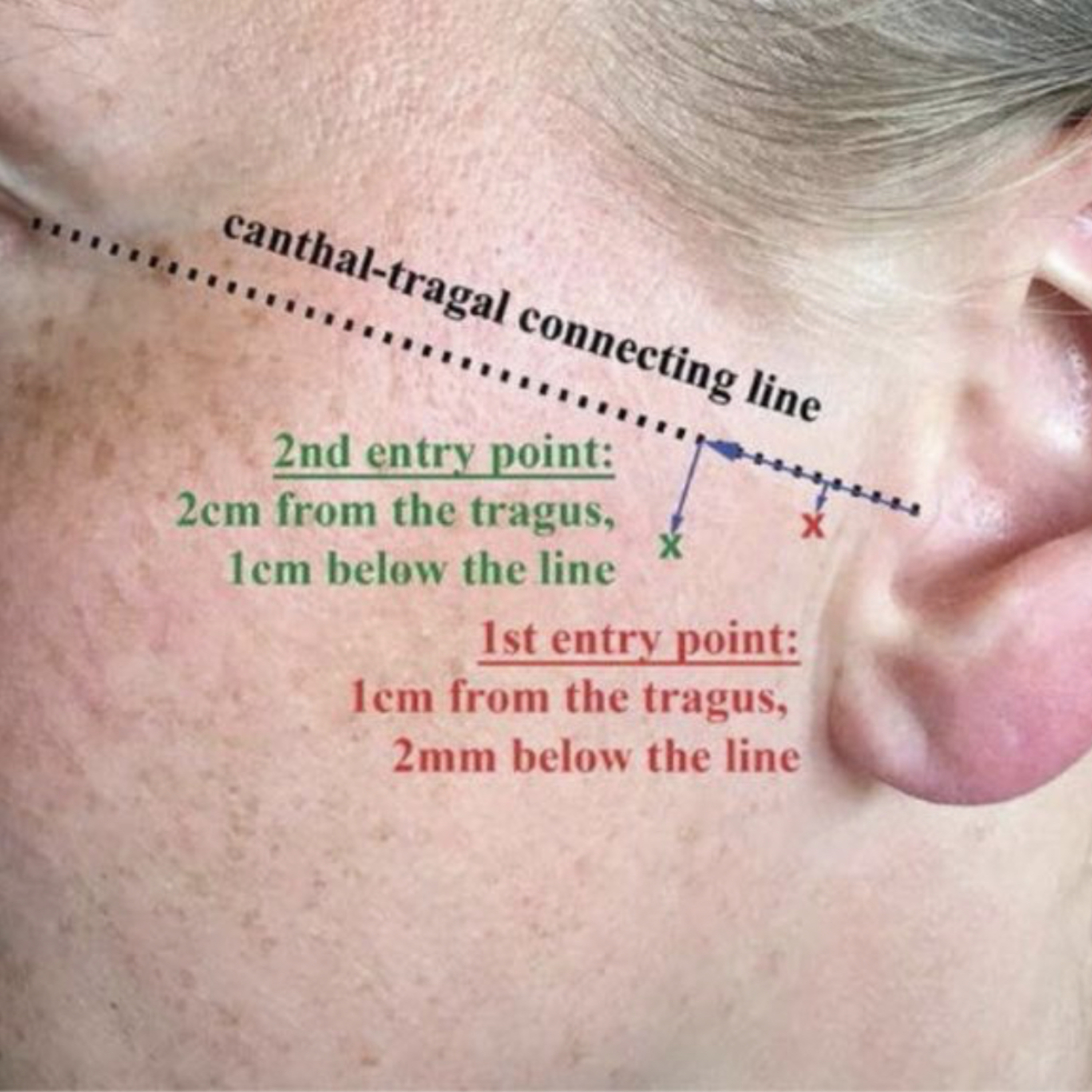
Quick Review #274 - #surgery #surgeon #doctorgallagher #oralsurgery #oralsurgeon #omfs #dentist #dentistry #dental #tmj #temporomandibular #joint - 4.5.25 The Canthal-Tragal Line used as a landmark for TMJ arthroscopy is commonly referred to as the “Holmlund–Hellsing Line.” It is an essential anatomical reference used in arthroscopic surgery of the temporomandibular joint (TMJ), especially during procedures such as arthroscopic lysis and lavage. Key points: • It is drawn from the lateral canthus (outer corner of the eye) to the tragus (specifically, 10 mm anterior to the tragus). • This line helps to approximate the location of the glenoid fossa, which houses the superior joint space, and assists in proper port placement during TMJ arthroscopy for procedures like lysis and lavage. • Typically, the posterolateral (posterior) cannula is placed 10 mm anterior to the tragus and 2 mm inferior to the Holmlund–Hellsing line. • The anterolateral (working) portal is placed approximately 10 mm anterior to the posterior portal, remaining parallel to the same line. Precise localization of the glenoid fossa is vital due to the compact and intricate anatomy of the TMJ, and the proximity of critical structures including the external auditory canal, facial nerve branches, superficial temporal vessels, and the middle cranial fossa. Improper portal placement may lead to intra-articular misplacement or injury to adjacent structures, underscoring the importance of this surface landmark References: 1. Gkikas, I. (2024). Review of TMJ surgery for non-surgeons. In B. C. Stack Jr., R. Shekar, & A. D. Sims (Eds.), Craniofacial pain: Temporomandibular disorders and beyond (pp. 135–150). Springer. 2. Miloro, M., Ghali, G. E., Larsen, P. E., & Waite, P. D. (Eds.). (2022). Peterson’s principles of oral and maxillofacial surgery (4th ed.). Springer. 3. Holmlund, A. B., & Hellsing, G. (1985). Arthroscopy of the temporomandibular joint: An anatomic study of portal placement. International Journal of Oral Surgery, 14(2), 169–175. 4. McCain, J. P., & Hossameldin, R. H. (2015). Arthroscopic surgery of the temporomandibular joint. In D. Kademani & P. Tiwana (Eds.), Atlas of oral and maxillofacial surgery (pp. 374–389). Saunders. 5. ChatGPT. 2025 #podcast #dentalpodcast #doctorgallagherpodcast #doctorgallagherspodcast #doctor #dentist #dentistry #oralsurgery #dental #dentalschool #dentalstudent #doctorlife #dentistlife #oralsurgeon #doctorgallagher
Embed this episode
Ready to play
📝 “What is the Canthal-Tragal Line?”
No transcript for this episode yet
Similar Episodes
No similar episodes found.
Similar Podcasts
No similar podcasts found.