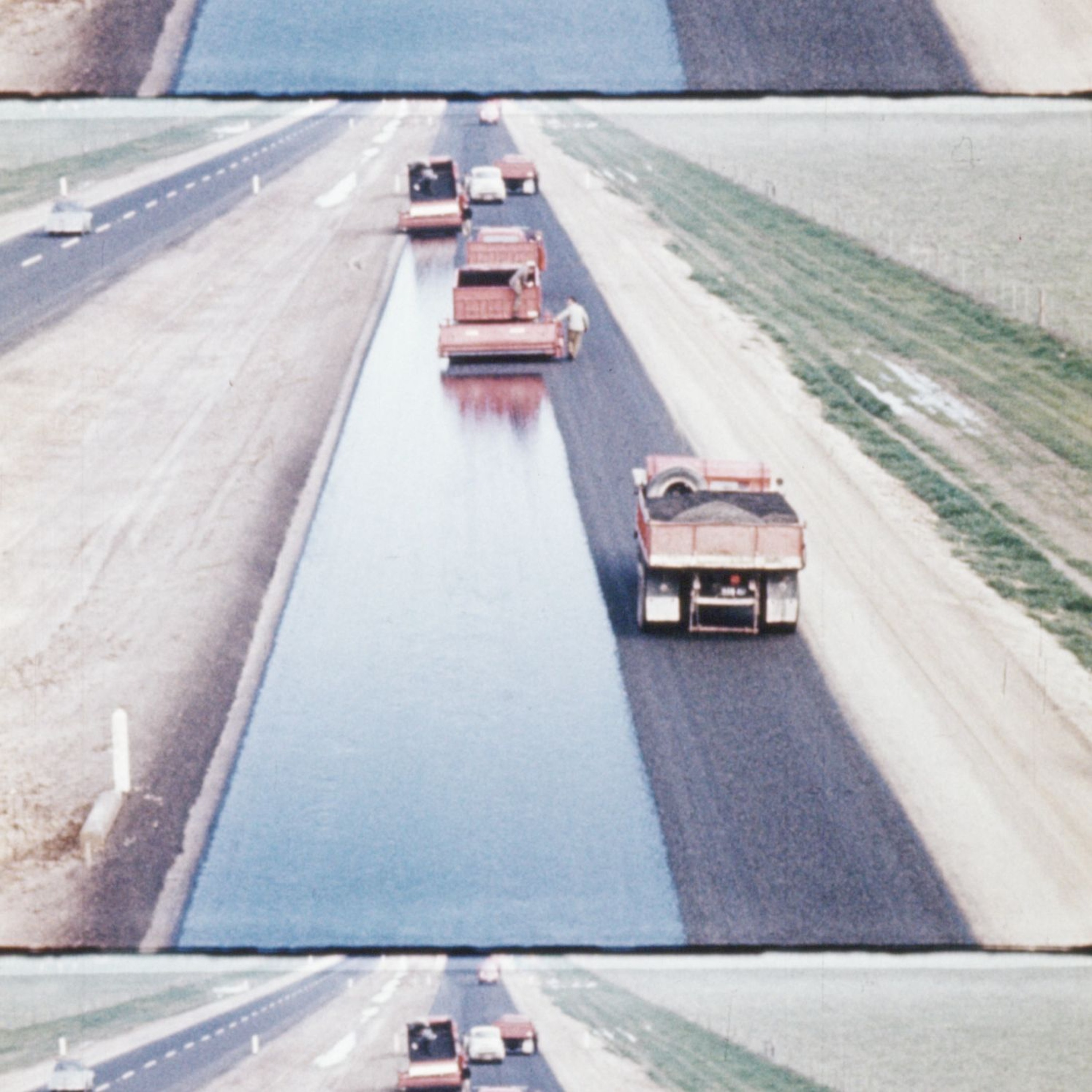
ACMI would like to acknowledge the traditional custodians of the lands and waterways of Greater Melbourne, the people of the Kulin Nation, and recognise that ACMI is located on the lands of the Wurundjeri people. We also acknowledge First Nations people as the original storytellers of this land, and recognise their significant contribution to the contemporary moving image. I'm Jenna Rain-Warwick. I am one of the First Nations curators here at Acme. I curated and produced one of the works exhibiting in Acme at the moment, Beneath Roads. Beneath Roads is a three-channel video work exploring Australian cinema through the lens of road movies and questioning why the road movie is so attached and synonymous with Australian cinema and how does that sit along with the truth of roads, the majority of Australian roads being Aboriginal walking paths, trading routes and in a bigger system of songlines throughout Australia.
And that's kind of knowledge that not many people really know about. And it's kind of two topics and points of interest that I guess the work downstairs talks to. Why I've asked Ruby to come today is because of one of the films used in Beneath Roads is The Back of Beyond. And The Back of Beyond was produced and funded by the Shell Film Unit. And Ruby is a programmer, researcher. She runs a free cinematech at the Art Gallery of New South Wales. And I came across her work as her thesis is mapping the settler colonial travelogue, the Shell Film Unit in Australia, 1939 to 1954.
Ruby, did you want to just talk about how you first came across the Shell Film Unit? Because I kept on kind of seeing it when I was doing research into the work Beneath Roads, and it seemed like a bigger picture in Australian cinema than it was really talked about when I first kind of came across it. So I first came across The Back of Beyond back in my undergraduate years. I was always struck that Australia's first internationally acclaimed art film was sponsored by a petroleum company. So The Back of Beyond won the Grand Prix at the Venice Film Festival in 1954.
and was really, I guess, a landmark of the 1950s era of Australian cinema. And back then I was struck by the alignment of artistic production and industry very naively. And I now know, having worked in the arts for several years, that those two things are, of course, deeply entwined and have always historically been deeply entwined. We can think about cultures of patronage and, of course, the imbrication of the fossil fuel industry in the arts today persists. I wondered if you could talk a little bit to the financial ecosystem of when Back Up Beyond was made and what, because they brought...
John Heyer onto the team to make this documentary. It wasn't kind of him coming with a project. And I just wanted to think about how is it possible and what was the kind of, you know, the financial landscape of Australian filmmaking at that time? Totally. There's a lot to kind of unpack there. I'll just maybe begin by giving a bit of a broader overview of Shell's film operations at the time. So why was an oil company invested in the production of moving images? So Shell really began sponsoring films in Australia in the 1930s and they made films for a huge range of reasons. We need to remember in the early 20th century, the oil intensive lifestyles that we all inhabit today weren't yet second nature. So the production of films was very much part of this project of naturalising oil in our lives, of selling the promise of new ways of moving across.
the land, new ways of working, new products, this sort of transformative potential of oil. So in 1948, Shell, as you say, invited John Heyer and he formed the Shell film unit in Australia. So this was an in-house production team. At the time, Shell, which was a multinational based in London and also the Netherlands, had a whole sort of transnational network of film units that radiated out from the metropole. So what was happening here in Australia was just one part of this broader circuit that went across the world from Egypt, Venezuela, parts of Southeast Asia and so on.
As well as making films, Shelter's also actively invested in distributing and exhibiting them. They had theatrettes in each capital city. They had a 60mm lending library. So if your organisation, your classroom, your church, your advocacy group had 60mm projection capabilities, you could loan a film from Shell. And they also had a fleet of mobile film units. So that's, I guess, a sort of, and by mobile film units, and maybe we can sort of touch on this more later, because it's a really interesting point. These mobile film units were these vans equipped with generators, equipped with drop-down screens, with 60mm projectors, and also with films that circled all around Australia, showing films in tiny townships, at pastoral stations.
in places where there wasn't necessarily a fixed commercial picture palace nearby. So I guess just to zoom back from what I've been saying, the company was invested in the production distribution and exhibition of cinema in Australia across the mid-century. So in this way, it was a fully vertically integrated ecosystem, kind of like a Hollywood studio. So it's a really significant form of industrially sponsored filmmaking that, as you say, is not really well known and not really part of the Australian film narrative, which I came across like I'd done a little film studies at university and I just... I thought that this was a really big chapter that kind of seemed not just left out, but obviously left out. And that's kind of what struck me.
Totally. I think like the Australian, the story we tell about Australian cinema tends to be one of boom, bust booms. The boom of the silent era, the bust of the mid-century, the 1940s to the 60s being these fallow years. And certainly in terms of feature film production, that was the case. And then of course, the second boom being the 70s film renaissance. It's interesting. I think that really these kinds of films challenge what we understand as a film, because we're not talking about theatrical feature films that were made for the purpose of entertainment and shown in the multiplex. Yeah. And I guess that kind of brings me to another point of like what a travelogue is. And The Back of Beyond is seen as a documentary, although.
Is it a documentary when it's like quite scripted or quite, you know? position on purpose and i kind of wondered what is that what is a travelogue really and how does that kind of fit when we're thinking about australian feature films and theatrical kind of films to me as well that because it was a travelogue because it was a documentary then it sits outside of like what these films like um you know the snowy you know although totally max cannon yeah yeah yeah well i think you're totally right like those feature films you mentioned um the travelogues are a part of the lineage they're the sort of um the mid-century bread and butter yeah these narratives and just to go to your question about what is a travelogue as i understand it and having watched now quite a lot of them they all tend to follow the same formula okay It's documenting movement across space. It's usually, you know, I can talk specifically about a shell film called Through the Centre, which is a film that it sets out from point A. It goes usually through the north and the centre of Australia, which at the time in that mid-century moment was such a sort of frontier for the centre of imagination. And then it sort of safely returns back to point B. And why there are so many films.
that are travelogues in Shell's corpus is quite obvious because it is a documentary that can showcase the, you know, the promise of oil as a means of travelling across the land, collapsing time and space. So travelogues are really key to the sort of, not just the oil sort of cinematic imaginary, but as you mentioned, like the cinematic imaginary of Australia more broadly and even like a kind of national ethos because the stories that these travelogues tell. They're the sort of same stories we see repeated from like, you know, explorer's journals and then 19th century like bush ballads and painting culture. So, you know, the construction of Australia as a settler nation is so founded on these stories of heroic overcoming of a so-called hostile or intractable land. Supplies and mail for lonely stations measured by thousands of miles, where the man living a hundred miles away is your neighbor. The link with the outside world is Her Majesty's Royal Mail, Tom Cruise.
laying heavy iron sheets kept beside the track and carried on the truck, while the sun beats down 120 degrees in the shade. And the only shade is the shadow of the truck. A carrier called Cruise, every fortnight fighting the sand 700 miles to Birdsville and Bank. Every fortnight, the story begins. I think I read John talking about the work and also kind of referring to past films and that it's trying to depict this Australian, this great, this one topic or this one kind of thing that is a singular vision of Australia and it ultimately is a battle against the natural, a battle against the red centre. But then I was kind of thinking in First Nations perspectives, are we the natural or what is that kind of as well? But yeah, I think broadly as well when you're thinking about what we think of Australian cinema today, that theme just comes through so much.
And yeah, I just am trying to understand like this kind of history that we're talking about and how like the construction of Australia and on screen is really constructed like very much on purpose. But in that it's one of our best or like most significant cultural exports is the outback. Totally, totally. And I think looking at Shell's films from this period is one. It's an archive that helps us look at how oil companies, how corporations themselves were so key to that construction. So, you know, oil companies and the state were so often working in cahoots to propagate these images. Yeah, I came across that with Paramount Films as well, because I was doing quite a lot of research into government road building films, gazettes kind of thing, newsreels.
It was so strange to kind of come across films that were from like 1930s around that time that again, I guess, were sponsored or they had the Paramount logos before them going into, you know, videos of men going to bush tracks. And yeah. So I think it was a bit of a, I think probably naively, I did think that the kind of separate of the two was very much the case. And I think uncovering it a little bit, it almost seemed real. It seems like this can't be true. And then you find out more and more and yeah. But yeah, I also wanted to kind of, another kind of similarity was that The Back of Beyond is.
it's a journey. And when you say that's a big thing of travelogues, but they're talking about the Birdsville track, which is, you know, a significant trading route and walking track from, it's like an open trading route from like Western Queensland down to South Australia or vice versa. And I kind of started making these connections that so much a part of the Australian identity on screen was about overriding these pathways. And that kind of comes back to like car culture. And yeah, there was like these two kind of things. I was like, how can this two be real as much as I like, yeah.
research it too can you speak to that a little bit or did you kind of know much about that kind of track history at all when you kind of came across the I knew a bit I mentioned it briefly in the film they say on the pads of camel tracks and bare black feet of desert tribesmen yeah no as much as it gets really yes that's true but I do think I'm re-watching the film this week in anticipation for our talk like the fact that there is acknowledgement that Birdsville is built atop of this trading route is quite rare for the kind of the travel or culture of the time and I think that speaks to You know, The Back of Beyond is just such a deeply complex, ambiguous film that's riven with contradiction because, you know, compared to the prevailing.
racist stereotypes of most first nations people when they were captured in travelogues at that time you know at least in the back of beyond uh you know the fellas they're there they're individuated they have names they have characters but you know in the next sentence there'll be reference to a vanishing race so it's not a straightforwardly you know progressive or positive representation by any means i was interested in that you're kind of coming across how progressive that it was seen at the time and the kind of the reception of it was like shown in classrooms it was very much an educational look into like what is life like in central desert and also like i'm a little woman so like my family's country is just outside of alice springs and that's why I also very much resonated with the thesis and thinking about through the Red Centre is like I've never really known that place in Australia as to be hostile so like seeing representations of it has always kind of like made me try to ask more and kind of like why is this position like that but yeah I guess speaking to the reception of the film because it was like ground bread and it's interesting as well. It was, it was. So as you mentioned, it was, I think, you know, seen by an estimated 10% of the entire Australian population. It was translated into multiple languages abroad. It, you know, obviously had international acclaim. It won so many like film festivals. It won so many awards. And I do think that that comes back to Haya, John Haya, who's a really interesting figure. You know, he was reading, you know, he would read Sergei Eisenstein's, you know, constructivist film theory. He was being actively surveilled by ASIO at the time for his supposed, you know, left-wing communist tendencies. And one of the things that's really interesting about the reception of The Back of Beyond is that ASIO.
were really displeased with the film. So there's a correspondence where they say, if Haya has deliberately set out to discredit Australia, then he's achieved his aim. So they were very unhappy with the image that it exported abroad. And I think that, you know, when I try and make sense of what could they be unhappy with, I think it does come back to the complex way in which, I mean, for me, it's a narrative where so many travelogues are that sort of triumphalist movement from A to B. There's so many scenes here of going in circles, of getting lost, of failed enterprise. There's such a preoccupation also with ruination, with, you know, the scenes of the Copperman emission, these scenes.
There's such an emphasis also on fossils, on carcasses, on a real dwelling with that. But there's also, I think, you know, as problematic as the film is, you know, a recognition that there are multiple different ways to live on the track. And I think here particularly of the scenes of Bija Dervish, the camellia who's featured in the film, and the acknowledgement that, you know, South Asian communities were also key to the transformation of that landscape as well as the different First Nations. folks who appear on the film. And there's this, you know, great anecdote about one of the guys, they call him Joe the Rainmaker. I'm sure he has his own, you know, he would have his own name. The last of the Rainmakers. The last of the Rainmakers, you know, but they, you know, they also say his incantations and, you know, cause them to cause huge production delays and cause, you know, these huge flooding. So it's sort of a film where you need to look at the edges to try and find moments of tension like that. Do you think that it was, you know, hiring or bringing somebody like him on was very much?
Because it was a little bit edgier, it was a little bit more progressive, that that's what the Shell film was really looking for, to kind of, like, bring them into, like, this new age, really? I think so. I think they gave Haya the deliberate brief to capture the essence of Australia. That's right, essence. Triumph of man, kind of. But, like, he brings his problems to it, really. He does. And that's why I think it's, like, it's such a complex text. But I'd be really keen to hear, you know, Jenna, as a literature woman, you know, you've talked about sort of being, you know, drawn to but also repelled by, you know, some of these images. I'd like to hear, you know, your thoughts on the representation of the landscape.
I guess that's that kind of ambivalence too because in one aspect it's positioning my people as a dying race but in the other it's I just kind of look at the country and I'm like at least I have some type of like filmic video of it as well. So it's as much as I feel and I can see why it is perceived as progressive I guess by what you're comparing it to. I'm grateful that it exists and that. Although, yeah, I kind of the overtones of the death and the rotting skeletons. And then also, you know, the story at the end with the two little girls kind of going off and being lost in the desert. That, again, you know, that's and that's the main sympathetic story that we hear from it. I was surprised watching it. I think I probably thought it was going to be a lot worse, you know, just thinking about the time. But then I think, yeah, reading a little bit more about him and, you know, his work and what he was kind of interested in. But I also like I just.
Yeah. I feel pretty gross about it too at the same time. Yeah. But I, I wanted, it was very, I wanted to put it in my work into Beneath Roads as to kind of acknowledge that and to also like take more ownership of the depiction of the central desert, you know? And then just reading your thesis, I was just really interested in the network of screening the show and how that the viewership, because I really don't understand why they would do it. Like what was the purpose of that kind of screening back to communities that they were trying, they were representing as well. Like I was, you know, what's the impetus to that?
the the network of 16 millimeter um screenings that were particularly big post-world war ii so world war ii was this really important moment for showing the supposed um power of 16 millimeter and by you know 16 millimeter here i'm referring to you know the small engaged film stock that has a projector that's a far more um lightweight flexible mobile can be moved around right um so after world war ii all range of organizations industries churches advocacy groups various you know departmental departments like the roads board for example all want to get in on the game of of 16 16 millimeter and i'll speak specifically about the northern territory here so um the department of Native Affairs explicitly sets out to set up this network of 16 mil screenings at government-run missions, settlements, other places that have attempted First Nations containment. And it was mainly at black missions and it wasn't like in town. It was like specifically for...
Black communities. Is that right? So for those particular like Department of Native Affairs screenings, screenings were. So it was this sort of idea that like screenings would come to these communities. And, you know, in the correspondence, the Department of Native Affairs are talking about, you know, using these screenings as part of broader project of assimilation that was, you know, the kind of governmental policy at the time. So they set up this network. And then because Shell, like because these oil companies were so big in the 60 mil space, their films inevitably fed into these circuits. Right.
Because also, you know, in the various travelogues that we've discussed, often, you know, and this is, you know, deeply, deeply problematic, but part of this history, no stopping in at missions, stopping in at pastoral stations. other places where there were, you know, large First Nations communities was part of the itinerary, often part of the itinerary in these travelogues because, you know, documenting travel to supposedly exotic places often went hand in hand with, you know, capturing footage of the supposedly exotic people that... It's like, we'll go the streets of Blackfellows and then we'll, yeah, put it back on. And so because Shell had often kind of made films in these communities, you know, it's very likely that there were instances where, you know, folks under the guise of an attempt at a similatory film screening would have sort of seen their images back on screen.
Am I right in thinking that they cut them kind of differently too? This is like the culture of like Indigenous cinema going and segregation is I think so... poorly known i was very um i had no idea about it until reading um your work and i i always felt like why didn't i know about it as much really as yeah yeah so i think it was in 1928 there's this royal commission into moving image in australia and um one of the findings is that there needs to be censorship for aboriginal viewers um and i think the line is that you know aboriginal viewers their minds might be quote riotously aroused yeah by certain films so there's this sort of and this was thinking about films that depicted indigenous community indigenous people or just broadly i think it was really broadly like you know the fear of certain narratives being suggestive like revolutionary kind of narratives yeah or certain genres that you know so there's these like cultures of censorship but also of segregation like in the Northern Territory at the time like it's you know in Darwin or in Alice like it's my understanding that cinemas were deeply racially stratified I guess what we talked about like why isn't this widely known or like why isn't this like more research on it do you feel like you can assume or make any kind of assumptions about that I guess or just like we are live in a colonial settler state really and this is like
I guess it's like a deeply shameful part of Australian cultural. I kind of find that the thing about being deeply ashamed, especially about like the back of beyond, because I don't like it is like there's deeply racist elements to it, but I think that we are better for it, like by watching and trying to understand it. Oh no, definitely with the back of beyond. I'm talking about like the histories of like cinema segregation, like those spatial practices. I think I was also, sorry to jump, but thinking about like other creators working and was reading about how Sidney Nolan, he went, he went on a, he's.
John Heyer's excursions to, on that same track, the Birdsville track. Right, right. And a lot of his paintings were inspired by that journey. I think he said... This trip had profound influence on Nolan. The animal carcasses strewn across the landscape on the open plain or lodged trees in the flood level intrigued him. He said, the landscape presents scenes of desolation, which mark the memory of all who see it. Thousands of carcasses are strewn on the baked and cracked plains. There is a brooding air of almost biblical intensity over millions of acres, which bear no trace of surface water. The driest stringent air extracts every drop of moisture from the grass. I was interested in that, like, they weren't just bringing filmmakers, now they've got the painter to come along and to create this, like, dead idea of the red centre.
I've never heard that quote before. And I only recently learned that Nolan was there as well. And he's the poster boy for mid-century Australian landscape painting. The transformation of the dead centre into a red centre was such a settler project all throughout the 20th century. And oil companies were often positioned themselves as the benevolent handmaiden to this transformation, the benevolent corporate handmaiden to all range of national interests because, of course, petrol.
and the camera are about the collapsing of time and space and, you know, the bringing of the centre and the north into the Australian sort of national body. Like it was always thought of as sort of recalcitrant or, you know, you read sort of these narratives come up again and again and again. So, you know, laying down roads, putting down petrol pumps, aviation, you know, all of laying down, all of this infrastructure, which as you say, it was all on top of existing infrastructure, was seen as so key to that transformation of the dead centre. I was really keen to speak more about Beneath Roads. And I wanted to talk about, in particular, Montage and the three channels. And I guess one of the things that's so hard working with some of these travelogues is that all of their narratives seem so overdetermined. Like they explicitly state they're horrific.
superior claims to triumphalism. So obviously, and I'm curious, like how that work of like juxtaposition sort of helps break that down at times or provide a counter narrative. I think it definitely, it helped really because they were some of those narrations provided the perfect, I could just, I mean, when I was researching other black cinema road movies, I already could kind of hear these little narrations over the top that I had heard. So it was interesting working with the production team and to kind of put those things together because unless you had really deep research, you didn't know why they went together. And I think having people come along that journey and then they really, I'm like, okay, this is why we need to put these two shots together because, yeah. But also like the montage and putting two things together, that's the reason why I had the Southern Warriors in there because I realised early on what I was trying to show just didn't exist. There is no movies that kind of, there's a subtext of Aboriginal walking paths in there. The opposite is true and they don't really exist. And I do think that the over kind of narration and the over kind of positioning of what they, that is very much true in the government road building movie films.
And I felt that that kind of, that push was really trying to hide something more so than anything. And that's what I kind of got. And so what I was trying to do with Southern Warriors is trying to have a visual representation of something that just wasn't, isn't visually acknowledged in Australian screen culture, I guess. I didn't really know how that's why that was going to fit into them until like we had got the footage and. I was just thinking about it. And I think subconsciously they were like, I chose them to be this answer to this void. And it kind of speaks to that. I felt like the purposeful void in what we are talking about as well. The shape of Australia on screen is very much shaped and formed. And it's not by creative accident. It's not even by even a director or somebody creating it because that's what they felt. But it was like government and these big conglomerates, really. Totally. You know, those scenes at the end are so powerful. And I also really liked the way that you use scenes from Gamilaroi filmmaker Ivan Sims.
beneath clouds. And I wondered if you could speak a bit more to that film. I think when I saw that film when I was about 14, 15, it just had such a huge impact on me. And I just always thought like, whatever I'm going to make, I want to pay homage to him. Yeah. Kind of growing up on a rural place and seeing these, I think it's interesting as well with that film, how people perceive it in that, is it a really sad story or is it this triumph of black love? Which I think it depends really who you ask. I think my love of that film probably came before any of this, but I also, why it made perfect sense was they're really.
you know it's about a journey you're on a journey together but they're walking out by foot most of the time and I thought that perspective was just really different to sea country by your feet and not by like a car um I messaged I emailed Ivan I was like could I name it after you and can I use that he's yeah he asked me a few questions and he said yeah of course I was like I think I was just trying to um talk to Ivan really yeah um but yeah that's and I think it was a conscious choice for me to use you know when you think about Australian road movies don't really think about black Australian road movies and I could have used Priscilla, Mad Max, you know, the things that come to mind. But I really just wanted, you know, it's kind of obvious and I just wanted to showcase that they're, even though they might not necessarily be tagline as a road movie because it's not in the car or because it's not, doesn't, they're the same kind of formula. They kind of very much are. Totally. And there's that particularly powerful scene where the young man, Vaughn.
you know, points out the, you know, the mountain as a massacre site. And I mean, you know, acknowledgement also of the Australian landmass as a huge historical crime scene is also so rare in Australian cinema. Yes, definitely. And I think that could only really come from a black filmmaker. I think that was very, when I was working with the team from Acme to put that together, that was one thing that I pointed out to them in that there are different experiences of country because of that crime scene, because of that history, you know.
A first Indigenous person could be walking somewhere and you don't really know that this is like a big crime scene, a big massacre site. And also it's kind of that history that's not really, I mean, obviously it's not acknowledged in Australian road movies, but even like in a passing way or even like to further the kind of the bad and good kind of thing, I think it's a loss. It's stories being put on the land, but the land already has these stories from the time of settler Australia and even before. Yeah, the narratives that, you know, Australian road movies and car culture more broadly have. kind of constructed, you know, they just for so many centuries have just been inscribed and re-inscribed and perpetuated. And so it's so important to have that counter inscription, which is, of course, like referencing stuff that's already there kind of in the land. But in terms of artistic production, I think it's really powerful. Yeah, especially when it's not a documentary, it's not a factual based media, like in kind of creative spaces as well. I think that is just as powerful, really. Totally, totally, totally. I really enjoyed it. And I've actually been thinking a lot differently about how I moved through Sydney with the knowledge of, you know, that say Parramatta Road, a road that I go down to go to work every day was, you know, centuries old.
you know, Aboriginal walking track. The thing with the buried underneath, and it was interesting when I posted about the beneath roads on my social media, I got a couple of messages from Indigenous friends of mine saying, you know, oh, well, on Noongar country, there's a hospital built on healing grounds and there's multiple cases, you know, it's like the MCG here built on like ceremonial grounds. It's one of those things that you kind of, a lot of Indigenous people, they will know it specific to their country or, you know, examples of that. But it's kind of hard to wrap your mind around that as well if that's the first time hearing it. But there is deep, deep bones within and it's just like.
whatever's already there kind of needs to exist as a healing ground. Or there's one that's, I forget where exactly in New South Wales, but it's a big stadium and there's often fights there, like UFC kind of fights, but that's a traditional fighting ground. And I always think about how interesting that would be to incorporate it in kind of like creative things as well, as not documentary, but as like acknowledging these histories. And I think it's that creative endeavour that can tell it in such a really emotional connection way. Totally, totally. Well, I think you've, yeah, you've really done that in Beneath Roads. So I thank you for it. And I encourage everyone to come and see the work while it's up at Acme.
Thank you so much for the chat. Thank you so much for coming. It's been a pleasure.